
Why is ABA controversial? The short answer is that the label covers a wide range of practices and histories, while autistic people, families, clinicians, and researchers may judge goals and outcomes differently. Critics point to past practices, compliance-focused goals, insufficient attention to assent and quality of life, and research gaps about long-term well-being. Supporters point to behavior-analytic methods that can teach communication, safety, independence, and other meaningful skills when they are individualized and monitored.
Table of Contents
- Why Is ABA Controversial in the First Place?
- How Does History Shape the Debate?
- What Does Evidence Actually Tell Us?
- Why Do Consent, Assent, and Goals Matter?
- What Can Better Current Practice Look Like?
- How Can Families Evaluate a Provider?
- Why Is ABA Controversial FAQ
- Key Takeaway
- Take the Free BCBA Mock Exam
A responsible answer cannot be a blanket “ABA is always good” or “ABA is always harmful.” It should ask what intervention is being used, for which goal, with whose consent or assent, how progress is measured, what happens when the learner says no, and whether the outcome matters to the person. This article is an educational framework, not a diagnosis or a treatment recommendation for an individual.
Why Is ABA Controversial in the First Place?
Several disagreements overlap. One is historical: some older behavior programs emphasized normalization, suppressing visible differences, or compliance without sufficiently asking whether the target was socially important to the autistic person. Another is ethical: a technically measurable goal may still be a poor goal if it removes harmless self-regulation, ignores communication, or treats distress as noncompliance. A third is scientific: research often supports particular procedures or outcomes, but people can reasonably ask whether a measured change transfers to autonomy, relationships, comfort, and quality of life.
The field is also heterogeneous. “ABA” can refer to focused teaching, caregiver coaching, naturalistic intervention, school consultation, organizational behavior management, or intensive programs with different assumptions and schedules. A criticism of one practice should not automatically be applied to every behavior-analytic service, and evidence for one method should not be used as proof for every package carrying the same label.
- Practice: What is the team actually doing during sessions and outside them?
- Person: Whose goals, communication, preferences, and lived experience are represented?
- Proof: Which outcomes are measured, and what would make the team change course?
How Does History Shape the Debate?

Historical context matters because trust is part of care. Some autistic adults report that earlier services prioritized eye contact, quiet hands, sitting still, or appearing typical over communication, sensory safety, self-advocacy, or meaningful participation. People who experienced coercive or humiliating procedures may reasonably be skeptical of promises that a newer program is different.
At the same time, behavior analysis has developed measurement, functional assessment, positive reinforcement, communication teaching, caregiver training, and ethical requirements that can look very different from older practices. The existence of an ethics code does not erase history, but it gives families and professionals a standard to question whether current delivery respects dignity, consent, competence, and the person’s interests. The BACB Ethics Code resources are one official source for professional obligations; they should be read alongside the individual’s voice and the relevant state and payer rules.
What Does Evidence Actually Tell Us?
Evidence is not one single score for “ABA.” Studies examine different populations, settings, intensities, procedures, comparison conditions, and outcomes. A result for early language teaching does not automatically answer whether a compliance goal is valuable for an adolescent. Improvement on a test does not automatically demonstrate greater autonomy. A controlled study may support a procedure while leaving questions about long-term experience, generalization, access, or acceptability.
Public-health and clinical sources describe behavioral approaches as one part of a broader autism intervention landscape. The CDC treatment and intervention overview notes that behavioral approaches have evidence for addressing symptoms and skills, while also describing other services such as speech and language therapy. The American Academy of Pediatrics emphasizes individualized goals and coordination. Those sources do not tell every family which service to choose; they show why the question should be specific.
- What exact behavior or skill is being targeted?
- Who chose the goal, and can the learner communicate agreement, refusal, or a preference?
- Is the goal functional for the person’s own life rather than only making others more comfortable?
- What outcomes are measured besides session compliance or task completion?
- What evidence would cause the team to revise or stop the plan?
Why Do Consent, Assent, and Goals Matter?
Ethics is not a decorative paragraph at the end of a treatment plan. It changes what the team targets, how it teaches, and how it responds to refusal. Informed consent from a legal decision-maker and assent or dissent from the learner are not interchangeable. A person may be unable to provide legal consent and still communicate that a task is painful, confusing, unwanted, or too intense.
Meaningful goals often include communication, safety, self-advocacy, daily living, access to preferred activities, social connection on the person’s terms, and independence. A target should be explained in plain language, connected to a real benefit, and reviewed when the person’s needs change. Suppressing harmless differences simply because they look unusual requires a much stronger justification than teaching a person how to request a break or cross a street safely.
A plan should also state what the team will do when the learner refuses. Will staff pause, offer a choice, reduce demands, teach a communication response, check for pain or sensory overload, or continue regardless? The answer reveals more about the quality of a program than a list of branded techniques.
What Can Better Current Practice Look Like?
Better practice is not defined by a single slogan. It is visible in the decisions and feedback loops around the intervention. A team can use behavioral measurement while still treating the learner as a partner whose values and experience matter.
- Functional relevance: Goals improve access, communication, safety, autonomy, or participation in activities the person values.
- Individualization: The plan reflects strengths, culture, communication mode, sensory needs, age, and context.
- Assent and choice: The learner has understandable ways to accept, pause, reject, or modify activities.
- Least intrusive teaching: The team begins with supportive, skill-building approaches and uses restrictive procedures only with strong justification and oversight.
- Outcome breadth: The team reviews generalization, maintenance, well-being, and quality of life instead of only trial counts.
- Transparency: Caregivers can see data, ask questions, and understand what would change the plan.
How Can Families Evaluate a Provider?
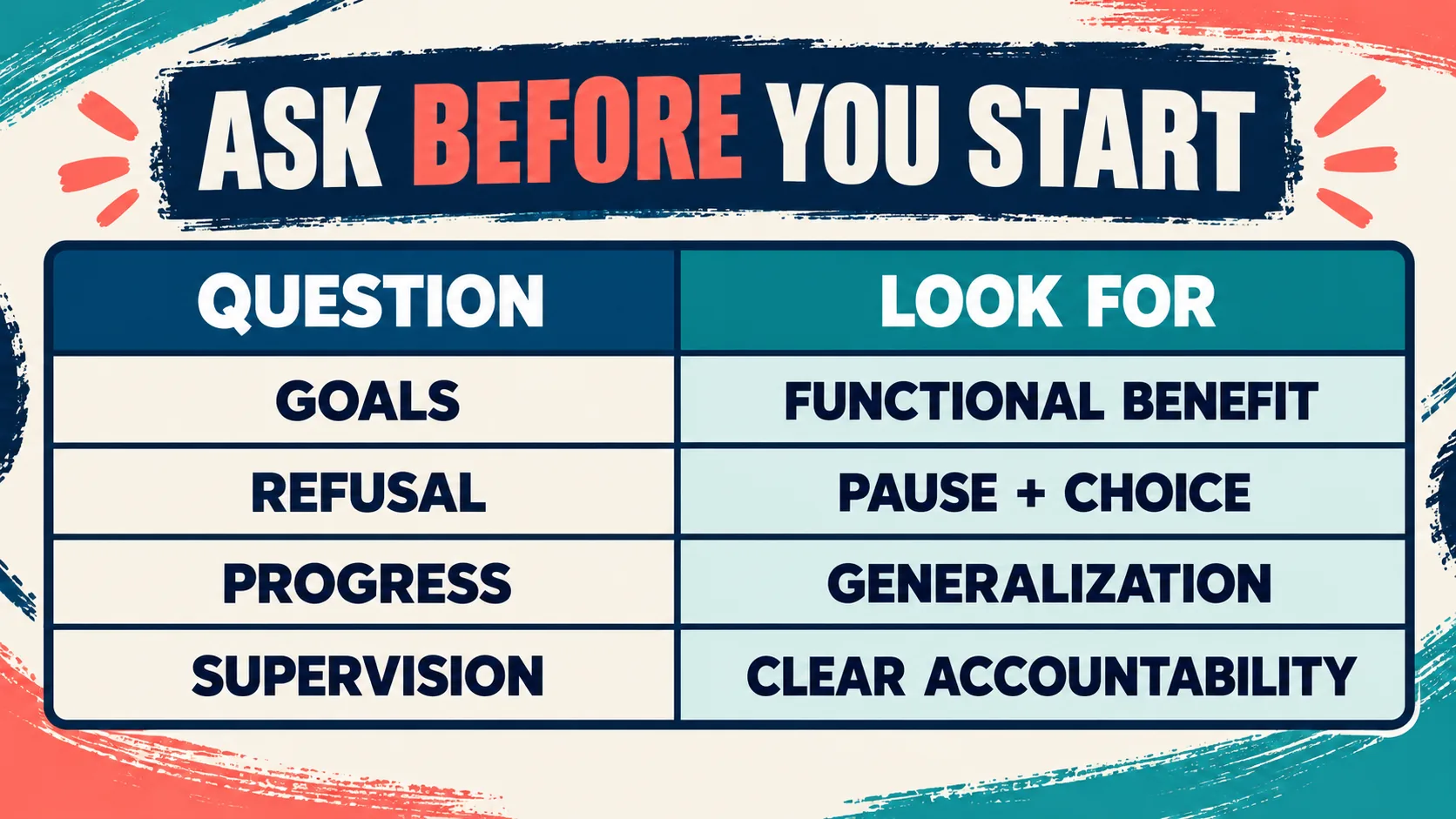
Interview the provider before services begin. Ask for a sample goal and request that the clinician explain why it matters, how progress is measured, and how the learner’s refusal is handled. You do not need to accept a vague answer just because the provider uses evidence-based language.
| Question | A reassuring answer explains | Follow-up concern |
|---|---|---|
| Why this goal? | The person’s functional benefit and their voice or preferences | Only “compliance” or appearance is offered |
| What if they refuse? | Pause, choice, communication, safety, and reassessment procedures | Refusal is treated as a behavior to overcome automatically |
| How is progress measured? | Meaningful outcomes, generalization, maintenance, and review dates | Only session compliance or a single percentage |
| Who supervises? | Credentials, availability, feedback, and a complaint path are clear | Titles are vague and questions are discouraged |
It is also reasonable to ask whether the provider has experience with the person’s communication system, age, support needs, and goals. Ask how caregivers and other professionals coordinate. If the service is funded by insurance or a public program, separate coverage rules from clinical appropriateness; a payer’s authorization does not prove that every goal is right for the individual.
Why Is ABA Controversial FAQ
Does controversy mean no one should use ABA?: No. It means the label should not end the evaluation. Different practices, goals, providers, and experiences exist. A family should review a specific plan, the person’s preferences, risks, likely benefits, and alternatives with qualified professionals and the learner.
Is modern ABA the same as older ABA?: Not necessarily. Training, ethics expectations, measurement, and common methods have changed, but families should examine actual delivery rather than relying on the word “modern.” Ask what staff do when the learner refuses and which goals are considered meaningful.
Can ABA be neurodiversity-affirming?: Some practitioners use behavior-analytic measurement and teaching within an affirming framework that prioritizes autonomy, communication, assent, and quality of life. The label alone is not proof; the goals and daily interactions are the evidence.
Where can I study for the BCBA exam responsibly?: Use the current BACB handbook, task-list materials, and supervised instruction as primary resources. The free BCBA mock exam can provide exam-style practice, but it is not a treatment guide or a substitute for ethics training and clinical supervision.
Key Takeaway
ABA is controversial because history, goals, evidence, power, and lived experience intersect. A useful evaluation asks what is being taught, why it matters, how the learner’s assent and refusal are respected, what outcomes are measured, and how the plan changes when the evidence or the person’s preferences change. That approach takes criticism seriously without reducing every current service to one historical example.
Take the Free BCBA Mock Exam
When you are ready to apply the idea, use the free practice resource below for additional feedback. Take the Free BCBA Mock Exam



