
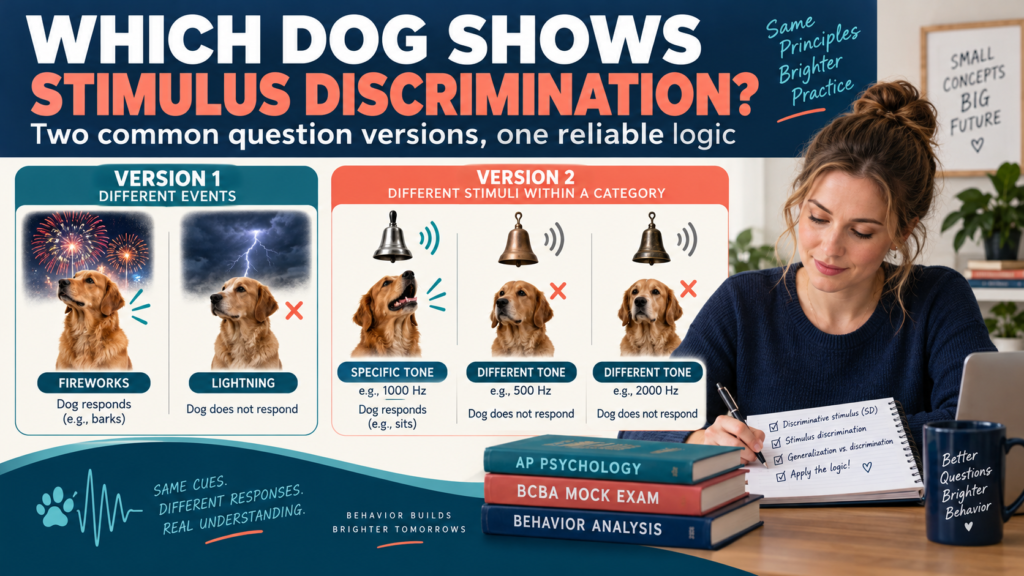
The query has two commonly indexed versions. One names Cookie; another names Dog A. The reliable answer is the same: choose the dog that responds to one specific cue but not to similar cues. If you are asking which dog is demonstrating stimulus discrimination in the following scenarios, do not select an answer from the dog’s name alone. First identify the stimulus, compare it with the similar stimuli in the scenario, and then ask whether the response is selective. In the commonly indexed AP Psychology version, the answer is Cookie: she cowers when she hears fireworks but not when she hears lightning. In the Pearson version, the answer is Dog A: it salivates to one specific bell tone paired with food but not to other bell tones.
Table of Contents
- Which Dog Is Demonstrating Stimulus Discrimination in the Following Scenarios?
- What Does Stimulus Discrimination Mean?
- Why Cookie Is Correct in One Common Version
- Why Dog A Is Correct in the Pearson Version
- How the Two Question Versions Compare
- Stimulus Discrimination vs. Stimulus Generalization
- How This Connects to ABA and Stimulus Control
- How to Solve Any Dog Scenario
- Common Exam Traps
- Mini Practice Set
- Frequently Asked Questions
- Quick Review Checklist
- Take the Free BCBA Mock Exam
Those answers are not a contradiction. They are two different question sets using the same learning principle. Stimulus discrimination means that an organism responds differently to stimuli that may look or sound similar because the learning history makes one cue relevant and another cue irrelevant. The behavior is not generalized across the whole category. For BCBA study purposes, the current BACB Test Content Outline places identifying examples of stimulus discrimination in Domain B, alongside stimulus control and stimulus generalization.
Which Dog Is Demonstrating Stimulus Discrimination in the Following Scenarios?
Cookie is correct in the version where she cowers for fireworks but not lightning. Fireworks and lightning are different events that can share some features, such as a sudden flash or loud sound. Cookie’s response occurs to one cue and not the other, so the pattern is selective.
Dog A is correct in the version where it salivates only to the specific bell tone paired with food. Dog A responds to the tone with the relevant conditioning history and does not respond to other tones. Dog B, which salivates to every bell tone, shows stimulus generalization rather than discrimination. Dog C responds to an owner who was never paired with food, and Dog D does not respond even to the trained tone; neither one shows the defining selective pattern.
Because the search query omits the actual answer choices, a page that names only one dog would be incomplete. Read the options you have in front of you. The correct option is the one that demonstrates different responding to similar stimuli, not necessarily a particular dog name.
What Does Stimulus Discrimination Mean?
Stimulus discrimination occurs when a person or animal responds in the presence of one stimulus but not, or less often, in the presence of another stimulus. The comparison stimuli are important. A response to a single event is not automatically discrimination. The scenario must show a contrast: the organism responds to one cue and withholds or changes the response to a similar cue.
In a respondent-conditioning example, a specific bell tone can elicit salivation after that tone has been paired with food, while other tones do not elicit salivation. In an everyday example, a dog may approach its caregiver’s particular car but not every car that looks similar. In an ABA teaching example, a learner may select the red card when the instruction is “touch red” but not select the blue card when the same comparison is presented. The form of the response can vary; the functional pattern is selective stimulus control.
Discrimination does not mean that the organism can verbally explain the difference. It is an observable relation between stimuli and responding. On a multiple-choice exam, look for wording such as only when, but not when, specific cue, not to other similar cues, or responds in the presence of one stimulus but not another. Quick rule: one cue produces the target response and a similar cue does not. That is the pattern to recognize.
Why Cookie Is Correct in One Common Version
In the AP Psychology-style version, the choices describe several dogs and different learning processes. Cookie cowers when she hears fireworks, but she does not cower when she hears lightning. The answer is Cookie because she differentiates between two potentially similar natural events.
The response is “cowering,” and the relevant stimuli are the sound or event associated with fireworks and the sound or event associated with lightning. Cookie’s cowering occurs for one stimulus but not the other. That is enough to identify a discrimination pattern in the question. The item does not require the dog to name the cue, think about the cue, or have a conscious rule. It asks what the response pattern shows.
The other choices are distractors built around related concepts: a return of responding, respondent conditioning without a comparison, stimulus generalization across bells, or extinction after treats stop. The important distinction is not whether the dog learned something. The question is whether the learning produced selective responding to one stimulus rather than another similar stimulus.
Why Dog A Is Correct in the Pearson Version
Pearson’s indexed version uses a classical-conditioning bell example. Dog A salivates only when it hears a particular bell tone that was paired with food, and it does not salivate to other bell tones. That is the textbook discrimination pattern: the conditioned response is restricted to the stimulus with the relevant pairing history.
The distractors are designed around predictable errors. Dog B salivates to any bell tone, so responding spreads across the stimulus class. Dog C salivates when it sees its owner even though the owner was never paired with food, so the option does not establish the stated conditioning relation. Dog D does not salivate to any bell tone, including the tone paired with food, so the response is absent rather than selectively controlled by the trained tone. To solve this version, ignore the dog labels and translate the answer choices into a small stimulus-response map:
| Pattern | What it shows | Why |
|---|---|---|
| Specific tone → salivation; other tones → no salivation | Stimulus discrimination | Responding is restricted to the cue with the relevant history. |
| Every tone → salivation | Stimulus generalization | The response spreads to similar stimuli. |
| No tone → salivation | No demonstrated conditioned response | There is no selective response to identify. |
How the Two Question Versions Compare
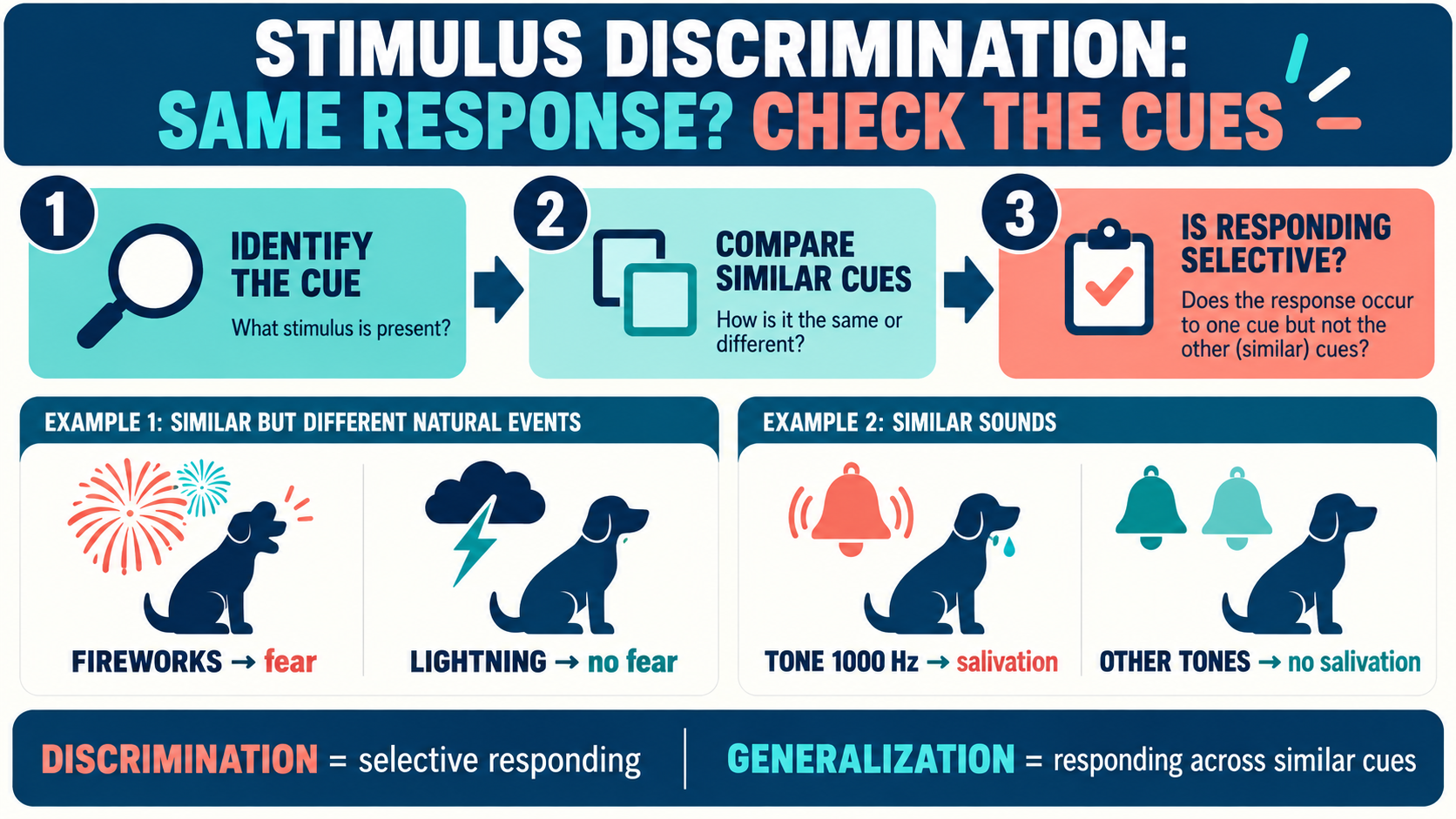
The Cookie and Dog A questions use different stimuli, responses, and learning histories, but they test the same logic. Cookie’s example compares natural events. Dog A’s example compares tones in a category of auditory stimuli. The question is not limited to dogs, bells, fireworks, or salivation; those are simply memorable examples.
| Question version | Stimuli compared | Correct dog | Discrimination clue |
|---|---|---|---|
| AP Psychology-style study version | Fireworks versus lightning | Cookie | Cowers for one event, not the other. |
| Pearson classical-conditioning version | A paired bell tone versus other tones | Dog A | Salivates for the specific tone, not other tones. |
Remember: same response system, different cue control. If a question bank changes the names or stimuli, keep the principle and re-check the actual options.
Stimulus Discrimination vs. Stimulus Generalization
Stimulus generalization is the opposite direction of stimulus control. Instead of responding only to the trained or relevant cue, the organism responds to other stimuli that resemble it. In the bell example, salivating to the trained tone and also to several unpaired tones is generalization. In the doorbell example, going to the door for both a real doorbell and a television contestant’s bell is generalization. A quick contrast is:
- Discrimination: respond to one cue, not to similar comparison cues.
- Generalization: respond across a range of similar cues.
- No demonstrated control: respond to none of the relevant cues or show too little information to identify a pattern.
Look for the comparison. “The dog salivates when the tone sounds” is not enough to distinguish discrimination from generalization. “The dog salivates to the 1000-Hz tone but not the 500-Hz or 2000-Hz tones” provides the needed contrast.
How This Connects to ABA and Stimulus Control
In ABA, stimulus discrimination is discussed as part of stimulus control. A stimulus can acquire control over behavior when a history of reinforcement, punishment, respondent pairing, or other learning conditions makes responding more likely in its presence than in the presence of comparison stimuli. The exact procedure matters, but the exam-level clue remains differential responding.
For operant examples, a red card may signal reinforcement while a blue card does not; for respondent examples, a particular cue may elicit a conditioned response while similar cues do not. The BACB outline treats stimulus control as the broader relation, with discrimination describing selective responding and generalization describing responding across a broader range. Read the learning arrangement before choosing labels such as SD or CS.
How to Solve Any Dog Scenario
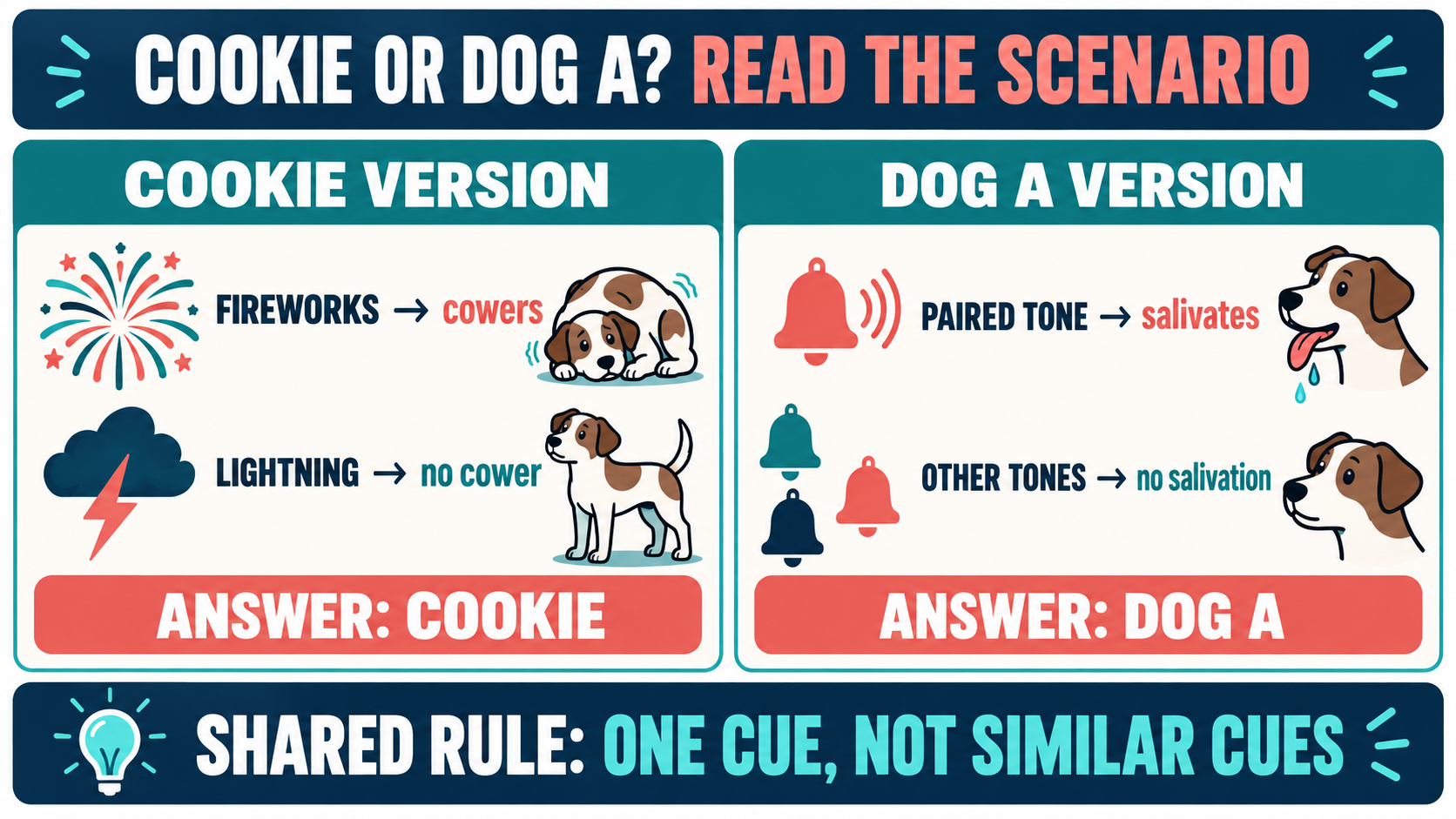
Use this six-step method when the prompt gives several dogs:
- Name the target response. Is the dog salivating, cowering, approaching, sitting, barking, or doing something else?
- List the stimuli. Write the bells, tones, fireworks, lightning, doorbells, people, or other cues that precede the response.
- Find the comparison. Which stimuli are similar enough that the item expects you to compare them?
- Mark the response pattern. Does the dog respond to one cue only, to many cues, or to none?
- Check the learning history. Was one cue paired with food, followed by reinforcement, or associated with another event?
- Choose the label that matches the pattern. One cue but not similar cues means discrimination; many similar cues means generalization.
This method also protects you from attractive distractors. A response can be conditioned without demonstrating discrimination, and a response can be extinguished without showing discrimination. The relationship among the cues is the deciding evidence.
Common Exam Traps
- Memorizing Cookie without reading the options: the name is correct only in the version that describes fireworks and lightning.
- Choosing a dog that responds to every similar cue: broad responding is stimulus generalization.
- Confusing learning with discrimination: conditioning, extinction, and spontaneous recovery can appear in the same set without being discrimination.
- Ignoring “but not” language: the contrast often carries the entire answer.
- Assuming a single response proves discrimination: the item must provide at least one comparison stimulus or a clear selective-history statement.
- Mixing stimulus and response generalization: stimulus generalization changes the range of stimuli that evoke or occasion the same response; response generalization concerns different responses that achieve a similar outcome.
When two options both sound like conditioning, return to the question’s requested concept. If it asks for stimulus discrimination, locate the response difference across stimuli. If it asks for respondent conditioning, locate the pairing history. If it asks for extinction, locate the discontinued consequence or omitted unconditioned stimulus.
Mini Practice Set
Quick practice: a dog approaches its owner’s blue car but ignores a neighbor’s blue car. Answer: stimulus discrimination, because the response occurs to one relevant cue but not a similar comparison. If the dog approached every similar blue car, the pattern would instead be generalization. For more practice with stimulus control and BCBA-style concepts, the site’s free BCBA mock exam is an independent study resource, not official BACB content. Practice performance is not a guarantee of certification.
Frequently Asked Questions
Which dog is demonstrating stimulus discrimination in the following scenarios?
The answer depends on the complete options. In the fireworks-versus-lightning version, it is Cookie. In the specific-bell-tone version, it is Dog A. In both, the dog responds to one cue but not to similar cues. Why is Cookie the answer?
Cookie cowers for fireworks but not lightning, so the response is selective across two potentially similar events. Why is Dog A the answer?
Dog A salivates only to the particular paired tone and not to other tones, showing selective responding based on learning history. Is responding to all bell tones discrimination?
No. Responding to many similar tones is generalization. The fastest test is “one cue, not another similar cue,” with a response contrast in the stem.
Bottom line: Do not memorize a dog’s name without the scenario. Translate the choices into cue-response patterns. Cookie is correct for fireworks versus lightning; Dog A is correct for one paired bell tone versus other tones. The general rule is stable: selective responding to one stimulus, with different responding to similar stimuli, demonstrates stimulus discrimination. For targeted review, use our which dog is demonstrating stimulus discrimination in the following scenarios practice questions to apply the concept in exam-style scenarios.
Quick Review Checklist
Use this final checklist to turn which dog is demonstrating stimulus discrimination in the following scenarios into exam-ready reasoning. The goal is not to memorize a label in isolation; it is to identify the relevant evidence and explain why the best answer fits the scenario. Key ideas to review:
- State the central definition or decision point for which dog is demonstrating stimulus discrimination in the following scenarios in your own words.
- Identify the detail that makes which dog is demonstrating stimulus discrimination in the following scenarios different from its closest related ABA term.
- Separate the observable facts in a scenario from assumptions that are not supported by the facts.
- Write one example and one nonexample so you can recognize the concept in a new setting.
Exam application checks:
- Ask what the question is actually requesting before comparing the answer choices.
- Mark the antecedent, response, consequence, or other evidence that supports the selected answer.
- Look for a distractor that describes a related process but does not answer the specific question.
Final self-check:
- Explain how you would verify the interpretation with clear observations or data.
- Change one detail in the scenario and decide whether your answer should change.
- Give a one-sentence rationale that a supervisor or study partner could evaluate.
Take the Free BCBA Mock Exam
When you are ready to apply the idea, use the free practice resource below for additional feedback. Take the Free BCBA Mock Exam



