
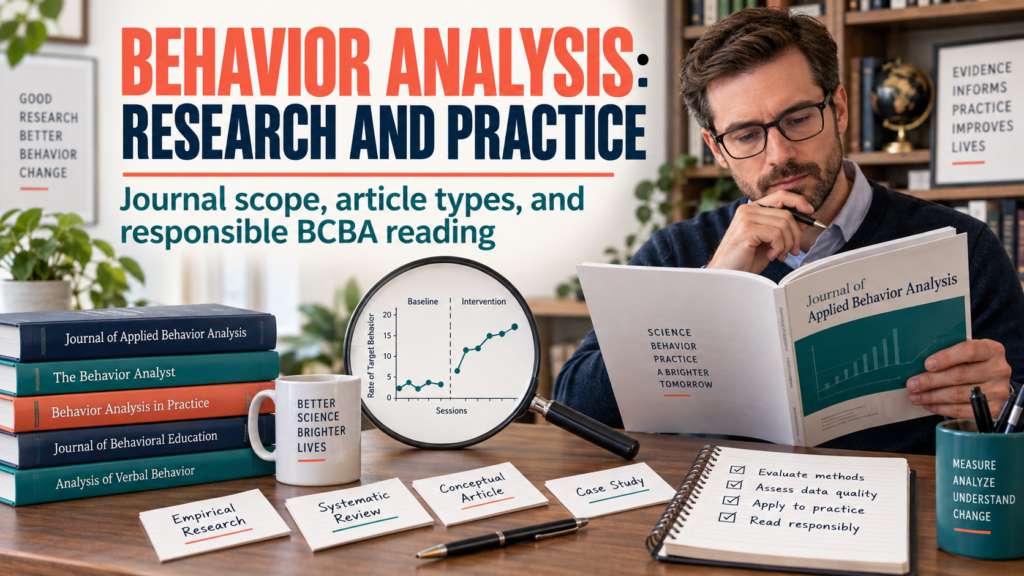
Behavior Analysis: Research and Practice is an APA journal, not a BACB certification product. This guide explains its scope, article types, and a practical way for BCBA students to read research without turning one paper into an automatic treatment plan.
Table of Contents
- What Is Behavior Analysis Research and Practice?
- What Does the Journal Cover?
- What Article Types Does It Publish?
- How Is the Journal Different From BACB Resources?
- How Should a BCBA Student Read a Journal Article?
- How Do You Evaluate the Evidence?
- How Can Research Inform Practice Responsibly?
- How Can You Search the Journal Efficiently?
- Common Reading Mistakes
- Frequently Asked Questions
- Take the Free BCBA Mock Exam
If you searched for behavior analysis research and practice, the leading exact-match entity is Behavior Analysis: Research and Practice, a multidisciplinary American Psychological Association journal. It publishes experimental, translational, applied, conceptual, clinical, organizational, and educational work across behavior analysis and psychology. The journal can be useful for building research literacy, but it is not the BACB, not a BCBA exam outline, and not a substitute for an individualized assessment or supervision.
The most reliable way to use the journal is to separate three questions: What does the journal publish? What did a particular article actually test? and What, if anything, can be responsibly considered in a specific practice context? The journal’s official APA journal page describes its research-and-practice mission, while the BACB Test Content Outline defines the certification-exam study context.
What Is Behavior Analysis Research and Practice?
Behavior Analysis: Research and Practice is a peer-reviewed APA journal focused on current experimental and translational research and applications of behavior analysis. The official journal description says its mission is to improve communication among subdisciplines within behavior analysis and psychology and to connect research with meaningful behavior change across settings.
That scope is broader than “ABA therapy articles.” The journal may include work in clinical behavior analysis, applied and translational behavior analysis, behavior therapy, behavioral consultation, organizational behavior management, human performance technology, community settings, residential settings, and educational or curricular development. A student should therefore read the setting, participants, target behavior, and outcome measure before deciding whether an article is relevant to a particular BCBA question or practice problem.
APA lists the journal as published quarterly, beginning in February, and notes that open access is offered. “Open access offered” does not mean every article has the same access route or license, so check the individual article page and reuse terms rather than copying or redistributing a paper automatically.
What Does the Journal Cover?
The journal’s topic range can be organized around the relation between evidence and application. A basic or experimental study may test a behavioral process under controlled conditions. An applied study may evaluate socially important behavior in a natural service context. A translational study may connect laboratory principles to a practical setting. A conceptual paper may analyze a theory or framework rather than collect a new intervention dataset.
These categories can overlap. For example, a paper may use a single-case design in a clinical setting while also examining a broader theoretical question. The label is a starting point, not a conclusion about quality. Evaluate the methods and limitations in the actual paper.
| Research orientation | What to look for | Study question |
|---|---|---|
| Experimental | Controlled conditions and a clearly specified process or relation. | What behavioral principle is being tested? |
| Applied | Socially important behavior, participant context, and meaningful outcomes. | Did the procedure change the target behavior in this setting? |
| Translational | A bridge from behavioral principles to a more complex real-world use. | What transfers, and what still needs local validation? |
What Article Types Does It Publish?
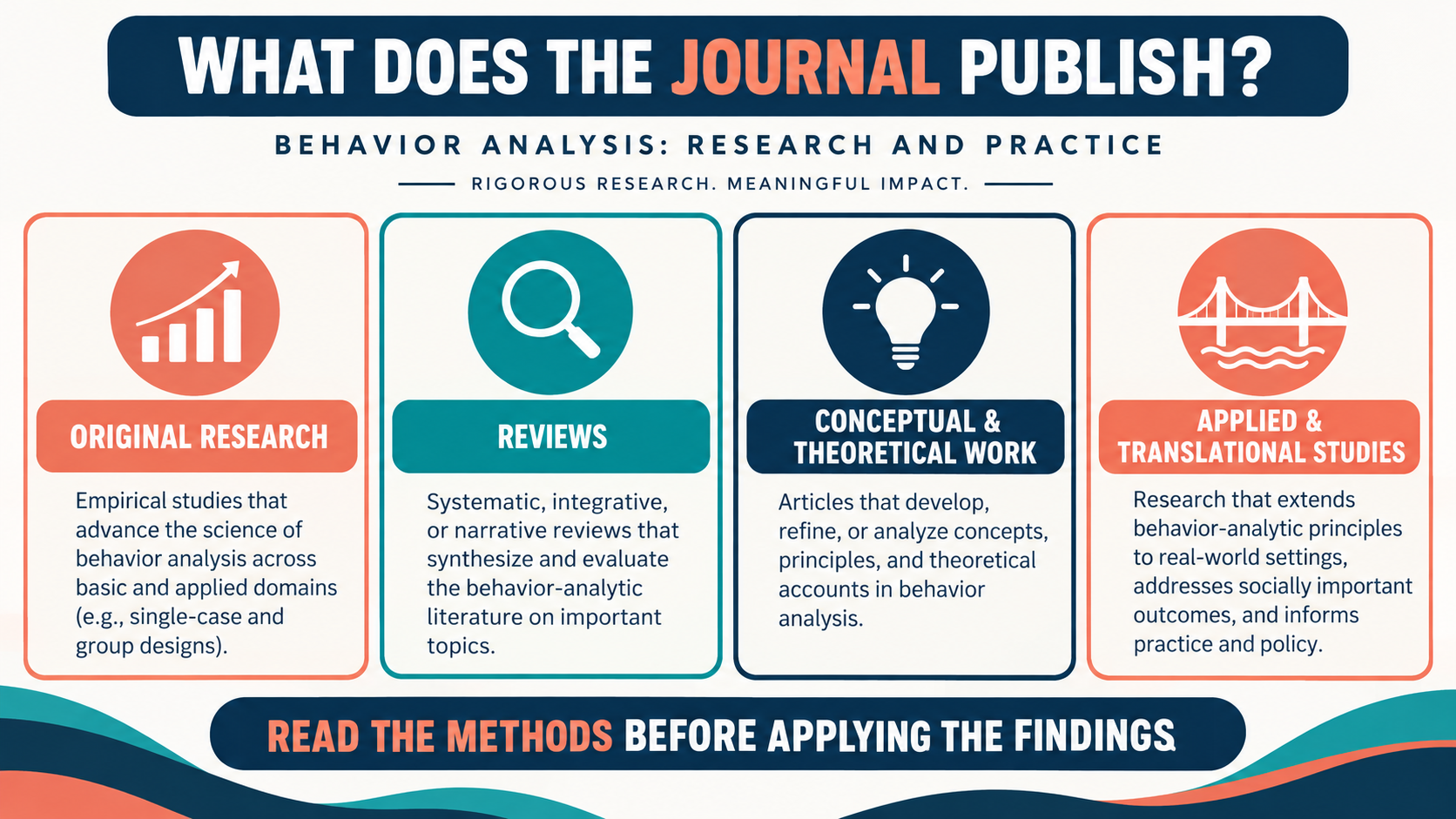
The APA journal description identifies a wide range of accepted work, including original research, reviews, theoretical and conceptual work, applied research, translational research, program descriptions, organizational and community research, clinical work, and curricular developments. This variety matters because the evidence you can take from a review is different from the evidence you can take from a single program description.
- Original empirical research: reports a study’s participants, procedures, measures, analyses, and findings.
- Review: synthesizes a body of literature; inspect the search method, inclusion criteria, and quality appraisal.
- Conceptual or theoretical article: develops or critiques ideas; it may not test an intervention.
- Applied or translational study: connects behavior-analytic principles with a practical setting, outcome, or implementation problem.
- Program description or curricular article: explains a service, training, or teaching model; description is not the same as controlled efficacy evidence.
Before citing a paper, write down its article type. That one step prevents a common error: treating an interesting conceptual argument as if it were a replicated outcome study, or treating a single demonstration as proof that a procedure will work for every learner.
How Is the Journal Different From BACB Resources?
Behavior Analysis: Research and Practice is a scholarly publication venue. The BACB publishes certification resources such as test content outlines, handbooks, application information, and ethics materials. The two serve different purposes:
| Resource | Primary purpose | What it cannot prove by itself |
|---|---|---|
| Behavior Analysis: Research and Practice | Share and critique research, theory, and applications. | That a paper is an official BCBA requirement or an automatic treatment prescription. |
| BACB Test Content Outline | Define certification-exam content and task domains. | That every journal finding generalizes to every client or setting. |
| A clinical or organizational protocol | Guide a defined service or implementation process. | That the protocol fits without assessment, consent, competence, and data review. |
For exam study, use the BACB outline to decide what concepts and tasks are in scope. Use journal articles to deepen understanding, compare evidence, and practice reading methods. Do not cite an APA journal as if it were a BACB rule.
How Should a BCBA Student Read a Journal Article?
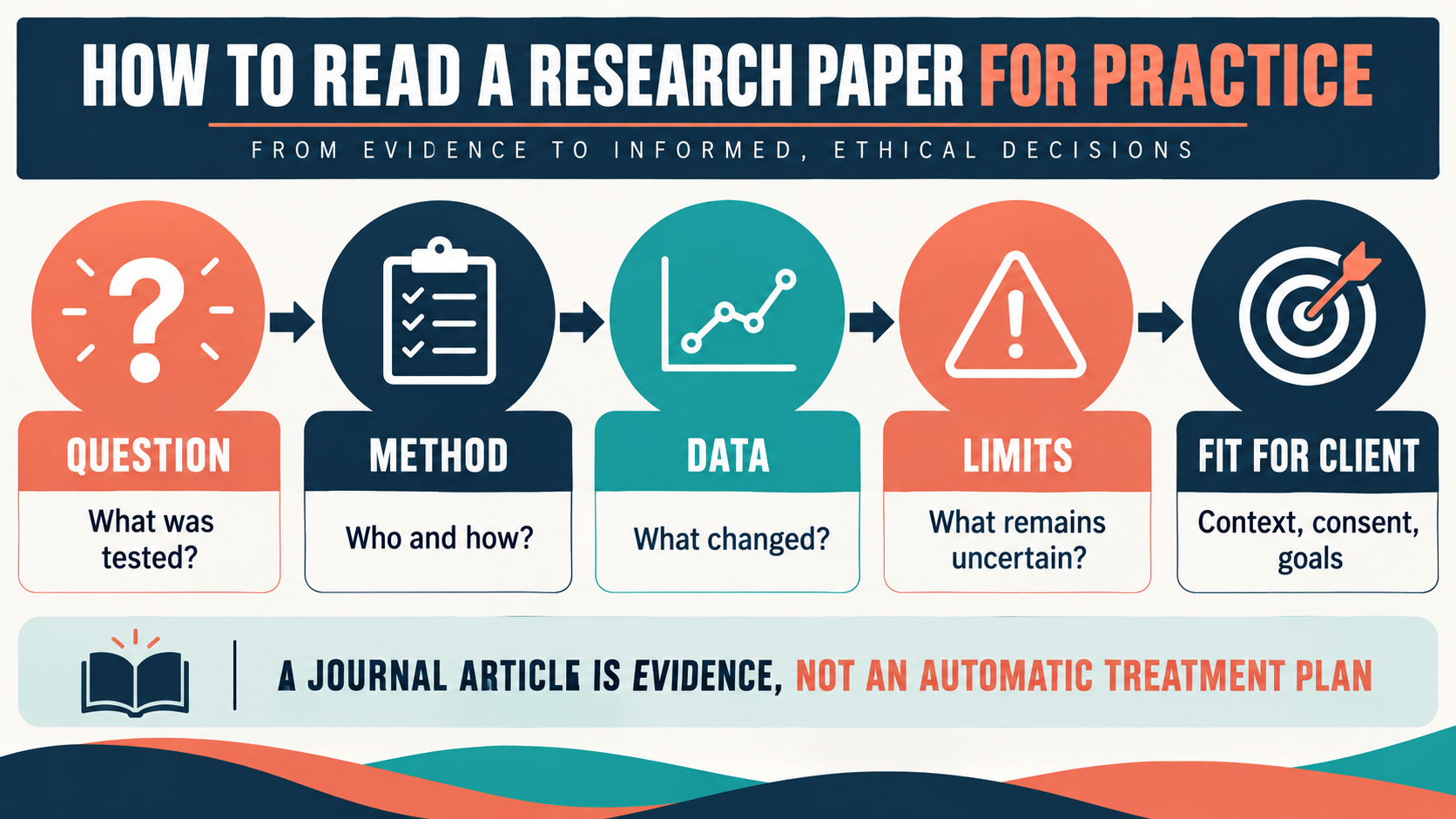
Read from the question outward rather than starting with the conclusion. First identify the problem the authors investigated. Then inspect the method, the measurement system, the design, and the results. Only after that should you decide what the findings might mean for a different learner, service, or organization.
- Question: What behavior, process, or implementation problem was tested?
- Method: Who participated, what setting was used, and what procedures were implemented?
- Measurement: How was behavior defined and measured? Is the measure aligned with the stated outcome?
- Design and data: What comparison or repeated-measure logic supports the conclusion?
- Limits and fit: What remains uncertain, and what contextual or client variables would need separate evaluation?
This routine is especially useful for BCBA candidates because it links the paper to familiar exam domains without confusing the domains. Measurement, experimental design, assessment, ethics, and intervention selection are related but not interchangeable. A strong result in one domain does not erase limitations in another.
How Do You Evaluate the Evidence?
Evidence quality is not a single adjective. Ask a set of narrower questions:
- Definition: Are the target behavior and outcome operationally defined?
- Measurement: Are the data direct, reliable, and sensitive to meaningful change?
- Design: Does the design support the claimed relation, or does it only describe a pattern?
- Procedural integrity: Was the independent variable implemented as described?
- Social validity: Are the goals, procedures, and outcomes meaningful to the people affected?
- Generalization: Do the participants, settings, materials, and follow-up conditions resemble the situation under consideration?
A statistically significant result, a visible graph, or an enthusiastic conclusion cannot answer all of these questions. In single-case research, inspect repeated measurement, prediction, verification, and replication. In group research, inspect comparison groups, attrition, outcome definitions, and the limits of average effects. In a review, inspect how the literature was located and selected.
How Can Research Inform Practice Responsibly?
A journal article can inform professional reasoning, but it does not replace a behavior assessment, client-informed goal setting, or supervision. Translate a finding into a hypothesis rather than a command: “This procedure was evaluated under these conditions; would it be appropriate to assess its fit here?” Then identify what data would show whether the decision is helping.
Responsible use also means respecting scope and consent. Do not copy a procedure from a paper without understanding its prerequisites, risks, implementer training, and measurement plan. Do not assume that a published intervention is appropriate for a person simply because the target behavior looks similar. Current BACB ethics resources and applicable law or regulation remain essential for professional decisions.
For exam preparation, this is a useful distinction: a question may ask you to identify an evidence-based practice principle, but real service delivery requires assessment, contextual fit, client preferences, collaboration, procedural integrity, and ongoing data review. Research literacy strengthens judgment; it does not eliminate the need for judgment.
How Can You Search the Journal Efficiently?
Start at the official APA journal page and use the journal’s own article, issue, or search links where available. Search by a behavior, population, design, or process rather than using only the broad journal title. For example, combine the journal name with “single-case design,” “functional communication,” “organizational behavior management,” “translational,” or a measurement term.
When you find a candidate article, record the title, authors, year, article type, population, setting, design, target behavior, and main limitation. Then check whether the full text is available under the relevant access terms. A citation manager or a simple evidence table can prevent an attractive abstract from becoming an unsupported claim in a study guide or clinical conversation.
Common Reading Mistakes
- Confusing the journal with the BACB: the journal publishes scholarship; the BACB defines certification requirements and exam content.
- Using the abstract as the whole study: methods, measures, and limitations can change the interpretation.
- Equating publication with universal effectiveness: publication is not proof that a procedure fits every client or setting.
- Ignoring article type: a conceptual paper, review, and empirical study make different kinds of claims.
- Skipping social validity and context: behavior change is not meaningful if the goal or outcome is disconnected from the people affected.
- Copying a protocol without supervision: research literacy is not a license to implement unfamiliar procedures outside competence.
These mistakes are avoidable when the reader writes down the research question, method, data, limits, and fit before summarizing the conclusion. For a separate practice step, the site’s free BCBA mock exam is an independent study resource, not an official BACB product. Practice performance does not guarantee certification.
Frequently Asked Questions
What is Behavior Analysis: Research and Practice?
It is an APA journal that publishes experimental, translational, applied, conceptual, clinical, organizational, community, and educational work related to behavior analysis and psychology. Is Behavior Analysis: Research and Practice the BACB?
No. The journal is a scholarly publication venue. The BACB publishes certification and exam resources, including the BCBA Test Content Outline. Can BCBA students use the journal to study?
Yes. Use articles to deepen concepts, practice reading designs and measures, and compare research with exam-domain language. Use the current BACB outline to determine certification-exam scope. Does an article prove that an intervention will work for every client?
No. Evaluate the participants, setting, design, measures, social validity, limitations, and fit before considering how evidence may inform a local decision. What should I write down after reading an article?
Record the question, participants, setting, target behavior, measurement, design, result, limitation, and unanswered question. That summary is more useful than copying the abstract alone.
Bottom line: For a behavior analysis research and practice search, start with the APA journal entity, then read each article on its own terms. Use the journal for research literacy and the BACB for current certification guidance; connect findings to practice only through assessment, context, ethics, and data. For targeted review, use our behavior analysis research and practice practice questions to apply the concept in exam-style scenarios.
Take the Free BCBA Mock Exam
When you are ready to apply the idea, use the free practice resource below for additional feedback. Take the Free BCBA Mock Exam



