
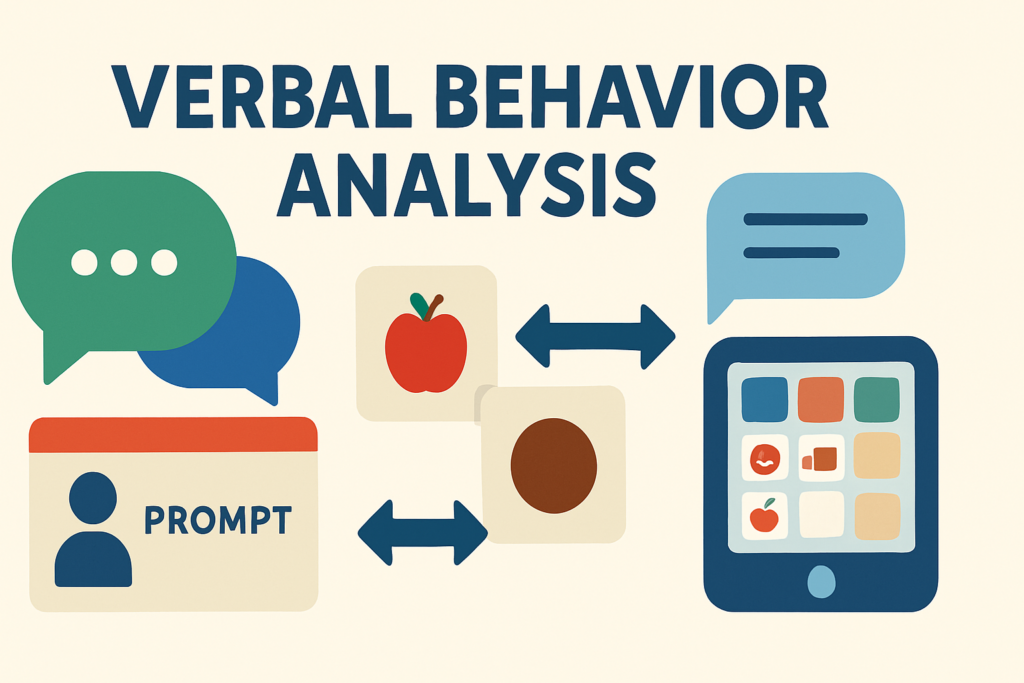
Understanding verbal behavior is essential for any behavior analyst preparing for the BCBA exam. B.F. Skinner’s analysis of language focuses on functional relationships rather than structural linguistics, providing a practical framework for assessing and teaching communication skills. This approach examines why verbal responses occur based on their environmental context and consequences.
Table of Contents
- verbal behavior analysis: What is Verbal Behavior? Skinner’s Functional Analysis
- The Elementary Verbal Operants: Definitions and Key Distinctions
- Applying Verbal Behavior: Worked ABC Examples
- BCBA Exam Focus: Common Traps and Study Strategies
- Summary and Key Takeaways
- References
verbal behavior analysis: What is Verbal Behavior? Skinner’s Functional Analysis
Skinner’s verbal behavior analysis represents a radical departure from traditional language studies. Instead of focusing on grammar or vocabulary structure, Skinner examined the functional relationships between verbal responses and their environmental determinants.
Verbal Behavior vs. Traditional Language
Traditional linguistics analyzes language structure—syntax, morphology, and phonology. In contrast, Skinner’s approach examines function over form. The same word or phrase can serve different functions depending on the context. For example, saying “water” could be a request when thirsty (mand) or a label when seeing water (tact).
The critical innovation in Skinner’s analysis is the role of the listener as mediator. Verbal behavior requires a listener who mediates reinforcement, distinguishing it from other operant behaviors. This functional approach directly informs assessment tools like the VB-MAPP and language intervention programming.
Why This Matters for the BCBA Exam
Verbal behavior concepts appear throughout the BACB Task List, particularly in Section B: Concepts and Principles. Understanding these concepts is foundational for designing effective language interventions and analyzing communication deficits. The topic frequently appears in exam questions requiring functional analysis of verbal responses.
Mastering verbal behavior analysis helps candidates distinguish between different verbal operants and select appropriate teaching procedures. This knowledge directly supports competency in developing comprehensive behavior change programs that address communication needs.
The Elementary Verbal Operants: Definitions and Key Distinctions
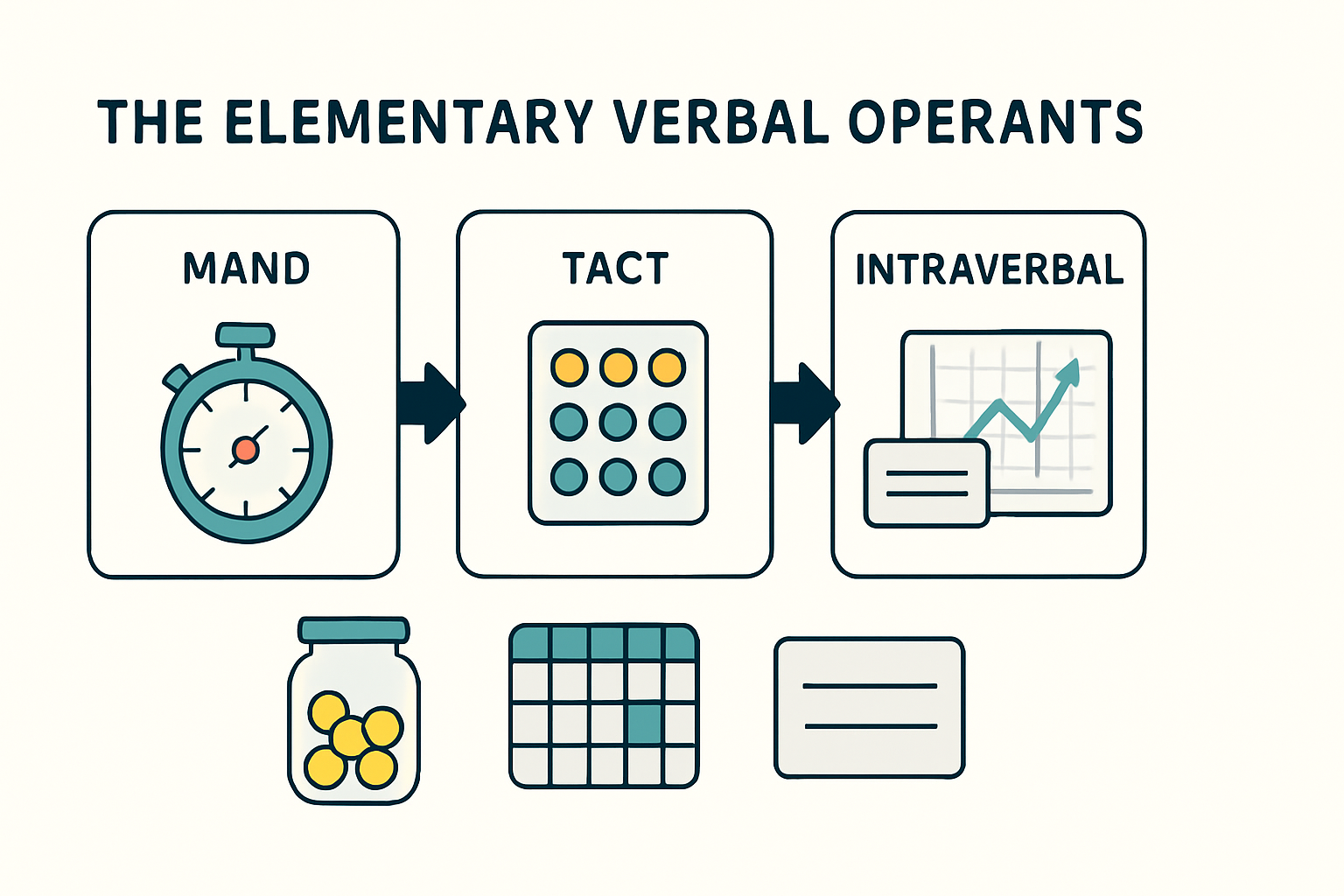
The core of Skinner’s analysis consists of elementary verbal operants, each defined by its unique controlling variables. Understanding these distinctions is crucial for accurate assessment and intervention planning.
The Mand: Requesting Based on Motivation
A mand is a verbal operant under the control of motivating operations (MOs) and reinforced by a specific consequence. The mand allows speakers to request what they need or want. For example, saying “cookie” when hungry to receive a cookie demonstrates manding.
The strength of a mand depends on the current level of deprivation or aversive stimulation. This operant is particularly important in early language intervention, as it gives learners control over their environment and immediate access to reinforcement.
The Tact: Naming or Labeling
A tact is a verbal operant under the control of a non-verbal stimulus and reinforced by generalized conditioned reinforcement. Tacting involves naming, labeling, or describing objects, events, or properties in the environment. Saying “dog” when seeing a dog is a tact.
Tacts expand a learner’s ability to comment on their environment and share experiences with others. Unlike mands, tacts are not controlled by specific deprivation states but by the presence of discriminative stimuli in the environment.
Intraverbal: Conversation and Fill-Ins
An intraverbal is a verbal operant under the control of a verbal stimulus with no point-to-point correspondence. Intraverbals form the basis of conversation, answering questions, and fill-in responses. Responding “blue” when someone asks “What color is the sky?” demonstrates intraverbal behavior.
Intraverbal relations are crucial for social interaction and academic responding. They differ from echoics in that there’s no formal similarity between the stimulus and response—the response is related but not identical to the verbal stimulus.
Echoic: Imitating Sounds
An echoic is a verbal operant with point-to-point correspondence and formal similarity between the stimulus and response. Echoics involve repeating or imitating what was heard. When a therapist says “ball” and the learner says “ball,” this demonstrates echoic behavior.
Echoics serve as a foundational skill for developing other verbal operants. They’re often targeted early in language intervention programs to establish basic vocal imitation skills before moving to more complex verbal behavior.
Applying Verbal Behavior: Worked ABC Examples
Moving from definitions to practical application requires analyzing real scenarios. These worked examples demonstrate how to identify verbal operants using the ABC framework.
Example 1: Distinguishing a Mand from a Tact
Consider a child saying “cookie” in two different contexts. In Scenario A, the child hasn’t eaten in three hours and sees cookies on a high shelf. The antecedent is cookie deprivation (MO), the behavior is saying “cookie,” and the consequence is receiving a cookie. This functions as a mand.
In Scenario B, the child just finished lunch and is looking at a picture book. The antecedent is seeing a picture of a cookie (non-verbal stimulus), the behavior is saying “cookie,” and the consequence is praise (“Good labeling!”). This functions as a tact.
The same topography (saying “cookie”) serves different functions based on the antecedent conditions. This distinction is critical for accurate assessment and intervention planning.
Example 2: An Intraverbal Chain in Social Interaction
Analyze this brief conversation between a therapist and client:
- Therapist: “What did you do today?” (verbal stimulus)
- Client: “I went to the park.” (intraverbal response)
- Therapist: “What did you see at the park?” (verbal stimulus)
- Client: “I saw swings and slides.” (intraverbal response)
Each client response is controlled by the therapist’s preceding verbal statement, demonstrating intraverbal chains. There’s no point-to-point correspondence—the responses are related but not identical to the stimuli. This analysis helps identify appropriate teaching targets for conversation skills.
BCBA Exam Focus: Common Traps and Study Strategies

Verbal behavior questions often trip up exam candidates due to subtle distinctions between operants. Recognizing these common pitfalls can improve your exam performance.
Top 3 Exam Traps in Verbal Behavior Questions
- Confusing mands with tacts based solely on topography. Remember to analyze the antecedent conditions—MOs control mands, while non-verbal stimuli control tacts.
- Misidentifying intraverbals as tacts when verbal stimuli are present. If the antecedent is verbal (someone speaking), it’s likely an intraverbal, not a tact.
- Overlooking the listener’s role in mediating reinforcement. Verbal behavior requires a listener who provides the consequence, distinguishing it from other operant behavior.
Your Verbal Behavior Study Checklist
- I can define each elementary verbal operant and identify its controlling variable
- I can analyze simple statements and determine their likely verbal function
- I understand the role of the listener as mediator in Skinner’s analysis
- I can distinguish between formal and functional approaches to language
- I recognize how motivating operations influence mand strength
Sample Practice Prompts
Test your understanding with these scenarios:
- A child points to a red ball and says “red.” The therapist responds, “Yes, that’s red!” What verbal operant is this likely demonstrating?
- During snack time, a student says “juice” while reaching toward the juice box. The teacher gives them juice. Analyze this using the ABC framework.
- A therapist asks, “What comes after Tuesday?” and the client responds “Wednesday.” Identify the verbal operant and controlling variable.
For more practice with behavior analysis concepts, explore our guide on radical behaviorism.
Summary and Key Takeaways
Skinner’s verbal behavior analysis provides a functional framework for understanding language that directly informs ABA practice. The elementary verbal operants—mand, tact, intraverbal, and echoic—each have distinct controlling variables that determine their function.
For BCBA exam success, focus on functional analysis rather than topography alone. Remember that the same verbal response can serve different functions depending on antecedent conditions. Practice analyzing scenarios using the ABC framework to strengthen your application skills.
This knowledge forms the foundation for effective language assessment and intervention. As you continue studying, connect verbal behavior concepts to other areas like motivating operations and stimulus control to build a comprehensive understanding of behavior analysis principles.


