
The common study question “three types of IOA data formulas were taught: those for counted data, timed data, and ______” is usually looking for interval data. In a typical ABA measurement study set, the three broad categories are counted data, timed data, and interval data. The exact labels can vary by course, so check the answer choices and your instructor’s terminology, but “interval data” is the expected completion for the familiar multiple-choice wording.
Table of Contents
- What Is the Answer to “Three Types of IOA Data Formulas Were Taught”?
- The Three Data Categories in Plain Language
- Which IOA Formula Family Matches Each Category?
- Worked Classification Example
- Why Frequency Is Not the Best Blank
- Common Study Mistakes
- Quick Review Checklist
- Practice Measurement Discrimination
- References
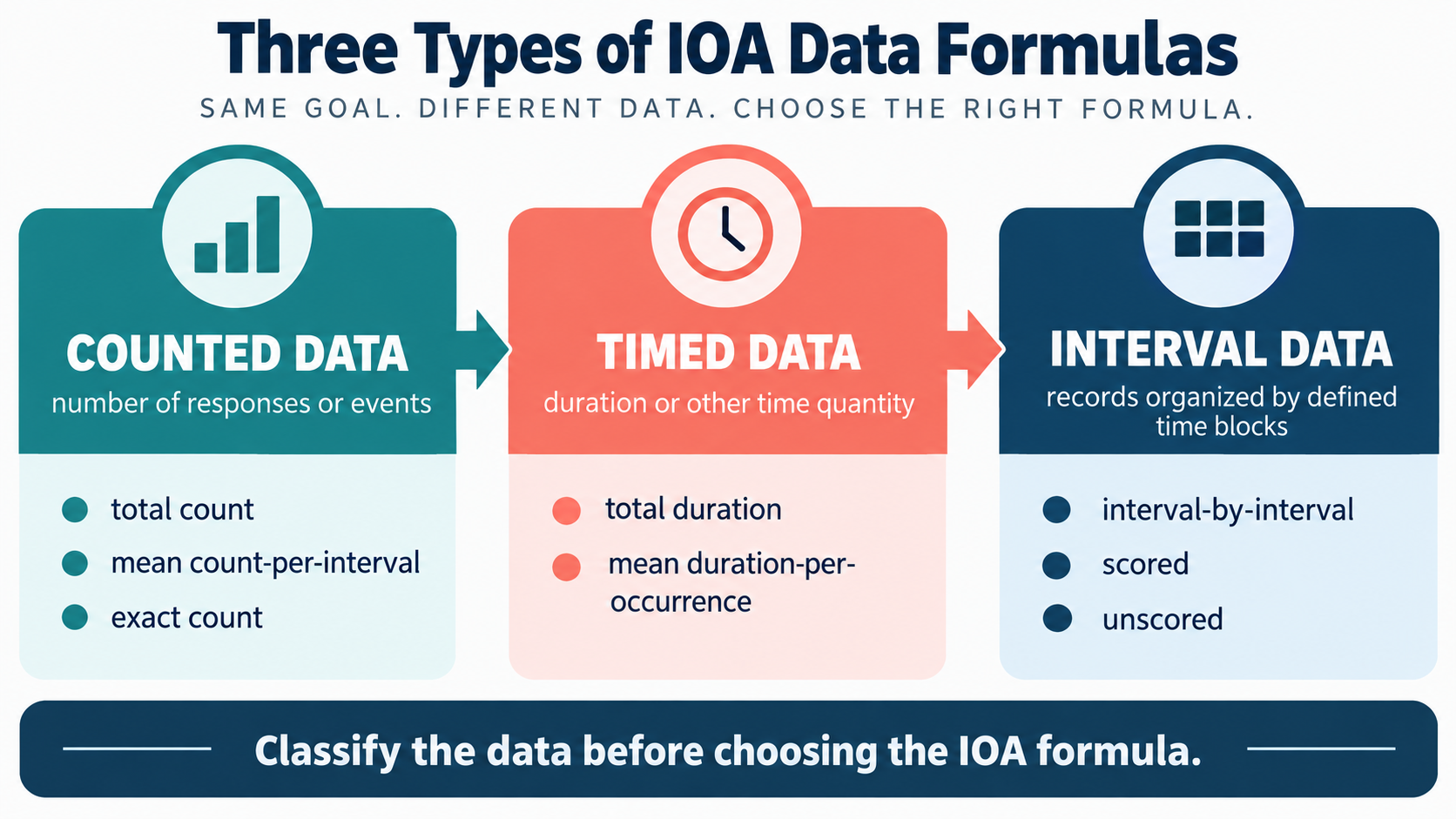
The question is easier when you connect each category to the way the observation was divided. Counted data focus on how many responses occurred. Timed data focus on how long behavior lasted or how much time passed. Interval data divide the observation into time blocks and compare what observers recorded in each block. Different IOA formulas follow from those measurement structures.
This guide explains the answer, maps each data category to common IOA methods, works through a short classification scenario, and shows why “frequency data” is not the best answer to the blank even though frequency is a count-based measurement. Table of Contents
What Is the Answer to “Three Types of IOA Data Formulas Were Taught”?
For the familiar fill-in-the-blank question, the answer is interval data: Counted data, timed data, and interval data. Why? Counted data use response totals or counts, timed data use duration or another time-based measure, and interval data use a set of defined time blocks. IOA is then calculated in a way that matches the measurement unit. The wording is testing classification, not asking you to name every individual formula in the IOA chapter.
There is an important nuance. “Three types” is not a universal taxonomy for every behavior-analysis course. Some instructors organize IOA methods by event recording, duration recording, interval recording, or trial-based measurement. If an actual exam item provides answer choices, use the wording and options in front of you. For the commonly circulated question that contrasts counted data and timed data, however, interval data is the intended third category.
The Three Data Categories in Plain Language
| Category | What is recorded? | Typical IOA clue |
|---|---|---|
| Counted data | The number of responses, events, or opportunities recorded. | Compare totals or counts within intervals. |
| Timed data | Duration, latency, interresponse time, or another time quantity. | Compare shorter and longer totals or average time-based agreements. |
| Interval data | Occurrence, nonoccurrence, or counts recorded in defined time blocks. | Compare interval-by-interval, scored, unscored, or count-per-interval records. |
These categories describe the data structure, not the quality of the data. A high IOA score does not make an unclear operational definition accurate, and a low score does not tell you by itself why observers disagreed. First identify what was measured; then select the formula that matches it.
Which IOA Formula Family Matches Each Category?
Once the data category is clear, use the formula family that preserves the relevant information:
- Counted data: total count IOA compares the smaller session total with the larger session total. Mean count-per-interval IOA calculates a smaller-over-larger ratio within each interval and then averages the interval percentages. Exact count-per-interval IOA counts only intervals in which the observers recorded exactly the same count. Trial-by-trial IOA compares outcomes on individual trials.
- Timed data: total duration IOA compares the shorter total duration with the longer total duration. Mean duration-per-occurrence IOA compares the durations of individual occurrences and averages those ratios.
- Interval data: interval-by-interval IOA counts intervals in which the observers agreed on the interval score. Scored interval IOA focuses on occurrence agreements, while unscored interval IOA focuses on nonoccurrence agreements.
The same word—“agreement”—can therefore lead to different arithmetic. A question that gives two session totals is not asking for the same calculation as a question that gives five interval rows. Preserve the level at which the data were collected.
| If the stem gives… | Start by asking… | Likely direction |
|---|---|---|
| Two total response counts | Is the question asking for total count IOA? | Smaller total ÷ larger total × 100. |
| Several count pairs by block | Should agreement be calculated within each interval? | Mean or exact count-per-interval IOA. |
| Start and stop times or total minutes | Is the measurement duration or another time dimension? | Total duration or mean duration-per-occurrence IOA. |
| Y/N scores by time block | Does the denominator include all, occurrence, or nonoccurrence intervals? | Interval-by-interval, scored, or unscored interval IOA. |
Worked Classification Example
Imagine a question that says: “Two observers divided a 10-minute observation into 20 thirty-second intervals. In each interval, they marked whether hand flapping occurred. Which type of IOA data formula best matches these records?” The answer direction is interval data. The observation is divided into defined blocks, and the observers record an occurrence or nonoccurrence score for each block. The exact IOA method still depends on the rest of the stem:
- If the question asks for the percentage of intervals with the same score, consider interval-by-interval IOA.
- If it asks about intervals in which at least one observer recorded occurrence, consider scored interval IOA.
- If it asks about intervals in which at least one observer recorded nonoccurrence, consider unscored interval IOA.
- If each interval contains a numerical count rather than a Y/N score, consider mean or exact count-per-interval IOA.
Notice that “interval data” identifies the broad category, while the later wording identifies the specific formula. That two-level reasoning is what prevents a learner from jumping directly to total count IOA just because the records contain numbers or percentages.
Why Frequency Is Not the Best Blank
Frequency usually means the number of times a behavior occurs in a specified period. It is therefore a counted or event-based measure. Frequency is related to counted data, but it does not complete the common three-part classification in the question. The contrast is “counted, timed, and interval,” not “counted, timed, and frequency.”
Do not treat “interval” here as the statistical interval scale from a general research-methods class. In common ABA measurement questions, interval data usually refers to recording behavior within time intervals or blocks. Context matters. Look at whether the stem describes time blocks, an interval scale, or a separate statistical concept.
- Frequency: how many responses occurred in a defined period.
- Counted data: the broader data family that includes response counts and frequency measures.
- Timed data: duration, latency, or another time-based quantity.
- Interval data: records organized by defined observation intervals.
Common Study Mistakes
- Answering “frequency data” because frequency is familiar, even though the common item expects interval data.
- Confusing the broad category with the exact formula requested in a later part of the question.
- Using total count IOA when the stem provides paired counts for several intervals.
- Calling every time-based record “interval data” without checking whether the measure is duration or a block score.
- Assuming interval-by-interval IOA is the same as scored or unscored interval IOA.
- Memorizing a taxonomy without noticing that the answer choices define the intended terminology.
- Forgetting that a sound formula still depends on a consistent measurement system.
Quick Review Checklist
Before answering a three-types IOA question, ask:
- Does the wording match the familiar “counted, timed, and ______” item?
- If yes, is the missing category interval data?
- Are the records totals, time values, or scores/counts organized by intervals?
- Is the question asking for a broad category or a specific IOA formula?
- Does the denominator use all intervals, occurrence intervals, or nonoccurrence intervals?
- Would the answer change if the stem supplied different options or course terminology?
For targeted review, use our three types of ioa data formulas practice questions to apply the concept in exam-style scenarios.
Practice Measurement Discrimination
Once you know that the common blank is interval data, practice identifying the measurement structure before doing any arithmetic. Our IOA data formula practice questions can help you separate counted, timed, and interval records and then choose the specific agreement method. Practice supports preparation, but follow the exact wording of the official exam and your approved study materials. Take the Free BCBA Mock Exam
References
- BACB BCBA Test Content Outline (6th ed.)
- Applied Behavior Analysis, Global Edition
- Common counted, timed, and interval-data question example
- Measurement and IOA formula study cards



