Reflexivity, Symmetry, and Transitivity: Understanding Stimulus Equivalence for the BCBA® Exam
By BCBA Mock Exam
Introduction
Stimulus Equivalence BCBA Exam questions are very common because stimulus equivalence is a foundational concept tested frequently on the BCBA® exam. Although the terms reflexivity, symmetry, and transitivity may sound abstract, they follow a predictable logic once you understand the relationships they describe. This article breaks down each component with clear definitions, examples, common exam traps, and mini practice questions to help you master this topic with confidence.
1. Stimulus Equivalence BCBA Exam Overview: Reflexivity, Symmetry, and Transitivity
Stimulus equivalence refers to a set of stimuli that become interchangeable in meaning for an individual after specific teaching procedures, even when some relationships were never directly taught. On the BCBA® exam, you must recognize:
-
Whether a scenario demonstrates stimulus equivalence
-
Which relationship (reflexivity, symmetry, transitivity) is being described
-
Whether the training provided was sufficient to produce equivalence
Stimulus equivalence typically emerges during matching-to-sample (MTS) procedures.
Mastering stimulus equivalence BCBA exam questions depends on recognizing which relation—reflexivity, symmetry, or transitivity—is being demonstrated.
2. Reflexivity (A = A)
Reflexivity is the simplest relation. It means the learner can match a stimulus to itself without needing prior training.
Examples:
-
Given picture A, the learner selects picture A.
-
When shown the written word “cat,” the learner selects the identical written word “cat.”
Exam Tip: Reflexivity is often described using the phrase “generalized identity matching.”
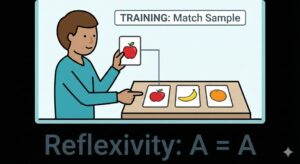
Infographic illustrating Reflexivity (A=A) with a person matching a red apple picture to an identical red apple picture.
3. Symmetry (If A = B, Then B = A)
Symmetry occurs when a learner can reverse a taught relationship.
Example training:
-
You teach A → B (spoken word ‘dog’ → picture of dog).
Symmetry test:
-
Without direct teaching, the learner matches B → A (picture of dog → spoken word ‘dog’).
Exam Tip: Symmetry requires bidirectional responding, but it only emerges if one direction was taught.
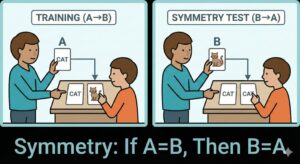
Infographic showing Symmetry with two panels: Training A to B (word ‘CAT’ to picture of a cat) and a Symmetry Test B to A (picture of a cat to word ‘CAT’).
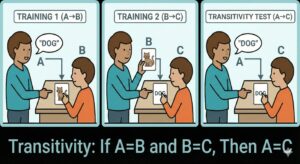
4. Transitivity (If A = B and B = C, Then A = C)
Transitivity requires two trained relations to form a new untrained relation.
Example training:
-
Teach A → B (spoken word ‘cat’ → picture of cat).
-
Teach B → C (picture of cat → written word ‘cat’).
Transitivity test:
-
Learner demonstrates A → C (spoken word ‘cat’ → written word ‘cat’) without direct instruction.
Exam Tip: Transitivity is what makes stimulus equivalence powerful—it allows learners to make new associations effortlessly.
5. Combined: Equivalence Class Formation
When reflexivity, symmetry, and transitivity are all demonstrated among a group of stimuli, an equivalence class has formed.
Example equivalence class:
Spoken word “dog” ↔ picture of dog ↔ written word “dog”
Exam Tip: If even one component (reflexivity, symmetry, transitivity) is missing, an equivalence class has NOT been established.
6. Common Stimulus Equivalence BCBA Exam Traps
-
Confusing symmetry with transitivity: Symmetry reverses one taught relation; transitivity links two relations.
-
Assuming equivalence emerges automatically: It only emerges after specific training.
-
Mislabeling A = A as symmetry: Matching a stimulus to itself is reflexivity.
-
Thinking that teaching A → C directly tests transitivity: Transitivity must be untrained.
-
Ignoring the role of MTS procedures: Many exam questions structure equivalence around matching tasks.
7. Mini Practice Questions
Question 1 – Reflexivity or Symmetry?
A learner is shown picture A and selects picture A without training. What relation is demonstrated?
-
A. Symmetry
-
B. Transitivity
-
C. Reflexivity
-
D. None of the above
Correct Answer: C
Question 2 – Symmetry Test
A BCBA teaches symbol A → symbol B. Later, without training, the learner responds B → A. What emerged?
-
A. Reflexivity
-
B. Symmetry
-
C. Transitivity
-
D. Equivalence class
Correct Answer: B
Question 3 – Transitivity Example
A learner is taught A → B and B → C. Later, they demonstrate A → C with no training. What relationship is shown?
-
A. Reflexivity
-
B. Symmetry
-
C. Transitivity
-
D. None
Correct Answer: C
Key Takeaways
-
Reflexivity: A = A
-
Symmetry: If A = B, then B = A
-
Transitivity: If A = B and B = C, then A = C
-
All three are required for an equivalence class
-
The BCBA® exam frequently tests whether a relationship is directly trained or emerges through derived responding