Stimulus Control vs Motivating Operations: Key Differences Every BCBA® Candidate Must Know
By BCBA Mock Exam
If you’re preparing for the BCBA® exam, SD vs MO is one of those pairs that shows up again and again:
-
“Is this an SD or an EO?”
-
“Is deprivation a discriminative stimulus?”
-
“When the teacher is in the room, is that a motivating operation or stimulus control?”
Many candidates kind of know the definitions but still get lost in scenario questions.
The exam really wants you to answer these two questions clearly:
-
What does a discriminative stimulus (SD) do?
-
What does a motivating operation (MO) do?
In this article, we’ll cover:
-
Simple, testable definitions of stimulus control and motivating operations
-
The difference between SD vs MO (and EO vs AO) in plain language
-
How they work together in the three-term contingency
-
Common BCBA® exam traps
-
A few practice questions with explanations
1. Big Picture: Why SD vs MO Matters
For the BCBA® exam (and real life), you need to be crystal clear on this:
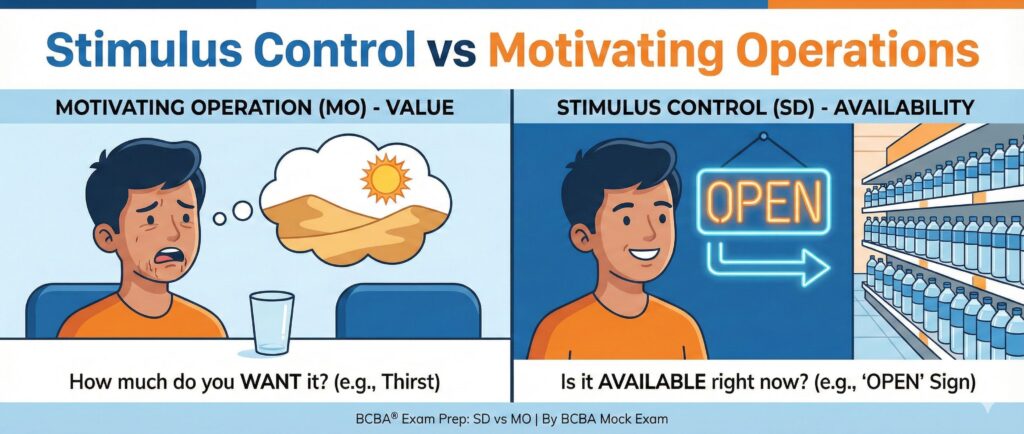
SDs are about the availability of reinforcement. MOs are about the value of reinforcement.
They both are antecedents, they both influence behavior — but in different ways.
If you mix them up, you’ll:
-
Misinterpret functional relations
-
Mislabel intervention components
-
Miss points on questions about antecedents, function, and motivation
So let’s break them apart.
2. What Is Stimulus Control?
Discriminative Stimulus (SD): The “Reinforcement Available” Signal
Definition A discriminative stimulus (SD) is a stimulus in the presence of which a particular response has been reinforced in the past and is now more likely because reinforcement is available for that response.
Key points:
-
An SD signals the availability of reinforcement (or punishment) for a specific response.
-
Behavior is more likely in the presence of the SD because of its history with that consequence.
-
SDs are about past learning: “When this is present, doing X has worked before.”
Simple Examples
-
The “OPEN” sign on a store:
-
SD for approaching the door to buy items.
-
In its presence, buying behavior has historically produced reinforcement (you get what you want).
-

-
Teacher says, “If you finish your worksheet, you can have 5 minutes on the iPad.”
-
The teacher’s instruction, in that context, becomes an SD for working on the worksheet, because it signals that reinforcement (iPad) is available for responding.
-
-
In a token economy: The presence of the token board might function as an SD for the behaviors that earn tokens.
SΔ (S-Delta)
-
SΔ is a stimulus in the presence of which reinforcement is not available for a particular response.
-
Example: “CLOSED” sign on a store is an SΔ for “trying to enter to buy food.”
3. What Is a Motivating Operation (MO)?
MO: Changing How Much You Care
Definition A motivating operation (MO) is an environmental event that:
-
Alters the value of a reinforcer or punisher (value-altering effect), and
-
Alters the current frequency of behavior that has produced that consequence in the past (behavior-altering effect).
In simple terms: MOs change how much you want something right now, and therefore how likely you are to do the behavior that gets it.

EO vs AO
There are two types of MOs:
1. Establishing Operation (EO)
-
Increases the value of a reinforcer
-
Evokes behavior that has produced that reinforcer before
-
Example: Food deprivation → food is more valuable → food-seeking increases
2. Abolishing Operation (AO)
-
Decreases the value of a reinforcer
-
Abates behavior that has produced that reinforcer before
-
Example: Eating a big meal → food is less valuable → food-seeking decreases
Everyday MO Examples
-
EO (attention):
-
A child has been ignored for an hour.
-
Attention becomes more valuable.
-
Behaviors that produce attention (calling out, joking, even problem behavior) are more likely.
-
-
AO (tangible):
-
A teenager has just spent two hours on the iPad.
-
The iPad is less valuable right now.
-
They’re less likely to nag for more screen time.
-
4. Core Difference: SD vs MO in One Table
You can think of SDs and MOs like this:
Shortcut for the exam:
-
SD: “If I do this now, will it be reinforced?”
-
MO: “Do I even want that reinforcer right now?”
Both must relate to the same reinforcer for a given response to be likely.
5. How SDs and MOs Work Together
In real behavior, SDs and MOs interact. A simple way to represent it:
MO → SD → R → SR
-
MO: Makes the reinforcer more or less valuable
-
SD: Signals that the reinforcer is available for a particular response
-
R (response): The behavior
-
SR (reinforcer): Consequence that follows the behavior
Example: Asking for Water (Mand)
-
MO: Thirst (EO for water)
-
Increases the value of water
-
Evokes behavior that has gotten water before
-
-
SD: Seeing the water cooler and an available adult
-
Signals that asking for water will be reinforced
-
-
R: Saying, “Can I have some water?”
-
SR: Adult gives water
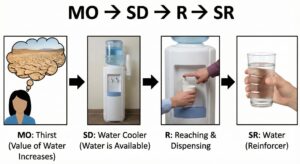
If the MO is not present (you’re not thirsty), the SD (water cooler) might be less effective in evoking the behavior. If the SD is not present (no one around, no access), the MO (thirst) might evoke other behaviors (searching, leaving the room) instead.
6. Quick Comparison Examples
Example 1 – Same Reinforcer, Different Roles
Scenario: A child loves gummy bears.
-
MO (EO):
-
Child hasn’t had sweets all day → gummy bears are extra valuable.
-
-
SD:
-
The teacher says, “If you finish these 5 problems, you will get gummy bears.”
-
This statement signals that gummy bears are available for completing work.
-
Together: Strong EO + clear SD = child is very likely to do the work.
Example 2 – When MO Changes but SD Stays
Same classroom, same teacher instruction:
-
In the morning, the child is very hungry (EO for food).
-
In the afternoon, after a snack, the child is full (AO for food).
The teacher’s instruction (“Do the problems for gummy bears”) is the same SD in both cases, but:
-
In the morning, behavior is more likely (strong EO).
-
In the afternoon, behavior may be less likely (AO) because gummy bears are less valuable.
The SD did not change; the MO did.
7. Common BCBA® Exam Traps: SD vs MO
Trap 1 – Calling Deprivation an SD
-
Deprivation (or satiation) is an MO, not an SD.
-
Example: Being deprived of attention is an EO for attention, not an SD for any particular response.
Trap 2 – Calling Instructions an MO
-
Clear instructions that specify a contingency (“If you do X, you get Y”) are usually functioning as SDs, not MOs.
-
They signal availability of reinforcement for certain behavior.
Trap 3 – Forgetting They Must Share the Same Reinforcer
When differentiating SD vs MO, always ask: “Are both referring to the same reinforcer?”
-
MO changes the value of that reinforcer.
-
SD signals whether that reinforcer is available for a specific behavior. If they involve different reinforcers, you’re mixing things that don’t belong together.
Trap 4 – Focusing Only on Emotions or “Motivation”
On the exam:
-
Words like “frustrated,” “bored,” “excited” may appear, but they are not technical MOs by themselves.
-
Instead, think:
-
What environmental conditions changed the value of a reinforcer?
-
What deprivation or satiation or aversive conditions are present?
-
Trap 5 – Ignoring How They Work Together
Some stems describe both an MO and an SD. You may be asked to identify:
-
Which part is the MO, and
-
Which part is the SD in the same scenario. Don’t assume it must be one or the other — they usually co-occur.
8. A Simple Heuristic for Exam Questions
When you see a tricky antecedent question, ask yourself:
-
What is the reinforcer in this situation?
-
Is the antecedent changing how valuable that reinforcer is?
-
Yes → likely an MO (EO or AO).
-
-
Is the antecedent signaling that reinforcement is available for a particular response?
-
Yes → likely an SD.
-
-
Could both be present?
-
If the stem clearly describes deprivation/satiation AND a cue that reinforcement is available, you might need to label both distinctions.
-
9. Mini BCBA® Exam–Style Questions (With Explanations)
Question 1 – SD or MO?
A child has not played video games all week (they usually play daily). On Friday afternoon, the caregiver tells the child, “If you finish your homework, you can have 30 minutes of video games.” What is the caregiver’s statement MOST likely functioning as?
A. An establishing operation for video games B. An abolishing operation for video games C. A discriminative stimulus for completing homework D. A conditioned motivating operation for escape
Correct Answer: C – A discriminative stimulus for completing homework
Why?
-
The deprivation of video games all week is the MO (EO) that increases the value of video games.
-
The statement “If you finish your homework, you can have video games” signals that video games are available for a specific response (completing homework).
-
That’s the role of an SD, not an MO.
Question 2 – MO or SD?
A student has been sitting through a long, difficult lecture. The teacher announces, “If you have a question, raise your hand and I’ll call on you.” What is the long, difficult lecture MOST likely functioning as with respect to seeking help?
A. An establishing operation increasing the value of teacher assistance B. A discriminative stimulus for asking questions C. An abolishing operation for teacher attention D. An SΔ for obtaining help
Correct Answer: A – An establishing operation increasing the value of teacher assistance
Why?
-
The long, difficult lecture is making teacher help more valuable; it increases the motivation to access assistance.
-
That is the role of an EO (MO).
-
The teacher’s announcement (“If you have a question, raise your hand…”) would be the SD for hand-raising, not the lecture itself.
Question 3 – Combined SD + MO
A client has not had anything to drink for several hours. They walk into the kitchen and see a full water bottle on the counter. In the past, when they reached for that bottle, they were allowed to drink from it. Reaching for the bottle occurs quickly. Which is the BEST description of the variables controlling reaching for the bottle?
A. The water bottle is an MO, and the lack of water is an SD B. The lack of water is an EO, and the bottle on the counter is an SD C. The lack of water is an AO, and the bottle is an SΔ D. Both the lack of water and the bottle are SDs
Correct Answer: B – The lack of water is an EO, and the bottle on the counter is an SD
Why?
-
Lack of water (deprivation) increases the value of water and evokes water-seeking behavior → EO (MO).
-
The bottle on the counter, given its learning history (“reaching gets me water”), signals that drinking is available for the response of reaching → SD.
-
Together, the EO + SD make reaching for the bottle very likely.
10. Key Takeaways
-
Stimulus control (SD):
-
Answers: “Is reinforcement available for this behavior right now?”
-
Is about availability, based on past history.
-
-
Motivating operations (MO):
-
Answer: “How valuable is this reinforcer right now?”
-
Are about value, based on current conditions.
-
-
They work together:
-
MO → SD → R → SR
-
You need both: a reason to want the reinforcer and a cue that it’s available for a specific response.
-