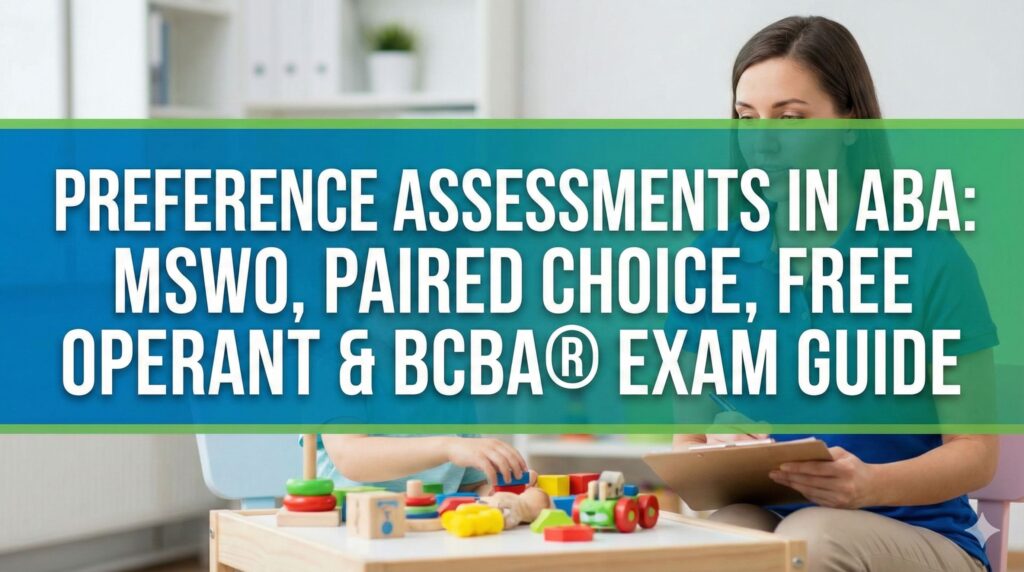
Preference Assessments in ABA: MSWO, Paired Choice, Free Operant and How They Appear on the Exam
By BCBA Mock Exam
Introduction
Preference assessments are a core tool in ABA and a frequent topic on the BCBA® exam. You’ll see them in questions about:
-
Identifying potential reinforcers
-
Designing treatment or teaching plans
-
Evaluating why an intervention isn’t working as expected
But on test day, the difficulty is rarely just recalling what “MSWO” or “paired choice” stands for. The real challenge is:
-
Recognizing which assessment is being described in a scenario
-
Knowing when to choose each type (paired choice vs MSWO vs free operant)
-
Interpreting results correctly and avoiding common exam traps (like confusing “preference” with “reinforcer”)
In this article, we’ll walk through:
-
What preference assessments are and why they matter
-
MSWO, paired-stimulus (forced-choice), and free-operant formats
-
How to interpret and compare results
-
How these assessments appear on the BCBA® exam
-
Mini exam-style questions with explanations so you can self-check your understanding.
1. What Are Preference Assessments in ABA and Why Do They Matter?
A preference assessment is a structured way to identify items, activities, or events that a client is likely to prefer.
Why this matters:
-
Preferred items are candidates for reinforcers.
-
Effective reinforcement is the backbone of teaching new skills and reducing problem behavior.
-
Weak or poorly chosen reinforcers often explain why an otherwise good intervention is failing.
Key exam distinction:
-
A preferred item is not automatically a reinforcer.
-
Something only qualifies as a reinforcer if it actually increases or maintains behavior when delivered contingent on that behavior.
Preference assessments help you find what is worth testing as a reinforcer, and the exam expects you to know how and when to use the major formats.
For BCBA® candidates, thinking in terms of preference assessments ABA concepts is essential for selecting effective reinforcers.
2. Big Categories: Types of Preference Assessments in ABA
When you study preference assessments ABA style for the exam, it helps to group them into a few big categories.
-
Single-stimulus (successive)
-
Present one item at a time and record approach/engagement.
-
-
Paired-stimulus (forced-choice)
-
Present two items at a time and ask the client to choose.
-
-
Multiple-stimulus
-
Present an array of items; the most common exam format is MSWO – Multiple Stimulus Without Replacement.
-
-
Free-operant
-
Provide access to many items/activities and record engagement without prompts to choose.
-
The BCBA® exam especially focuses on paired choice, MSWO, and free operant—and on how to match each method to client needs.
3. Paired-Stimulus (Forced-Choice) Preference Assessment
What it is:
-
Also called paired-stimulus or forced-choice preference assessment.
-
Two items are presented at a time; the learner is asked to choose one.

Basic steps:
-
Select a set of items to test (e.g., toys, snacks, activities).
-
Present all possible pairs of items across trials.
-
On each trial, record which item is chosen.
-
Calculate a percentage of selection for each item (number of times chosen ÷ number of times presented × 100%).
-
Rank items from most to least selected.
Strengths:
-
Produces a clear preference hierarchy.
-
Good for clients who can scan and choose between two items.
-
Reduces side bias compared to single-stimulus methods.
Limitations:
-
Can be time-consuming if there are many items (because you must present all pairs).
-
May be difficult for clients who have trouble with choice-making or scanning.
Exam cues:
-
The stem says “the BCBA presents two items at a time…” and calculates percentage of selections.
-
The question mentions “forced-choice” or “paired-stimulus” directly.
Watch for:
-
Paired-stimulus is often chosen when you need a highly precise ranking of a moderate number of items.
4. MSWO – Multiple Stimulus Without Replacement
What it is:
-
MSWO stands for Multiple Stimulus Without Replacement.
-
The learner chooses from an array of items; once an item is chosen for that trial, it is removed from the array on the next trial.

Basic steps:
-
Arrange several items (e.g., 5–8) in front of the learner.
-
Instruct them to “pick one” or “choose one to play with/eat.”
-
Allow brief access to the selected item.
-
Remove the chosen item from the array.
-
Redistribute the remaining items and repeat until all items are chosen or the learner stops choosing.
-
Record the order in which items are selected across repeated arrays.
Strengths:
-
More time-efficient than paired-stimulus when there are many items.
-
Still produces a clear rank order of preferences.
-
Can be very practical in clinical and classroom settings.
Limitations:
-
Requires that the learner can scan an array and make selections.
-
Items selected later might appear “less preferred,” but could be affected by satiation on earlier items.
Exam cues:
-
The stem mentions an array of items, repeated trials, and items not returned after selection.
-
Key phrase: “multiple stimulus without replacement.”
On the exam, MSWO is often chosen when you want a relatively quick, efficient assessment that still gives a ranked hierarchy.
5. Free-Operant Preference Assessment (Contrived and Naturalistic)
What it is:
-
A free-operant preference assessment allows the learner free access to a variety of items or activities while observers record how much time the learner spends engaging with each option.
-
No explicit trials or “choose one” prompts—just continuous observation.

Types:
-
Contrived free operant
-
The clinician arranges many items/activities in an environment at once.
-
The learner is permitted to interact freely while the BCBA records engagement.
-
-
Naturalistic free operant
-
Observation occurs in the everyday environment (classroom, home) without adding special items.
-
The BCBA records naturally occurring engagement.
-
Basic steps:
-
Provide access to multiple items or observe in a rich environment.
-
Set a defined observation period (e.g., 10–20 minutes).
-
Record either duration or frequency of engagement with each item.
-
Items with the highest engagement are inferred to be highly preferred.
Strengths:
-
Very easy to implement.
-
Good for individuals who have difficulty with structured choices.
-
Minimizes problem behavior that can sometimes occur when items are presented and then removed.
Limitations:
-
Does not always give a precise rank order across many items.
-
Items that are not contacted during the observation may look like “low preference,” even if they could be reinforcing in different conditions.
Exam cues:
-
The stem describes the BCBA observing what the client naturally plays with and measuring time spent.
-
No discrete trials, no “choose one” prompts, and no array rotation → free operant.
6. Other Formats You Might See (Single-Stimulus and MSW)
The exam may also mention other structured formats:
-
Single-stimulus (successive) assessment
-
Present one item at a time.
-
Record whether the learner approaches/engages or rejects the item.
-
Helpful for learners who struggle with scanning arrays or making choices.
-
-
MSW – Multiple Stimulus With Replacement
-
Similar to MSWO, but the chosen item is returned to the array on the next trial.
-
The learner could select the same item on many trials.
-
Although these are less emphasized in your requested topic, it’s useful to know that they exist and how they contrast with MSWO, paired choice, and free operant—especially for definition-matching items.
7. Comparing MSWO, Paired Choice, and Free Operant: Pros, Cons, and When to Use
When choosing among MSWO, paired choice, and free operant preference assessments ABA clinicians often compare efficiency, precision, and client fit.
Paired-Stimulus (Forced-Choice)
-
Pros:
-
Produces a strong preference hierarchy.
-
Limits side bias (you rotate positions).
-
-
Cons:
-
Can be time-consuming with many items.
-
-
Best when:
-
You need precise ranking and the learner can handle repeated two-item choices.
-
MSWO (Multiple Stimulus Without Replacement)
-
Pros:
-
More efficient than paired choice for many items.
-
Still yields a meaningful rank order.
-
-
Cons:
-
Requires adequate scanning and choice skills.
-
Some items may look less preferred due to satiation or order effects.
-
-
Best when:
-
You have several potential reinforcers and need a quick but structured assessment.
-
Free-Operant
-
Pros:
-
Very low effort and natural.
-
Minimizes problem behavior related to removal of items.
-
-
Cons:
-
Less precise ranking, especially for items rarely contacted.
-
-
Best when:
-
You want to observe natural engagement or the learner struggles with structured choice tasks.
-
Exam hint: When a question asks which assessment is most appropriate given a client description (e.g., limited choice skills, high problem behavior during item removal, short time available), use this comparison to guide your answer.
8. From Preference to Reinforcer: Don’t Skip the Next Step
The exam regularly tests whether you understand that preference is not the same as reinforcement.
Key points:
-
A preference assessment tells you what the client likes or chooses.
-
A reinforcer assessment tests whether delivery of an item actually increases a behavior.
Simple reinforcer assessment logic:
-
If behavior increases or maintains when an item is provided contingent on the behavior, the item is functioning as a reinforcer.
-
If behavior does not change, the item might be preferred but not highly reinforcing in that context.
Exam cues:
-
Vignettes may show an item identified in a preference assessment not improving performance when used as a reward. The correct answer might emphasize:
-
Conducting a reinforcer assessment.
-
Testing other highly preferred items.
-
Adjusting how and when the item is delivered.
-
9. How Preference Assessments Show Up on the BCBA® Exam
Preference assessments ABA questions on the BCBA® exam usually appear inside longer vignettes rather than as pure definition items.
-
Definition or matching items
-
“Which of the following best describes an MSWO preference assessment?”
-
“Which method involves presenting two items at a time and asking the learner to choose one?”
-
-
Scenario identification
-
Describing a procedure without naming it and asking which type of assessment it is.
-
-
Choosing the best assessment
-
Given client characteristics (limited scanning, high escape-maintained behavior during testing, time constraints), you choose between MSWO, paired choice, free operant, or single-stimulus.
-
-
Interpreting results
-
Questions may show a simple table or description of selections/time and ask which item is most preferred or what to test as a reinforcer.
-
-
Troubleshooting weak interventions
-
If an intervention isn’t working, the exam may expect you to consider whether preference assessment or reinforcer assessment has been adequately conducted.
-
10. Common BCBA® Exam Traps with Preference Assessments
Trap 1 – Confusing preference with reinforcement
-
Just because an item is chosen doesn’t mean it will increase behavior. Look for follow-up data.
Trap 2 – Mislabeling procedures
-
Calling MSWO a “concurrent schedule” or confusing free operant with “just letting them choose once.”
-
Make sure you map what the stem describes to the correct label.
Trap 3 – Ignoring client skill level
-
Choosing MSWO or paired choice for clients who cannot scan an array or make reliable choices.
-
The best answer often adjusts the assessment type to the learner’s abilities.
Trap 4 – Overlooking environment and problem behavior
-
If the stem describes severe problem behavior when items are removed, a free-operant or naturalistic approach may be safer and more appropriate.
Trap 5 – Too few or too similar stimuli
-
If all items are nearly identical (e.g., only different colors of the same toy), the assessment may not detect meaningful differences.
-
The exam may point you toward expanding the stimulus set or including varied categories (snacks, toys, social games).
11. Mini BCBA® Exam–Style Questions (With Explanations)
Question 1 – Identifying Paired-Stimulus Assessment A BCBA presents two toys at a time to a child and says, “Pick one.” The child is allowed 30 seconds of play with the selected toy. Across sessions, each toy is paired with every other toy several times. The BCBA then calculates the percentage of trials on which each toy was selected.
Which type of preference assessment is being conducted? A. Free-operant preference assessment B. Multiple stimulus without replacement (MSWO) C. Paired-stimulus (forced-choice) preference assessment D. Single-stimulus preference assessment
Correct Answer: C – Paired-stimulus preference assessment Explanation: Two items are presented at a time, and the BCBA calculates percentage of selections—hallmarks of a paired-stimulus assessment.
Question 2 – Identifying MSWO A therapist places six different snacks on the table and tells the client, “Choose one.” After the client selects and consumes one snack, the therapist removes the chosen item and rearranges the remaining five. This process continues until the client has selected all items or stops choosing.
This procedure is BEST described as: A. Multiple stimulus with replacement (MSW) B. Multiple stimulus without replacement (MSWO) C. Free-operant preference assessment D. Paired-stimulus preference assessment
Correct Answer: B – MSWO Explanation: Items are presented in an array and removed once chosen—this is MSWO.
Question 3 – Choosing Free Operant A client engages in severe problem behavior when preferred items are taken away during structured assessments. The BCBA wants to identify preferred activities while minimizing this problem behavior. The BCBA arranges a room with many toys and activities, allows the client to roam freely for 15 minutes, and records how long the client spends interacting with each option.
Which preference assessment format is MOST appropriate here? A. Paired-stimulus B. MSWO C. Free-operant D. Single-stimulus
Correct Answer: C – Free-operant Explanation: The BCBA is observing natural engagement with multiple available items without frequent removal, which matches free-operant assessment.
Question 4 – From Preference to Reinforcer A BCBA conducts an MSWO and finds that a specific puzzle is highly preferred. The BCBA then uses the puzzle as a consequence for correct responses in a teaching session, but correct responding does not increase.
What is the BEST conclusion? A. The puzzle is not a reinforcer in this context and additional items should be tested B. The MSWO was conducted incorrectly and must be repeated C. Preference assessments cannot be used for adults D. The client does not respond to reinforcement
Correct Answer: A Explanation: A highly preferred item in an assessment may still fail to function as a reinforcer in a specific context. The BCBA should test additional items.
Question 5 – Matching Assessment to Client Skills A learner has limited visual scanning skills and becomes frustrated when asked to choose between multiple items. The BCBA wants to identify preferred items.
Which assessment is MOST appropriate to start with? A. MSWO with 10 items B. Paired-stimulus assessment with 6 items C. Free-operant or single-stimulus assessment D. Concurrent schedules arranged across two response options
Correct Answer: C – Free-operant or single-stimulus assessment Explanation: For learners with limited scanning or choice abilities, free-operant or single-stimulus methods are often more appropriate starting points.
12. Key Takeaways
-
Preference assessments identify what the client likes, which guides selection of potential reinforcers.
-
Paired-stimulus: present two items at a time, calculate percent selections; very precise but time-intensive.
-
MSWO: multiple items in an array, remove chosen items; efficient and still yields a preference hierarchy.
-
Free-operant: observe engagement with freely available items; easy to implement and good for clients with limited choice skills.
-
Always remember that preference ≠ reinforcement; follow up with reinforcer assessments when necessary.
On the BCBA® exam, focus on:
-
Matching assessment type to client skills and context
-
Correctly labeling procedures described in vignettes
-
Distinguishing between identifying preference and demonstrating reinforcement
With these tools in mind, preference-assessment questions become not just memorization tasks, but practical decision-making scenarios you can handle with confidence—both on the exam and in real-world ABA practice.
Building fluency with preference assessments ABA procedures will make these exam scenarios feel much more straightforward on test day.