Positive vs Negative Punishment in ABA: Examples & BCBA Exam Traps
By BCBA Mock Exam
“Punishment” is one of those words that sounds simple in everyday language, but on the BCBA® exam it has a very specific, technical meaning.
Many candidates make mistakes because they:
-
Confuse punishment with negative reinforcement
-
Focus on the client’s emotional reaction, not the future frequency of behavior
-
Mix up positive vs negative just because the consequence “feels bad”
In this article, we’ll walk through:
-
What punishment really means in ABA
-
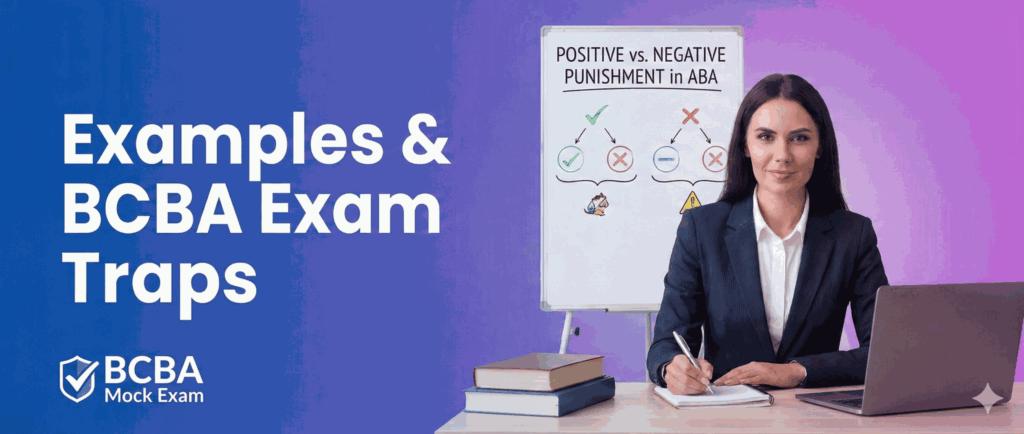
The difference between positive and negative punishment
-
Everyday and clinical examples
-
How punishment differs from reinforcement and extinction
-
The most common BCBA® exam traps
-
A few practice questions with explanations
In ABA, punishment is defined solely by its effect on future behavior: it must cause the behavior to decrease.
1. Quick Review: What Is Punishment in ABA?
In applied behavior analysis:
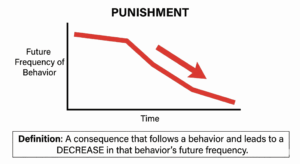
Punishment is a consequence that decreases the future frequency of a behavior.
Key points:
-
It’s about the effect on the behavior over time, not how “bad” it looks or feels.
-
If the consequence does not reduce the behavior in the future, it is not punishment (even if you meant it that way).
Contrast with reinforcement:
-
Reinforcement → behavior goes up in the future
-
Punishment → behavior goes down in the future
Both reinforcement and punishment can be:
-
Positive (something is added)
-
Negative (something is removed)
Positive/negative = what happens to the stimulus, not whether it is “good” or “bad.”
2. Positive Punishment: Adding Something After Behavior
Definition
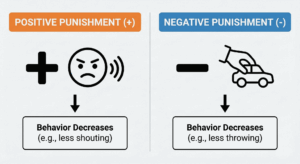
Positive punishment occurs when a stimulus is added immediately after a behavior and, as a result, the behavior decreases in the future.
“Positive” = plus = something is added.
Examples (everyday)
-
A child touches a hot stove → feels pain
-
Pain is added after touching stove
-
If touching the stove decreases in the future, pain functioned as positive punishment.
-
-
A driver speeds and gets a loud scolding from a police officer
-
Scolding is added
-
If speeding later decreases, the scolding functioned as positive punishment.
-
Examples (ABA-friendly, mild)
-
A learner frequently shouts out in class. Each time, the teacher provides a brief, firm reprimand (“Remember, raise your hand before speaking”).
-
If shouting out decreases over time, the reprimand acted as positive punishment.
-
-
A child engages in mild aggression during play. When this happens, the adult says “Hands are for gentle touches,” and briefly removes access to play while also adding a corrective statement.
-
The corrective statement itself can be a positive punisher if it reduces aggression.
-
Exam tip: When you see something added (reprimand, extra chores, additional work, sensory event) immediately after behavior, and the behavior decreases over time, think positive punishment.
Remember: “Positive” means adding a stimulus, and “Negative” means removing one. Both result in behavior decreasing.
3. Negative Punishment: Taking Something Away After Behavior
Definition
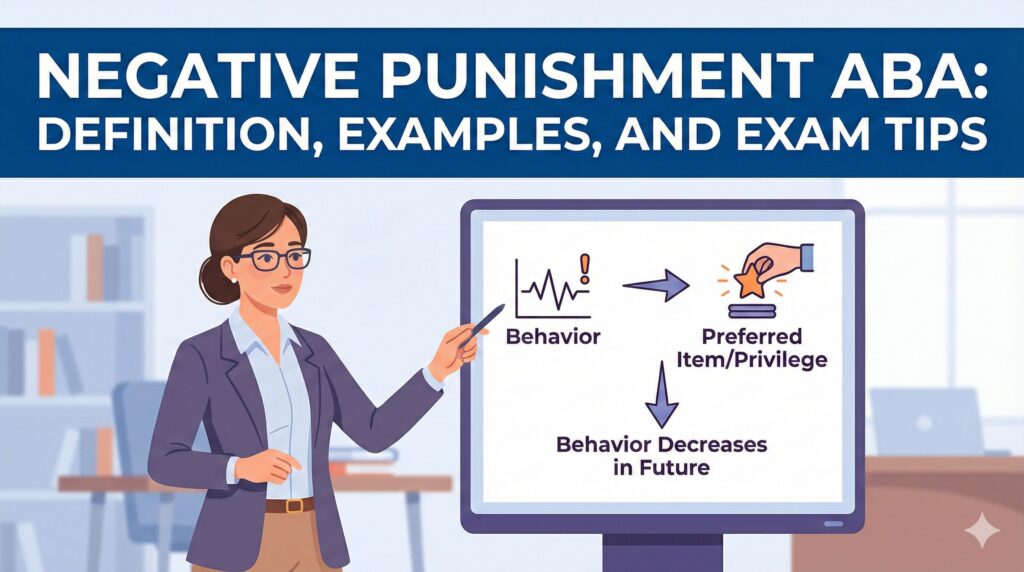
Negative punishment occurs when a stimulus is removed immediately after a behavior and, as a result, the behavior decreases in the future.
“Negative” = minus = something is taken away.
Two common forms on the exam:
-
Response cost – loss of a specific amount of a reinforcer
-
Time-out from positive reinforcement – removal from a reinforcing environment for a period of time
Examples (everyday)
-
A teenager breaks curfew. Parents take away car privileges for a week.
-
If curfew violations decrease, the loss of car access is negative punishment.
-
-
A child throws a toy at a sibling. The parent removes the toy and puts it away for the afternoon.
-
If toy-throwing decreases, loss of the toy functioned as negative punishment.
-
Examples (ABA)
-
Response cost:
-
A client earns tokens for appropriate behavior. When they engage in property destruction, the BCBA has programmed that one token will be removed.
-
If property destruction decreases, the loss of tokens is negative punishment.
-
-
Time-out from positive reinforcement:
-
During a group game, a child continually hits peers. The BCBA implements a brief, clearly defined time-out where the child is removed from the game and sits in a neutral area for 2 minutes.
-
If hitting decreases, the loss of access to the game is negative punishment.
-
Exam tip: If the stem describes losing access to something preferred, or removal from a reinforcing context immediately after a behavior, and the behavior decreases, think negative punishment.
4. Don’t Confuse Punishment with Negative Reinforcement
A major BCBA® exam trap is mixing up:
-
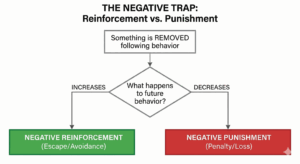
Negative punishment – removing something after behavior to decrease it
-
Negative reinforcement – removing something after behavior to increase it
Negative reinforcement
A stimulus is removed following a response, and the behavior increases in the future because it escaped or avoided something aversive.
Example:
-
A student raises their hand and asks for a break. The teacher allows them to stop working for 2 minutes.
-
If “asking for a break” increases, this is negative reinforcement for the break-request behavior (removal of work = escape).
-
Compare with negative punishment
-
A student repeatedly throws pencils during work. Each time, the teacher takes away access to a preferred fidget.
-
If pencil-throwing decreases, that is negative punishment.
-
Key exam question to ask yourself: “Which behavior am I analyzing, and did it increase or decrease?”
If the behavior increases because an aversive is removed → negative reinforcement
If the behavior decreases because a reinforcer is removed → negative punishment
The critical difference is the future effect on behavior: does it increase (reinforcement) or decrease (punishment)?
5. Punishment vs Extinction
Another common confusion is punishment vs extinction.
-
Punishment – you present or remove a stimulus contingent on behavior, and future behavior decreases.
-
Extinction – you withhold the maintaining reinforcer for a previously reinforced behavior, and behavior decreases over time.
Example (extinction):
-
A child whines for candy at the store. Historically, the parent often gave in.
-
Now the parent stops giving candy when whining occurs.
-
Whining eventually decreases → that is extinction, not punishment (no new aversive or removal is added; the reinforcer is simply no longer delivered).
Exam tip: If the consequence is “no longer delivering the reinforcement that used to maintain the behavior,” that’s extinction. If the consequence is adding or removing a stimulus after behavior to reduce it, that’s punishment.
6. Ethical and Clinical Considerations (You Will See This Theme)
The BCBA® exam also cares about how punishment is used.
Common exam principles:
-
Emphasize reinforcement-based procedures first
-
Use punishment procedures only when necessary, with appropriate oversight
-
Ensure informed consent and ethical review
-
Monitor for side effects, such as:
-
Emotional responding
-
Aggression
-
Escape/avoidance of the punishing person or setting
-
-
Combine punishment (if used) with differential reinforcement of an appropriate alternative behavior (DRA, DRI, etc.)
If you see an option that adds punishment without:
-
assessment,
-
reinforcement for alternative behavior,
-
or ethical safeguards, that option is usually not the best answer.
7. Common BCBA® Exam Traps Around Punishment
Here are the big ones:
Trap 1 – “Positive” and “negative” based on “good” vs “bad” On the exam:
-
Positive = stimulus added
-
Negative = stimulus removed There is no moral judgment in the terms themselves.
Trap 2 – Looking only at the immediate emotional reaction Crying, upset, or “looking sad” does not automatically mean punishment is happening.
-
A child might cry after losing a token, but if the problem behavior does not decrease, it was not punishment in the technical sense. Always ask: “Did this consequence change the future frequency of the behavior?”
Trap 3 – Confusing negative punishment with negative reinforcement
-
Both involve removal of a stimulus.
-
The difference is what happens to the behavior being analyzed.
-
Behavior increases → negative reinforcement
-
Behavior decreases → negative punishment
-
Trap 4 – Calling something a punishment procedure when it’s actually extinction
-
If the consequence description is simply “stop delivering attention,” “stop delivering escape,” or “no longer give access to the item,” and that consequence used to be the reinforcer, that’s likely extinction.
Trap 5 – Ignoring the targeted behavior Sometimes the exam stem describes multiple behaviors:
-
One behavior gets reinforced
-
A different behavior results in loss of privilege You must be clear about which behavior you are labeling. For example:
-
Tantrums result in loss of tokens → negative punishment for tantrums.
-
Calm requests result in gaining tokens → positive reinforcement for requests. A single program can include both reinforcement and punishment for different behaviors.
8. Mini Practice Questions (With Explanations)
Question 1 – Positive or Negative Punishment? During circle time, a student repeatedly talks out without raising a hand. Each time this happens, the teacher immediately says, “That’s a warning. If you talk out again, you will lose 2 minutes of recess.” After a week of this procedure, the student’s rate of talking out decreases.
Which statement is most accurate? A. The teacher’s warning functioned as positive punishment for talking out B. The loss of recess time functioned as negative punishment for talking out C. The teacher used extinction for talking out D. The student’s behavior decreased due to negative reinforcement
Correct Answer: B
Why?
The loss of recess time is a removal of a preferred activity contingent on talking out.
The future frequency of talking out decreased → by definition, this is punishment.
Because something preferred is removed, it is negative punishment.
A is about the warning itself; the stem emphasizes the loss of recess.
C is incorrect because the teacher is adding a consequence, not simply withholding reinforcement.
D is incorrect because negative reinforcement would increase a behavior.
Question 2 – Punishment vs Negative Reinforcement A client is working on a difficult puzzle. When they start to whine and say “This is too hard,” the therapist removes half the puzzle pieces and simplifies the task. After a few sessions, the client whines more often when tasks are presented.
What process is most likely maintaining the whining? A. Positive punishment B. Negative punishment C. Negative reinforcement D. Extinction
Correct Answer: C
Why?
Whining leads to the removal of an aversive condition (a difficult task).
As a result, whining increases in the future.
Removal of an aversive stimulus that increases behavior = negative reinforcement.
The behavior is not decreasing, so this is not punishment.
Question 3 – Punishment or Extinction? In the past, when a child screamed in the grocery store, the parent often gave candy to keep them quiet. Now, the parent decides to stop buying candy during screaming episodes and simply finishes shopping. Over several weeks, screaming in the store decreases.
Which procedure is the parent most likely using? A. Positive punishment B. Negative punishment C. Extinction D. Negative reinforcement
Correct Answer: C
Why?
The parent is withholding the reinforcer (candy) that previously maintained screaming.
No new consequence is added or removed; the existing reinforcement is simply no longer delivered.
When behavior decreases due to withholding its maintaining reinforcer, that is extinction, not punishment.
9. Key Takeaways
-
Punishment in ABA means a consequence that reduces future behavior, not just something that “feels bad.”
-
Positive punishment: add a stimulus → behavior decreases.
-
Negative punishment: remove a stimulus → behavior decreases.
-
Don’t confuse negative punishment with negative reinforcement:
-
Negative reinforcement → remove something aversive → behavior increases.
-
-
Always pay attention to:
-
What is added or removed
-
Which behavior you’re analyzing
-
Whether that behavior goes up or down over time
-
-
On the BCBA® exam, the best answers:
-
Use precise definitions
-
Consider the future frequency of behavior
-
Respect ethical guidelines and emphasize reinforcement-based approaches first
-