
In Applied Behavior Analysis, prompts are essential tools for teaching new skills. Among these, physical prompts represent a specific type of assistance that involves direct physical guidance. Understanding this procedure is crucial for both effective practice and BCBA exam success.
Table of Contents
- Physical Prompts ABA: Defining Physical Prompts in Applied Behavior Analysis
- Applying Physical Prompts: Worked Examples and Function Analysis
- Ethical Considerations and the BCBA Exam Focus
- Quick Implementation and Fading Checklist
- Summary and Key Takeaways for Exam Success
Physical Prompts ABA: Defining Physical Prompts in Applied Behavior Analysis
A physical prompt is a type of response prompt that involves physically guiding a learner’s movements to complete a target behavior. This tactile assistance helps establish the correct motor response when other prompting methods might be insufficient.
The Technical Definition and Key Characteristics
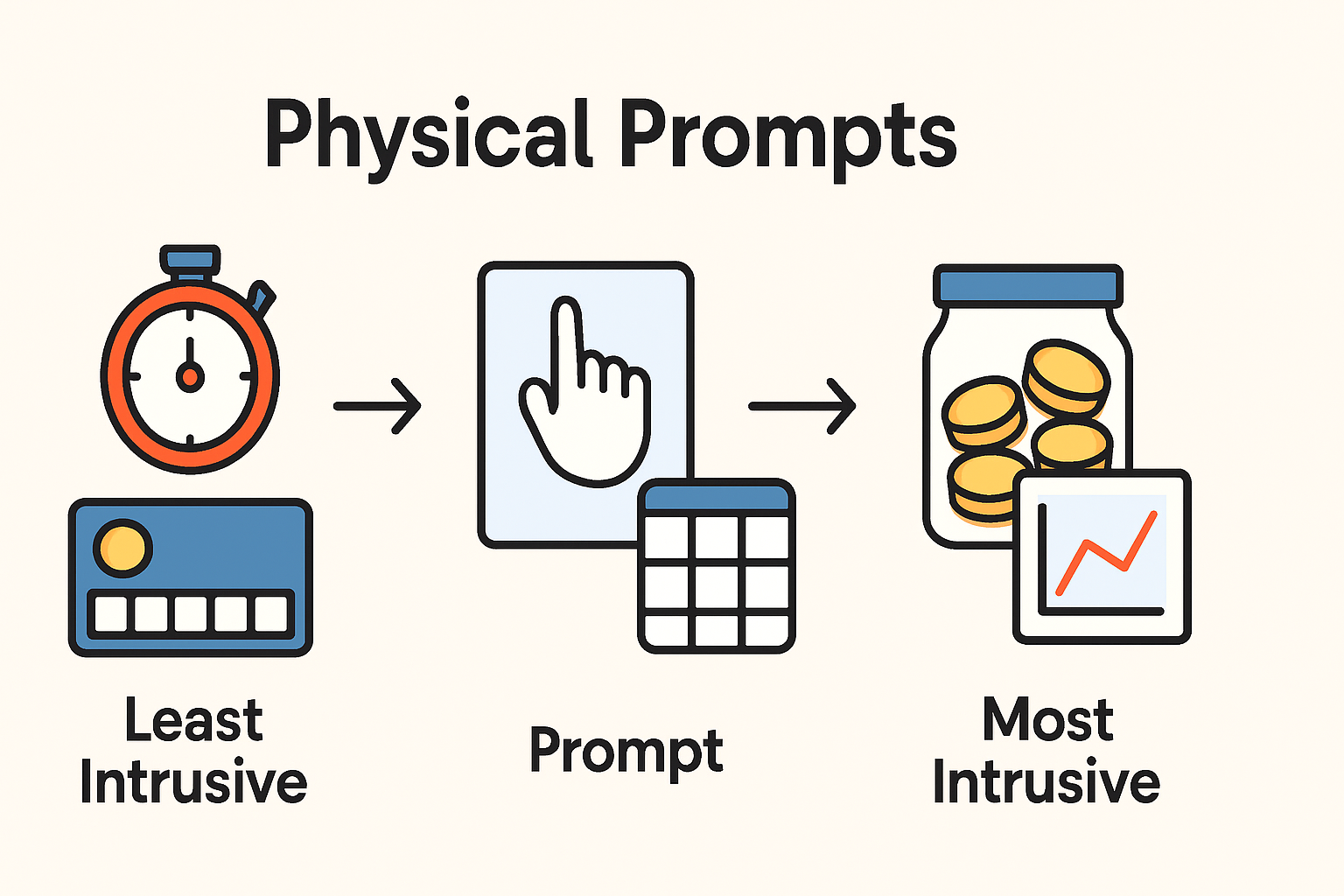
Physical prompts involve hand-over-hand guidance or partial physical assistance to help a learner perform a specific action. These prompts are considered most intrusive in the prompting hierarchy because they involve direct physical contact. Key related procedures include most-to-least prompting, where you start with full physical guidance and gradually reduce assistance, and graduated guidance, which involves subtle physical support that fades as the learner demonstrates competence.
Physical Prompts vs. Other Response Prompts: An Exam Critical Distinction
Understanding the differences between prompt types is essential for exam questions. Here’s how physical prompts compare to other common prompting methods:
- Physical prompts involve direct physical guidance (hand-over-hand assistance)
- Model prompts demonstrate the behavior for the learner to imitate
- Verbal prompts provide spoken instructions or cues
- Gestural prompts use pointing, nodding, or other non-verbal signals
A common exam trap involves confusing physical prompts with model prompts when a therapist demonstrates a movement. Remember: physical means tactile guidance, not just demonstration.
Applying Physical Prompts: Worked Examples and Function Analysis
Let’s examine practical applications of physical prompts through detailed scenarios. These examples demonstrate how to plan, implement, and analyze this prompting strategy effectively.
Example 1: Teaching a Motor Skill (Handwashing)
Consider teaching handwashing to a learner with limited fine motor skills. The ABC contingency would be structured as follows:
- Antecedent: SD “Wash your hands” presented with soap and running water
- Behavior: Turning on the faucet and applying soap
- Consequence: Access to water and completion of hygiene routine
The physical prompt involves hand-over-hand guidance to help the learner turn the faucet handle. The function analysis might reveal this behavior serves to access water (positive reinforcement) or escape/avoid a demand (negative reinforcement). A proper prompt fading plan would gradually reduce from full physical guidance to partial assistance, then to shadowing, and finally independence.
Example 2: Shaping a Communication Response (Activating a Switch)
For a learner with limited motor skills learning to activate a communication device:
- Antecedent: Presence of switch-activated toy or communication device
- Behavior: Pressing the switch with sufficient force
- Consequence: Toy activation or voice output
A partial physical prompt might involve a gentle tap on the elbow to initiate the arm movement toward the switch. This approach respects the learner’s autonomy while providing necessary support. The function is likely access to sensory stimulation or social interaction through the activated device.
Ethical Considerations and the BCBA Exam Focus
Physical prompts carry significant ethical implications that frequently appear on BCBA exams. Understanding these considerations is essential for both ethical practice and exam success.
Prioritizing Least Intrusive Methods and Client Dignity
According to the BACB Ethics Code, behavior analysts must use the least intrusive effective interventions. Physical prompts should only be used when less intrusive methods (verbal, gestural, or model prompts) have proven ineffective. Always consider client assent and comfort with physical contact, and be mindful of cultural considerations regarding touch. For more on ethical practice, see our guide on ethics in ABA practice.
Common Exam Traps and How to Avoid Them
BCBA exam questions often test your ability to identify and apply physical prompts correctly. Watch for these common pitfalls:
- Confusing physical prompts with punishment: Physical guidance is a teaching prompt, not a consequence
- Misidentifying prompt types in scenario questions: Look for tactile guidance, not just demonstration
- Forgetting prompt fading: Physical prompts should always include a plan for systematic reduction
- Overlooking assent procedures: Failure to obtain and monitor client assent during implementation
Quick Implementation and Fading Checklist
Use this practical checklist when planning and implementing physical prompts:
- Assess prerequisite skills and determine if physical prompting is necessary
- Obtain informed consent and discuss physical contact with stakeholders
- Establish clear fading criteria from the beginning of intervention
- Monitor client comfort and assent throughout each session
- Use shadowing technique to gradually reduce physical contact
- Collect data on prompt level and independence for each trial
- Adjust fading schedule based on learner progress and comfort
For more on effective teaching procedures, explore our guide to errorless learning which often incorporates physical prompts.
Summary and Key Takeaways for Exam Success
Physical prompts are powerful teaching tools that require careful implementation and ethical consideration. Remember these essential points:
- Physical prompts involve direct physical guidance to help complete a target behavior
- They are the most intrusive type of response prompt in the hierarchy
- Always include a systematic fading plan from the beginning
- Consider client dignity and assent when using physical contact
- Use physical prompts only when less intrusive methods have proven ineffective
- Monitor for prompt dependency and adjust fading accordingly
For authoritative guidance on prompting procedures, refer to the BACB Ethics Code and research on effective prompting strategies. Understanding these concepts thoroughly will help you answer related questions correctly on the BCBA exam and implement physical prompts ethically in practice.
Complete BCBA Exam Prep
Turn this topic into exam-day practice
Practice concepts in context with five full-length 6th Edition mock exams, two bonus practice exams, a 6th Edition study guide, and key-term flashcards—all in one $120 USD package.
Get the $120 All-in-One Prep Pack
Review everything included on the product page before ordering. No pass guarantee is implied.



