
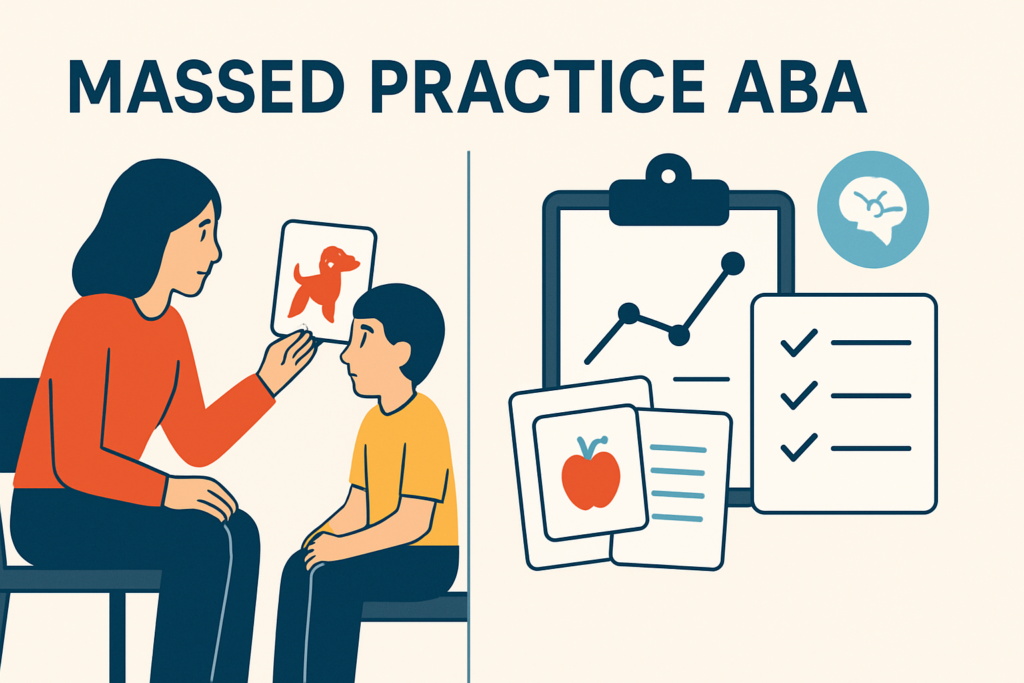
Massed practice is a fundamental instructional strategy in applied behavior analysis that involves concentrating practice trials into a short time period. This approach is particularly valuable during initial skill acquisition phases and appears in the BCBA Task List under item D-3. Understanding when and how to implement massed practice effectively can significantly impact treatment outcomes and exam performance.
Table of Contents
- Massed Practice ABA: What is Massed Practice? A Core ABA Procedure
- Massed Practice in Action: ABA Examples with Data
- Massed Practice on the BCBA Exam: Common Traps and Tips
- Quick Checklist: Implementing Massed Practice Effectively
- References
Massed Practice ABA: What is Massed Practice? A Core ABA Procedure
Massed practice refers to a schedule where learning trials are presented in rapid succession with minimal rest intervals between attempts. This concentrated approach contrasts with distributed practice, which spaces trials over longer periods.
Definition and Key Characteristics
In massed practice, the practitioner delivers multiple opportunities to practice a target behavior within a brief session. The defining feature is the high density of trials relative to the session duration. This approach directly relates to BCBA Task List item D-3, which addresses using instructions and rules effectively.
Key characteristics include rapid trial presentation, minimal inter-trial intervals, and focused attention on a single skill or response class. This method is particularly effective for building response fluency during early learning stages.
When is Massed Practice Typically Used?
Massed practice serves specific purposes in ABA programming:
- Initial skill acquisition: When introducing new behaviors or responses
- Building response fluency: To increase speed and accuracy of performance
- Behavioral Skills Training (BST): During modeling and rehearsal phases
- Discrete Trial Training (DTT): For establishing stimulus control
- Error correction procedures: Following incorrect responses
Massed Practice in Action: ABA Examples with Data
Exam-style scenarios help illustrate how massed practice functions in real applications. These examples include ABC data and functional analysis to demonstrate practical implementation.
Example 1: Teaching Manding with an AAC Device
A client learning to request ‘more’ using an augmentative communication device demonstrates massed practice principles. The therapist conducts 20 trials within a 5-minute session, with each trial following the same sequence.
- Antecedent: Establishing operation for preferred item + SD ‘What do you want?’
- Behavior: Touching ‘more’ icon on AAC device
- Consequence: Access to item + social praise
The hypothesized function is access to tangibles, with massed practice helping establish the manding response quickly. This approach accelerates the learning curve by providing multiple opportunities within a motivating context.
Example 2: Discrete Trial Training for Color Identification
Teaching color matching through discrete trial training showcases massed practice for academic skills. The therapist presents rapid, repeated SDs (‘Touch red’) with systematic prompt fading.
- Antecedent: Array of colored cards + verbal instruction
- Behavior: Pointing to target color
- Consequence: Token reinforcement + verbal feedback
Potential limitations include satiation effects if reinforcement isn’t varied, and possible escape-maintained behavior if pacing is too aggressive. Monitoring client engagement is crucial to prevent these issues.
Massed Practice on the BCBA Exam: Common Traps and Tips
BCBA exam questions often test your ability to distinguish between practice schedules and select appropriate applications. Understanding common pitfalls can improve your exam performance significantly.
Key Distinction: Massed vs. Distributed Practice
The fundamental difference lies in trial spacing. Massed practice concentrates trials, while distributed practice spreads them out. Exam questions frequently ask which schedule is ‘best’ given specific clinical scenarios.
- Massed practice: Best for initial acquisition, building fluency, error correction
- Distributed practice: Better for maintenance, generalization, preventing fatigue
- Mixed schedules: Often optimal for long-term skill retention
Remember that behavioral fluency goals typically benefit from massed practice initially, then transition to distributed schedules for maintenance.
Frequent Exam Traps and How to Avoid Them
Several common mistakes can trip up even well-prepared candidates:
- Confusing with overlearning: Massed practice focuses on trial density, not mastery beyond criterion
- Assuming universal superiority: It’s not always best; consider client characteristics and goals
- Missing schedule aspects: Focus on the timing and spacing of trials, not just repetition
- Overlooking fatigue effects: Monitor for decreased performance due to mental exhaustion
- Ignoring individual differences: Some learners respond better to distributed approaches
To avoid these traps, always consider the specific learning objective, client characteristics, and stage of skill development when selecting practice schedules.
Quick Checklist: Implementing Massed Practice Effectively
Use this actionable guide for both exam recall and clinical application. These steps ensure proper implementation of massed practice procedures.
- Define clear objectives: Specify exact target behaviors and mastery criteria
- Establish baseline: Collect initial performance data before intervention
- Plan trial density: Determine appropriate number of trials per session
- Monitor engagement: Watch for signs of fatigue or decreased motivation
- Use varied reinforcement: Prevent satiation by rotating reinforcers
- Track progress: Collect ongoing data to evaluate effectiveness
- Transition appropriately: Move to distributed practice when criteria met
- Assess generalization: Test skill transfer to natural environments
Massed practice remains a powerful tool in the ABA practitioner’s toolkit when applied thoughtfully. By understanding its theoretical foundations, practical applications, and exam implications, you can make informed decisions about when to use this approach. Remember that effective implementation requires balancing trial density with client needs and monitoring for optimal learning outcomes.
For more information on related ABA procedures, explore our guides on discrete trial training and Behavioral Skills Training. Additional resources on instructional strategies can be found in the BACB Task List guide.
References
Next step for BCBA exam prep
Turn this topic into exam-day practice
Use this topic as a focused review, then test it in exam-style conditions with a free mock before deciding whether five full-length mocks are the right next step.
Start the Free BCBA Mock ExamContinue with Five Full-Length Mocks — $99
Review the included materials and access details before ordering. No pass guarantee is implied.



