Understanding negative punishment is essential for any behavior analyst preparing for the BCBA exam. This operant conditioning principle involves removing a stimulus to decrease future behavior. While it’s a powerful behavior-reduction tool, it requires careful ethical application and precise understanding to avoid common exam traps.
Table of Contents
- Negative Punishment in ABA: Defining Negative Punishment in Applied Behavior Analysis
- Negative Punishment in Practice: ABA Examples with ABC Data
- Ethical Application and Considerations for Practitioners
- Negative Punishment on the BCBA® Exam: What to Expect
- Quick-Reference Checklist and Summary
Negative Punishment in ABA: Defining Negative Punishment in Applied Behavior Analysis
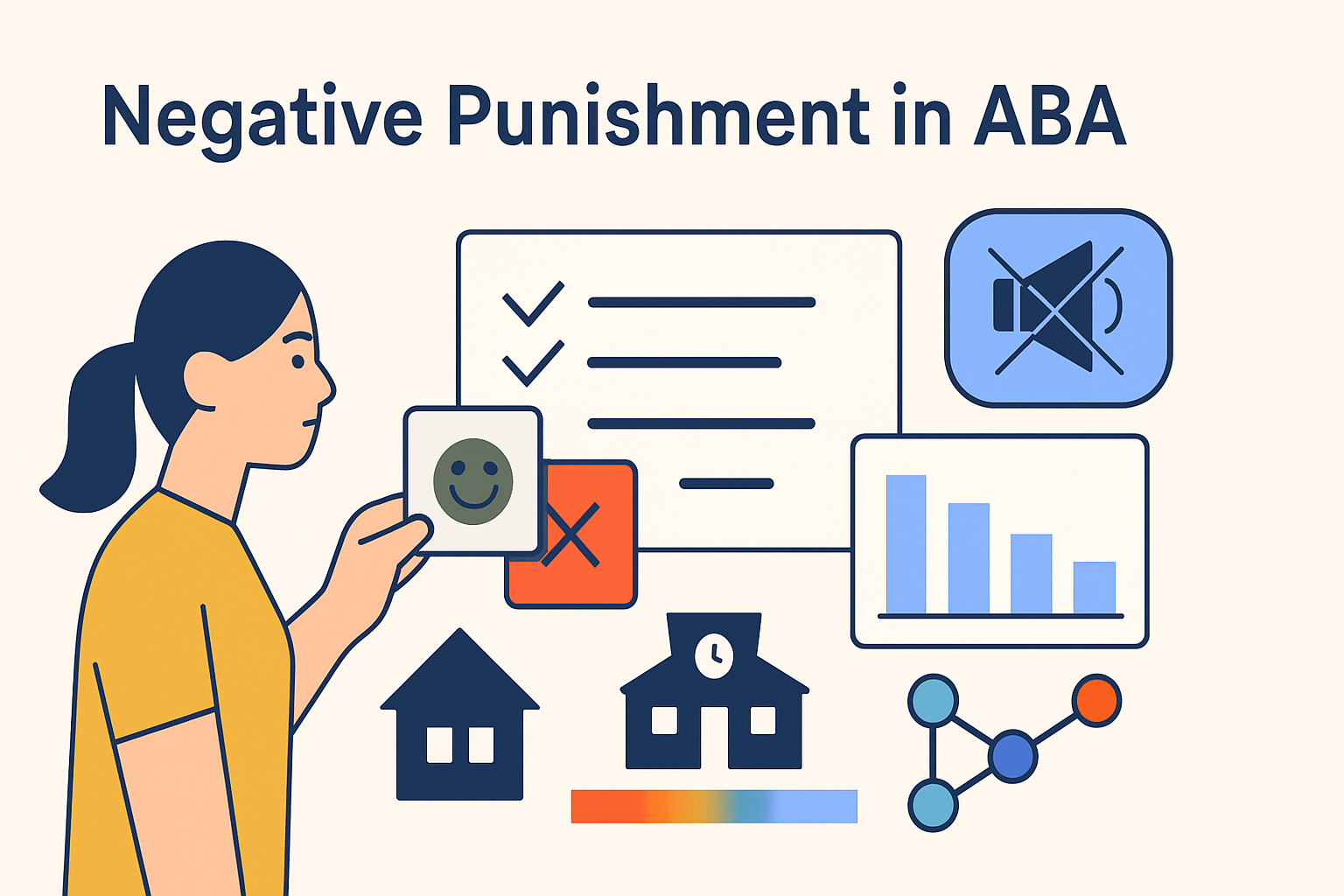
Negative punishment occurs when a stimulus is removed following a behavior, resulting in a decrease in that behavior in the future. The term ‘negative’ refers to removal, while ‘punishment’ indicates the behavioral effect of reduction.
The Core Principle: Removal of a Stimulus
The fundamental mechanism involves taking away something valuable contingent on behavior. This could be a preferred item, access to an activity, or social attention. The removal must be directly linked to the behavior and result in measurable reduction.
For the procedure to qualify as negative punishment, two conditions must be met: the stimulus removal must be contingent on the behavior, and the behavior must decrease in frequency as a result. This distinguishes it from other procedures that might involve removal without behavioral effect.
Negative Punishment vs. Other Contingencies: A BCBA Exam Must-Know
Differentiating between similar-sounding concepts is crucial for exam success. Here’s a quick comparison:
- Negative punishment: Removing a stimulus to decrease behavior
- Positive punishment: Adding an aversive stimulus to decrease behavior
- Negative reinforcement: Removing an aversive stimulus to increase behavior
- Positive reinforcement: Adding a desirable stimulus to increase behavior
The key distinction lies in whether you’re adding or removing, and whether the goal is to increase or decrease behavior. Negative punishment specifically involves removal to decrease.
Negative Punishment in Practice: ABA Examples with ABC Data
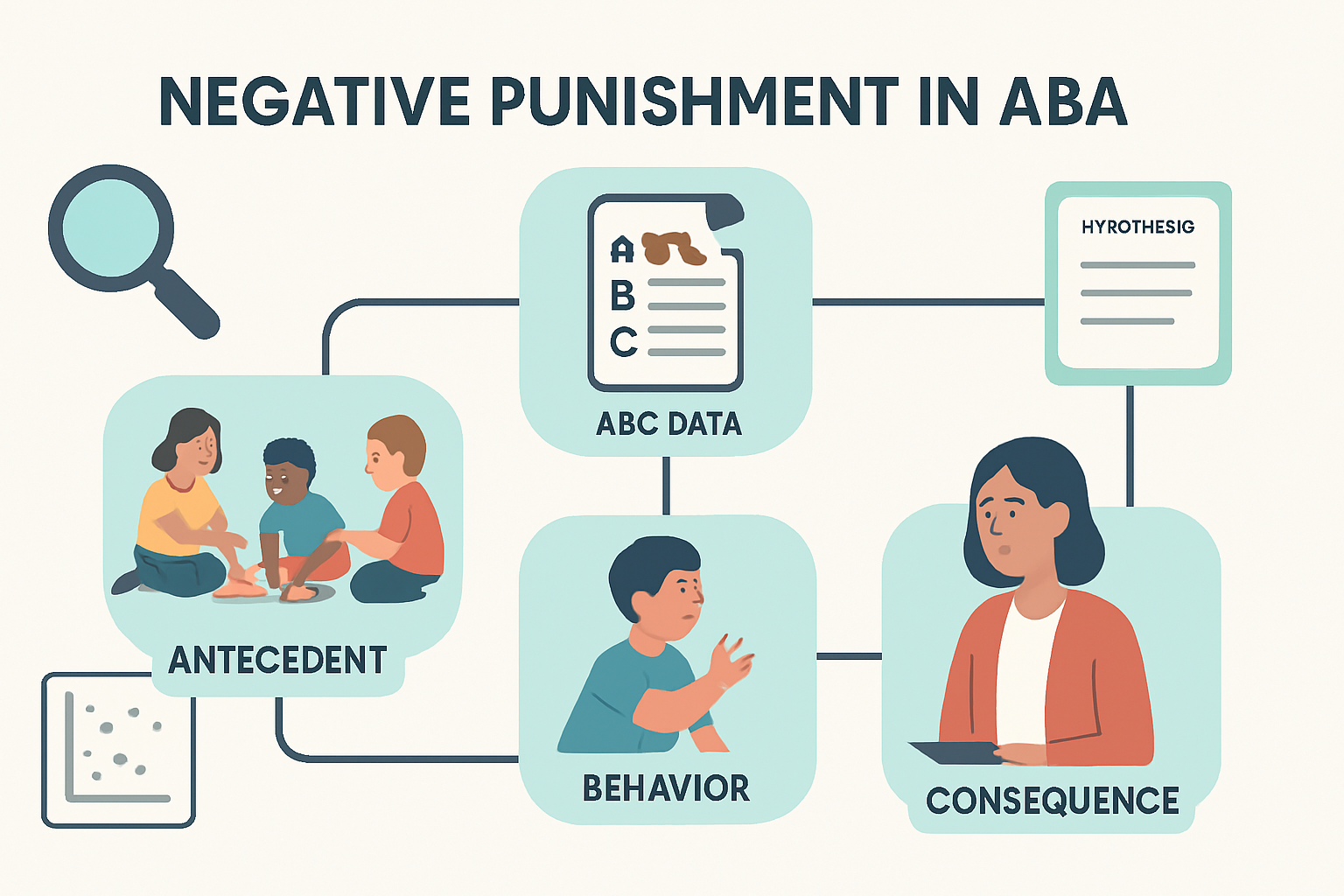
Real-world applications help solidify understanding. Each example includes Antecedent, Behavior, Consequence analysis to model clinical thinking.
Example 1: Time-Out from Positive Reinforcement
Antecedent: Child is playing a preferred board game with peers. Behavior: Child hits peer during turn-taking. Consequence: Therapist removes child from game for 2 minutes.
This represents time-out from positive reinforcement if hitting decreases. The removed stimulus is access to the fun activity. The hypothesized function is likely access to tangibles or attention.
Example 2: Response Cost in a Token Economy
Antecedent: Student has earned 5 tokens toward a preferred activity. Behavior: Student calls out answers without raising hand. Consequence: Teacher removes one token from the board.
This is response cost, where tokens function as generalized conditioned reinforcers. Removal of tokens contingent on inappropriate behavior constitutes negative punishment if calling out decreases.
Example 3: Planned Ignoring for Attention-Maintained Behavior
Antecedent: Client is working on a task with therapist attention available. Behavior: Client makes silly noises during work time. Consequence: Therapist briefly turns away and withholds attention.
This is only negative punishment if the attention-maintained behavior decreases. The removed stimulus is social attention, which must be a reinforcer for the behavior to be effective.
Ethical Application and Considerations for Practitioners
Negative punishment procedures require careful ethical consideration. The BACB Ethics Code provides specific guidance on behavior-reduction strategies.
Prioritizing Reinforcement-Based Strategies
Ethical practice requires that punishment procedures, including negative punishment, should only be implemented after reinforcement-based alternatives have been exhausted. This aligns with the principle of using the least restrictive effective intervention.
Before implementing negative punishment, consider:
- Have differential reinforcement procedures been tried?
- Is the behavior dangerous enough to warrant punishment?
- Can the behavior be addressed through antecedent interventions?
- Are there potential side effects to consider?
Informed Consent and Environmental Arrangements
Informed consent is mandatory for any behavior-reduction plan. Clients or their representatives must understand the procedure, potential risks, and alternatives. The removed stimulus must never be a basic necessity like food, water, or safety.
Environmental considerations include ensuring the removal is brief, appropriate, and doesn’t create additional problems. The client’s dignity must be maintained throughout implementation.
Negative Punishment on the BCBA® Exam: What to Expect
Exam questions often test your ability to identify and apply negative punishment concepts. Understanding common traps is key to success.
Common Exam Traps and How to Avoid Them
Watch for these frequent distractors:
- Confusing negative punishment with negative reinforcement (remember: reinforcement increases behavior)
- Misidentifying the removed stimulus (it must be a reinforcer)
- Assuming all removal procedures are punishment (must show behavior decrease)
- Overlooking the importance of behavioral effect in definition
Create a mental checklist: Is a stimulus being removed? Does the behavior decrease? Is the removal contingent on the behavior?
Sample Practice Scenario and Analysis
Scenario: During math class, a student frequently taps their pencil loudly. The teacher implements a procedure where each pencil tap results in loss of 1 minute of computer time at the end of class. Pencil tapping decreases from 20 to 2 times per session.
Analysis: This is negative punishment. The removed stimulus is computer time (a reinforcer). The behavior (pencil tapping) decreases. The removal is contingent on the behavior. For more practice with similar scenarios, check our free BCBA mock exam questions.
Quick-Reference Checklist and Summary
Use this checklist to quickly assess if a procedure qualifies as negative punishment:
- ✓ A stimulus is removed following behavior
- ✓ The removed stimulus functions as a reinforcer
- ✓ The behavior decreases in future occurrences
- ✓ The removal is contingent on the behavior
- ✓ Ethical considerations have been addressed
- ✓ Reinforcement alternatives were considered first
Negative punishment remains a valuable tool when used ethically and appropriately. Remember that the key to mastery is understanding both the technical definition and practical application. For further study on related concepts, explore our guide on positive vs negative punishment to strengthen your comparative analysis skills.
Always consult the BACB Ethics Code for current guidelines on punishment procedures and stay updated with the latest research through peer-reviewed journals like the Journal of Applied Behavior Analysis.