

Interresponse Time ABA: What is Interresponse Time (IRT) in ABA?
Interresponse Time (IRT) is a fundamental dimensional quantity in applied behavior analysis that measures the elapsed time between two consecutive instances of the same behavior. Unlike other temporal measures, IRT specifically captures the time between responses, providing crucial information about response patterns and potential maintaining variables.
Table of Contents
- Interresponse Time ABA: What is Interresponse Time (IRT) in ABA?
- Applying IRT: Worked Examples from ABA Practice
- IRT on the BCBA Exam: Relevance and Common Traps
- Quick Checklist for Mastering IRT
- Summary and Key Takeaways
This measurement helps behavior analysts understand how behaviors are distributed over time, which can reveal important information about reinforcement schedules, satiation, and behavioral momentum.
The Formal Definition and Formula
The formal definition of IRT is straightforward: it’s the time interval that elapses between the end of one response and the beginning of the next identical response. To calculate IRT, you simply subtract the time of Response A from the time of Response B.
For example, if a child engages in hand flapping at 10:05:15 and again at 10:05:45, the IRT would be 30 seconds. This simple calculation provides valuable data about response patterns and potential behavioral functions.
IRT vs. Latency vs. Duration: Keeping Them Straight
Understanding the differences between these three temporal measures is essential for accurate data collection and analysis on the BCBA exam:
- Interresponse Time (IRT): Measures time between responses of the same behavior
- Latency: Measures time from stimulus presentation to the onset of a response
- Duration: Measures how long a single response lasts from start to finish
A simple analogy: Think of IRT as the time between phone calls, latency as how long it takes you to answer a ringing phone, and duration as how long you stay on the call.
Applying IRT: Worked Examples from ABA Practice
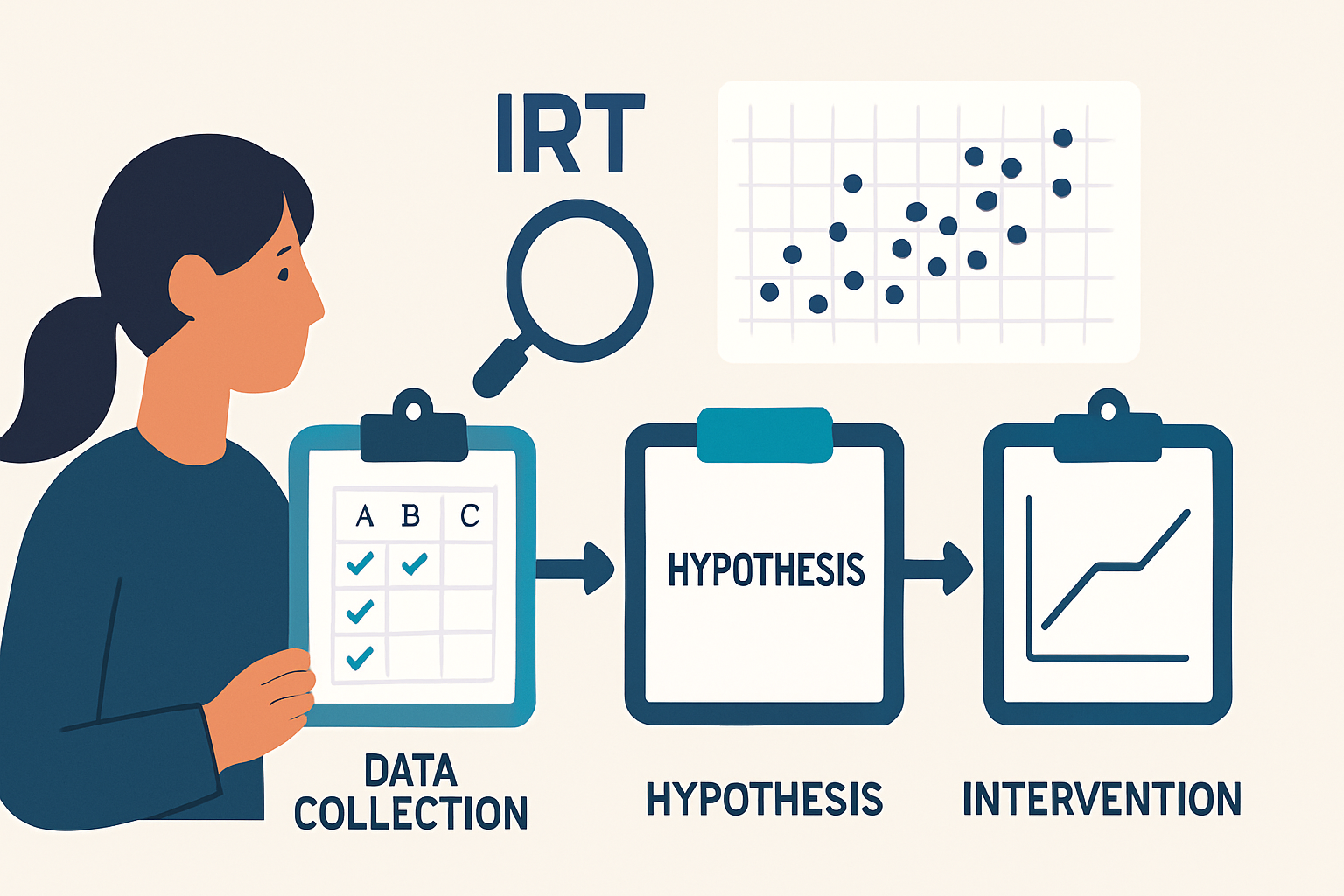
Practical application of IRT reveals its true value in behavior analysis. By examining IRT patterns, analysts can develop hypotheses about behavioral functions and design more effective interventions.
These examples demonstrate how IRT data informs clinical decision-making and intervention planning in real-world scenarios.
Example 1: Hand Flapping and Potential Automatic Reinforcement
Consider a client who engages in hand flapping during independent work time. ABC data shows the following sequence:
- Hand flap at 9:00:00 (no apparent antecedent)
- Hand flap at 9:00:15 (IRT = 15 seconds)
- Hand flap at 9:00:30 (IRT = 15 seconds)
- Hand flap at 9:00:45 (IRT = 15 seconds)
The consistent, short IRT of 15 seconds suggests a stable response pattern that may be maintained by automatic reinforcement. This pattern could indicate the behavior serves a sensory regulation function, leading to hypotheses about sensory needs and potential replacement behaviors.
Example 2: Task Requests and Escape-Maintained Behavior
During a work session, a client requests breaks with the following timing:
- Break request at 10:00:00 (after task presentation)
- Break request at 10:00:45 (IRT = 45 seconds)
- Break request at 10:01:15 (IRT = 30 seconds)
- Break request at 10:01:30 (IRT = 15 seconds)
The progressively shorter IRT pattern suggests increasing aversion to the work task. This data supports an escape function hypothesis and could inform intervention strategies like scheduled breaks or teaching tolerance skills.
IRT on the BCBA Exam: Relevance and Common Traps
Understanding IRT is essential for BCBA exam success, as questions frequently test your ability to identify, differentiate, and interpret this measurement. Mastery requires both conceptual understanding and practical application skills.
The exam often presents scenarios where you must select the appropriate measurement system or interpret data patterns to make clinical decisions.
How the BCBA Exam Tests Your Understanding of IRT
Exam questions typically assess IRT knowledge in three main ways:
- Identifying IRT from descriptive data narratives or scenarios
- Differentiating IRT from other temporal measures like latency or duration
- Interpreting what changing IRT trends imply about behavioral function or reinforcement effectiveness
Questions may ask you to select the most appropriate measurement system for a given target behavior or interpret graphed data showing IRT patterns over time.
Frequent Mistakes and How to Avoid Them
Common errors on IRT-related questions include:
- Confusing IRT with duration measurement (measuring the response itself rather than time between responses)
- Attempting to calculate IRT for the first response in a session (requires a prior response)
- Forgetting that IRT is a temporal measure rather than a count or rate measure
- Misapplying IRT to behaviors that don’t have discrete beginnings and endings
A helpful mnemonic: “IRT = Interval Between Responses, Time-wise” to remember it measures time between behaviors.
Quick Checklist for Mastering IRT
Use this checklist to ensure you’ve mastered all aspects of IRT for your BCBA preparation:
- Define IRT accurately as time between consecutive responses
- Differentiate IRT from latency and duration with clear examples
- Calculate IRT from provided time-stamped data
- Interpret IRT patterns to hypothesize behavioral function
- Identify appropriate scenarios for IRT measurement
- Recognize common exam traps and how to avoid them
- Connect IRT data to intervention planning decisions
Practice applying this checklist to sample exam questions to build confidence and accuracy.
Summary and Key Takeaways
Interresponse Time is a powerful measurement tool in applied behavior analysis that provides unique insights into behavioral patterns. By measuring the time between responses, analysts can identify patterns that suggest specific behavioral functions and inform intervention strategies.
Key points to remember include IRT’s role as a dimensional quantity, its distinction from other temporal measures, and its practical applications in both clinical practice and exam scenarios. Understanding IRT patterns can reveal important information about reinforcement schedules, behavioral momentum, and potential maintaining variables.
For comprehensive BCBA exam preparation, consider exploring our guide on data collection methods in ABA and the four functions of behavior. These resources provide essential context for understanding how IRT fits into broader assessment and intervention frameworks. For authoritative information on measurement standards, refer to the Behavior Analyst Certification Board resources on measurement and data analysis.


