
What Is Interval Recording?
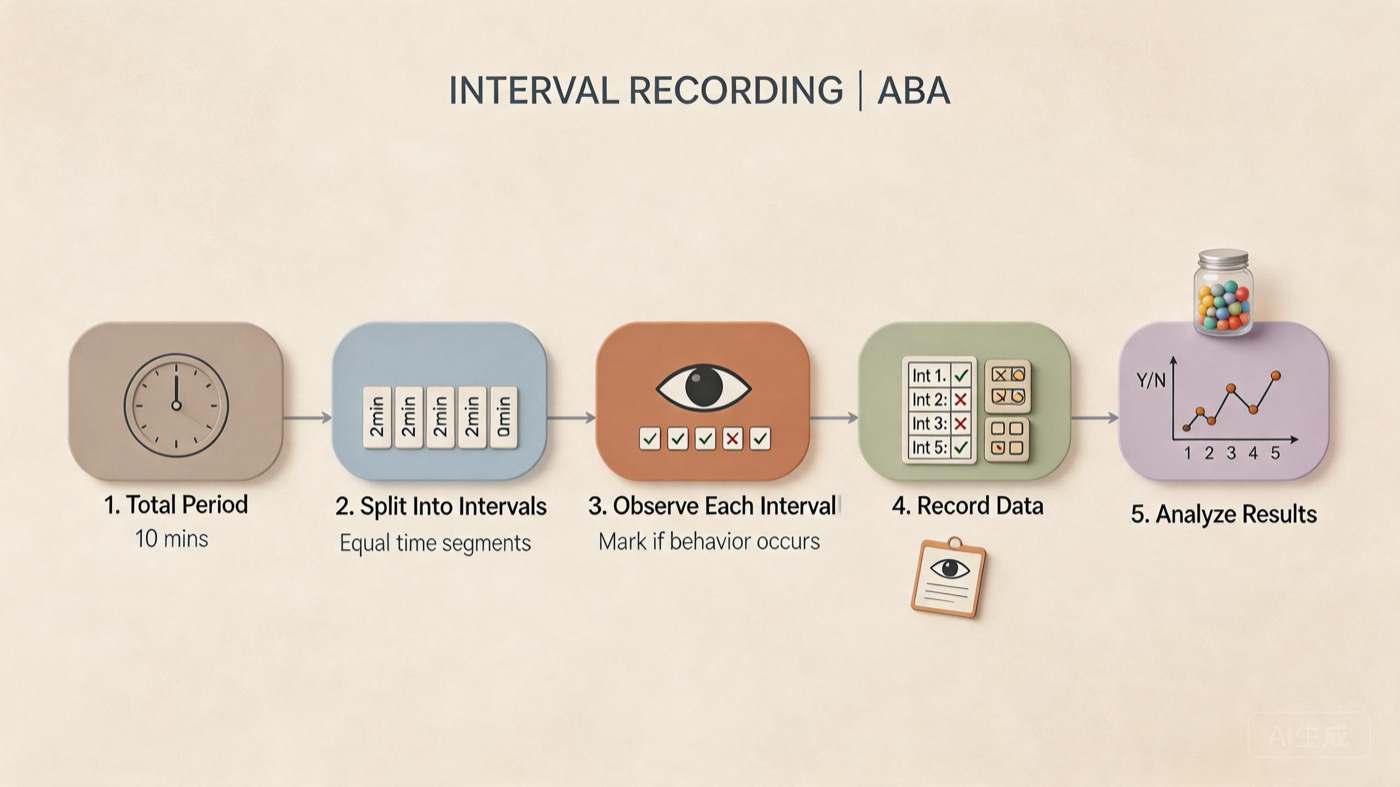
Interval recording is a method of data collection in applied behavior analysis (ABA) where an observation period is divided into equal time intervals. The observer records whether a behavior occurs during each interval, but does not measure the exact frequency or duration. This technique is efficient for behaviors that are too frequent or continuous to count in real time.
Practice this concept
After reviewing measurement procedures, practice with exam-style BCBA measurement questions.
Table of Contents
- What Is Interval Recording?
- Three Methods of Interval Recording
- Real-World ABA Examples of Interval Recording
- Exam Relevance: How to Ace Interval Recording Questions
- Quick Reference Checklist for Interval Recording
Key Components of Interval Recording
- Observation period is divided into equal intervals (e.g., 30 seconds, 1 minute).
- At the end of each interval, the observer records occurrence or non-occurrence of the target behavior.
- Data are reported as the percentage of intervals in which the behavior occurred (e.g., 80% of intervals).
How It Differs from Continuous Recording
Unlike frequency recording (counting every instance) or duration recording (tracking total time), interval recording sacrifices fine-grained accuracy for practicality. It is particularly useful when behaviors have no clear start and end or occur at high rates.
Three Methods of Interval Recording
There are three main types of interval recording, each with distinct rules and applications. Choosing the right one depends on the nature of the behavior and the goal of measurement.
Partial Interval Recording
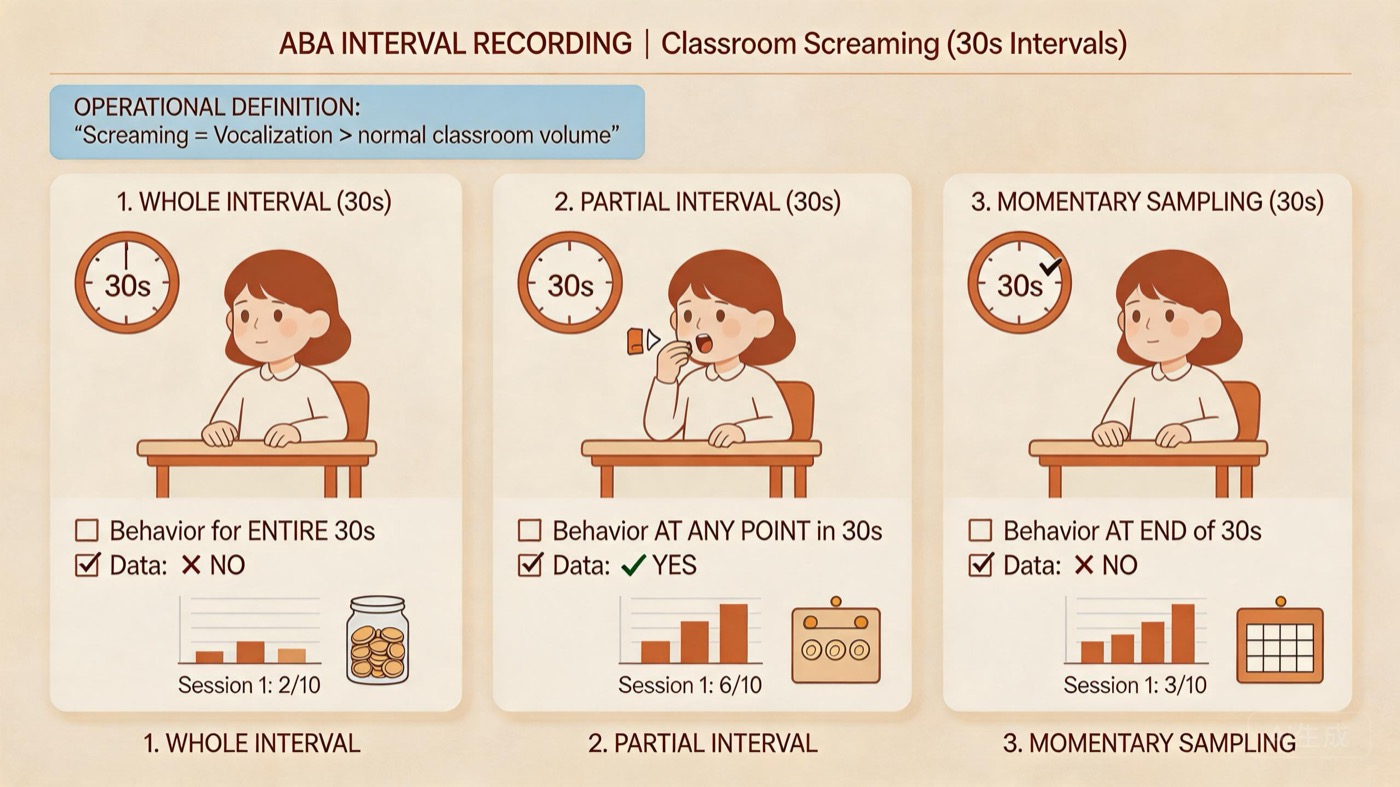
The behavior is recorded if it occurs at any time during the interval, even for a fraction of a second. This method tends to overestimate the behavior because one brief instance counts as an occurrence. It is best for behaviors that occur frequently or continuously, such as nail-biting or vocal tics.
When to use: Behaviors you want to decrease; the overestimation makes the target behavior appear more frequent, highlighting the need for intervention.
Whole Interval Recording
The behavior is recorded only if it occurs throughout the entire interval. If the behavior stops for any moment, the interval is marked non-occurrence. This method tends to underestimate the behavior. It is ideal for behaviors with a clear onset and offset, such as staying seated or on-task behavior.
When to use: Behaviors you want to increase; underestimation provides a conservative measure of progress.
Momentary Time Sampling (MTS)
The behavior is recorded only if it is occurring at the exact end of the interval (the moment of observation). This method is very efficient and less sensitive to duration or frequency. It is suitable for high-rate behaviors or when you need to collect data on multiple behaviors simultaneously.
When to use: Behaviors that are continuous or when real-time recording is impractical.
Real-World ABA Examples of Interval Recording
Applying these methods in practice clarifies their differences. Below are three examples with ABC data and hypothesized functions.
Example 1: Partial Interval Recording for Tantrums
Setting: Classroom. Behavior: Screaming (operationalized as vocalizations above conversational level). Interval: 30 seconds. Data show screaming occurred in 8 out of 10 intervals. ABC: Demand presented (antecedent), screaming (behavior), escape from task (consequence). Hypothesized function: Escape from demands.
Example 2: Whole Interval Recording for On-Task Behavior
Setting: Therapy room. Behavior: Working independently (eyes on materials, writing, or manipulation). Interval: 1 minute. Data show on-task behavior in 4 out of 6 intervals. ABC: Task instruction (antecedent), on-task behavior (behavior), teacher praise (consequence). Hypothesized function: Access to attention.
Example 3: Momentary Time Sampling for Stereotypy
Setting: Home. Behavior: Hand flapping. Interval: 30 seconds. At the end of each interval, hand flapping was observed in 3 out of 10 intervals. ABC: No demands present (antecedent), hand flapping (behavior), automatic sensory feedback (consequence). Hypothesized function: Automatic (sensory) reinforcement.
Exam Relevance: How to Ace Interval Recording Questions
The BCBA exam frequently tests your understanding of interval recording methods and their biases. You can expect scenarios where you must select the appropriate method or interpret data accurately.
Common Exam Traps
Watch out for these pitfalls:
- Confusing partial and whole interval recording — remember: partial overestimates, whole underestimates.
- Forgetting to operationalize the behavior before choosing a method.
- Misreading the behavior description — e.g., choosing whole interval for a behavior that starts and stops quickly.
- Ignoring the function — the method should align with whether you want to increase or decrease the behavior.
Practice Questions to Test Yourself
- Which interval recording method overestimates a behavior? Answer: Partial interval recording, because any occurrence during the interval counts as an occurrence.
- You want to measure a child’s on-task behavior during a 20-minute reading task. Which method is most appropriate? Answer: Whole interval recording, because on-task behavior is a continuous behavior you want to increase.
- A behavior occurs at high rates throughout the day, and you cannot track every instance. Your best option is: Answer: Momentary time sampling, which allows efficient sampling with minimal observer fatigue.
For more exam strategies, check out our BCBA test question strategies guide.
Quick Reference Checklist for Interval Recording
- Define the target behavior clearly before selecting a method.
- Choose partial interval for behaviors you want to decrease (overestimates).
- Choose whole interval for behaviors you want to increase (underestimates).
- Use momentary time sampling when real-time recording is not feasible.
- Always consider the function of the behavior to inform intervention decisions.
Review the functional behavior assessment process to integrate interval recording into a comprehensive FBA. For external reading, see the BACB’s guidelines on measurement in behavior analysis (BACB website).
Mastering interval recording is essential for accurate data collection and effective intervention design. By understanding the three methods and their biases, you will be well-prepared for both the BCBA exam and real-world practice.
Complete BCBA Exam Prep
Turn this topic into exam-day practice
Practice concepts in context with five full-length 6th Edition mock exams, two bonus practice exams, a 6th Edition study guide, and key-term flashcards—all in one $120 USD package.
Get the $120 All-in-One Prep Pack
Review everything included on the product page before ordering. No pass guarantee is implied.



