
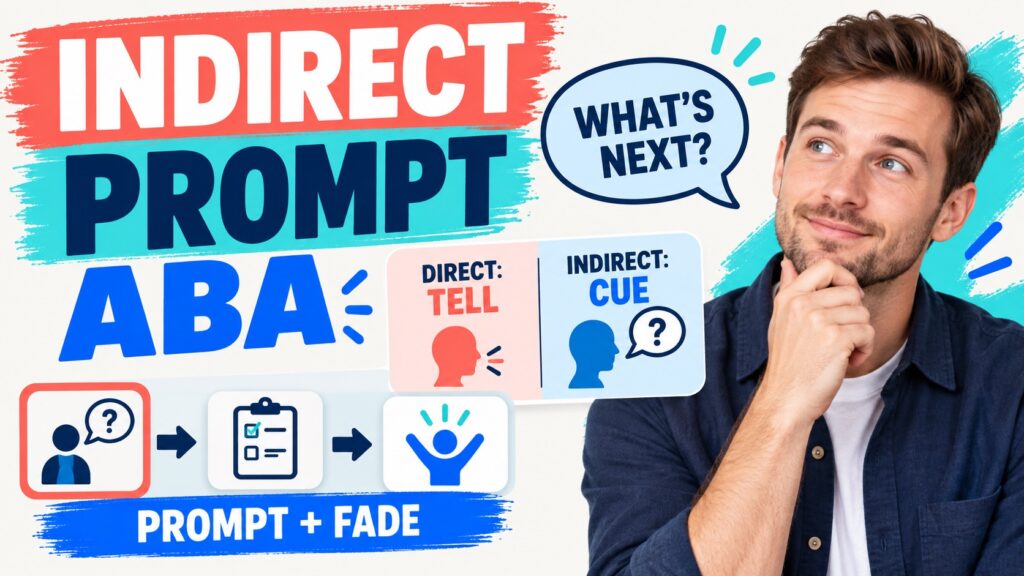
What is an indirect prompt in ABA? An indirect prompt is a verbal cue that signals a response is expected without stating the response in full. Questions such as “What comes next?” or “What do you need?” can guide a learner toward a task step while leaving room for an independent response. The prompt supplies less information than a direct verbal instruction, but it is still an added antecedent that should be planned, measured, and faded.
Table of Contents
- What is an indirect prompt in ABA?
- How is an indirect verbal prompt different from a direct prompt?
- Where does an indirect prompt fit in a prompt hierarchy?
- When should an indirect prompt be used?
- What does an indirect prompt look like in a teaching sequence?
- How are indirect prompts faded?
- What are the BCBA exam traps?
- Indirect prompt ABA FAQ
- Quick Review Checklist
- Take the Free BCBA Mock Exam
Indirect prompts are easy to confuse with hints, instructions, questions, or natural cues. The wording alone does not decide the category. The important question is whether the cue is an extra stimulus delivered to increase the probability of the target response, and whether the learner would respond without it. This guide explains indirect prompt ABA definitions, direct-versus-indirect examples, prompt hierarchy decisions, fading, and common BCBA exam traps. Table of Contents
What is an indirect prompt in ABA?
An indirect prompt is an additional verbal stimulus that cues a learner about an expected response but does not explicitly tell the learner exactly what to do or say. For example, during a hand-washing routine, “What is the next step?” may cue the learner to turn on the water. During a communication lesson, “What could you ask for?” may encourage a mand without modeling the exact word or selecting the response for the learner.
The Autism Center for Excellence describes an indirect verbal prompt as a cue that something is expected while providing little information about the exact response. A task-analysis resource from Utah State University’s Institute for Disability Research, Policy & Practice gives examples such as “What do you need to do now?” and “What is next?” The shared feature is not politeness or question punctuation; it is the prompt’s functional role in evoking a response.
In a BCBA exam scenario, first identify the natural discriminative stimulus (SD), the target response, and the extra cue. If the learner responds only after an added verbal cue, that cue may be functioning as a prompt. If the cue gives the full answer, it is more direct. If the cue is already part of the natural task arrangement and is available to everyone in the same way, it may be the SD or an environmental support rather than a prompt. Context and response history matter.
- It is verbal. The prompt is delivered through spoken or written language rather than a gesture, model, or physical guidance.
- It is indirect. It signals or hints at the expected response without fully specifying the response.
- It is supplementary. It is added to help the learner respond to the relevant task cue.
- It should be temporary. The objective is transfer of stimulus control to the natural SD, not permanent dependence on the adult’s words.
How is an indirect verbal prompt different from a direct prompt?
A direct verbal prompt states the action or response more explicitly. If a learner is learning to put a book on a shelf, “Put the book on the shelf” is a direct verbal prompt. “What do you do with the book?” is an indirect verbal prompt because it cues the learner to respond without naming the complete action. Neither type is automatically better. The correct choice depends on the learner’s current skill, the goal of the teaching arrangement, and the prompt-fading plan.
| Cue | Example | What it provides | Exam question to ask |
|---|---|---|---|
| Natural SD | A sink, soap, and the start of the hand-washing routine are available. | The task context in which the skill should eventually occur. | Would the learner respond without the added adult cue? |
| Indirect verbal prompt | “What is the next step?” | A hint that a response is expected, without stating the full response. | Does the cue leave the learner to select or produce the response? |
| Direct verbal prompt | “Turn on the water.” | A clearer instruction that specifies the expected action. | Does the cue tell the learner what response to make? |
| Model prompt | The instructor demonstrates turning on the water. | A demonstration of the response topography. | Is the added cue spoken, or is the response being shown? |
Where does an indirect prompt fit in a prompt hierarchy?
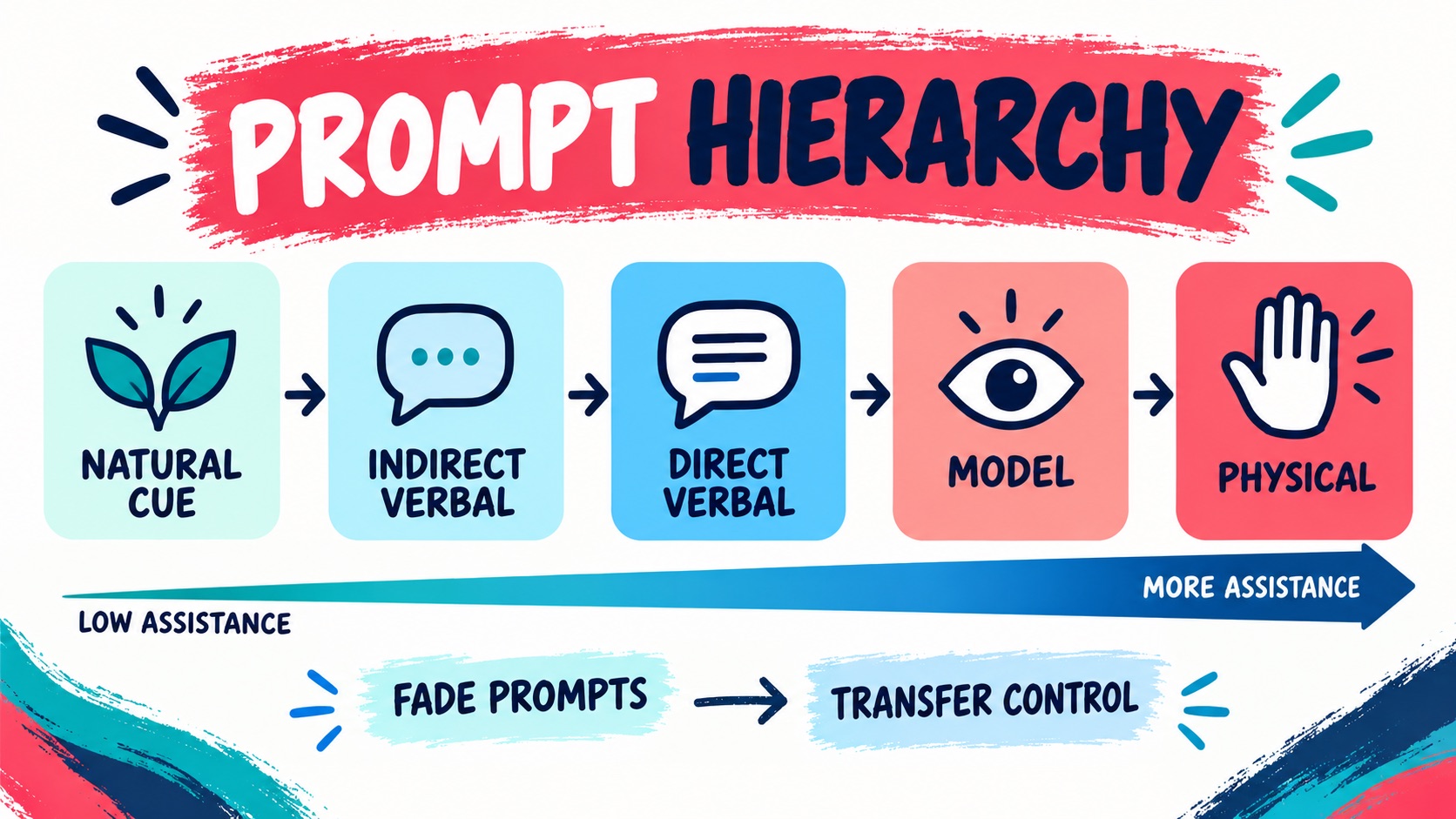
An indirect verbal prompt is often placed before a direct verbal prompt in a least-to-most sequence. A typical sequence may begin with an opportunity for an independent response, then use a gesture, an indirect verbal cue, a direct verbal cue, a model, and physical assistance. The exact order is not universal. The sequence should be defined before teaching, and the clinician should know what happens after no response, an incorrect response, or a prompt-dependent response.
The University of Nevada, Reno provides an example in which a learner first receives an opportunity to respond, then a gesture, an indirect verbal prompt, a direct verbal prompt, a model, and progressively more physical assistance. The page also emphasizes that a prompt hierarchy should be used to support independence, not to fill every pause with adult language.
For exam reasoning, separate the hierarchy from the prompting procedure. “Least-to-most” describes an arrangement in which more intrusive help is delivered only if less intrusive help does not produce the target response. “Most-to-least” begins with a controlling prompt and systematically reduces assistance. An indirect prompt can appear in either approach; its presence does not by itself identify the hierarchy.
When should an indirect prompt be used?
An indirect prompt may be useful when the learner has the component skill but needs a small cue to initiate or organize the response. It can preserve an opportunity for the learner to retrieve the answer rather than immediately hearing the answer from the instructor. It may also fit a least-to-most sequence when the team wants to offer a low-information cue before a more explicit prompt.
Before using it, ask whether the learner understands the language, can discriminate the natural cue, and has enough response time. An indirect question that is too vague may not help. A question that is repeated rapidly may become an aversive or distracting event. A learner who does not yet have the skill may need instruction, modeling, or a more controlling prompt rather than a series of increasingly frustrated hints.
- Define the target response. Specify what counts as correct, including the relevant form, quality, and completion criterion.
- Identify the natural cue. State what should eventually evoke the response without the instructor’s added prompt.
- Choose one clear indirect cue. Avoid changing the wording from trial to trial unless variation is part of the plan.
- Allow a planned response interval. Give the learner a reasonable opportunity before escalating the prompt.
- Record the prompt level and outcome. Track independent, indirect, direct, model, and physical responses when those distinctions matter.
- Plan the fade before starting. Decide how the cue will be delayed, shortened, made less salient, or removed.
What does an indirect prompt look like in a teaching sequence?
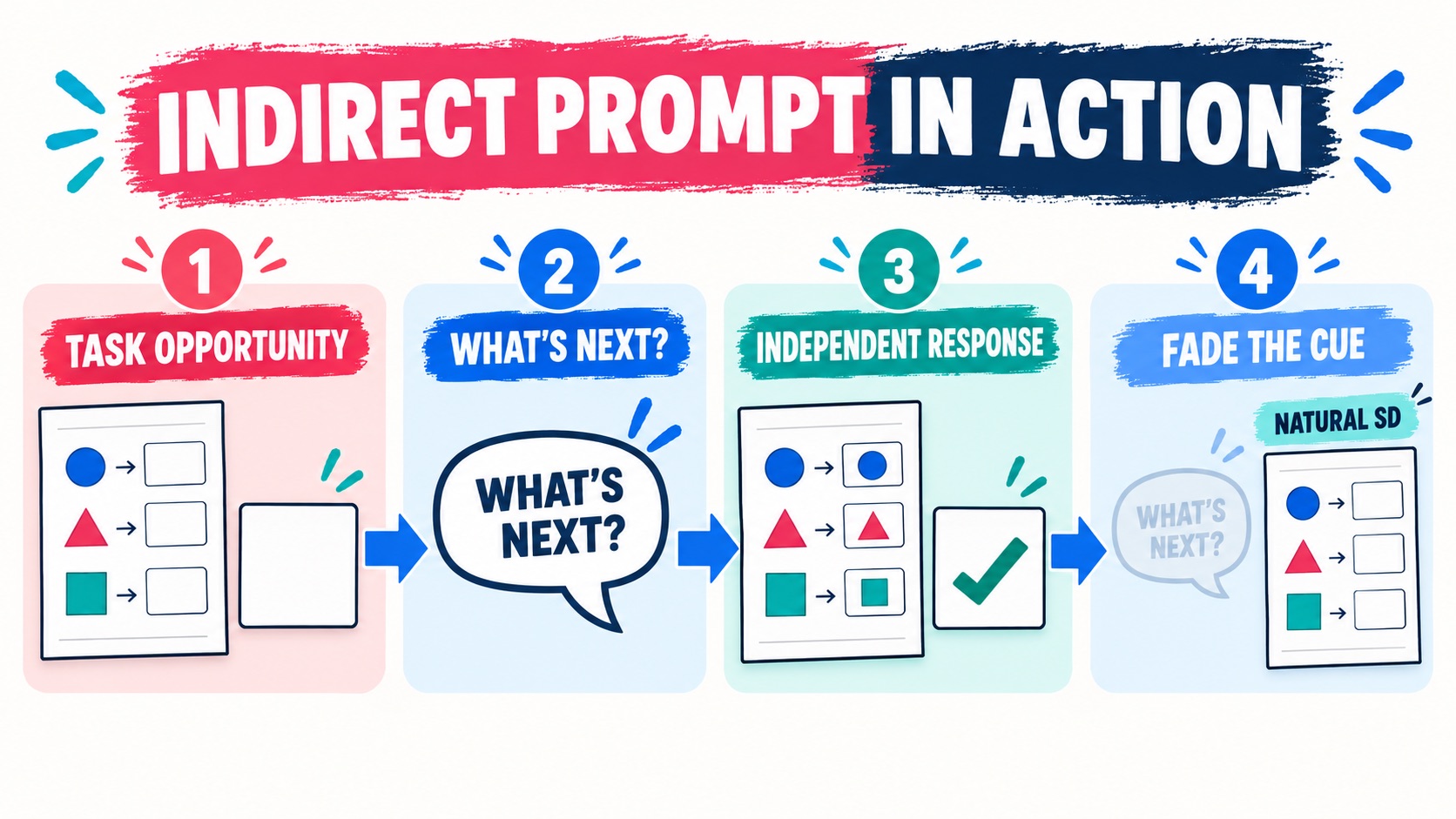
Suppose a learner is practicing how to request help during a difficult worksheet. The natural opportunity is a challenging task and access to a communication response. The target response might be handing over a help card or saying “help.” If the learner pauses, the instructor might first wait, then gesture toward the communication card, then ask “What do you need?” That question is indirect if it cues communication without modeling “help” or physically selecting the card.
If the learner still does not respond, a direct verbal prompt such as “Say help” or a model of the communication response may follow, depending on the written teaching plan. After the response, the programmed consequence should occur as planned. The important analysis is not simply whether the instructor used a question. It is whether the sequence creates a clear opportunity, supports the correct response, and eventually transfers control to the task or motivating condition.
How are indirect prompts faded?
Prompt fading is the systematic removal or reduction of an added cue so that the natural SD controls the response. The review of response prompting and fading methods indexed in PubMed describes the instructional goal as responding to natural stimuli rather than continuing to rely on response prompts. The BACB 6th Edition Test Content Outline specifically includes selecting stimulus and response prompting procedures and designing procedures to fade them.
Possible fading decisions include waiting longer before delivering the cue, reducing the number of words, moving from a direct prompt to an indirect cue, changing a verbal cue into a less salient support, or removing the cue after stable independent responding. The method must match the prompt type. A stimulus-fading procedure changes a feature of the stimulus; it is not automatically the same as fading an indirect verbal prompt.
- Measure independence, not just correct responses. A correct response after a prompt is different from an unprompted correct response.
- Watch for prompt dependency. If the learner waits for “What is next?” before acting, the prompt may have acquired too much control.
- Check generalization. Test the skill with different people, materials, settings, and natural cues when those changes are part of the goal.
- Review learner experience. A technically correct prompt can still be poorly designed if it creates confusion, unnecessary repetition, or avoidable burden.
What are the BCBA exam traps?
The most common trap is treating every question as a prompt or assuming that indirect always means least intrusive. Look for the functional relation among the cue, the response, and the natural SD. The BACB TCO places prompting alongside stimulus control, discrimination, instructions, modeling, and prompt fading, so a strong answer often requires identifying both the prompt type and the transfer-of-control problem.
- Question punctuation is not the definition. A question can be a natural instruction, an assessment question, or an indirect prompt depending on its role and timing.
- Indirect is not the same as noncontingent. A cue can be delivered after a missed response and still function as a response prompt.
- Less information is not always less intrusive. A vague prompt may require more repeated assistance and create more frustration than a well-designed direct prompt.
- Prompted accuracy is not independent mastery. Examine prompt level, latency, and transfer to the natural cue.
- Do not confuse response and stimulus prompts. Verbal directions, models, and physical guidance affect the response; changing a feature of the SD is a stimulus-prompt issue.
For additional unofficial BCBA study practice, use the free BCBA mock exam as a way to test whether you can distinguish a prompt’s form from its function. It is practice support, not an official BACB product, a guarantee of exam performance, or individualized clinical guidance.
Indirect prompt ABA FAQ
Is “What’s next?” an indirect prompt?: It can be. If the question is added after the learner does not respond and is intended to cue the next task step without stating it, it is commonly classified as an indirect verbal prompt. The same words may serve a different role in another context, so analyze timing and function.
Is an indirect prompt the same as a hint?: In everyday language, the terms can overlap. In an ABA teaching plan, “indirect verbal prompt” should be defined operationally so the team knows what wording, timing, and response opportunity count as that prompt level.
Should indirect prompts always come before direct prompts?: No. They often appear before direct prompts in a least-to-most sequence, but the correct arrangement depends on the learner, target, errorless-learning goals, prompt intrusiveness, and fading plan. The BACB exam does not support one universal hierarchy for every learner.
What is the key exam takeaway?: An indirect prompt is an added verbal cue that hints at an expected response without giving the full response. Classify it by its function, distinguish it from direct and stimulus prompts, and evaluate whether it is being faded so the natural SD controls responding.
In short, indirect prompt ABA questions are testing more than vocabulary. The best answer connects prompt form, learner response, natural stimulus control, individualized teaching, data collection, and systematic fading. That is the difference between naming a prompt and reasoning like a BCBA candidate.
Quick Review Checklist
Use this final checklist to turn indirect prompt aba into exam-ready reasoning. The goal is not to memorize a label in isolation; it is to identify the relevant evidence and explain why the best answer fits the scenario. Key ideas to review:
- State the central definition or decision point for indirect prompt aba in your own words.
- Identify the detail that makes indirect prompt aba different from its closest related ABA term.
- Separate the observable facts in a scenario from assumptions that are not supported by the facts.
- Write one example and one nonexample so you can recognize the concept in a new setting.
Exam application checks:
- Ask what the question is actually requesting before comparing the answer choices.
- Mark the antecedent, response, consequence, or other evidence that supports the selected answer.
- Look for a distractor that describes a related process but does not answer the specific question.
Final self-check:
- Explain how you would verify the interpretation with clear observations or data.
- Change one detail in the scenario and decide whether your answer should change.
- Give a one-sentence rationale that a supervisor or study partner could evaluate.
Take the Free BCBA Mock Exam
When you are ready to apply the idea, use the free practice resource below for additional feedback. Take the Free BCBA Mock Exam



