
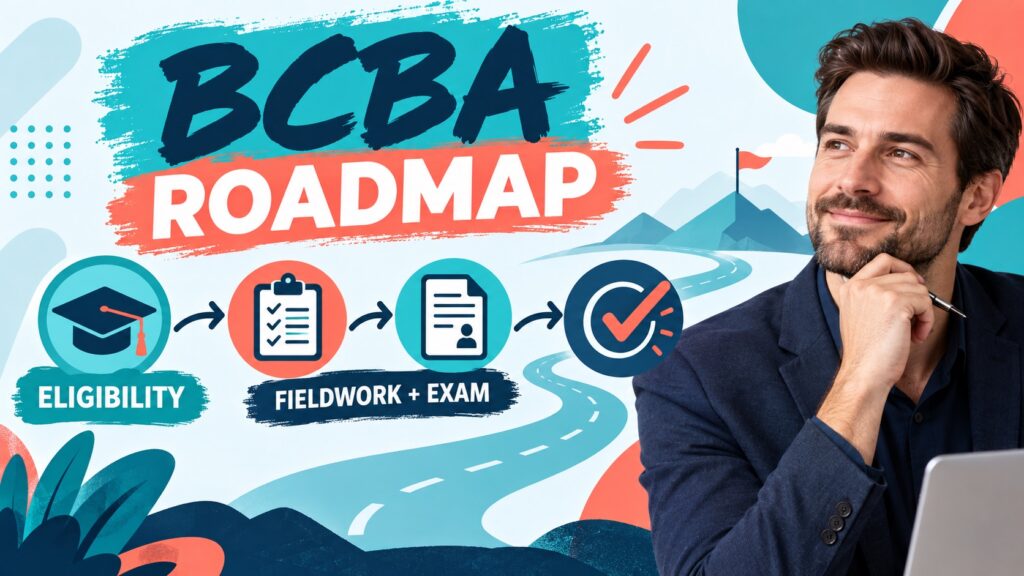
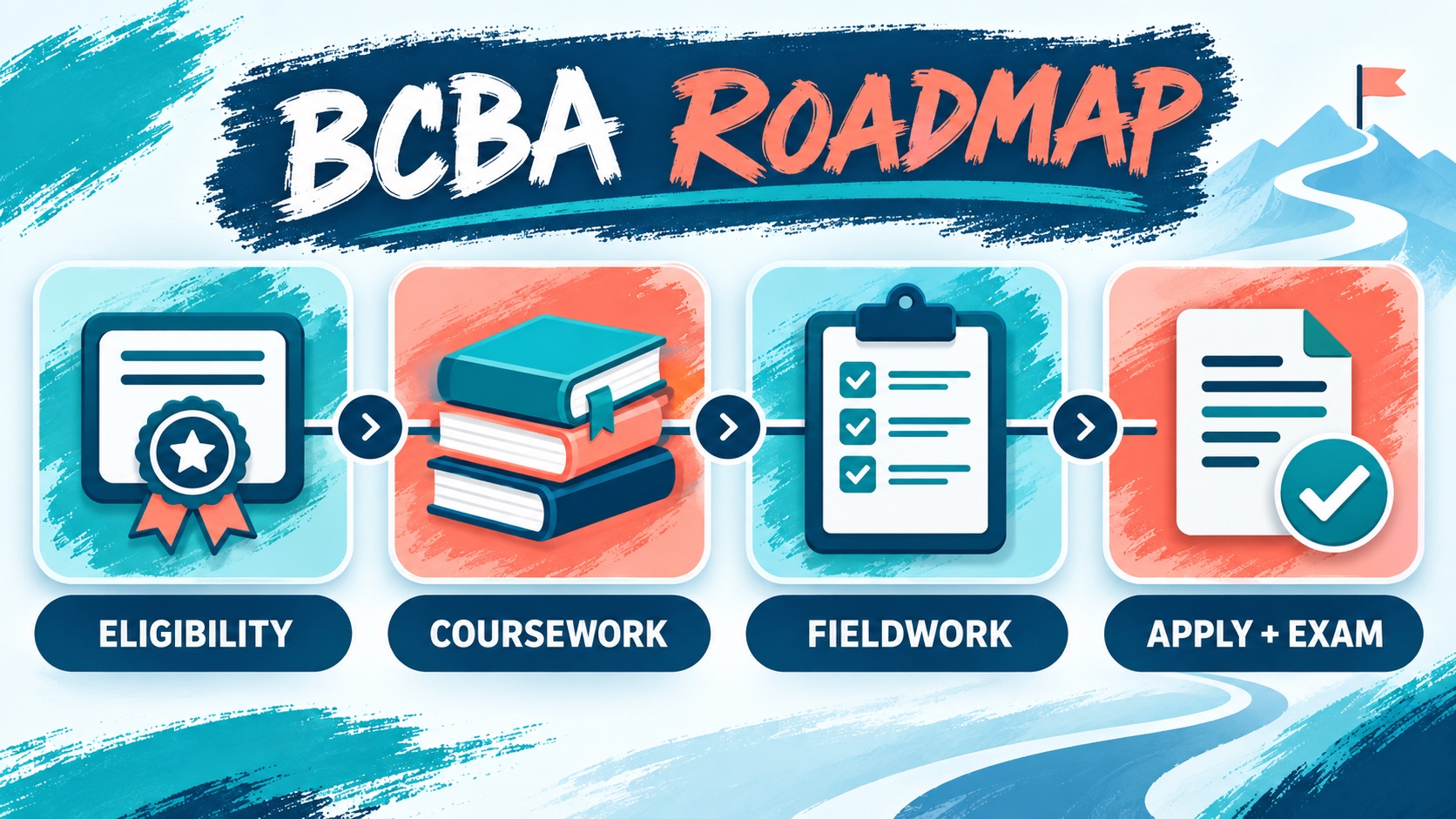
If you want to know how to obtain BCBA certification, use a sequence instead of a single checklist: choose the applicable BACB eligibility pathway, complete the degree and behavior-analytic content, document supervised fieldwork, submit a complete application, pass the BCBA examination, and maintain the certification after approval.
Table of Contents
- What Is The Shortest Accurate Path To BCBA Certification?
- Which Eligibility Pathway Applies To Me?
- What Degree And Coursework Evidence Do I Need?
- How Should I Document Supervised Fieldwork?
- What Belongs In The BACB Application Packet?
- What Happens After BACB Review?
- Where Is My Current Bottleneck?
- What Changes In 2027?
- How Do I Maintain Certification?
- Which Mistakes Slow The Process?
- How To Obtain BCBA Certification FAQ
- What Should I Do Today?
- Take the Free BCBA Mock Exam
The Behavior Analyst Certification Board (BACB) is the source of the credential requirements. A university website, supervisor, prep course, or employer can help you interpret your plan, but it cannot replace the current BCBA Handbook. The handbook version and the date you apply matter, especially during the transition to requirements that begin January 1, 2027.
This roadmap is designed to answer the practical question behind the search: “What should I do next?” It separates eligibility from application processing and exam preparation, so you can find the actual bottleneck before paying for another resource. Table of Contents
What Is The Shortest Accurate Path To BCBA Certification?
The accurate path is:
- Read the current BCBA Handbook and identify the eligibility pathway you can document.
- Complete the qualifying graduate degree and behavior-analytic coursework or accredited/recognized program requirement for that pathway.
- Complete supervised fieldwork under the current BACB rules and keep the monthly and final verification records.
- Submit the paid application, official transcripts, attestations, fieldwork forms, and other required documents through your BACB portal account.
- Respond to any action item, wait for the application decision, receive authorization, schedule the exam, and pass it.
- Follow the maintenance, continuing-education, ethics, and renewal requirements after certification.
“Shortest” does not mean skipping a requirement. It means finding the correct pathway early and preventing rework. A candidate who starts with a mock exam before confirming coursework or fieldwork may learn useful content while still being unable to submit an eligible application.
Which Eligibility Pathway Applies To Me?
Start with the handbook’s eligibility section rather than choosing a pathway based on a social-media summary. In the current 2022 requirements, the BACB describes several eligibility routes, including a qualifying graduate degree plus behavior-analytic coursework and other routes tied to accredited education or faculty/research experience. The evidence is different for each route. The first question is not “Which course should I buy?” It is “What can I prove?” Make a one-page eligibility inventory:
- Degree title, institution, conferral date, and whether the institution is acceptable under the handbook.
- Behavior-analytic course titles, academic credits, grades, content areas, and the person or program contact who can verify the pathway.
- Fieldwork type, supervisor status, dates, hours, supervision percentage, observations, and unrestricted activities.
- Any nonstandard education, international degree, faculty appointment, or transition detail that requires a closer handbook review.
If the answer to one of those lines is unknown, that unknown is your next task. Do not turn uncertainty into a confident application claim.
What Degree And Coursework Evidence Do I Need?
The degree and coursework rules depend on the pathway and the requirements in effect when you apply. Under the 2027 guidance, for example, Pathway 1 uses a master’s degree from an APBA-accredited or ABAI-accredited/recognized behavior-analysis program, while Pathway 2 uses a master’s degree or higher plus qualifying behavior-analytic coursework. The guidance also describes the required academic content areas and the minimum instructional hours for Pathway 2.
Use official records, not course marketing copy. Save the transcript, course descriptions, syllabus or content map when available, and the current BACB attestation or verification form. A course title such as “learning theory” may sound relevant but still need to be mapped to the BACB requirement by the responsible program contact or by the formal application review. For a simple document audit, compare each course against:
- the required content area;
- the academic level and credit or instructional-hour requirement;
- the time window or program-contact rule, if the applicable pathway has one;
- the evidence that the course was completed for academic credit with the required grade or status.
International degrees require additional care. The handbook controls whether an equivalency evaluation is needed and which evaluation process is accepted. Do not rely on a general credential evaluator without checking the current BACB instructions first.
How Should I Document Supervised Fieldwork?
Fieldwork is not just a total-hours number. The current handbook describes supervised fieldwork and concentrated supervised fieldwork, with different total hours and supervision percentages. The 2022 overview is commonly summarized as 2,000 hours of supervised fieldwork or 1,500 hours of concentrated supervised fieldwork, but the supervisory-period, contact, observation, individual-supervision, and unrestricted-activity rules also have to be met.
The BACB’s fieldwork resources emphasize that your supervisor must make the judgment about whether an activity counts in your specific context. Keep the supervision contract, monthly verification forms, final verification form, activity records, and any audit log that your supervisor uses. If you change employers or supervisors, preserve a clean record for each period instead of trying to reconstruct everything at application time. A strong fieldwork folder answers four questions:
- Who supervised the work, and did that person meet the supervisor requirements at the time?
- When did each supervisory period occur, and how many hours were accrued?
- Were the required contacts, observations, supervision percentage, and individual/group balance documented?
- Did the activities include enough unrestricted work to develop behavior-analytic skills rather than only implementation tasks?
Do not count hours based only on a job title. Ask the supervisor to apply the current handbook to the activity and record the decision while the work is still recent.
What Belongs In The BACB Application Packet?
When the eligibility evidence is complete, submit through your BACB portal account using the current forms. The application is not complete merely because the online form was opened. The BACB’s application-processing page says BCBA/BCaBA certification applications are reviewed once both the paid certification application and official university transcripts have been received.
Your packet may include pathway-specific attestations, official transcripts, final fieldwork verification forms, degree or faculty evidence, and other documents requested by the current handbook. Use the document versions named on the live BACB processing page. As of the October 2, 2026 update, the page listed the BCBA Pathway 2 Coursework Attestation as 7/2026 and identified the fieldwork forms as versions for the 2022 Fieldwork Requirements.
After submission, check your portal and email. If the BACB posts an action item, respond with the requested evidence rather than uploading an unrelated document. Keep a copy of the original submission, every response, and the date each item was sent.
What Happens After BACB Review?
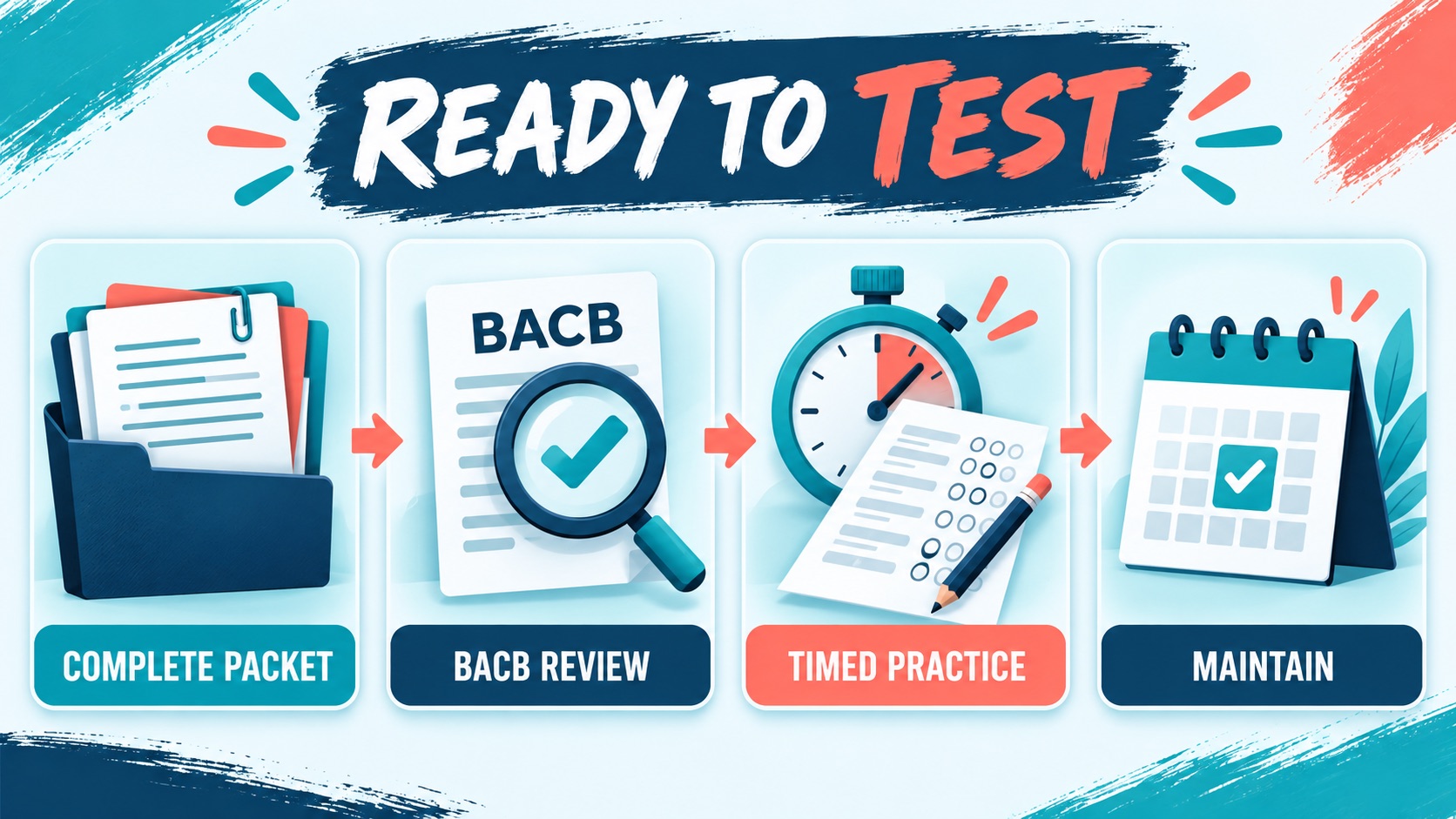
If your application is approved, follow the authorization instructions to schedule the BCBA examination. The exam is based on the applicable BCBA Test Content Outline; the 6th edition took effect January 1, 2025. Your study plan should therefore follow the current outline and your own error data, not an older unofficial topic list.
Separate the application clock from the exam clock. The BACB posts a live processing snapshot because review dates move as submissions are handled. On October 2, 2026, the page said it was reviewing BCBA/BCaBA submissions from September 28, 2026; that is a dated operational snapshot, not a guaranteed turnaround time. After authorization, Pearson scheduling, seat availability, retake rules, and exam appointment policies are their own planning items. Use a practice loop:
- Take a timed diagnostic or domain set.
- Tag each missed item by concept, discrimination error, calculation, application, or reading mistake.
- Review the source concept and write a one-sentence correction.
- Retest the same concept later in a new context.
A practice score is a planning signal, not a BACB prediction. The useful question is whether your error pattern is shrinking and whether you can explain why the correct option is better than the distractors.
Where Is My Current Bottleneck?
Use the table to choose the next action before buying another study resource:
| What is missing? | Evidence to inspect | Next action |
|---|---|---|
| Eligibility is unclear | Handbook pathway, degree, coursework, and program contact | Map the records to one pathway and ask the supervisor or program contact about unresolved evidence. |
| Fieldwork is incomplete | Monthly forms, contract, hours, supervision, observations, unrestricted activities | Fix documentation and plan remaining hours with a qualified supervisor. |
| Application is submitted | Portal receipt, payment, transcript receipt, action items | Monitor the portal and answer only the requested item with matching evidence. |
| Exam is authorized | Current TCO, diagnostic data, domain errors, appointment rules | Build a timed practice loop and schedule using the official instructions. |
What Changes In 2027?
The BACB’s 2027 transition guidance says significant BCBA eligibility and maintenance changes take effect January 1, 2027. To be reviewed under the current 2022 requirements, a complete application—including payment and all required documents—must be received by December 31, 2026.
Starting in 2027, the BACB describes two eligibility pathways. Pathway 1 uses a master’s degree from an APBA-accredited or ABAI-accredited/recognized behavior-analysis program; Pathway 2 uses a master’s degree or higher plus qualifying behavior-analytic coursework. Both include practical fieldwork and the BCBA examination. The 2027 guidance also lists 2,000 supervised or 1,500 concentrated fieldwork hours, with a 5% or 7.5% supervision percentage, and new 2027 fieldwork forms for post-transition applications.
Do not rush a deficient application just to meet a date. Compare your records with the correct transition guidance, confirm that the application is complete, and save proof of receipt. If you apply after January 1, 2027, use the 2027 forms and requirements that apply to your pathway.
How Do I Maintain Certification?
Obtaining the credential is not the end of the process. The 2027 guidance says BCBA certificants must complete 32 continuing-education units in each two-year cycle, including 4 ethics CEUs and 4 supervision CEUs for supervisors, along with ethics, self-reporting, and timely recertification obligations. Check the handbook for the rules attached to your actual certification cycle.
Keep a recurring maintenance calendar, store CE certificates and ethics documentation, update personal information in the BACB portal, and do not wait until the recertification deadline to discover a missing category. A candidate who plans maintenance while studying will have a clearer view of the professional commitment behind the exam.
Which Mistakes Slow The Process?
- Choosing an eligibility pathway after reading only a course advertisement.
- Counting fieldwork hours without the required records, observations, supervision, or unrestricted-activity mix.
- Submitting the paid application before official transcripts or required attestations are ready.
- Using old forms when the live BACB page names a newer version.
- Treating a practice score as a promise that the examination will be passed.
- Ignoring the 2027 cutoff or applying a 2022 document rule to a 2027 application.
How To Obtain BCBA Certification FAQ
How long does it take to obtain BCBA certification?: There is no single timeline. Degree and coursework, supervised fieldwork, application review, exam scheduling, and maintenance planning each take different amounts of time. Use the BACB’s live processing page for the current review snapshot rather than relying on an old “average” promise.
Can I apply before finishing fieldwork?: Do not assume you can. The application must document the eligibility requirements for the pathway you are using, including the applicable fieldwork evidence. Review the current handbook and submit the required final verification forms when the fieldwork is complete. Does a BCBA mock exam give me certification?: No. A mock exam is practice. BACB certification requires the applicable eligibility evidence, a complete application, and a passing BCBA examination under BACB procedures.
What Should I Do Today?
Make a four-column tracker labeled degree, coursework, fieldwork, and application. Add the source document, responsible person, status, and next date for each row. If all four columns are complete and your next bottleneck is exam performance, use our free BCBA mock exam practice for how to obtain bcba certification as a timed checkpoint.
The practice resource is independent exam preparation, not BACB eligibility approval, certification, legal advice, or a guarantee of a passing score. The strongest BCBA plan is evidence-led: confirm the rule, document the requirement, submit a complete packet, and use practice data to guide the next study session.
Take the Free BCBA Mock Exam
When you are ready to apply the idea, use the free practice resource below for additional feedback. Take the Free BCBA Mock Exam



