
If you are searching for how to get a board certified behavior analyst certification, you probably want more than a definition of BCBA. You want to know what to do first, which documents matter, when fieldwork is ready to verify, how the BACB application moves forward, and when exam preparation becomes the right next step.
Table of Contents
- how to get a board certified behavior analyst certification: the short answer
- Which Rule Set Applies To My Application?
- How Do I Choose The Right BCBA Pathway?
- What Evidence Should I Collect?
- How Do I Make Fieldwork Application-Ready?
- What Makes A BACB Application Complete?
- When Should I Schedule BCBA Exam Preparation?
- What Should I Do Next?
- How Does The 2027 Transition Change The Plan?
- What Does A Practical Timeline Look Like?
- Which Mistakes Create Avoidable Delay?
- How To Get BCBA Certification FAQ
- What Should You Do Today?
- Take the Free BCBA Mock Exam
The reliable route is evidence-led: choose the applicable BACB eligibility pathway, confirm the degree and behavior-analytic content, document supervised fieldwork, submit a complete application, receive an approved determination, pass the BCBA examination, and then maintain the certification. The order matters because a strong practice score cannot repair missing eligibility evidence.
This guide is written for a first-time applicant who needs an execution plan. It uses BACB pages and handbooks available in October 2026. The handbook and live BACB instructions control your application, especially if any milestone falls near the January 1, 2027 requirements transition. Table of Contents
how to get a board certified behavior analyst certification: the short answer
Use this sequence:
- Open the current BCBA Handbook and record the eligibility pathway and rule set that apply to you.
- Confirm your qualifying graduate degree, behavior-analytic coursework or program evidence, and any pathway-specific documentation.
- Complete supervised fieldwork under the current requirements and keep contemporaneous records.
- Assemble the application, official transcripts, attestations, final fieldwork verification, payment, and any other required evidence.
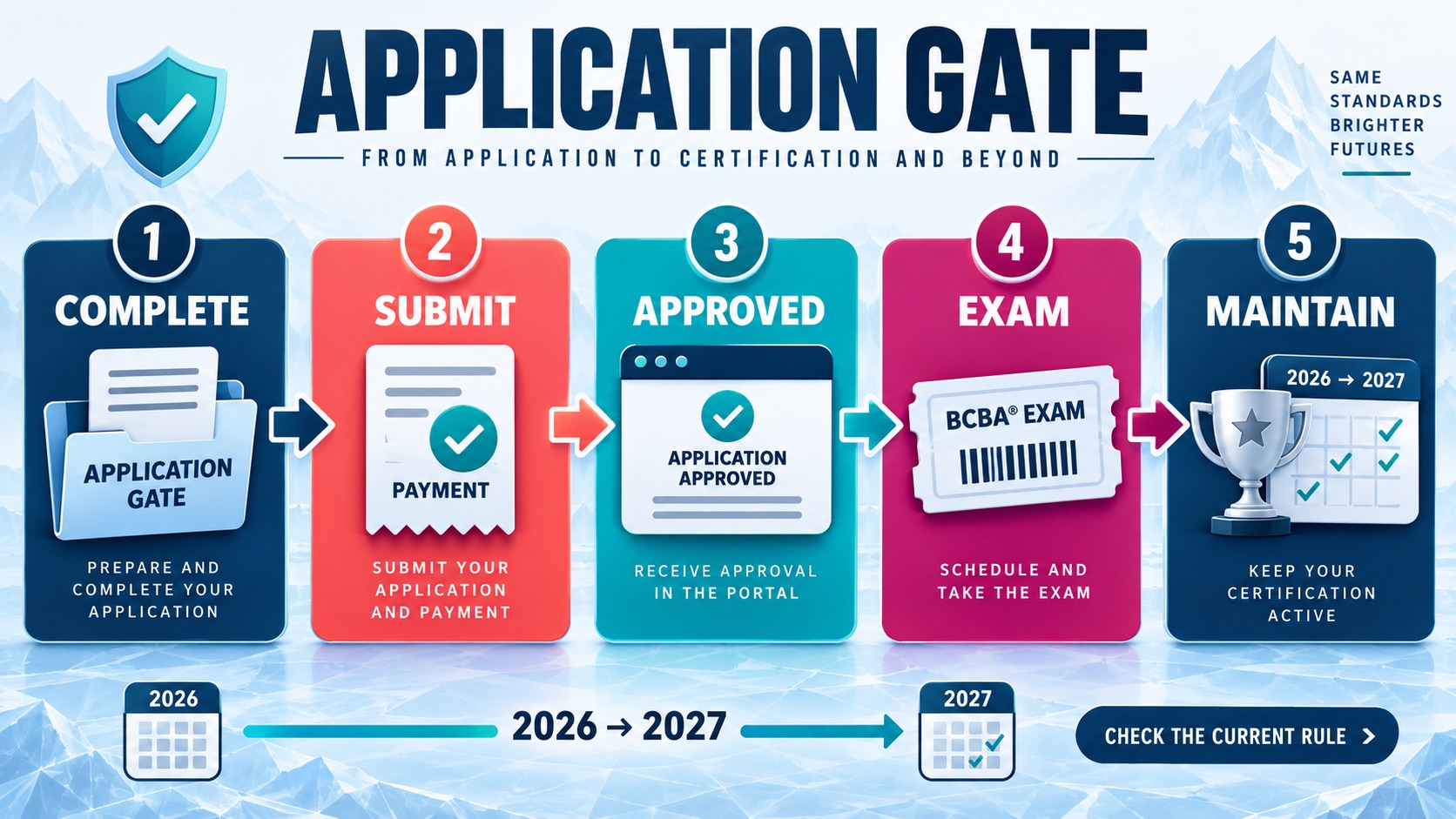
- Submit the application, respond to action items, and wait for the approved determination.
- Schedule and pass the BCBA examination through the authorized testing process.
- Maintain the certification with the required continuing education, ethics, supervision, and renewal actions.
The practical difference between a successful plan and a frustrating one is usually not motivation. It is whether the applicant can prove each step with the exact record the current handbook expects.
Which Rule Set Applies To My Application?
Before you compare programs or buy a study package, write down your target application date. The BACB’s 2027 transition guidance says significant BCBA and BCaBA certification changes take effect January 1, 2027. It also says that an application reviewed under the current 2022 requirements must be complete—including payment and all required documents—by December 31, 2026.
“I submitted the online form” is not necessarily the same as “my application is complete.” Your tracker should show the date payment was received, the date official transcripts were received, the date every required document was uploaded or accepted, and any action-item response date. If one of those pieces is missing, ask the BACB which rule set and transition instruction apply instead of assuming. For applications after the transition, use the current 2027 pages and the updated handbook. Never combine a 2022 fieldwork form, a 2027 coursework rule, and an old blog post into one unofficial pathway.
How Do I Choose The Right BCBA Pathway?
The BACB’s current BCBA applying page directs candidates to the handbook and describes the journey as meeting eligibility requirements, applying, and passing the examination. The handbook is the place to decide which pathway you can document.
The current 2027 BCBA summary identifies pathways that include a qualifying graduate degree from an accredited or recognized behavior-analysis program, a qualifying graduate degree plus behavior-analytic coursework, and other routes tied to faculty/research or postdoctoral experience. The details are not interchangeable. Choose a pathway from your records, not from the title of a prep course. Ask three questions:
- What graduate degree do I have or expect to confer, and when?
- Which institution, program contact, transcript, attestation, or content map proves my behavior-analytic preparation?
- Which fieldwork and supervisor records connect to this pathway?
If you cannot answer one question, that is not a reason to guess. It is a reason to request the missing record from the university, supervisor, or BACB process before you invest in a final exam schedule.
What Evidence Should I Collect?
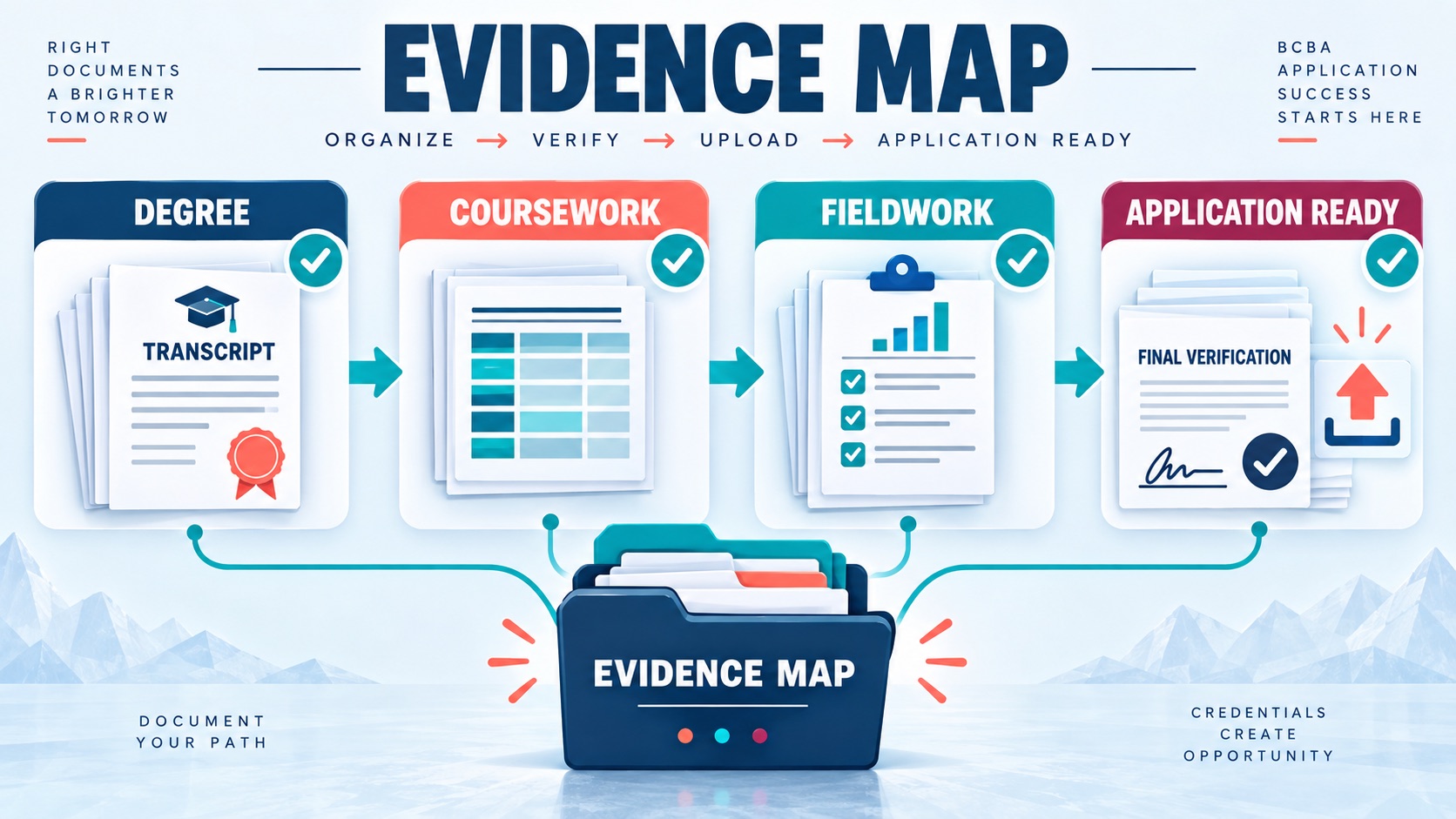
Create one digital folder with a subfolder for each eligibility requirement. The goal is not to collect every document you have ever received. The goal is to make it obvious which document proves which requirement. Your evidence map should include:
- Degree: official transcript, conferral date, institution details, and any equivalency evidence required for an international degree.
- Behavior-analytic content: course titles, credits or instructional hours, grades, content descriptions, and the applicable program contact or attestation.
- Fieldwork: supervisor information, contract, dates, hours, contacts, observations, individual and group supervision, and unrestricted activities.
- Application: current forms, payment receipt, official transcript receipt, attestations, final verification, and portal correspondence.
- Ethics and disclosure: records needed to answer the application questions accurately and evidence of any required self-report.
Use a naming convention such as `01_degree_transcript`, `02_coursework_attestation`, and `03_fieldwork_final_verification`. Record the source, received date, version, and status in a spreadsheet. A document that cannot be connected to a requirement is not yet useful evidence.
Keep copies of the rule page you used, but do not treat a saved PDF as permanently current. Add a “recheck date” to every rule-sensitive item so you revisit it when the handbook, form, or application window changes.
How Do I Make Fieldwork Application-Ready?
Fieldwork is often where a promising plan becomes difficult to prove. The BACB’s Fieldwork: Getting It Right guidance and the current handbook explain that fieldwork must meet more than a total-hours target. The supervisor, supervision contacts, observations, documentation, and activity mix all matter.
At the start of each supervisory period, confirm the pathway and the forms you will use. During the period, record the work while it is fresh. At the end, ask the supervisor to review the monthly and final records before you move to a new setting. Do not wait until the application is open to discover that a signature, observation, or date is missing. Use this fieldwork readiness check:
- The supervisor’s current qualification and status are documented.
- The supervision contract and start date match the period being counted.
- Monthly records show hours, supervision contacts, observations, and the required activity categories.
- Restricted and unrestricted activities are separated clearly enough for review.
- Final verification is signed, dated, and connected to the records that support it.
Job titles are not fieldwork evidence by themselves. A position called “behavior technician,” “analyst trainee,” or “clinical assistant” may contain useful activities, but the supervisor must determine what qualifies under the current pathway.
What Makes A BACB Application Complete?
When your evidence map is ready, use the live BACB application instructions and the current forms. The application-processing page explains that certification applications are reviewed after the paid application and official university transcripts have been received. That makes transcript delivery a real project milestone, not an administrative afterthought. Before pressing submit, run a completeness audit:
- Does the selected pathway match the degree, coursework, and fieldwork records?
- Are official transcripts being sent through the route the BACB accepts?
- Are the current attestation and fieldwork forms used?
- Does the payment receipt show the correct application?
- Have the ethics, disciplinary, and disclosure questions been answered fully and consistently?
- Can you open every uploaded file and read the signature, date, and identifying information?
After submission, monitor the portal and email. If the BACB sends an action item, answer the exact question with matching evidence. Uploading a large collection of unrelated documents can make the record harder to interpret. Keep a response log with the request date, the document supplied, and the date submitted.
When Should I Schedule BCBA Exam Preparation?
Study continuously enough to build competence, but make intensive exam preparation the priority when the eligibility and application steps are no longer your bottleneck. The BACB examination information page says the BCBA examination is a 4-hour, 185-question, computer-based exam delivered in person at authorized Pearson VUE testing sites. Use the current BCBA Test Content Outline and your diagnostic data to plan. A good preparation loop is:
- Take a timed baseline across the current content areas.
- Tag missed questions as knowledge, discrimination, application, calculation, ethics, or pacing errors.
- Review the source concept and explain why the correct answer beats the distractors.
- Practice the weak domain in a new context rather than memorizing the original item.
- Repeat a timed checkpoint and record the error trend.
Exam practice should answer “What do I need to improve?” It should not be used to answer “Am I eligible?” The application, handbook, and BACB determination answer the second question.
What Should I Do Next?
Use this decision table to turn the roadmap into one next action:
| Current status | Evidence to check | Best next action |
|---|---|---|
| You do not know your pathway. | Current BCBA Handbook, degree, coursework, and program contact. | Choose the pathway you can prove before buying a final prep package. |
| Coursework is documented, but fieldwork is ongoing. | Supervisor status, monthly forms, observations, and activity mix. | Fix the record-keeping process now and review each supervisory period. |
| Fieldwork is complete. | Final verification, transcript, attestation, payment, and current forms. | Run a completeness audit before submitting the application. |
| Application is approved and the exam is next. | Current TCO, diagnostic scores, domain errors, and appointment rules. | Use timed, error-based practice and follow the official scheduling process. |
How Does The 2027 Transition Change The Plan?
The 2027 transition is a date-and-document problem, not just a new study topic. The BACB says applications reviewed under the current 2022 requirements must be complete by December 31, 2026. For an application submitted under the 2027 framework, use the 2027 eligibility pages, updated handbook, current forms, and transition guidance.
The official 2027 BCBA Requirements page describes the graduate degree, behavior-analytic content, fieldwork, and examination components. It also lists the 2027 coursework details and fieldwork overview. Because the transition can determine which forms, pathway, and dates apply, save the source page and confirm your complete-application status instead of relying on a social-media summary.
If you are close to the cutoff, do not submit a deficient packet merely to create a timestamp. Confirm what the BACB considers complete, document receipt, and ask the BACB about the correct transition instruction when the answer is not clear. A later complete application may be safer than an earlier incomplete one.
What Does A Practical Timeline Look Like?
Organize the work in phases rather than promising a universal number of months:
- Orientation: read the handbook, choose the pathway, and create the evidence map.
- Build: finish the degree and content requirements while setting up supervised fieldwork.
- Document: keep monthly records, resolve missing signatures, and prepare final verification.
- Submit: send the application, official transcript, payment, attestations, and other required evidence.
- Prepare: once approval and authorization are in place, intensify TCO-aligned practice and schedule the exam.
- Maintain: after passing, plan continuing education, ethics, supervision, and recertification tasks.
This phase model is more useful than a generic “become a BCBA in X months” promise because it shows what can run in parallel and what cannot. Fieldwork documentation can be improved during the fieldwork period; an exam appointment cannot replace a missing final verification.
Which Mistakes Create Avoidable Delay?
- Using an old blog post instead of the current BCBA Handbook and live application page.
- Choosing a program before identifying the BACB pathway it supports.
- Waiting until the final month to reconstruct fieldwork dates, observations, and signatures.
- Submitting the form while official transcripts or pathway-specific attestations are still missing.
- Assuming a practice score predicts BACB approval or a passing result.
- Missing the 2027 transition rule because “submitted” was confused with “complete.”
- Forgetting that state licensure may add a separate authorization after certification.
How To Get BCBA Certification FAQ
What is the first step to becoming a BCBA?: Start with the current BCBA Handbook and identify the eligibility pathway you can document. Then map your degree, behavior-analytic content, fieldwork, and application records to that pathway.
Can I take a BCBA practice exam before applying?: Yes, practice can help you identify learning gaps. It does not establish eligibility, replace fieldwork, or guarantee approval. Use it as a diagnostic while you build the formal evidence file.
How many questions are on the BCBA exam?: The current BACB examination information page lists a 4-hour, 185-question BCBA exam delivered in person at authorized Pearson VUE testing sites. Recheck the official page and handbook for your appointment because policies and forms can change.
Do I need a state license after becoming a BCBA?: It depends on where and how you practice. BACB certification is not a substitute for a state behavior-analyst license, registration, payer credential, or employer requirement. Check the jurisdiction connected to your actual services.
What Should You Do Today?
Create a tracker with five columns: requirement, evidence, source version, status, and next date. Fill it with your degree, coursework, fieldwork, application, and examination milestones. If the first four are complete and the BCBA exam is the real bottleneck, our free BCBA mock exam practice for how to get BCBA certification can provide a timed checkpoint.
Use the result to guide study—not as an eligibility decision, a certification guarantee, or legal advice. The clearest route to BCBA certification is not a shortcut; it is a current-source checklist in which every requirement has a matching record and every date has a recheck plan.
Take the Free BCBA Mock Exam
When you are ready to apply the idea, use the free practice resource below for additional feedback. Take the Free BCBA Mock Exam



