

If you searched for board certified assistant behavior analyst bcba certification, you are probably trying to decide whether the BCaBA or BCBA path fits your education and career plan. The wording is easy to misunderstand because the official credentials are different: Board Certified Assistant Behavior Analyst (BCaBA) and Board Certified Behavior Analyst (BCBA).
Table of Contents
- BCaBA Vs BCBA: What Is The Difference?
- board certified assistant behavior analyst bcba certification: what does each credential mean?
- What Education Does Each Path Require?
- How Do Fieldwork And Supervision Differ?
- What About The Application And Exam?
- Which Path Fits Your Current Goal?
- What Changes In 2027?
- How Should You Choose Your Next Step?
- Which Mistakes Should You Avoid?
- BCaBA And BCBA Certification FAQ
- The Practical Takeaway
- Take the Free BCBA Mock Exam
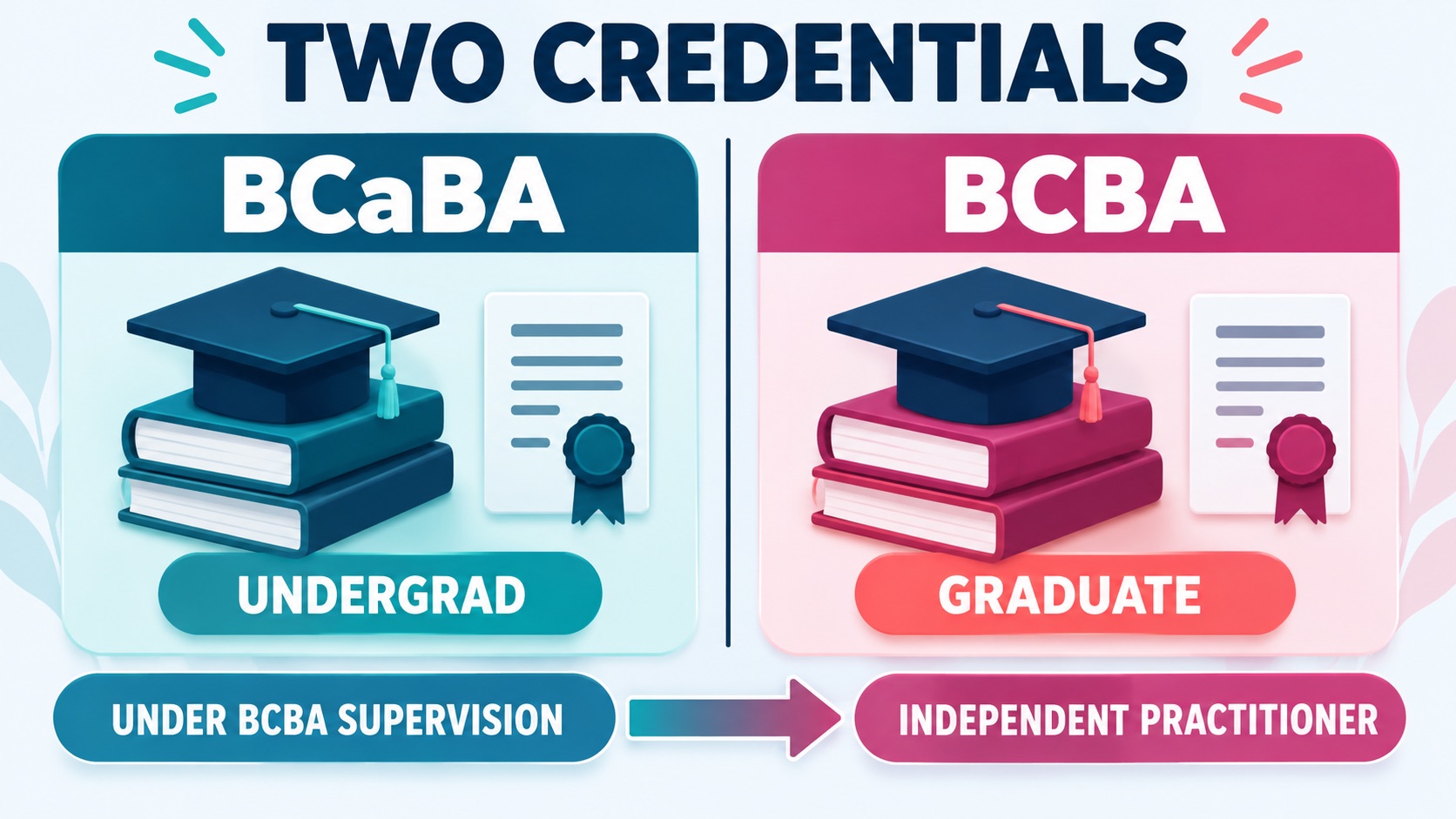
The short version is that BCaBA is an undergraduate-level certification for behavior-analytic work under BCBA supervision, while BCBA is a graduate-level certification for independent behavior-analytic practice within the limits of applicable law and licensure. Neither credential should be chosen from a title alone. Your degree level, fieldwork route, supervision arrangement, state rules, and intended responsibilities all matter.
This comparison reflects the BACB pages and handbooks available in October 2026. Before applying, use the current BACB handbook, application instructions, and your state’s licensing rules. The BACB’s 2027 transition pages are especially important if your application or fieldwork crosses January 1, 2027. Table of Contents
BCaBA Vs BCBA: What Is The Difference?
BCaBA and BCBA are both BACB credentials, but they do not represent the same level of preparation or responsibility.
- BCaBA: an undergraduate-level certification. A BCaBA may provide behavior-analytic services under the supervision of a qualified BCBA and may supervise RBTs when the applicable supervision requirements are met.
- BCBA: a graduate-level certification. A BCBA is described by the BACB as an independent practitioner who may supervise RBTs, BCaBAs, and other implementers, subject to applicable standards and laws.
“Independent practitioner” describes the certification level; it does not override a state license, a payer rule, an employer policy, or a scope-of-practice restriction. A candidate should treat BACB certification and state authorization as related but separate questions.
board certified assistant behavior analyst bcba certification: what does each credential mean?
The BACB BCaBA overview identifies BCaBA as a bachelor’s-level certification. The role is valuable in service teams, but it is not a shortened BCBA credential. The supervision relationship is part of the role’s design: a BCaBA does not simply receive a title and then perform every responsibility assigned to a BCBA.
The BACB BCBA overview describes BCBA as a graduate-level certification and identifies BCBAs as independent practitioners. A BCBA still works within ethical, organizational, payer, and state requirements. “Independent” does not mean that every BCBA can practice in every location without a state license or additional credential.
This distinction answers the most common version of the search query. If a school, job posting, or training provider uses the phrase “board certified assistant behavior analyst BCBA certification,” confirm whether it means a BCaBA comparison, a future BCBA plan, or a state-specific job requirement. Ask for the exact credential abbreviation before paying for a program.
What Education Does Each Path Require?
Start with the current handbook rather than a program advertisement. The BCaBA Handbook explains the eligibility evidence for the assistant-level certification. In general, the pathway is built around a bachelor’s degree or higher, behavior-analytic coursework or an eligible program route, supervised fieldwork, and a passing examination. The exact route and documentation depend on the rules that apply to the application.
The BCBA Handbook governs the graduate-level route. A BCBA candidate generally needs a qualifying graduate degree, the required behavior-analytic coursework or program evidence, supervised fieldwork, a complete application, and a passing BCBA examination. A certificate that says “BCBA preparation” is not itself proof that BACB eligibility has been met. Before enrolling, build an evidence folder containing:
- the degree level and institution information;
- course titles, syllabi or transcripts, and the applicable coursework route;
- supervisor qualifications, fieldwork agreements, monthly records, and final verification;
- the handbook version and pathway decision you used;
- application receipts, correspondence, authorization, and examination records.
That folder helps you catch a costly problem early: a course may be useful for learning but not count as the evidence required for a particular BACB pathway. If the school cannot explain how its program maps to the current BACB requirements, pause before assuming that the marketing language is an eligibility determination.
How Do Fieldwork And Supervision Differ?
Fieldwork is not a box to check after coursework. It is documented supervised experience, and the quality of the arrangement matters. The BACB’s supervision and training guidance explains the responsibilities of supervisors and the relationship between BCBA, BCaBA, and RBT supervision.
A BCaBA candidate needs an approved fieldwork arrangement that matches the applicable BCaBA rules. After certification, the BCaBA provides services under BCBA supervision. A BCaBA may have meaningful clinical responsibilities, but the supervising BCBA remains central to the supervision structure and the boundaries of the role.
A BCBA candidate needs fieldwork that meets the BCBA pathway requirements. Once certified, the BCBA may serve as the independent practitioner and supervise qualified team members. That does not make every supervision activity interchangeable. Supervisors must meet the relevant training, competence, documentation, and ethical requirements. Ask these questions before starting fieldwork:
- Which BACB pathway and handbook version are we using?
- Is the supervisor qualified for this type of supervision?
- How will restricted and unrestricted activities be documented?
- How often will observations, feedback, and verification occur?
- What happens if the supervisor, employer, setting, or client population changes?
If the answers are vague, the problem is not solved by accumulating hours. Request the current forms and written expectations before counting the fieldwork toward an application.
What About The Application And Exam?
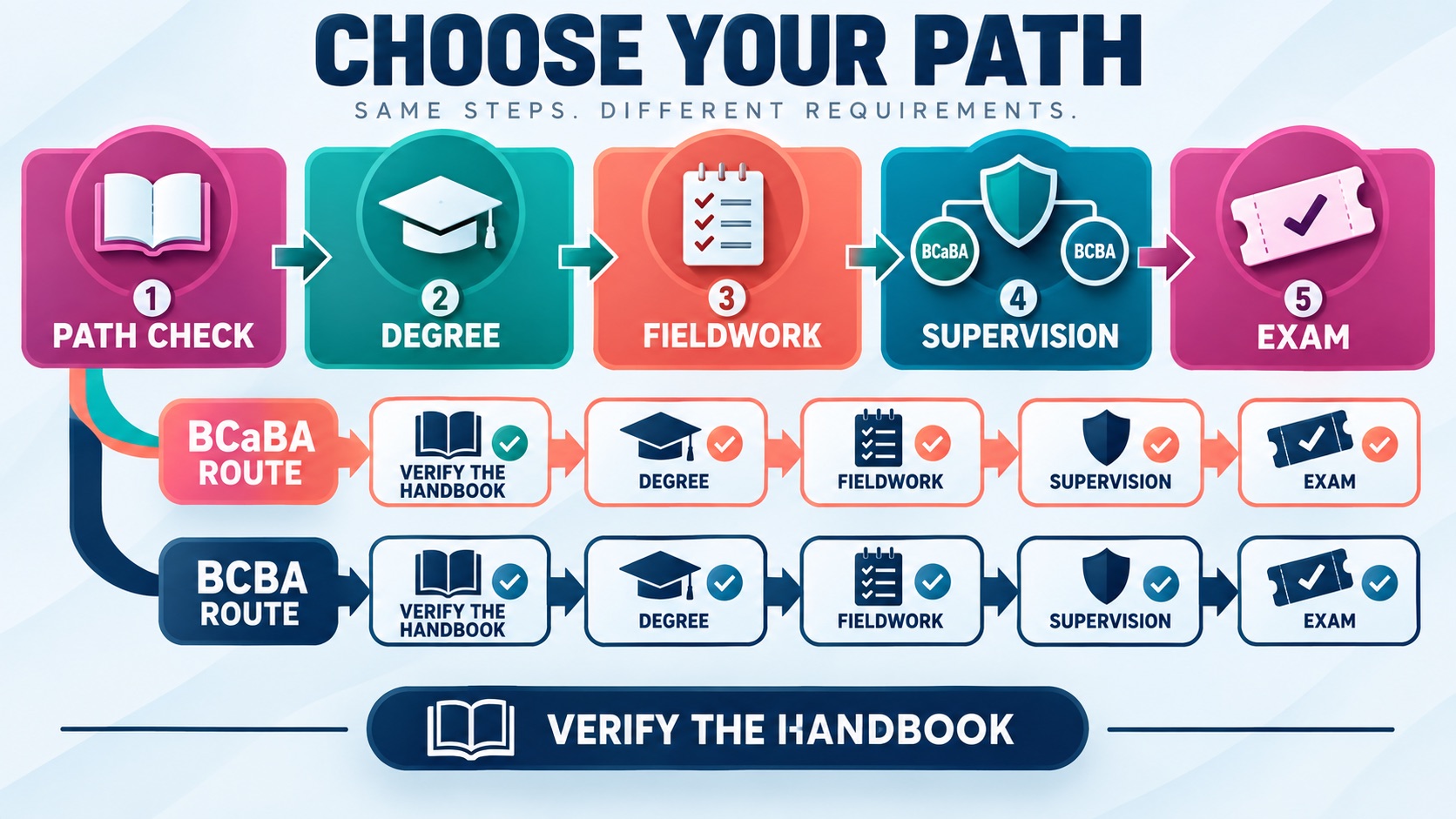
Both credentials use an application-and-examination process, but each has its own handbook, eligibility evidence, and examination blueprint. The BACB examination information page describes computer-based examinations delivered in person at authorized testing locations. A practice test can help you prepare; it cannot replace a complete eligibility application, supervised fieldwork, or a state license. For either route, use this order:
- Choose the credential that matches your degree level and target role.
- Read the current handbook and identify the exact eligibility pathway.
- Confirm that your coursework, degree, and fieldwork evidence match that pathway.
- Submit a complete application and respond to any BACB action items.
- Study to the current test content outline, then schedule through the authorized process.
- After certification, check your state’s licensure and practice requirements.
Do not choose a BCaBA program only because it appears faster, and do not choose the BCBA route only because the title sounds more advanced. The better route is the one you can document and responsibly use in the setting where you want to work.
Which Path Fits Your Current Goal?
Use the following decision table as a starting point, then verify the live BACB rules and your state’s requirements:
| Your situation | Likely path to investigate | Why | Important boundary |
|---|---|---|---|
| You are completing a bachelor’s degree and want an assistant-level role. | BCaBA | It is the undergraduate-level BACB credential. | Plan for BCBA supervision and check state licensure. |
| You have or are pursuing a qualifying graduate degree and want independent practitioner responsibilities. | BCBA | It is the graduate-level certification associated with independent practice. | Independent certification does not cancel state licensing rules. |
| You are already a BCaBA and want broader responsibility. | Review the current BCBA pathway | The BCBA route has its own graduate-degree, coursework, fieldwork, and exam evidence. | BCaBA experience does not automatically substitute for every BCBA requirement. |
| You only want to take a preparation course. | First identify the intended credential | A course is a study resource, not a certification. | Ask how the course maps to the current handbook and test content outline. |
What Changes In 2027?
The BACB’s 2027 BCaBA requirements page says that beginning January 1, 2027, the BCaBA eligibility framework includes two pathways. The summary identifies a Pathway 1 based on a bachelor’s degree or higher from an ABAI-accredited behavior-analysis program and a Pathway 2 based on a bachelor’s degree or higher plus behavior-analytic coursework and supervised fieldwork. The complete requirements and transition rules control the application.
The BACB’s published 2027 BCaBA materials also describe fieldwork quantities and supervision conditions, including a supervised fieldwork option and a concentrated fieldwork option. Because dates, forms, complete-application rules, and transition eligibility can affect which requirements apply, do not copy a number from a summary into your personal plan without checking the current official page and handbook.
BCBA eligibility and maintenance requirements also have a 2027 transition. The BACB’s 2027 BCBA and BCaBA guidance explains the timing and points candidates to the applicable requirements. If your course, fieldwork, or application spans 2026 and 2027, record the date of every milestone and confirm whether the BACB considers your application complete under the transition rule. Finally, certification changes are not the same as state licensure changes. A state may add or revise its own license, title, renewal, or telehealth requirements. Recheck both systems before you practice.
How Should You Choose Your Next Step?
Make a one-page decision sheet with four headings: degree, intended role, fieldwork access, and jurisdiction. Under degree, write the credential level you can actually document. Under intended role, describe whether you want to work under BCBA supervision or eventually take independent-practitioner responsibilities. Under fieldwork access, list the supervisor and setting you can verify. Under jurisdiction, list the state license or registration questions that remain. Then choose one bottleneck:
- If your degree or coursework is unclear, speak with the program and compare it with the current handbook.
- If fieldwork is the problem, secure a qualified supervisor and written documentation process.
- If eligibility is approved and the exam is next, use the current test content outline and timed practice.
- If certification is complete, research your state license before accepting a role or serving clients.
When the BCBA examination is genuinely your next gate, our free BCBA mock exam practice for BCaBA and BCBA candidates can provide a timed checkpoint. Use the result to identify content and pacing gaps. It is not a BACB eligibility decision, a certification guarantee, or a state license.
Which Mistakes Should You Avoid?
- Searching for a “BCaBA certification” and enrolling in a BCBA program without first confirming the credential.
- Assuming that BCaBA is simply a shorter BCBA path rather than a distinct undergraduate-level certification.
- Counting fieldwork hours without verifying the supervisor, documentation, and current pathway requirements.
- Assuming that BCaBA experience automatically satisfies every BCBA graduate-level requirement.
- Treating a practice score as evidence of eligibility or certification.
- Following a 2026 checklist after your application moves into the 2027 transition window.
- Assuming BACB certification alone answers the licensing question in your state.
BCaBA And BCBA Certification FAQ
Is BCaBA the same as BCBA?: No. BCaBA is the undergraduate-level assistant certification and is designed for services under BCBA supervision. BCBA is the graduate-level certification associated with independent practitioner responsibilities, subject to applicable law and licensure.
Can a BCaBA become a BCBA?: Yes, a BCaBA can investigate the BCBA pathway, but the person must meet the current BCBA eligibility requirements. Existing BCaBA experience may be useful, but it should not be assumed to replace a qualifying graduate degree, coursework, fieldwork, or other required evidence.
Do both credentials require an exam?: Both are certification pathways with application and examination requirements. Use the handbook and examination information for the credential you are pursuing; do not use a BCBA study guide as proof that you qualify for the BCaBA exam or vice versa.
Does passing the BCBA exam give me permission to practice anywhere?: No. Certification and state authorization are separate. Check the state where services will be delivered, the client’s location for remote services, employer policies, payer rules, and any applicable title or license requirements.
Which credential should I choose?: Choose BCaBA if your documented education and intended role fit the undergraduate-level assistant pathway. Choose BCBA if your plan and evidence fit the graduate-level route and you want the responsibilities associated with independent practitioner certification. In either case, begin with the current BACB handbook and a written evidence checklist.
The Practical Takeaway
The phrase “board certified assistant behavior analyst bcba certification” hides an important decision: BCaBA and BCBA are not interchangeable. Compare the degree level, supervision relationship, fieldwork evidence, examination route, 2027 transition, and state licensing layer before you choose a program or study schedule. Once your eligibility is documented and the exam is truly next, targeted practice can turn a vague goal into a measurable preparation plan. For targeted review, use our board certified assistant behavior analyst bcba practice questions to apply the concept in exam-style scenarios.
Take the Free BCBA Mock Exam
When you are ready to apply the idea, use the free practice resource below for additional feedback. Take the Free BCBA Mock Exam



