

If you are asking how long does it take to get a bcba certification, the honest answer is that there is no single countdown for every candidate. The calendar usually has five different clocks: qualifying education, supervised fieldwork, document preparation, BACB application review, and examination scheduling or retakes. The first two are often the longest because they depend on your starting point, available supervision, and the pathway that applies to you.
Table of Contents
- How Long Does It Take To Get A BCBA Certification?
- Why Does the BCBA Timeline Have Several Clocks?
- Which Stage Usually Controls the Calendar?
- What Must Be Ready Before You Submit?
- How Long Can BACB Application Review Take?
- What Happens After Application Approval?
- How Do Retakes Change the Timeline?
- How Should You Plan Around January 1, 2027?
- Which Delays Are Preventable?
- BCBA Timeline FAQ
- What Should You Do This Week?
- Take the Free BCBA Mock Exam
A more useful estimate is a stage-by-stage plan. You can control some dates, such as when you request transcripts, complete forms, pay an application fee, and book a study window. Other dates are conditional. The BACB says a complete application may take up to 45 days to review, and missing or corrected documents can add time. After approval, the candidate receives instructions to schedule the exam, but preparation and an available appointment still belong in the calendar. This guide separates the stages so you can estimate your own timeline without turning an official processing window into a promise that the entire certification path will take a particular number of months. Table of Contents
How Long Does It Take To Get A BCBA Certification?
There is no universal total because candidates enter at different stages. Someone who already has the required degree, coursework, fieldwork documentation, and a ready application may be planning around document collection, BACB review, exam preparation, and appointment availability. Someone beginning graduate education or supervised fieldwork needs to plan for those academic and experience requirements first.
For the post-submission portion, use the BACB’s current rules as anchors rather than guesses. The BCBA Handbook says application review may take up to 45 days from payment and receipt of all required documents. If the application is approved, the BACB says an email with instructions to schedule the examination is sent within 24–48 hours. The exam is continuously available in the BACB jurisdiction, subject to appointment availability and the applicable testing rules.
That means “45 days” is an application-review allowance, not a promise that a person can become certified in 45 days. Put the full pathway on your calendar and label each date as either candidate-controlled, BACB-controlled, university-controlled, supervisor-controlled, or conditional.
Why Does the BCBA Timeline Have Several Clocks?
The phrase “get certified” compresses several different activities. The current BACB application lifecycle describes documentation being received, added to a queue, reviewed, and sometimes returned for applicant action. Before that can happen, the candidate needs a qualifying route and evidence that the route has been completed. After review, the candidate still has to prepare for and pass the exam.
Think of the timeline as a handoff chain. Education produces records. Fieldwork produces verification. The candidate assembles documents and submits payment. The BACB reviews the complete packet. Approval opens the examination scheduling step. A passing result completes the national certification exam requirement, while any separate state license or employer credentialing process can continue afterward. For your own calendar, label the clocks this way:
- Eligibility clock: the education, coursework, and supervised fieldwork still needed before an application can be complete.
- Evidence clock: the time required to request, correct, and receive official records and signed verification forms.
- Review clock: the BACB processing period that starts after payment and all required documents are received.
- Readiness clock: the study, appointment, and retake window that follows application approval.
This model prevents a common planning error: counting only the review period while ignoring the time required to obtain the evidence that makes review possible.
Which Stage Usually Controls the Calendar?
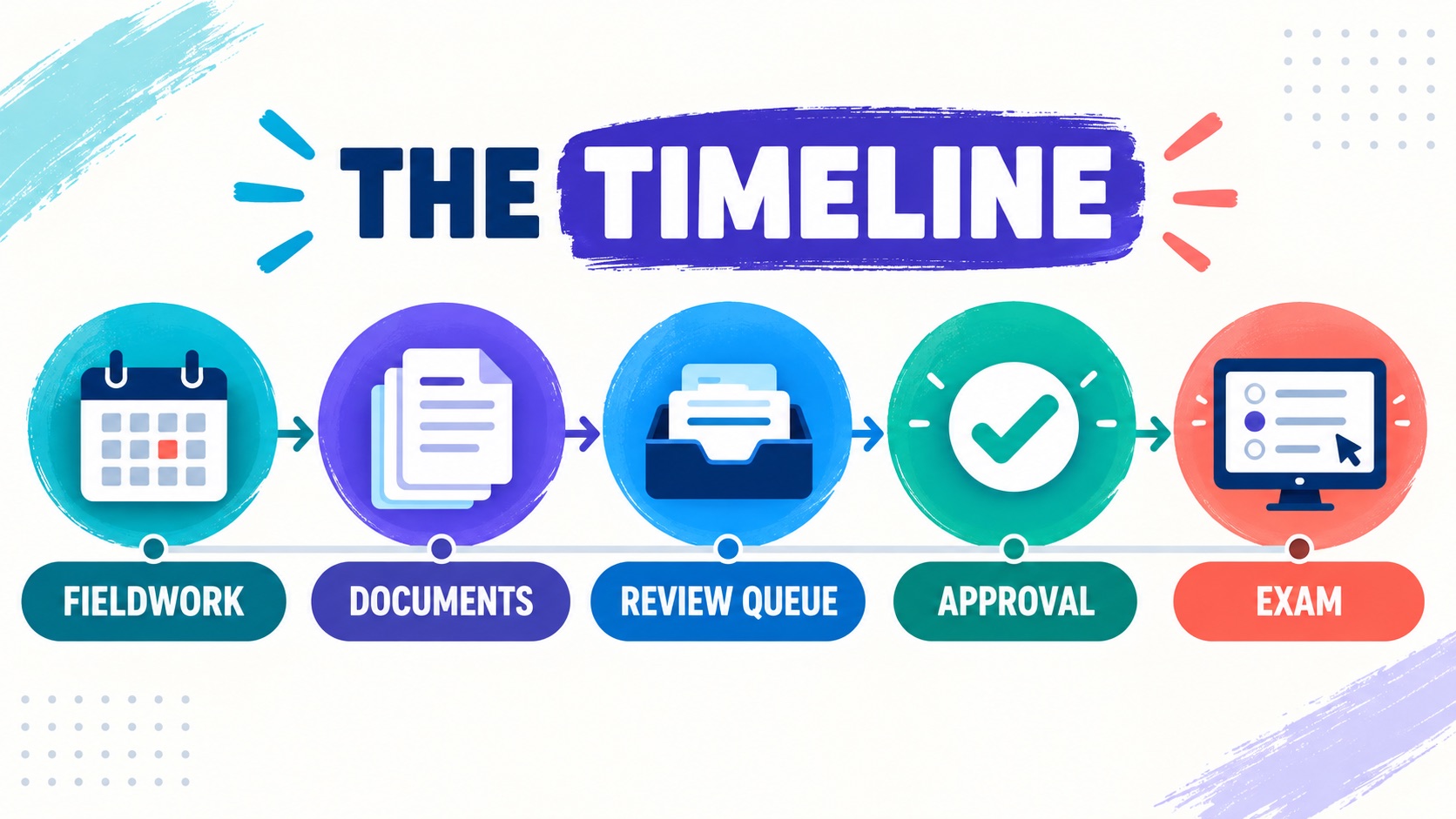
The controlling stage is the unfinished requirement with the least flexibility. For a new student, that may be a graduate degree or qualifying coursework. For a candidate with education completed, it may be supervised fieldwork, an unavailable supervisor, or a form that needs a corrected signature. For an application-ready candidate, it may be BACB review or a study plan that is not yet strong enough for an exam appointment.
| Stage | Who controls the next date? | What can expand the timeline? |
|---|---|---|
| Education and coursework | University and candidate | Course sequence, term dates, transcript corrections, or a pathway change. |
| Supervised fieldwork | Candidate, supervisor, and fieldwork setting | Finding supervision, collecting signatures, audits, or incomplete monthly records. |
| Application review | BACB queue after payment and required documents | Missing documents, incorrect versions, applicant action, or an audit. |
| Examination | Candidate and testing appointment availability | Study readiness, appointment changes, a failed attempt, or retake rules. |
Use the table as a diagnostic tool. The question is not “What is the average?” but “Which row is unfinished for me, and what evidence proves that it is finished?” That answer gives you a better estimate than an internet headline.
What Must Be Ready Before You Submit?
Before paying, verify the pathway and assemble the exact documents the current BACB instructions call for. The application lifecycle explains that documentation is received and added to the review queue; it does not mean an incomplete packet has started the normal review clock. The current application-processing page also says BCBA applications are reviewed once the paid application and official university transcripts have been received. Make a pre-submission folder with the following categories:
- Eligibility evidence: degree, coursework or program attestation, fieldwork verification, and any required supervisor information.
- Identity and application details: names and dates that match your official records, contact information, and the pathway-specific forms.
- Payment and timing: the application fee, the date payment is made, and a calendar reminder for any document deadline.
- Source checks: the current handbook version and the current form instructions used to prepare the packet.
The handbook says supplemental documents should be received within 90 days after payment or a new application may be required. That is a practical reason to request documents before you pay rather than treating payment as the first research step. Keep confirmation emails and copies of submitted materials in the same folder.
How Long Can BACB Application Review Take?
According to the current BCBA Handbook, review may take up to 45 days from the date the BACB receives payment and all required documents. The application-processing page is a useful live check because it shows which submission dates the BACB is currently reviewing. That page can change, so record the date you viewed it and do not use an old screenshot as a personal guarantee.
Review time can grow when the packet needs missing or updated documents, when an action item is waiting for the applicant, or when fieldwork is selected for an audit. The lifecycle page explains that application statuses have different meanings. “Under review” is not the same as “approved,” and “awaiting applicant action” is not passive waiting: it is a signal to read the request and respond through the prescribed channel.
Do not send duplicate documents simply because the queue feels slow. Check the official status instructions, confirm whether a document was actually requested, and keep a dated record of every response. A duplicate upload can create confusion without moving the review forward.
What Happens After Application Approval?
After approval, the BACB says candidates receive an email with instructions for scheduling the examination within 24–48 hours. The current examination information and Pearson VUE page should be checked together for appointment, identification, rescheduling, and testing-center details. The fact that an exam is continuously available does not mean every location has an immediate appointment.
Protect this part of the calendar by choosing a realistic study window before you schedule. Review your practice data by content area, build timed sessions, and leave room for a final source check. If your approval arrives before you are ready, the fastest available appointment may not be the fastest route to a passing result. A planned date with adequate preparation can be more efficient than a rushed date followed by a retake.
How Do Retakes Change the Timeline?
A retake adds more than another test day. The current handbook lists a retake application fee and says that candidates in the BACB jurisdiction have two years from application approval to pass, with up to eight attempts and at least 30 days between attempts. Recheck the live handbook before relying on those numbers, because rules and fees can change.
If a practice test shows uneven performance, use the result as a planning signal. A retake plan should identify the missed content area, the evidence that the gap has been corrected, the next eligible testing date, and the money reserved for the additional application and appointment. This is also why practice should be tied to the current examination content outline rather than treated as a single pass-or-fail prediction.
How Should You Plan Around January 1, 2027?
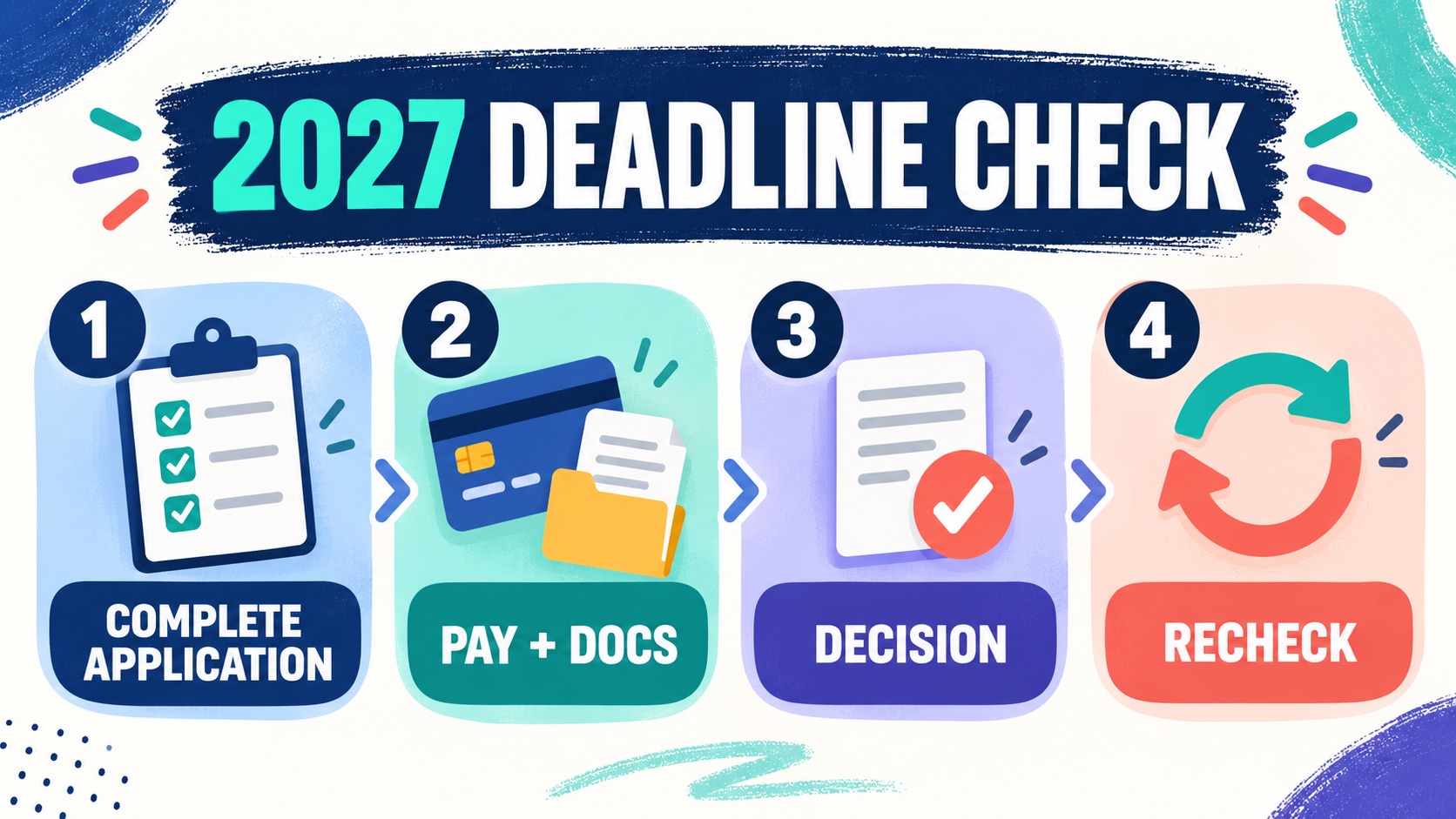
The BACB’s 2027 requirements guidance describes significant changes taking effect January 1, 2027. It says that candidates who want to be reviewed under the current 2022 requirements must have a complete application, including payment and all required documents, received by December 31, 2026. The relevant date is not simply when you begin studying or when a university says a course is “2027 ready.”
If your plan crosses that boundary, create two columns: the requirements you are documenting now and the requirements that may apply after the transition. Then verify the correct route with the current BACB source and your program or supervisor. Do not rush an incomplete application to meet a date; an incomplete packet can create a different delay and may not receive the review treatment you expected. For a timeline that includes 2027, put three reminders on your calendar: check the current handbook, confirm that your documents are complete, and recheck the processing page immediately before payment or submission.
Which Delays Are Preventable?
Some waiting is normal, but candidates can reduce avoidable back-and-forth. Use this short checklist before you submit and again when you receive a status update:
- Match your name, dates, degree information, and supervisor details across every document.
- Use the current form versions identified by the BACB rather than a saved form from an older application.
- Ask the university or supervisor to send official records through the channel the BACB accepts.
- Set a reminder for the 90-day supplemental-document window after payment.
- Read each applicant-action request completely and answer the specific issue instead of uploading unrelated files.
- Keep a private timeline with payment date, document date, status change, response date, and next check date.
These steps cannot control the BACB queue or guarantee approval, but they make it easier to identify where a delay actually sits. That distinction matters when you decide whether to contact a university, your supervisor, the testing provider, or the BACB.
BCBA Timeline FAQ
Can I finish BCBA certification in a few weeks?: Only a candidate who has already completed the applicable education and fieldwork requirements and has a complete, reviewable application could be planning on a short post-submission window. Even then, BACB review, appointment availability, exam preparation, and a passing result are separate conditions. A few weeks is not a general promise for the full pathway.
Does the 45-day review period include education and fieldwork?: No. The 45-day statement applies to BACB review after payment and receipt of all required documents. It does not represent the time needed to earn a degree, finish coursework, complete supervised fieldwork, correct records, or prepare for the exam.
Can a mock exam tell me my certification date?: No. A mock exam can help estimate study readiness and reveal content gaps, but it cannot determine BACB eligibility, application review time, appointment availability, or the result of the official examination.
What Should You Do This Week?
Start with a one-page timeline. Write down your pathway, the last unfinished eligibility item, the documents that prove completion, the likely submission date, the official review window, and a study block that fits your actual schedule. Add the 2027 boundary if your plan crosses January 1, 2027. Mark every assumption as “to verify” until a current BACB source confirms it.
When your eligibility work is organized and you want a timed practice checkpoint, use our free BCBA mock exam practice for how long does it take to get a bcba certification study planning. It is independent exam-preparation support, not official BACB certification, an application review, or a promise of a passing result.
Finally, reopen the current BCBA Handbook and application pages before you pay or submit. A realistic answer to how long certification takes is not a single number; it is a documented sequence with the longest unfinished stage, the official review window, and a recheck date for any rule that may change.
Take the Free BCBA Mock Exam
When you are ready to apply the idea, use the free practice resource below for additional feedback. Take the Free BCBA Mock Exam



