
If you are asking, how do i become a board certified behavior analyst, start with an evidence question rather than a program list: which degree, coursework, fieldwork, and application records do you already have, and which gate is still unverified? The answer depends on the BACB requirements in effect when you apply. Your job is to identify the earliest missing gate, verify it against the current official handbook, and take one concrete next action.
Table of Contents
- How Do I Become a Board Certified Behavior Analyst? Start With Four Gates
- Start With Your Current Evidence
- Use the Eligibility Decision Tree
- Compare Pathway 1 and Pathway 2 Evidence
- Separate Education, Coursework, and Fieldwork
- Run the 2027 Transition Check
- Know When You Are Application-Ready
- Avoid False “I’m Eligible” Signals
- Choose the Next Study Action
- FAQ
- Practice After the Eligibility Check
- Take the Free BCBA Mock Exam
This page is an eligibility decision tree, not another general career roadmap. For the broad role description and sequence, keep the site’s BCBA role and roadmap guide nearby. This article helps you audit your own file, compare the current pathway evidence, and separate eligibility from exam preparation. Review boundary: BACB requirements and dates can change; the current BCBA Handbook and official 2027 materials control. No degree, practice score, or article guarantees certification.
How Do I Become a Board Certified Behavior Analyst? Start With Four Gates
The short answer is: select an eligible BACB pathway, complete the required education and behavior-analytic coursework, document the required supervised fieldwork, and submit an application that satisfies the rules in effect at that time. If the application is accepted, you then schedule and take the BCBA examination through the official process. The sequence is simple to say but easy to misread, because a transcript, a supervision log, and an exam score prove different things.
| Gate | Question to answer | Evidence to locate |
|---|---|---|
| Education | Does my degree and institution fit the applicable pathway? | Official transcript, degree record, and the pathway-specific program or institution evidence. |
| Coursework | Can I prove the required behavior-analytic content under the correct route? | Course titles, syllabi or attestation evidence when required, and official records. |
| Fieldwork | Was supervised fieldwork completed and documented under the applicable rules? | Supervision records, dates, hours, responsible supervisor information, and required verification. |
| Application and exam | Is the application complete, accepted, and ready for the official examination step? | Application confirmation, payment, correspondence, authorization, and appointment record. |
Do not jump to the exam gate because you feel ready to study. First identify whether the earlier evidence gates are complete. A high practice score cannot repair a missing transcript, unverified coursework, or incomplete fieldwork documentation.
Start With Your Current Evidence
Write down what is already true today. Do not begin with the pathway you hope to use; begin with the records you can produce. Check your existing degree and coursework before choosing a program or supervision arrangement.
| Your starting point | First question | Best next action |
|---|---|---|
| No graduate degree yet | Which current BACB pathway will the future program support? | Compare the official 2027 requirements with program documentation before enrolling. |
| Graduate degree, unclear coursework | Can the courses be mapped to the applicable content and verification rule? | Request the transcript, syllabi, and pathway-specific verification from the institution or BACB process. |
| Coursework complete, fieldwork incomplete | Is the supervision arrangement valid and are records being maintained? | Audit dates, supervisor status, activities, and documentation before accumulating more hours. |
| Fieldwork and documents complete | Does the current application packet satisfy the rule window? | Read the current handbook and transition notice, then prepare the application and exam sequence. |
- Save the legal name, degree date, institution, and transcript location in one checklist.
- List every behavior-analytic course separately instead of describing the program with one broad label.
- Mark fieldwork as documented only when the supervisor and records support the dates and activities.
- Record the date you checked each official BACB page because a future version may change the answer.
Use the Eligibility Decision Tree
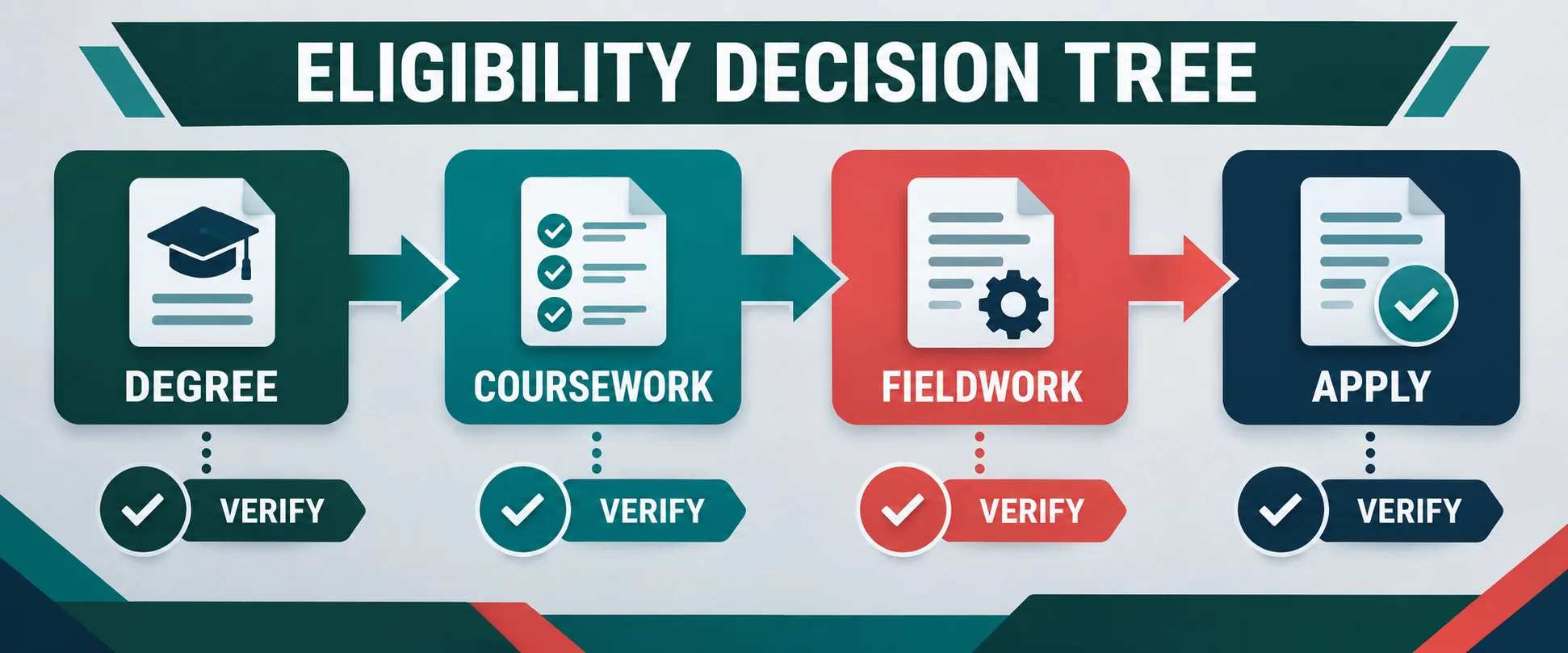
Use the following order. At each branch, stop when the answer is “not verified.” The correct next step is to obtain evidence, not to move further down the tree.
- Degree branch: do you have the degree or program evidence required by the pathway in effect when you will apply? If not, stay at education planning.
- Coursework branch: can an official record or accepted attestation show the required behavior-analytic content? If not, request a formal course map before assuming a class counts.
- Fieldwork branch: are the supervision, dates, activities, and verification records complete under the applicable standard? If not, repair the documentation process before applying.
- Application branch: do the live handbook and application instructions match your evidence, name, declarations, payment, and timing? If not, resolve the mismatch.
- Exam branch: only after the official application pathway is clear should you turn study time into a focused BCBA exam plan.
This is not a timeline question. The earliest unverified gate determines the next action. If a timeline says you are ready while evidence is unclear, verify the evidence and the current official source.
Compare Pathway 1 and Pathway 2 Evidence
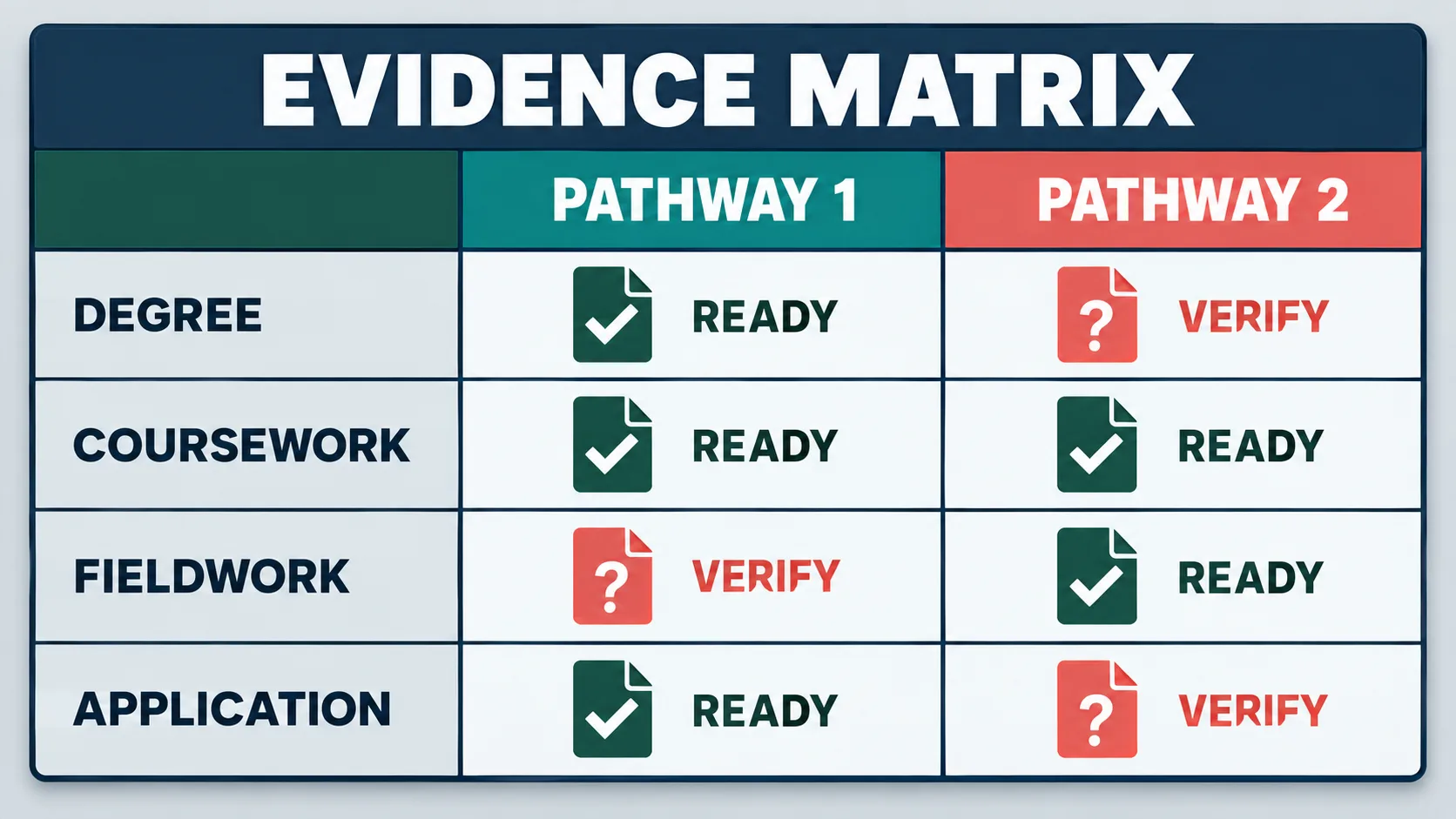
The BACB’s 2027 materials describe two post-2027 routes: a pathway based on qualifying program recognition or accreditation and a pathway based on behavior-analytic coursework with required verification. The exact definitions, dates, and documentation belong to the current BACB materials. Use this table as a sorting tool, not an eligibility ruling.
| Evidence question | Pathway 1 focus | Pathway 2 focus |
|---|---|---|
| What must the program prove? | The degree or program meets the applicable recognition or accreditation condition. | The applicant’s degree and behavior-analytic coursework meet the applicable coursework route. |
| What should you request? | Program status, degree record, transcript, and current pathway instructions. | Transcript, course map, required attestation or verification, and current handbook instructions. |
| What is the common mistake? | Assuming any online or graduate program automatically meets the route. | Assuming course titles alone prove the required content or verification. |
| What controls the decision? | The current BACB requirements, handbook, transition guidance, and official review process—not a school’s marketing language. | |
Compare the BACB’s 2027 BCBA requirements page with the handbook. If a program gives a different answer, ask which official rule and date support it.
Separate Education, Coursework, and Fieldwork
These terms are related, but they are not interchangeable. Education answers whether you hold the required degree or program evidence. Coursework answers whether the behavior-analytic content is documented through the accepted route. Fieldwork answers whether supervised practice was completed and verified. A master’s degree by itself does not prove the other two gates.
| File section | Keep together | Audit question |
|---|---|---|
| Education | Degree award, institution, dates, transcript, and pathway evidence. | Can the official record be matched to the route and application date? |
| Coursework | Course list, content mapping, syllabi or attestation, and any required institutional confirmation. | Can each required area be supported without relying on a course name alone? |
| Fieldwork | Supervisor details, dates, activities, monthly or final records, and verification. | Would an independent reviewer understand what was done, when, and under whose supervision? |
- Do not count a course because its title contains “ABA” without checking the required content and verification rule.
- Do not count fieldwork from memory; reconcile the log, supervisor records, and dates before submitting.
- Do not assume a later pathway can retroactively change how older coursework or fieldwork is evaluated.
Run the 2027 Transition Check
The 2027 change is a timing and evidence issue. The BACB says significant BCBA and BCaBA changes take effect January 1, 2027. Its transition notice states that a complete application, including payment and required documents, must be received by December 31, 2026 to be reviewed under the current 2022 requirements. A saved draft or practice score is not a complete application.
| Timing question | What to verify | Safe planning rule |
|---|---|---|
| Applying before January 1, 2027 | Whether the complete-application checkpoint and current 2022 requirements apply to your file. | Use the official transition notice; do not infer eligibility from a deadline alone. |
| Applying on or after January 1, 2027 | Which of the new pathways and documentation rules apply to your application. | Plan against the 2027 requirements page and current handbook version. |
| Using older coursework or fieldwork | Whether transition guidance preserves, changes, or limits the route for your evidence. | Ask the program, supervisor, or BACB process for written clarification rather than guessing. |
Read the BACB’s 2027 transition notice and the linked transition guidance together. The BACB’s upcoming changes page is also worth checking before you commit to a long education or supervision plan.
Know When You Are Application-Ready
“Application-ready” means your file is supported by current evidence and matches the instructions, not merely that you feel prepared. Before you submit, create a last-pass folder and check each item against the official source you used.
| Ready check | Pass condition | If it fails |
|---|---|---|
| Identity and names | Application, transcript, BACB record, and identification are consistent or supported by change evidence. | Resolve the mismatch before payment or submission. |
| Pathway evidence | The degree, coursework, and fieldwork records match the applicable pathway and date. | Return to the earliest unverified gate. |
| Application record | Required fields, declarations, uploads, payment, and confirmation are saved. | Use the live instruction or contact channel, not an old checklist. |
| Exam handoff | You know what official authorization or scheduling step follows review. | Do not book or advertise as eligible until the official status supports it. |
- Save a dated copy of the handbook or page version you relied on.
- Keep payment and submission confirmations separate from practice-test results.
- Record who owns each missing item: university, supervisor, BACB, or you.
- Set a recheck date for any item that depends on an upcoming 2027 transition.
Avoid False “I’m Eligible” Signals
Several statements sound reassuring but do not answer the BACB’s eligibility question. Treat them as prompts for verification, not as approvals. Use the official source to turn each statement into a dated, documentable checkpoint before you submit.
| Statement | Why it is incomplete | Better question |
|---|---|---|
| “I have a master’s degree.” | Degree level alone does not prove the pathway, coursework, or fieldwork gates. | What official record maps my degree and content to the applicable route? |
| “My school says the program qualifies.” | Marketing language may not reflect the current BACB requirements or your application date. | Which current BACB pathway and verification document does the program support? |
| “I finished my hours.” | Hours without valid supervision records and required verification may not establish completion. | Can my complete fieldwork file be reviewed against the applicable rule? |
| “I scored well on a mock exam.” | Practice performance is study feedback, not application approval or a pass guarantee. | Which exam-content areas should I strengthen after the eligibility gates are clear? |
Choose the Next Study Action
Once you know the earliest missing gate, choose a task that produces evidence. That makes the plan measurable and keeps study time from becoming a substitute for eligibility work.
| Earliest missing gate | This week’s deliverable | What not to do yet |
|---|---|---|
| Education or program route | A side-by-side comparison of official pathway evidence and program documentation. | Do not choose based only on delivery format, advertisements, or a promised timeline. |
| Coursework mapping | A course-to-requirement map with missing syllabi or attestation items highlighted. | Do not submit an informal spreadsheet as official proof. |
| Fieldwork documentation | A supervisor-confirmed audit of dates, activities, and records. | Do not add more hours while a basic documentation mismatch remains unresolved. |
| Exam preparation | A study block tied to a current content outline and missed-question pattern. | Do not treat a practice percentage as eligibility approval or a predicted result. |
- Write the missing gate in one sentence.
- Name the person or official source that can verify it.
- Set a date for the evidence request or review.
- Only then move to the next gate.
FAQ
Do I need to choose Pathway 1 or Pathway 2 before graduate school? Understand which official evidence the program supports before enrolling. The requirements in effect when you apply control; a school’s general statement is not a substitute for BACB materials. Can I use this article to decide that I am eligible? No. It is a self-audit structure. The BACB’s official requirements and documentation process control. Is fieldwork separate from coursework? Yes. Coursework shows academic content; fieldwork shows supervised experience and documentation. Keep separate evidence folders.
Does passing a BCBA practice test mean I should apply? No. Practice is useful after you understand the eligibility and application gates. It does not create a degree, coursework record, fieldwork verification, or BACB authorization.
Practice After the Eligibility Check
When the evidence audit tells you that exam preparation is the next gate, use practice questions to find application and content gaps. Review each missed item by task area, write the rule or concept you misapplied, and schedule a short recheck. If the missing gate is education, coursework, or fieldwork, return to that evidence task instead of using a test score to create false certainty. For a focused preparation checkpoint, try the site’s free BCBA mock exam. It is independent practice content, not an official BACB assessment, does not determine eligibility, and cannot guarantee a passing result.
Bottom line: the reliable answer to “how do I become a board certified behavior analyst?” is to follow the evidence in order: education, coursework, fieldwork, application, and exam. Check the date-sensitive 2027 transition materials, identify the earliest unverified gate, and take the next action that creates or confirms evidence.
Reviewed October 11, 2026. Always verify current requirements directly with the BACB before making an education, supervision, application, or examination decision. This review date does not replace an official eligibility determination or individual advice from the BACB.
Take the Free BCBA Mock Exam
A useful next step is to apply this idea in a fresh set of BCBA-style practice questions and review the feedback. Take the Free BCBA Mock Exam



