

Habilitation in ABA represents a fundamental principle that distinguishes applied behavior analysis from mere behavior modification. This concept focuses on building new skills and capabilities that enhance independence and improve quality of life. Understanding this principle is essential for both ethical practice and exam success.
Table of Contents
- Habilitation in ABA: What is Habilitation? A Foundational ABA Principle
- Habilitation in Action: Worked ABA Examples
- Habilitation on the BCBA® Exam: Relevance and Common Traps
- The Habilitation Checklist for Treatment Planning
- Summary: Integrating Habilitation into Your Practice
- References
Habilitation in ABA: What is Habilitation? A Foundational ABA Principle
Habilitation refers to the process of acquiring new skills, behaviors, and abilities that were never previously in an individual’s repertoire. This principle emphasizes skill development rather than just behavior reduction. It’s about building capabilities that provide access to new reinforcers and opportunities.
The Operational Definition: Building New Skills for Better Living
Operationally, habilitation involves teaching skills that increase independence across multiple domains. These include functional communication, self-care abilities, social skills, and community navigation. The key distinction from rehabilitation is that habilitation builds new capabilities, while rehabilitation focuses on regaining lost skills.
This principle aligns with the broader goals of socially significant behaviors in ABA. Effective habilitation programs consider long-term outcomes and quality of life improvements rather than just immediate behavior change.
Habilitation and the BACB Ethics Code: A Direct Link
The BACB Ethics Code explicitly supports habilitation principles through several key standards. Code 2.09 emphasizes maximizing benefits and minimizing harm, while Code 2.14 requires behavior analysts to design effective procedures. Habilitation serves as the ethical foundation for skill-acquisition programs.
When behavior analysts prioritize habilitation, they ensure interventions have long-term utility and promote client autonomy. This approach moves beyond compliance training to meaningful skill development that persists across settings and time.
Habilitation in Action: Worked ABA Examples
Understanding habilitation requires seeing it applied to real scenarios. These examples demonstrate how the principle guides assessment and intervention planning.
Example 1: Teaching Functional Communication to Replace Elopement
Consider a child who elopes from academic tasks. A traditional approach might focus on blocking escape behaviors. A habilitation-focused plan instead teaches functional communication as a replacement skill.
- Antecedent: Difficult academic task presented
- Behavior: Elopement from classroom
- Consequence: Escape from task demands
The habilitation intervention teaches the child to use a break card or verbal request for assistance. This new skill serves the same escape function but is socially appropriate and builds communication abilities.
Example 2: Building Self-Management Skills for an Adolescent
An adolescent struggles with morning routines, leading to family conflict. Rather than implementing parent-delivered prompts, a habilitation approach focuses on self-management skills.
The intervention teaches the teen to use a visual checklist and self-monitoring system. This approach fosters independence rather than creating prompt dependency. The new skills transfer to other routines and settings, demonstrating true habilitation.
Example 3: Community Habilitation: Using a Public Bus
For an adult client with limited community access, teaching public transit navigation represents classic habilitation. This skill provides access to new reinforcers like employment opportunities, social activities, and community resources.
The intervention breaks down bus navigation into teachable components: reading schedules, purchasing tickets, recognizing stops, and safety procedures. Each component builds toward greater community independence and expands behavioral repertoire.
Habilitation on the BCBA® Exam: Relevance and Common Traps
The habilitation principle appears frequently on the BCBA exam, often embedded in scenario-based questions. Recognizing how it’s tested helps avoid common mistakes.
Spotting Habilitation Questions in Scenarios
Exam questions may ask for the ‘primary rationale’ or ‘best ethical justification’ for an intervention. When answer choices include building long-term independence or teaching functional skills, habilitation is often the correct concept.
Questions might present scenarios where you must choose between habilitation-focused interventions and alternatives that only address immediate behavior reduction. The habilitation option typically emphasizes skill acquisition and quality of life improvements.
Distractors to Avoid: Rehabilitation, Normalization, and Mere Compliance
Several concepts are commonly confused with habilitation. Understanding these distinctions is crucial for exam success.
- Rehabilitation: Focuses on regaining lost skills, not building new ones
- Normalization: Aims to make behavior appear typical without functional benefit
- Compliance training: Teaches rote following of instructions without skill development
- Behavior reduction: Only decreases problem behaviors without replacement skills
True habilitation always involves meaningful skill building that increases independence and access to reinforcement. This aligns with the seven dimensions of ABA, particularly the dimensions of generality and effective outcomes.
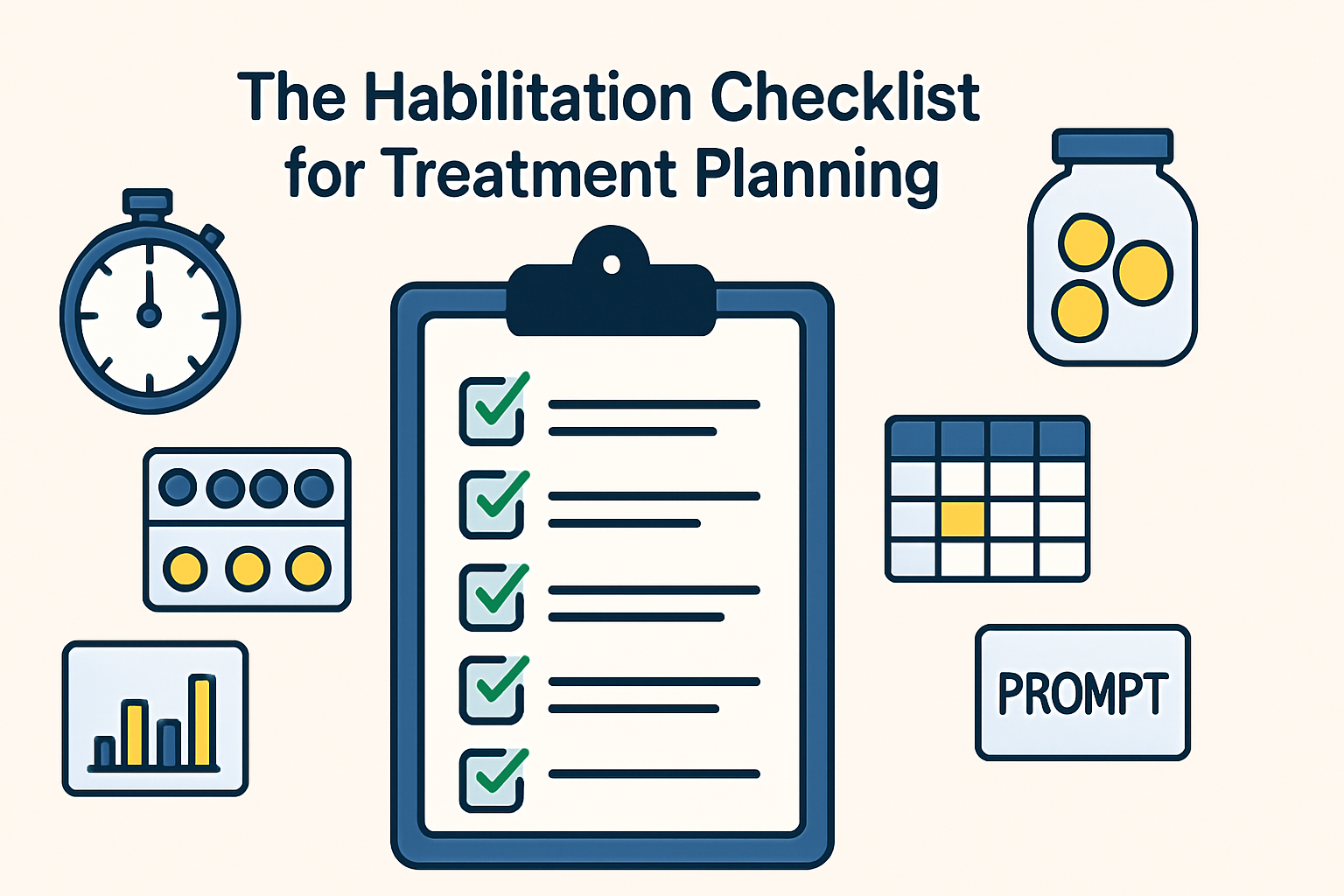
The Habilitation Checklist for Treatment Planning
This practical tool helps evaluate whether intervention plans prioritize habilitation principles. Use it during treatment planning and exam preparation.
Five Questions to Ensure Your Plan Prioritizes Habilitation
- Does this intervention teach a new skill that wasn’t previously in the repertoire?
- Will this skill increase independence in meaningful settings and situations?
- Does it provide access to new reinforcers or expand reinforcement opportunities?
- Is the skill age-appropriate and does it have social validity for stakeholders?
- Does the skill have long-term utility beyond the immediate intervention context?
If you answer ‘no’ to any question, reconsider whether your plan truly embodies habilitation principles. This checklist helps ensure interventions align with ethical ABA practice and produce meaningful outcomes.
Summary: Integrating Habilitation into Your Practice
Habilitation serves as the ethical backbone of effective ABA practice. This principle emphasizes building new skills that enhance independence and improve quality of life. When integrated into assessment and intervention, habilitation ensures behavior change has lasting value.
Remember that habilitation differs fundamentally from rehabilitation and behavior reduction approaches. It focuses on skill acquisition, independence building, and long-term outcomes. For exam preparation, recognize that habilitation questions often test your ability to prioritize interventions that build capabilities rather than just reduce problems.
As you develop treatment plans, consistently apply the habilitation checklist to ensure ethical, effective practice. This approach aligns with the BACB Professional and Ethical Compliance Code and produces outcomes that truly benefit clients across their lifespan.
References
Complete BCBA Exam Prep
Turn this topic into exam-day practice
Practice concepts in context with five full-length 6th Edition mock exams, two bonus practice exams, a 6th Edition study guide, and key-term flashcards—all in one $120 USD package.
Get the $120 All-in-One Prep Pack
Review everything included on the product page before ordering. No pass guarantee is implied.



