

Discriminative Stimulus ABA: What is a Discriminative Stimulus (Sᴰ)? A Core ABA Definition
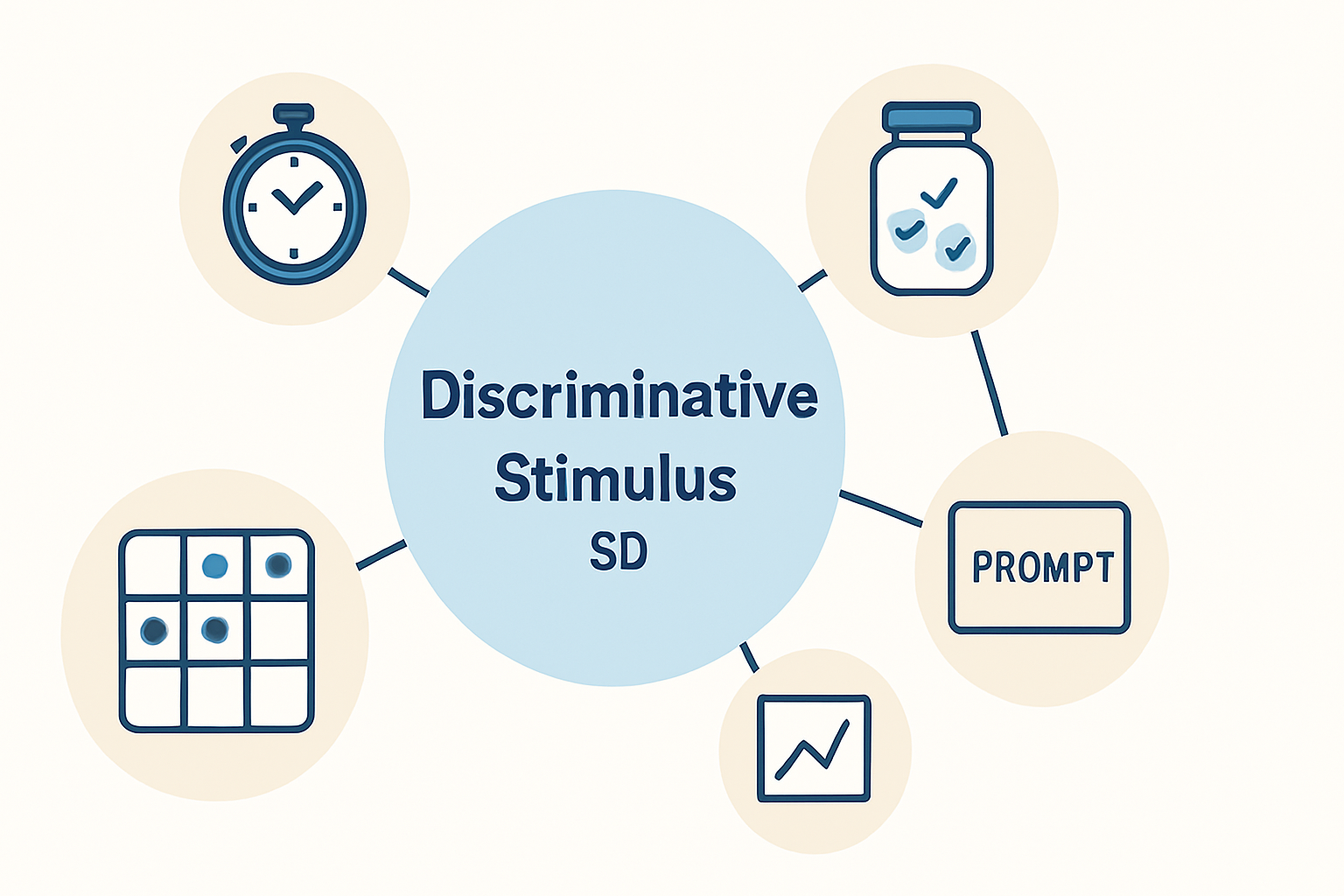
A discriminative stimulus (abbreviated as Sᴰ) is a fundamental concept in applied behavior analysis that signals the availability of reinforcement for a specific behavior. In simpler terms, it’s an antecedent event that tells you ‘if you do this behavior now, you’ll get reinforced.’ This concept is crucial for understanding how stimulus control develops in operant conditioning.
Table of Contents
- Discriminative Stimulus ABA: What is a Discriminative Stimulus (Sᴰ)? A Core ABA Definition
- Discriminative Stimulus Examples in Practice
- Sᴰ and the BCBA Exam: What You Need to Know
- Quick-Reference Checklist: Identifying a Discriminative Stimulus
- Summary and Key Takeaways
The Sᴰ gains its power through a learning history where a particular behavior has been reinforced in its presence. When this stimulus appears, it increases the likelihood of the target behavior occurring because it predicts that reinforcement is available.
The Sᴰ in the Three-Term Contingency
To truly understand discriminative stimuli, you must place them within the three-term contingency framework. This ABC model (Antecedent-Behavior-Consequence) shows how environmental events influence behavior. The Sᴰ serves as the antecedent that sets the occasion for reinforcement.
The basic formula is straightforward: Sᴰ → Behavior → Reinforcement. When the discriminative stimulus is present, and the target behavior occurs, reinforcement follows. This consistent relationship teaches organisms to discriminate when reinforcement is available.
Sᴰ vs. Other Antecedents: Motivating Operations and S-Delta
For BCBA exam success, you must distinguish between different antecedent variables. A motivating operation (MO) changes the value of a reinforcer, while an Sᴰ signals its availability. For example, being hungry (an MO) makes food more valuable, while seeing an open restaurant (an Sᴰ) signals that food-seeking behavior might be reinforced.
Equally important is understanding the S-delta (SΔ), which signals that reinforcement is NOT available for a particular behavior. If you’re looking for more detailed comparisons, our guide on Sᴰ vs. MO differences provides additional clarity.
Discriminative Stimulus Examples in Practice
Let’s move from theory to practical application with realistic scenarios that demonstrate how discriminative stimuli function in everyday and clinical settings.
Example 1: The Classroom Instruction
Consider this ABC breakdown in an educational setting:
- Antecedent (Sᴰ): Teacher says ‘Take out your math book’
- Behavior: Student retrieves math book from desk
- Consequence: Teacher provides praise (‘Great job getting ready!’)
The teacher’s instruction becomes a discriminative stimulus because it signals that compliance will lead to social reinforcement (praise). Over time, students learn that following this specific instruction reliably produces positive attention.
Example 2: The Ringing Phone
This everyday example shows discriminative control in natural environments:
- Antecedent (Sᴰ): Your phone plays your specific ringtone
- Behavior: You answer the phone call
- Consequence: Engaging conversation with a friend
The ringtone functions as an Sᴰ because it signals that answering behavior will access social interaction. Different ringtones might signal different reinforcement opportunities (work calls vs. friend calls), demonstrating stimulus discrimination.
Example 3: Clinical Application – Mand Training
In therapeutic settings, discriminative stimuli play crucial roles:
- Antecedent (Sᴰ): Presence of a preferred cookie on the table
- Behavior: Client signs ‘cookie’ using ASL
- Consequence: Receives a piece of cookie
Here, the cookie itself serves as the discriminative stimulus, not any verbal instruction. This is a key distinction in mand training where the item’s presence signals that the mand will be reinforced with access to that specific tangible.
Sᴰ and the BCBA Exam: What You Need to Know
Understanding discriminative stimuli is essential for BCBA exam success. These concepts appear frequently across multiple domains of the BACB Task List.

Common Exam Traps and How to Avoid Them
Many candidates stumble on these subtle distinctions:
- Confusing Sᴰ with a prompt: A prompt directly evokes behavior, while an Sᴰ signals reinforcement availability. Test-taking tip: If it tells you WHAT to do, it’s likely a prompt; if it tells you WHEN reinforcement is available, it’s an Sᴰ.
- Misidentifying an MO as an Sᴰ: Remember that MOs alter reinforcer value, while Sᴰs signal availability. When in doubt, ask: ‘Does this change how much I want something (MO) or does it tell me I can get it (Sᴰ)?’
- Selecting SΔ when Sᴰ is correct: S-deltas signal extinction, not reinforcement. If the scenario describes behavior NOT being reinforced, you’re likely dealing with an SΔ.
Practice Scenario for Self-Test
Try this exam-style question: ‘A child only asks for juice when the juice carton is visible on the counter. When the carton is put away, she doesn’t ask. What is the juice carton functioning as in this scenario?’
Answer: The juice carton is a discriminative stimulus. Its presence signals that asking behavior will be reinforced with juice access. Its absence (when put away) likely functions as an S-delta, signaling that asking won’t produce reinforcement.
Quick-Reference Checklist: Identifying a Discriminative Stimulus
Use this actionable checklist when analyzing scenarios:
- Check for reinforcement history: Has the behavior been reinforced when this stimulus was present?
- Verify predictive relationship: Does the stimulus predict reinforcement availability?
- Examine behavior increase: Does the stimulus increase the likelihood of the target behavior?
- Differentiate from MOs: Is it signaling availability (Sᴰ) or changing value (MO)?
- Consider stimulus class: Could similar stimuli also function as Sᴰs through generalization?
- Assess discrimination: Is there evidence the organism responds differently when Sᴰ is absent?
For more on related concepts, explore our guide to stimulus control in ABA.
Summary and Key Takeaways
Mastering discriminative stimulus concepts is essential for both clinical practice and exam success. Remember these core points:
- A discriminative stimulus signals that reinforcement is available for a specific behavior
- It functions within the three-term contingency as an antecedent that sets the occasion for reinforcement
- Critical distinctions exist between Sᴰ, motivating operations, and S-deltas
- Real-world examples demonstrate how Sᴰs develop through consistent reinforcement histories
- Exam questions often test your ability to differentiate Sᴰ from other antecedent variables
- Clinical applications rely on establishing appropriate discriminative control
For authoritative information on behavior analysis concepts, refer to the Behavior Analyst Certification Board resources and peer-reviewed journals. Understanding these foundational concepts will help you apply applied behavior analysis principles effectively in both assessment and intervention contexts.
Complete BCBA Exam Prep
Turn this topic into exam-day practice
Practice concepts in context with five full-length 6th Edition mock exams, two bonus practice exams, a 6th Edition study guide, and key-term flashcards—all in one $120 USD package.
Get the $120 All-in-One Prep Pack
Review everything included on the product page before ordering. No pass guarantee is implied.



