

Logical reasoning errors can undermine even the most carefully planned behavior interventions and lead to incorrect conclusions in assessment. One particularly common mistake is affirming the consequent, a logical fallacy that appears frequently in both clinical practice and BCBA exam questions. Understanding this error is essential for developing sound analytical skills.
Table of Contents
- What is Affirming the Consequent? The Logical Structure
- Affirming the Consequent in ABA Practice: Three Worked Examples
- Why This Matters on the BCBA Exam
- Moving From Fallacy to Sound Analysis
What is Affirming the Consequent? The Logical Structure
At its core, affirming the consequent involves incorrectly reversing a conditional statement. This fallacy occurs when someone assumes that because the consequent is true, the antecedent must also be true.
The formal structure follows this pattern: If P then Q. Q is true. Therefore, P must be true. This reasoning is flawed because multiple different antecedents could lead to the same consequent.
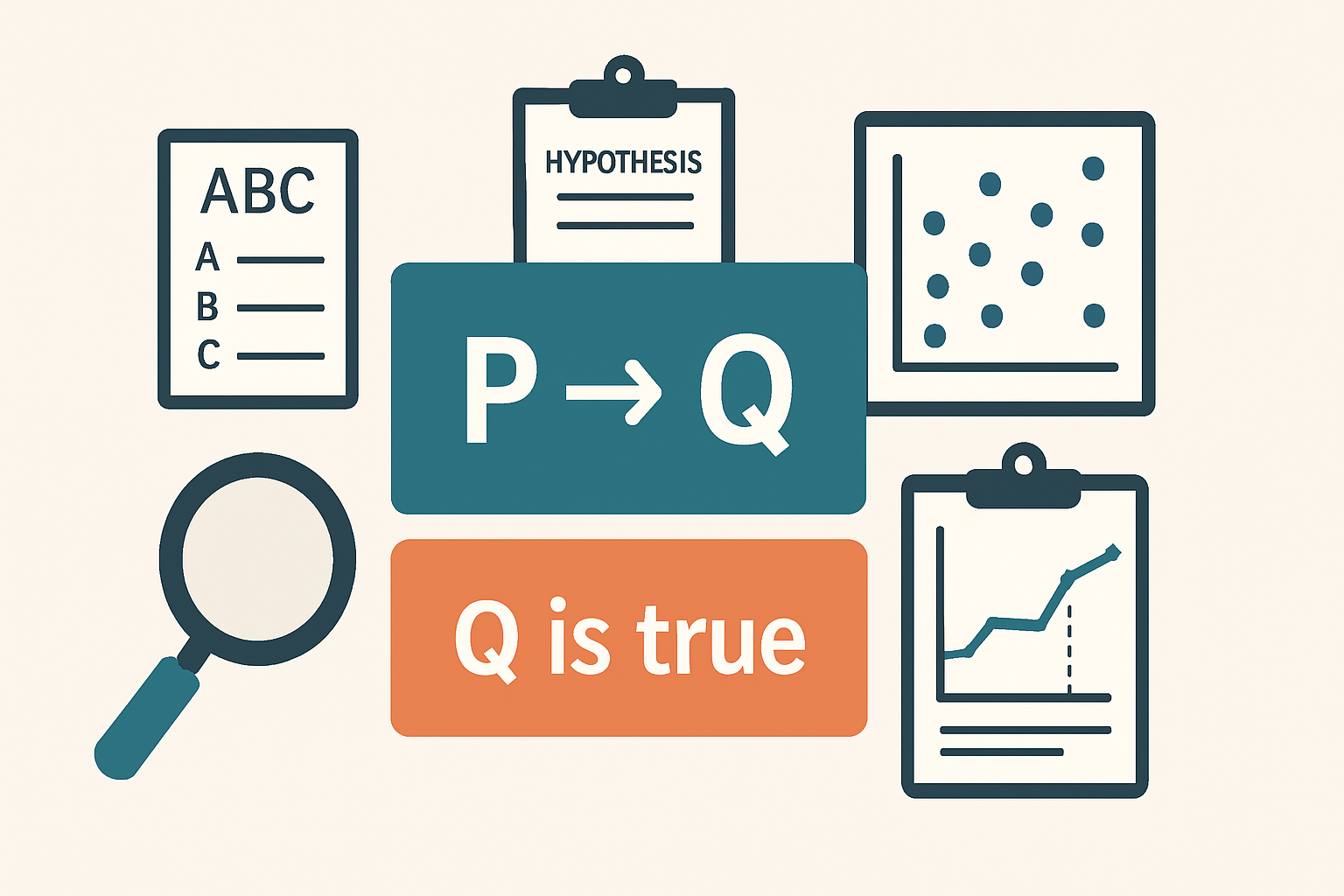
The Formal Rule vs. The Fallacious Flip
To understand the error, we need to contrast it with valid reasoning. Modus ponens represents correct logical deduction: If P then Q, P is true, therefore Q is true. This valid form follows the original conditional statement directly.
The fallacious version flips this logic: If P then Q, Q is true, therefore P is true. Consider this everyday example: If it’s raining (P), then the ground is wet (Q). The ground is wet (Q), therefore it’s raining (P). This conclusion ignores other possibilities like sprinklers, a spilled drink, or morning dew.
Affirming the Consequent in ABA Practice: Three Worked Examples
This logical error appears frequently in behavior analysis contexts, often leading to incorrect assessments and ineffective interventions. Let’s examine three realistic scenarios.
Example 1: Misinterpreting a Functional Analysis
Consider this flawed reasoning: If behavior is maintained by attention reinforcement (P), then it will occur most frequently in the attention condition during a functional analysis (Q). The behavior occurs most in the attention condition (Q), therefore it is maintained by attention (P).
The error here ignores alternative explanations. The behavior could actually be maintained by automatic reinforcement but coincidentally occur more during attention sessions due to other variables. Proper analysis requires considering all possible functions, not just the most obvious one.
Example 2: Jumping to Conclusions About Reinforcement
Another common mistake involves intervention effectiveness: If a token economy is effective (P), then target behavior will increase (Q). The behavior increased (Q), therefore the token economy was effective (P).
This reasoning fails to account for confounding variables like natural maturation, changes in medication, concurrent interventions, or alterations in setting events. Without proper experimental control, we cannot attribute behavior change to the specific intervention.
Example 3: Over-Applying a Diagnosis
Diagnostic reasoning can also fall prey to this fallacy: If a client has autism spectrum disorder (P), then they may engage in stereotypy (Q). They engage in stereotypy (Q), therefore they have autism (P).
This error is particularly dangerous as it leads to misdiagnosis and inappropriate treatment planning. Stereotypy can occur for many reasons beyond autism, including other developmental conditions, sensory processing differences, or learned patterns. Proper assessment requires comprehensive evaluation, not single-symptom reasoning.
Why This Matters on the BCBA Exam
The BCBA examination frequently tests your ability to identify logical errors in assessment and intervention scenarios. Recognizing affirming the consequent can help you avoid common traps and select the most appropriate answers.
Common Exam Traps and Question Formats
Exam questions often present scenarios where someone draws incorrect conclusions from data. You might encounter questions about interpreting functional analysis results, evaluating intervention effectiveness, or analyzing assessment data.
Watch for answer choices that make the logical jump from observing an effect to assuming a specific cause. These questions test your understanding of experimental control and proper inference from data.
Your Quick-Reference Checklist
- Identify the conditional statement – Look for ‘If P then Q’ reasoning in the scenario
- Check the evidence – Determine if only Q has been observed or demonstrated
- Consider alternatives – Ask yourself: ‘What other P could lead to this Q?’
- Reject flawed conclusions – Eliminate answers that assume P must be true based only on Q
- Look for experimental control – Proper conclusions require systematic manipulation and measurement
Moving From Fallacy to Sound Analysis
Developing strong analytical skills requires moving beyond simple conditional reasoning. Sound behavior analysis involves systematic investigation, consideration of multiple variables, and careful interpretation of data within appropriate experimental designs.
Instead of jumping to conclusions based on single observations, effective practitioners use single-subject designs to establish functional relationships. They consider multiple control conditions and systematically rule out alternative explanations through careful experimental arrangement.
For comprehensive preparation on related analytical skills, explore our guide to single-subject experimental designs, which covers the methodological foundations for avoiding logical errors in practice.
Remember that proper assessment requires considering all possible behavioral functions, not just the most apparent one. Our resource on the four functions of behavior provides a framework for comprehensive functional assessment.
For authoritative information on behavior analytic standards and ethics, consult the BACB Ethics Code, which emphasizes evidence-based decision making and proper assessment procedures.
Mastering logical reasoning is essential for both exam success and effective practice. By recognizing and avoiding affirming the consequent, you strengthen your analytical skills and improve your ability to make sound, evidence-based decisions in behavior analysis.
Next step for BCBA exam prep
Turn this topic into exam-day practice
Use this topic as a focused review, then test it in exam-style conditions with a free mock before deciding whether five full-length mocks are the right next step.
Start the Free BCBA Mock ExamContinue with Five Full-Length Mocks — $99
Review the included materials and access details before ordering. No pass guarantee is implied.



