

Understanding the mand is essential for BCBA candidates and practicing behavior analysts. This verbal operant represents one of the most functional forms of communication, directly tied to an individual’s immediate needs and wants. Mastering the mand in ABA requires precise analysis of motivating operations and reinforcement contingencies.
Table of Contents
- Mand in ABA: Defining the Mand: The Core Verbal Operant
- Analyzing Mands: Worked Examples for BCBA Candidates
- Mand Mastery for the BCBA Exam and Beyond
- References
Mand in ABA: Defining the Mand: The Core Verbal Operant
The mand stands apart from other verbal operants due to its unique relationship with motivation. Unlike tacts or intraverbals, the mand is directly controlled by the speaker’s current state of deprivation or aversion.
The Formal Definition and Its Critical Components
A mand is defined as a verbal operant where the form of the response is under the functional control of a motivating operation (MO) and is reinforced by a consequence specific to that MO. The antecedent is not merely a discriminative stimulus (SD) but rather a state of deprivation or aversion that establishes the value of a particular reinforcer.
Three critical components distinguish true mands:
- The behavior occurs because of a current motivating operation
- The response form is functionally related to the MO
- The specific reinforcement delivered matches the MO’s establishing operation
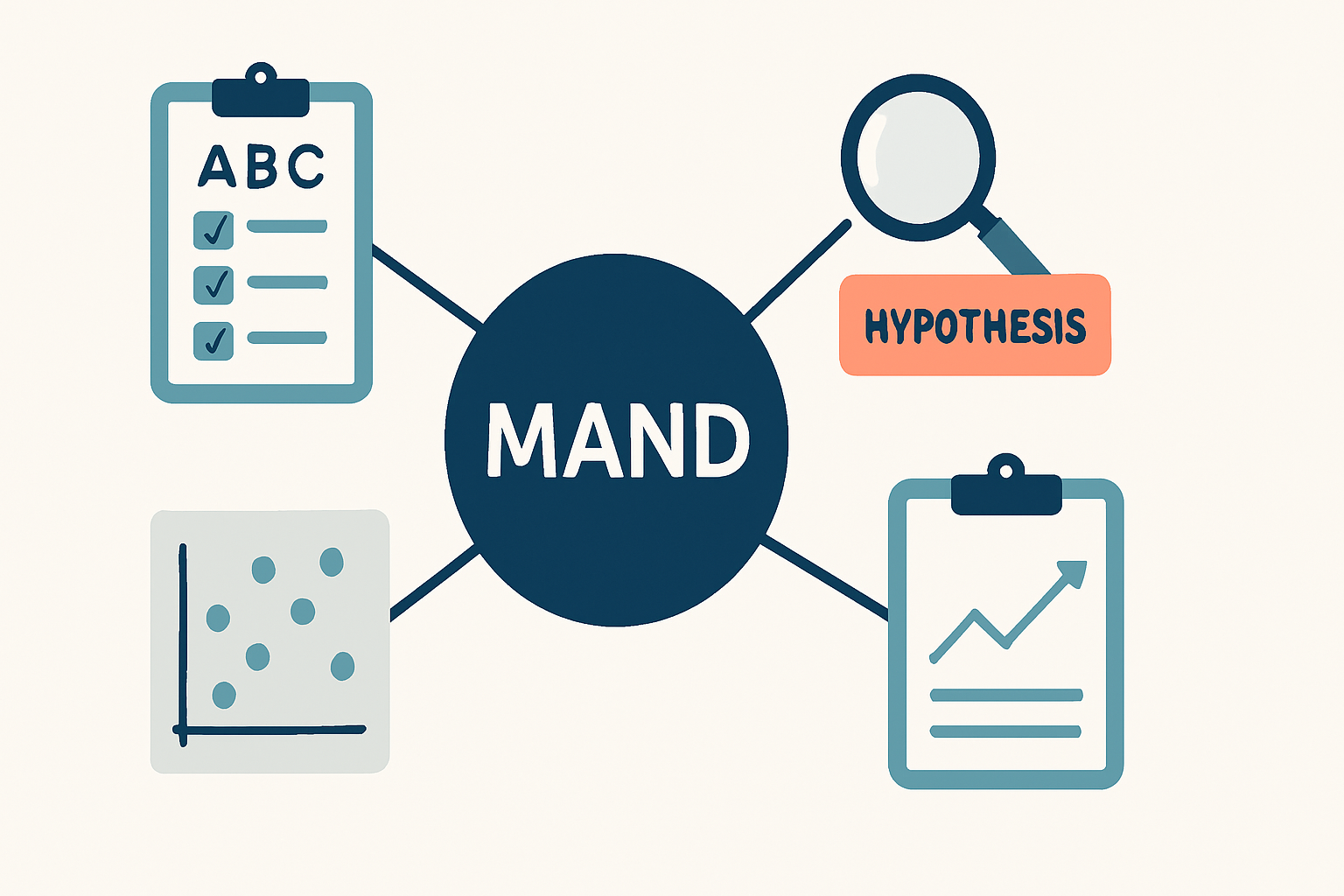
Mand vs. Tact vs. Request: Clarifying Common Confusions
Many exam questions test your ability to distinguish mands from other verbal operants. A tact is controlled by a non-verbal stimulus in the environment and reinforced by generalized conditioned reinforcement. An intraverbal is controlled by a verbal stimulus and maintains conversational flow.
Colloquial requests may not qualify as technical mands if they lack MO control. For example, a child saying ‘cookie’ when they see one (tact) versus saying ‘cookie’ when hungry (mand). This distinction is crucial for both assessment and intervention planning. Understanding these differences is fundamental to verbal operants analysis.
Analyzing Mands: Worked Examples for BCBA Candidates
Practical application requires analyzing real-world scenarios through an ABC framework. These examples demonstrate how to identify mands and their functions in clinical settings.
Example 1: The Early Learner Mand for a Tangible
Scenario: A 4-year-old child hasn’t eaten in two hours and sees cookies on the counter. She points to the cookie jar and says ‘cookie’ while making eye contact with her mother.
- Antecedent: Food deprivation (MO) combined with visual access to cookies
- Behavior: Vocalization ‘cookie’ with pointing gesture
- Consequence: Mother gives child a cookie
- Function: Access to tangible item
This represents a pure mand because the behavior is directly controlled by the MO (hunger) and reinforced by the specific consequence (cookie). The response form is functional and likely to be reinforced in the natural environment.
Example 2: The Complex Mand for Attention or Escape
Scenario: A student working on difficult math problems says ‘I need help’ to the teacher. The student has a history of receiving breaks when asking for help with challenging work.
- Antecedent: Aversive math task (MO establishing escape as reinforcing)
- Behavior: Vocalization ‘I need help’
- Consequence: Teacher provides assistance, resulting in temporary break from work
- Function: Escape from difficult task
This example highlights how the same topography (‘I need help’) can serve different functions based on the MO. The critical analysis involves determining whether the MO establishes attention or escape as reinforcing. This complexity often appears in functional behavior assessments.
Mand Mastery for the BCBA Exam and Beyond
Translating conceptual knowledge into exam success requires recognizing common patterns and applying systematic analysis. Clinical competency extends beyond identification to effective intervention design.

Common Exam Traps and How to Avoid Them
BCBA exam questions frequently test subtle distinctions that trip up unprepared candidates. Recognizing these patterns can improve your accuracy.
- Confusing MOs with SDs: Remember that mands require motivating operations, not just discriminative stimuli
- Over-relying on topography: The form of the response doesn’t determine if it’s a mand; function does
- Missing generalized reinforcement: Mands are reinforced by specific consequences, not generalized praise or attention
- Ignoring response form functionality: Even if MO-controlled, the response must be functional for the speaker’s environment
These traps often appear in scenario-based questions where multiple variables interact. Systematic analysis of the three-term contingency helps avoid these errors.
Quick-Reference Clinical Application Checklist
Use this practical checklist when analyzing potential mands in clinical practice or exam scenarios:
- Identify the current motivating operation (deprivation or aversion)
- Determine if the behavior is under functional control of that MO
- Verify that the specific reinforcer delivered relates directly to the MO
- Assess whether the response form is functional for the individual’s environment
- Consider if prompts are fading appropriately to avoid prompt dependency
- Evaluate if the mand generalizes across settings, people, and materials
This systematic approach ensures comprehensive analysis and effective intervention planning. For related concepts, explore our guide to conditioned motivating operations.
Mastering the mand requires both conceptual understanding and practical application skills. By focusing on the functional relationship between MOs, behavior, and specific reinforcement, you can accurately identify mands, avoid common exam traps, and design effective communication interventions. This knowledge forms the foundation for teaching functional communication skills that directly improve quality of life.



