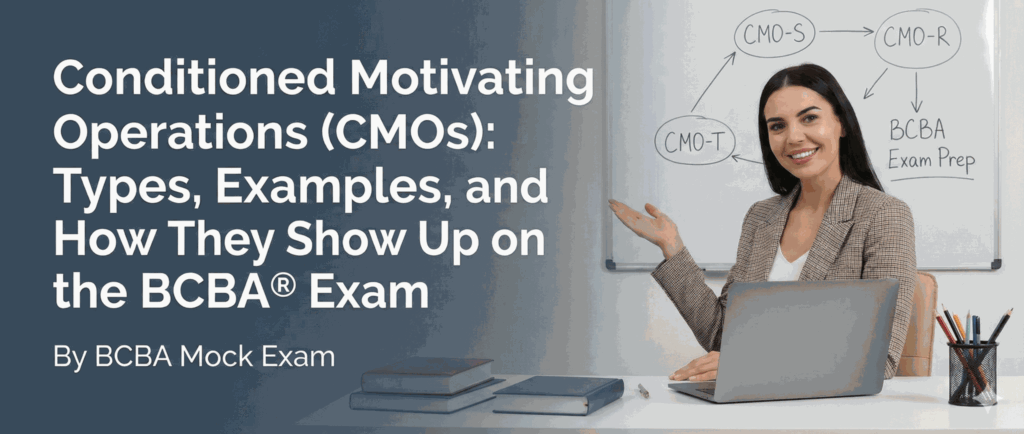
Conditioned Motivating Operations (CMOs): Types, Examples, and How They Show Up on the BCBA® Exam
By BCBA Mock Exam
If you’re preparing for the BCBA® exam, motivating operations (MOs) are one of those topics that look simple in the textbook but feel confusing in scenarios—especially when the exam starts talking about CMO-S, CMO-R, and CMO-T.
The good news: once you see clear examples of each type of CMO and know how they’re tested, most of the confusion goes away.
In this article, we’ll cover:
-
What motivating operations (MOs) are in plain language
-
The difference between unconditioned MOs (UMOs) and conditioned MOs (CMOs)
-
The three types of CMOs: surrogate, reflexive, and transitive
-
Everyday and ABA examples of each CMO type
-
How CMOs show up on the BCBA® exam and how to decode those questions
1. Quick Review: What Is a Motivating Operation (MO)?
Before we talk about CMOs, we need to get the basic MO idea clear.
A motivating operation (MO) is an environmental event that:
-
Changes how much you value a reinforcer or punisher right now (value-altering effect), and
-
Changes how frequently you engage in behaviors that have produced that consequence in the past (behavior-altering effect).
In simpler language:
MOs temporarily change how much you want something and how likely you are to do behaviors that get it.
Classic examples:
-
Food deprivation → increases the value of food and evokes food-seeking behavior
-
Having just eaten a big meal → decreases the value of food and reduces food-seeking behavior
-
Extreme heat → increases value of shade/cool water and evokes behaviors like moving to shade, turning on AC
These are usually Unconditioned MOs (UMOs), because they work without learning.
2. UMOs vs CMOs: What’s the Difference?
Unconditioned Motivating Operations (UMOs)
-
Their value-altering effects do not depend on learning
-
Examples: deprivation and satiation of food, water, sleep, oxygen; extreme temperatures; sexual reinforcement
A newborn doesn’t need to learn that food deprivation makes food valuable—this is unconditioned.
Conditioned Motivating Operations (CMOs)
-
Their value-altering and behavior-altering effects depend on a learning history
-
They become MOs because of being paired with other MOs or reinforcement contingencies
Exam-friendly definition: A conditioned motivating operation (CMO) is a motivating operation whose value-altering effect depends on a learning history.
CMOs are the “learned” version of MOs. There are three types:
-
CMO-S (Surrogate)
-
CMO-R (Reflexive)
-
CMO-T (Transitive)
These three labels are extremely testable.
3. Type 1: Surrogate CMO (CMO-S)
Concept
A Surrogate CMO (CMO-S):
-
Acquires its MO effects by being paired with another MO
-
After enough pairings, the new stimulus takes on the same value-altering and behavior-altering effects as the original MO
In simple terms:
Something becomes an MO just by being repeatedly paired with another MO. It becomes a “surrogate” for the original MO.
Everyday Example
Imagine this:
-
Every time you’re sleep-deprived (UMO for sleep), you also drink coffee and sit in the same chair in a specific corner of your living room.
-
Over time, just sitting in that chair, even when you’re not sleep-deprived, may start to evoke coffee-craving and “I should rest” feelings.
That chair has been paired with the sleep-deprivation+coffee situation so often that it starts to act like a surrogate MO for rest/coffee.
ABA Example
-
A therapist always turns on a specific white noise machine whenever a child is deprived of attention and about to receive 1:1 attention in a quiet room.
-
Over many sessions, the sound of the white noise alone may start to increase the child’s behavior that previously led to attention—even before attention deprivation is strong.
The white noise is functioning as a CMO-S because it acquired MO effects via pairing with a condition where attention was highly valuable.
Exam Clue for CMO-S Look for:
A neutral stimulus that is repeatedly paired with an existing MO
Later, that neutral stimulus alone changes the value of a reinforcer and evokes related behavior
Key phrase: “after repeated pairings with…” / “began to evoke the same behaviors as…”
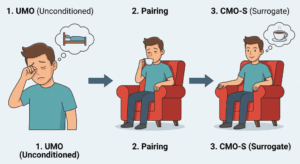
The following image illustrates the concept of a Surrogate CMO, showing how a neutral item (chair) can become a CMO through pairing.
4. Type 2: Reflexive CMO (CMO-R)
Concept
A Reflexive CMO (CMO-R):
-
Is associated with worsening or improving conditions
-
Signals that something good or bad is about to happen based on a history of contingencies
-
Alters the value of its own removal or occurrence as a reinforcer
Very exam-friendly way to think about it:
CMO-R often looks like a “warning signal”: “If this happens, things will get worse (or better) soon.” Because of this, behaviors that avoid, escape, or change that signal become more likely.
Everyday Example (Worsening Conditions)
-
Your boss’s “We need to talk in my office” tone, paired repeatedly with criticism or punishment, can become a CMO-R.
-
Over time, hearing that tone increases the value of getting out of the situation and evokes avoidance behaviors (e.g., making excuses, delaying, changing the subject).
The tone signals worsening conditions and makes escape/avoidance more reinforcing.
ABA Example (Demands and Escape)
-
A child has repeatedly experienced a therapist’s “Work time!” cue followed by difficult tasks + no breaks.
-
Over several sessions, the phrase “Work time!” becomes a CMO-R:
-
It signals that aversive conditions (hard work, no break) are coming
-
The value of escape (e.g., leaving the table, tantrum) is increased
-
Escape-maintained behaviors are evoked when that cue appears
-
If the therapist later pairs “Work time!” with fun tasks, reinforcement, and more frequent breaks, the CMO-R effect can weaken.
Exam Clue for CMO-R Look for:
A stimulus that precedes worsening conditions (punishment, aversive tasks, loss of reinforcement)
The stimulus increases the value of escape or avoidance
Behaviors that remove or avoid that stimulus are more likely
Phrases like “signals that more work is coming” / “signals that punishment is likely” / “correlated with worsening conditions”
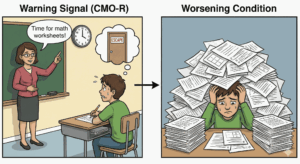
The following image visualizes the concept of a Reflexive CMO acting as a warning signal for a worsening condition, increasing the value of escape.
5. Type 3: Transitive CMO (CMO-T)
Concept
A Transitive CMO (CMO-T):
-
Makes something else into an effective reinforcer or punisher
-
Often involves a problem or barrier, so that certain objects or events suddenly become valuable to solve that problem
Simple version:
A CMO-T is when a new reinforcer becomes valuable because it’s needed to get something else.
Everyday Example
-
You want to unlock your home door (already a valuable goal).
-
You realize the door is locked.
-
Suddenly the key becomes extremely valuable, because it is needed to access the house.
The locked door acts as a CMO-T:
-
It increases the value of the key as a reinforcer
-
It evokes key-seeking behaviors
ABA Example
-
A child really wants to play with a tablet (highly preferred).
-
The tablet is locked with a password or kept in a closet—the child cannot access it directly.
-
Suddenly, the adult who knows the password or the closet key becomes highly valuable.
-
The child is more likely to request help, follow instructions, or complete tasks to get that help.
The blocked access (tablet locked or put away) functions as a CMO-T, making help/assistance (or key, or password) into effective reinforcers.
Exam Clue for CMO-T Look for:
A situation where access to a reinforcer is blocked or conditional
Another object, person, or behavior becomes necessary to access that reinforcer
That necessary thing suddenly increases in value and evokes behavior
Phrases like “in order to obtain… the client must first…” / “now the key/assistance is required…”
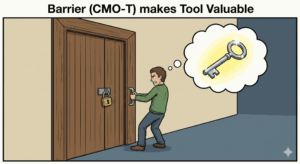
The following image illustrates the concept of a Transitive CMO, where a barrier (locked door) makes a tool (key) valuable.
6. CMOs vs SDs: A Common Exam Trap
CMOs and SDs both come before behavior, but they do different jobs:
SD (Discriminative Stimulus)
-
Signals that reinforcement is available for a specific behavior
-
Related to the availability of reinforcement
-
Example: “OPEN” sign on a shop → signals you can now buy items
CMO
-
Changes how much you care about a reinforcer (value-altering)
-
Evokes or abates behaviors that historically produce that reinforcer
-
Example: not having eaten all day → food is more valuable → food-seeking is evoked
Exam shortcut:
-
Ask yourself:
-
Is this cue telling me that reinforcement is available right now? → SD
-
Or is it changing how much I want the reinforcer or making something else become a reinforcer? → MO/CMO
-
In many questions, the correct answer will mention both SD and MO, but you must pick the one that matches what the stem actually describes.
7. How CMOs Show Up on the BCBA® Exam
Typical patterns include:
-
Labeling the type of CMO in a scenario (CMO-S, CMO-R, CMO-T)
-
Distinguishing CMO vs UMO vs SD
-
Identifying a warning stimulus as a CMO-R
-
Identifying a blocked access situation as a CMO-T
-
Describing pairing procedures that create a CMO-S
Common wording:
-
“After repeated pairings with deprivation of X, the presence of Y now…” → CMO-S
-
“The instruction has been consistently followed by a series of difficult tasks…” → CMO-R
-
“In order to access the preferred activity, the learner must first obtain…” → CMO-T
8. Step-by-Step Strategy for CMO Questions
When you see a question about MOs/CMOs, walk through these steps:
-
Identify the reinforcer or consequence first.
-
What outcome is valuable in this scenario? (e.g., escape, attention, access to item)
-
-
Ask: What made this outcome more or less valuable right now?
-
Deprivation/satiation (food, water, sleep etc.) → likely UMO
-
Pairing with another MO → likely CMO-S
-
Signal of worsening/improving conditions → likely CMO-R
-
Blocked access that makes a tool/help/key more valuable → likely CMO-T
-
-
Check if it’s actually an SD instead.
-
If the main effect is “telling you reinforcement is available” with an existing history of reinforcement → SD
-
If the main effect is “making something more valuable and evoking behavior” → MO/CMO
-
-
Match the description with the specific CMO type using the simple tags:
-
CMO-S → paired with another MO
-
CMO-R → warning signal for worsening conditions
-
CMO-T → problem/barrier that makes something else become a reinforcer
-
9. Mini Practice Questions (With Explanations)
Question 1 – Which CMO Type?
A student has repeatedly experienced the instruction “Time for math” followed by long, difficult worksheets with few breaks. Over time, when the teacher says “Time for math,” the student immediately begins to complain, leave their seat, or ask to go to the bathroom. Escape behavior is frequently reinforced by brief breaks.
Which type of CMO best describes the teacher’s statement “Time for math”?
A. CMO-S (Surrogate) B. CMO-R (Reflexive) C. CMO-T (Transitive) D. Unconditioned MO
Correct Answer: B
Why?
“Time for math” has become correlated with worsening conditions (long, difficult tasks, few breaks).
It increases the value of escape and evokes escape behaviors.
This matches a Reflexive CMO (CMO-R), which is often a warning stimulus.
Question 2 – Blocked Access
A child loves playing a specific computer game. The game is now password-protected. To play, the child must ask an adult to enter the password. Since the password was added, the child’s requests for help from the adult have increased.
What is functioning as a CMO-T (Transitive CMO) in this scenario?
A. The child’s general interest in computer games B. The adult who knows the password C. The password requirement that blocks direct access to the game D. The computer itself
Correct Answer: C
Why?
The password requirement is a barrier that makes help from the adult suddenly more valuable.
The password requirement is the event that alters the value of help and evokes help-seeking behaviors.
That is exactly what a Transitive CMO (CMO-T) does.
Question 3 – Paired Stimulus
During early intervention, a therapist always wears a specific bright green lanyard when delivering highly preferred social games and snacks to a learner who is usually food-deprived. After many sessions, when the learner sees the green lanyard—before any food is presented—they smile, move closer, and start requesting.
The green lanyard is best described as:
A. An SD that signals food is available B. A CMO-S that has acquired value-altering effects through pairing C. A CMO-R correlated with worsening conditions D. A CMO-T because it blocks access to other reinforcers
Correct Answer: B
Why?
The green lanyard was neutral at first and was repeatedly paired with an existing MO condition (food deprivation + access to highly preferred items).
Over time, it acquired similar value-altering and behavior-altering effects.
That matches a Surrogate CMO (CMO-S).
10. Key Takeaways
-
CMOs are learned MOs whose effects depend on a learning history.
-
There are three major types:
-
CMO-S (Surrogate) – acquires MO effects through pairing with another MO
-
CMO-R (Reflexive) – correlated with worsening or improving conditions, often a warning signal
-
CMO-T (Transitive) – makes another stimulus into an effective reinforcer because it is needed to solve a problem or gain access
-
-
On the BCBA® exam, CMOs often appear in scenario questions where you must:
-
Identify the type of CMO,
-
Distinguish MO vs SD, or
-
Spot blocked access or warning signals that change the value of consequences.
-