ABA Terms

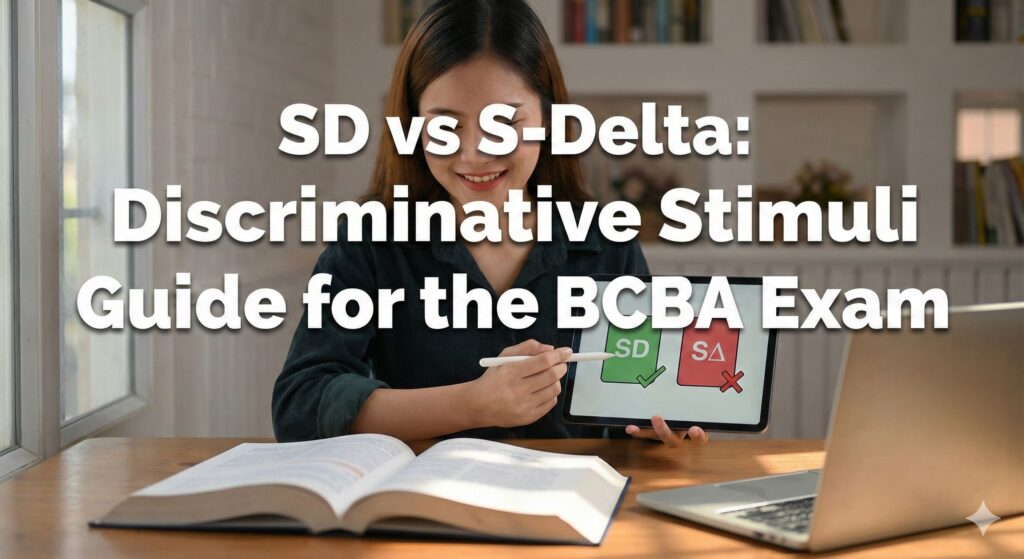
Discriminative Stimuli (SD) and S-Delta: How Stimuli Signal Reinforcement, Punishment, and Extinction

Discriminative Stimuli (SD) and S-Delta: How Stimuli Signal Reinforcement, Punishment, and Extinction By BCBA Mock Exam Introduction Discriminative stimuli and S-Delta in ABA work show up everywhere—SDs and S-deltas (SΔs) are all over practice and the BCBA® exam. You’re expected to be able to: Define SD and SΔ in clear, behavior-analytic terms Recognize how stimuli […]
Discriminative Stimuli (SD) and S-Delta: How Stimuli Signal Reinforcement, Punishment, and Extinction Read More »

Discriminative Stimulus ABA: Definition, Examples, and Exam-Style Questions

Discriminative Stimulus ABA: Definition, Examples, and Exam-Style Questions Introduction If you’re preparing for the BCBA® exam, you must be solid on the idea of the discriminative stimulus in ABA (SD). The term shows up everywhere: in stimulus control questions, discrimination training, verbal behavior, and functional communication. You’re expected to be able to: Define discriminative stimulus

Discriminative Stimulus ABA: Definition, Examples, and Exam-Style Questions Read More »

Respondent Behavior vs Operant Behavior: How to Tell Them Apart in Real Life and on the Exam

Respondent Behavior vs Operant Behavior: How to Tell Them Apart in Real Life and on the Exam By BCBA Mock Exam Introduction Respondent and operant behavior show up all over the BCBA® exam—often in the same question. You’re expected to: Know the definition of each Recognize them in real-life style scenarios Understand how consequences relate

Respondent Behavior vs Operant Behavior: How to Tell Them Apart in Real Life and on the Exam Read More »

Respondent Conditioning (Classical Conditioning): Key Terms, Examples, and Common BCBA® Question Types By BCBA Mock Exam

Respondent Conditioning (Classical Conditioning): Key Terms, Examples, and Common BCBA® Question Types By BCBA Mock Exam Introduction Respondent (classical) conditioning doesn’t get as much attention as operant behavior in everyday ABA practice—but it still shows up on the BCBA® exam. Even if you don’t run Pavlov-style bell-and-salivation experiments, you’re expected to: Know the key terms

Respondent Conditioning (Classical Conditioning): Key Terms, Examples, and Common BCBA® Question Types By BCBA Mock Exam Read More »

Variable Dependency and Experimental Control: Understanding IV, DV, and Confounds for the BCBA® Exam

Variable Dependency and Experimental Control: Understanding IV, DV, and Confounds for the BCBA® Exam By BCBA Mock Exam Introduction Independent variables (IVs), dependent variables (DVs), and confounding variables show up all over the BCBA® exam—especially in questions about experimental design, graphs, and functional relations. But the exam doesn’t just ask you to define terms. It

Variable Dependency and Experimental Control: Understanding IV, DV, and Confounds for the BCBA® Exam Read More »

Independent and Dependent Variables in ABA: Simple Definitions, Graph Examples, and BCBA® Exam Tips

Independent and Dependent Variables in ABA: Simple Definitions, Graph Examples, and BCBA® Exam Tips By BCBA Mock Exam Introduction You don’t pass the BCBA® exam just by memorizing definitions. You also need to quickly recognize what is being manipulated and what is being measured in a scenario or graph. In experimental design language, those are

Independent and Dependent Variables in ABA: Simple Definitions, Graph Examples, and BCBA® Exam Tips Read More »

How to Turn ABA Concepts into Exam Points: A Study Framework Using Mock Exams and Task List Terms

How to Turn ABA Concepts into Exam Points: A Study Framework Using Mock Exams and Task List Terms By BCBA Mock Exam Introduction You don’t pass the BCBA® exam just by “knowing ABA.” You pass when you turn ABA concepts into exam points on specific questions. That means: Connecting what you study to Task List

How to Turn ABA Concepts into Exam Points: A Study Framework Using Mock Exams and Task List Terms Read More »

Ethics in ABA Practice: Applying the Code to Real Scenarios and BCBA® Exam Questions

Ethics in ABA Practice: Applying the Code to Real Scenarios and BCBA® Exam Questions By BCBA Mock Exam Introduction Ethics is more than a separate section of the BCBA® exam—it’s woven into almost every question. The exam doesn’t just test whether you can recite parts of the Ethics Code. Instead, it wants to know whether

Ethics in ABA Practice: Applying the Code to Real Scenarios and BCBA® Exam Questions Read More »

Single-Subject Experimental Designs: Reversal, Multiple Baseline, Alternating Treatments & Changing Criterion

Single-Subject Experimental Designs: Reversal, Multiple Baseline, Alternating Treatments & Changing Criterion By BCBA Mock Exam Introduction Single-subject experimental designs are a core part of ABA—and a favorite topic on the BCBA® exam.  These designs let you: Demonstrate a functional relation between your intervention and behavior change Make data-based decisions for individual clients Show that changes

Single-Subject Experimental Designs: Reversal, Multiple Baseline, Alternating Treatments & Changing Criterion Read More »

Treatment Integrity and Social Validity: Subtle but Important Topics on the BCBA® Exam

Treatment Integrity and Social Validity: Subtle but Important Topics on the BCBA® Exam By BCBA Mock Exam Introduction Treatment integrity and social validity might feel like “side topics” compared to functions of behavior or measurement—but they show up on the BCBA® exam more often than many candidates expect.  The exam wants you to think like

Treatment Integrity and Social Validity: Subtle but Important Topics on the BCBA® Exam Read More »