
BCBA major is a useful search phrase, but it can hide an important distinction: your undergraduate major can prepare you for behavior analysis without being the requirement that makes you eligible for BCBA certification. For the 2027 rules, the decisive questions move toward the qualifying master’s degree, behavior-analytic coursework, supervised fieldwork, and examination pathway.
Table of Contents
- Is There One Best BCBA Major?
- What Should Your Major Prepare You to Do?
- ABA, Psychology, or Special Education?
- How Does the 2027 BCBA Pathway Change the Decision?
- How to Verify a Program Before You Enroll
- Courses and Skills That Transfer Well
- How Your Major Connects to Fieldwork
- Questions to Ask an Advisor
- Common BCBA Major Mistakes
- Use the Choice as Exam Preparation
- BCBA Major FAQ
- Take the Free BCBA Mock Exam
This guide helps you choose an academic foundation and check the next step. It is educational, not an admission decision, certification determination, licensure opinion, or guarantee that a particular program will satisfy the BACB. Always compare your plan with the current BACB requirements and the program’s written documentation. Table of Contents
Is There One Best BCBA Major?
No single bachelor’s major is universally required for BCBA certification. That conclusion follows from the BACB’s 2027 eligibility structure: the degree and coursework gates are described at the graduate level, and Pathway 2 requires a master’s degree or higher from a qualifying institution in any field plus behavior-analytic coursework. Pathway 1 centers on a qualifying accredited or recognized behavior-analysis degree program. In other words, an undergraduate major can be strategically helpful, but it does not replace the graduate degree, coursework, fieldwork, or examination requirements.
The best choice is therefore the major that gives you a strong academic base, keeps the graduate options you want open, and fits how you learn. An applied behavior analysis major may provide earlier exposure to behavior principles. Psychology may offer broader research and human-behavior coursework. Special education may add useful knowledge of instruction, disability services, and school systems. A related major can also work if you deliberately add the prerequisites and experiences that your future program expects.
Do not choose only from a label. Ask what you will actually study, how much research and statistics you will complete, whether you can obtain relevant experience, and whether the schools you may apply to accept that background. A familiar major with weak preparation can be less useful than a less obvious major with excellent advising, writing, data, and applied-learning opportunities.
What Should Your Major Prepare You to Do?
A strong undergraduate foundation should help you read evidence, describe behavior precisely, communicate with different audiences, and learn from data. Those skills matter whether your next step is an ABA master’s program, a psychology program with behavior-analytic coursework, or another qualifying route.
- Observe and define: practice turning broad concerns into observable, measurable descriptions rather than labels such as “unmotivated” or “defiant.”
- Read and question research: learn how to identify a research question, compare methods, notice limitations, and explain what a result does—or does not—support.
- Use data: build comfort with graphs, basic statistics, measurement, reliability, and the difference between a change in behavior and a change in recording.
- Write clearly: develop concise academic and professional writing for case summaries, family communication, treatment rationale, and team decisions.
- Work respectfully: understand disability, culture, context, assent or choice, and the difference between a support need and a judgment about a person.
These are preparation goals, not a hidden list of BACB requirements. Use them to compare curricula, not to assume that one department’s course title will automatically count toward future certification.
ABA, Psychology, or Special Education?
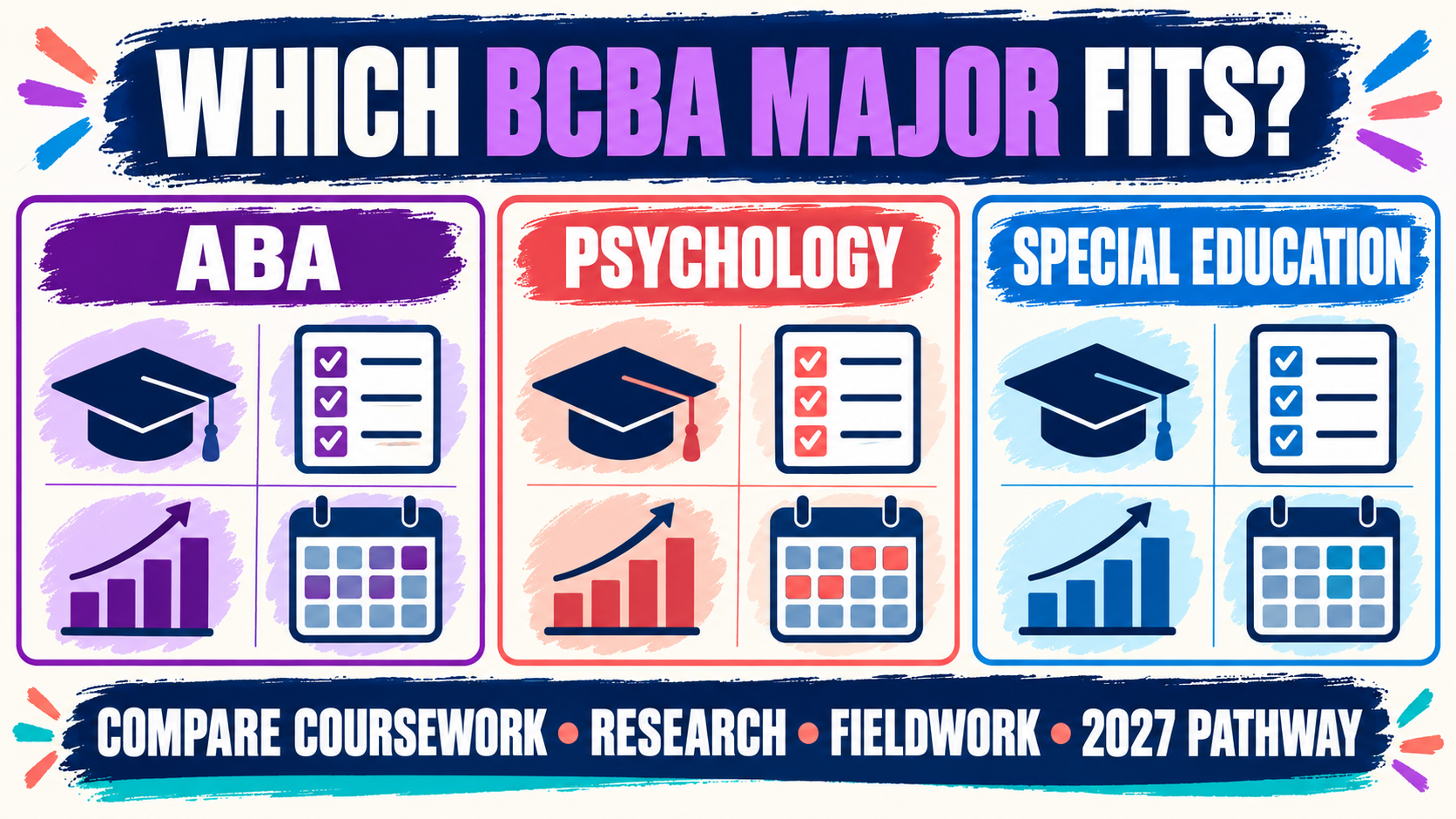
Each major can be a reasonable starting point, but each creates a different verification task. The table below is a planning tool, not a ranking. “Best” depends on your target graduate programs, budget, location, interests, and the support you can actually access.
| Possible major | Potential strength | What to verify | Common limitation |
|---|---|---|---|
| Applied behavior analysis | Early exposure to behavior principles, measurement, intervention, and applied examples. | Whether the bachelor’s curriculum is designed for graduate preparation or has a clear bridge to a qualifying master’s. | A major name alone does not prove that a graduate pathway or specific coursework will qualify. |
| Psychology | Broad study of behavior, research methods, statistics, development, and assessment. | Behavior-analytic electives, applied experience, faculty advising, and prerequisites for the target graduate programs. | A general psychology degree may leave behavior analysis, single-case design, or field experience to you. |
| Special education | Instruction, disability services, classroom systems, collaboration, and individualized supports. | Research and measurement depth, behavior-analytic coursework, and whether the program meets your graduate admissions prerequisites. | Strong educational preparation is not the same as qualifying behavior-analytic coursework. |
| Related major | A close fit with your interests, language, health, education, or research goals. | Every prerequisite, data skill, writing expectation, and behavior-analytic opportunity required by your next program. | You may need more deliberate planning to demonstrate fit to an ABA graduate admissions team. |
The practical winner is the option you can complete well while building the next bridge. Compare required courses and actual learning outcomes—not only the department name, marketing copy, or a promise that graduates “can become a BCBA.”
How Does the 2027 BCBA Pathway Change the Decision?
The BACB 2027 BCBA Requirements describe two pathways beginning January 1, 2027. Pathway 1 uses a master’s degree or higher from an APBA-accredited program or an ABAI-accredited or recognized behavior-analysis degree program. Pathway 2 uses a master’s degree or higher from a qualifying institution in any field plus behavior-analytic coursework that meets the stated requirements, supervised fieldwork, and the examination.
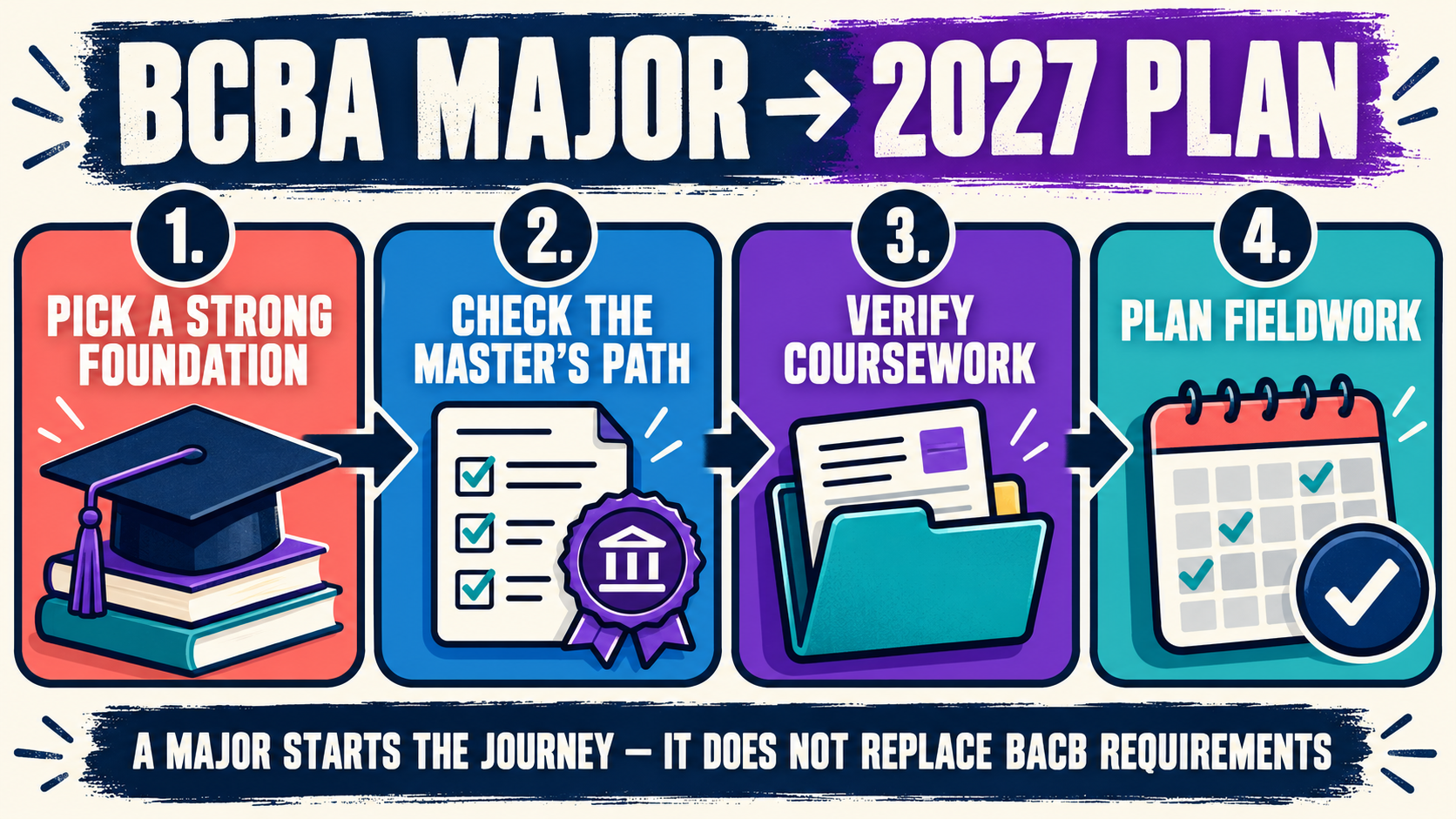
The BACB transition guidance is especially important if your timeline crosses the change date. It explains that coursework structures, freestanding-course expectations, content-hour allocations, and fieldwork documentation change under the 2027 requirements. It recommends planning with an advisor or supervisor when you are unsure which application requirements will apply. What does that mean for your major? It means you should work backward from the graduate pathway rather than assuming that your bachelor’s title decides the outcome:
- Choose a foundation: select a major where you can build research, writing, data, and applied experience.
- Choose the graduate route: decide whether you are comparing an accredited/recognized behavior-analysis degree or a Pathway 2 program with an authorized contact and qualifying coursework.
- Check the 2027 map: compare the program’s written course structure, fieldwork guidance, and application timeline with the current BACB documents.
- Keep evidence: save syllabi, transcripts, advising notes, fieldwork records, and program correspondence. A website slogan is not an eligibility file.
The BACB’s university training resource also distinguishes the two training options and explains what students experience when applying. Use it as a starting point, then confirm the program’s current status directly.
How to Verify a Program Before You Enroll
Before committing time and tuition, run a four-part check. First, ask the program whether it is describing the bachelor’s degree, the master’s degree, or only a recommended sequence. Second, request the current curriculum and identify where research methods, measurement, single-case design, intervention, ethics, and statistics are taught. Third, ask how graduates are expected to meet the 2027 pathway requirements. Fourth, ask what the program can attest to and what must be verified by the BACB or another authority.
Be precise about the word qualifying. A school may offer a helpful course without that course being the same as a qualifying Pathway 2 course. A program may support future fieldwork without being the supervisor or employer that documents it. An ABA-labeled bachelor’s degree may still require a separate master’s plan. Get these distinctions in writing.
Also verify admissions reality: prerequisite grades, statistics requirements, recommendation letters, experience expectations, online or in-person delivery, transfer-credit rules, and the cost of completing missing courses. The most efficient major is not useful if it leaves you unable to enter the graduate program you actually want.
- Degree: confirm whether the page describes a bachelor’s degree, a qualifying master’s degree, or both.
- Coursework: ask for current syllabi, content hours, delivery format, and the person responsible for pathway questions.
- Fieldwork: separate a practicum or internship from supervised fieldwork that is documented under the applicable BACB requirements.
- Timeline: identify which rules and forms could apply when you expect to submit your application.
Courses and Skills That Transfer Well
When comparing two majors, look for evidence of learning rather than an impressive course list. Helpful experiences can include research design, data collection, graphing, statistics, child or adult development, disability studies, communication, ethics, writing-intensive assignments, and supervised applied projects. An internship can be valuable when it includes training, feedback, and reflection instead of only observation hours.
Ask whether you will be able to explain why a measure fits a behavior, how a graph supports a decision, and what a study cannot establish. Those questions are useful in graduate coursework, fieldwork meetings, and the BCBA exam. They also reduce the risk of treating a major as a shortcut rather than a foundation.
How Your Major Connects to Fieldwork
Your major does not automatically create qualifying supervised fieldwork. Fieldwork must be planned and documented under the requirements that apply to your application, with an appropriate supervisor and setting. Your undergraduate experience may help you find a relevant role, but employment in an ABA setting is not, by itself, proof that every hour will count.
Ask future programs and supervisors how students learn the difference between direct service, unrestricted activities, supervision, documentation, and ordinary job duties. If your plan crosses January 1, 2027, review the BACB transition guidance carefully and maintain records that match the requirements in effect when you apply. Do not let a major’s practicum description substitute for a fieldwork agreement.
Questions to Ask an Advisor
- Which graduate programs do students from this major commonly enter, and what prerequisites do those programs require?
- Where will I learn measurement, data display, single-case design, behavior assessment, and research methods?
- Which courses are required, which are electives, and which can be taken before graduation?
- Does this major offer a clear bridge to a 2027 BCBA Pathway 1 or Pathway 2 plan, or is that a separate decision?
- What applied experiences include supervision, feedback, and documented learning outcomes?
- How often is the curriculum reviewed against BACB updates, and who can answer pathway questions?
- What would I need to add if I later choose a different graduate program?
Take the answers home and compare them with the official BACB documents. An advisor can explain a curriculum; the BACB controls certification requirements.
Common BCBA Major Mistakes
- Assuming the bachelor’s title is the credential: BCBA eligibility is not completed by selecting a major.
- Trusting “BACB approved” without asking what it refers to: clarify the exact degree, coursework, pathway, dates, and attestation process.
- Ignoring research and statistics: these skills support both graduate study and sound clinical decisions.
- Choosing by salary claims: career outcomes vary by setting, location, licensure, experience, and employer; a major cannot guarantee them.
- Waiting until graduation to check prerequisites: missing a statistics or writing course can delay the next application cycle.
- Confusing an internship with qualifying fieldwork: ask how hours, supervision, activities, and forms will be handled.
Use the Choice as Exam Preparation
A good BCBA major decision is already practice in evidence-based reasoning. Define the decision, identify the relevant data, compare alternatives, check the governing requirement, and document what remains uncertain. That is more useful than memorizing that one major is “the best.”
When you study for the exam, practice separating a recommendation from a requirement. A psychology course may be useful without being a BACB-required course; an ABA major may be relevant without replacing a qualifying master’s degree; and a practicum may be educational without automatically being qualifying fieldwork. The free BCBA mock exam can help you practice data-based and ethics-focused reasoning. It is exam practice, not a certification decision or substitute for current BACB guidance.
BCBA Major FAQ
What major should I choose to become a BCBA?: Choose a major that builds research, data, writing, communication, and applied-learning skills while keeping your target graduate programs open. ABA, psychology, special education, and related majors can all be reasonable starts; the graduate pathway and current BACB requirements determine eligibility.
Can I major in psychology and become a BCBA?: Yes, psychology can be a strong foundation, but the psychology bachelor’s degree alone does not complete BCBA eligibility. You still need the qualifying graduate education, behavior-analytic coursework, supervised fieldwork, and examination requirements that apply to your pathway.
Does my undergraduate major need to be ABA?: Not necessarily. The 2027 BCBA requirements focus on qualifying graduate pathways and behavior-analytic coursework. An ABA major may make some preparation more direct, but it is not a reason to skip verification or assume that every ABA-labeled program satisfies a future requirement.
Does the 2027 change eliminate Pathway 2?: No. The BACB’s current 2027 summary describes two pathways: an accredited or recognized program pathway and a behavior-analytic coursework pathway. The BACB also publishes later planned changes, so use the current official documents for your application timeline rather than relying on a social-media summary.
Bottom line: Treat your BCBA major as the first design decision, not the final credentialing answer. Pick the foundation that helps you learn and keeps options open, then verify the master’s pathway, coursework, fieldwork, and 2027 documentation with current official sources.
Take the Free BCBA Mock Exam
If you want a low-pressure way to check your recall, use the free practice resource below. Take the Free BCBA Mock Exam



