
Introduction: When “almost ready” still isn’t ready
You can feel close to certification—classes done, fieldwork started, studying underway—yet one missing detail can stall your application. I’ve seen candidates lose weeks (and sometimes an exam window) because they didn’t match their coursework to the right edition requirements or logged hours incorrectly. This guide breaks down BCaBA requirements in plain language, with a step-by-step path you can follow and double-check.

What is the BCaBA credential (and what it allows you to do)?
The Board Certified Assistant Behavior Analyst (BCaBA) is an undergraduate-level behavior analysis certification. A BCaBA can provide behavior-analytic services only under BCBA supervision, and may supervise RBTs when permitted and within supervision rules. In practice, that means you can take on more clinical responsibility than an RBT, but your work still sits inside a structured supervisory relationship.
If you’re deciding between credentials, it helps to compare scope, independence, and career trajectory. A BCaBA path can be a strong “step-up” credential while you work toward BCBA requirements later, but your day-to-day will still be shaped by supervision and payer/state rules.
BCaBA requirements at a glance (the 4 pillars)
Most candidates can think of BCaBA requirements as four connected pillars. Miss one pillar and your application doesn’t move forward.
- Education (degree level)
- Verified coursework (behavior analysis content aligned to BACB standards)
- Supervised fieldwork (hours + documentation + correct supervisor relationship)
- Exam + ongoing ethics/maintenance (pass the test and keep the credential active)
1) Education requirement: the degree baseline
To meet BCaBA requirements, you typically need an undergraduate degree (bachelor’s level) from an eligible institution. This is the foundational gate: even perfect hours and great studying won’t matter if the degree requirement isn’t met at application time.
My practical tip: confirm your transcripts early. I’ve watched candidates assume their degree posted, only to learn conferral wasn’t finalized until weeks later.
2) Verified coursework: what “counts” and what commonly doesn’t
BCaBA coursework must be behavior-analytic, align with current BACB pathways/handbook guidance, and be completed through acceptable coursework structures (often through verified course sequences or approved content). Exact course titles vary by university, but the content typically spans:
- Concepts and principles of behavior analysis
- Measurement, data display, and interpretation
- Behavior assessment and behavior-change procedures
- Experimental design (single-case emphasis)
- Ethics and professional conduct
- Supervision, management, and systems-related topics (where applicable)
Common mistakes I’ve seen:
- Taking “similar” psychology courses that feel relevant but don’t meet verified requirements
- Missing the ethics content expectations
- Assuming older coursework automatically transfers to the current requirements without confirming edition alignment
For the most current details, always cross-check the official handbook and updates:
- BCaBA certification overview (BACB)
- BCaBA Handbook (BACB)
- Recent and upcoming changes to BACB requirements
3) Supervised fieldwork: hours, structure, and documentation that won’t get rejected
Supervised fieldwork is where most preventable errors happen. The BCaBA requirements for fieldwork are not just about “getting hours”—they’re about how those hours are earned, supervised, and recorded.
What fieldwork must include (high-level)
- Work tasks that align with behavior-analytic service delivery and training expectations
- Ongoing supervision by an eligible supervisor (typically a BCBA in good standing)
- Proper documentation and forms, completed on time
- Meeting minimum supervision contacts and quality requirements (not just total hours)
The logs matter as much as the hours
In real life, I’ve found candidates struggle most with consistency: back-dating contacts, unclear activity descriptions, or mixing unrestricted vs. restricted work incorrectly (depending on current rules). Treat documentation like billing: if it isn’t clean, it didn’t happen.
| Requirement Area | What to Track | Common Error | Fix/Best Practice |
|---|---|---|---|
| Supervision contact notes | Date, duration, format (live/remote), agenda/topics, feedback provided, signatures/initials | Vague notes (e.g., “met w/ supervisor”) or missing feedback | Use a consistent template; record actionable feedback and link notes to specific fieldwork activities |
| Activity descriptions | Client/program context, target skills, procedures used, your role, outcomes/data summary | Listing tasks only (e.g., “session with client”) without ABA detail | Write behavior-analytic descriptions (antecedent–behavior–consequence, protocols, data collected) and your specific responsibilities |
| Date/time accuracy | Start/end times, total minutes/hours, time zone if remote, same-day entry | Rounding excessively, overlapping entries, or backfilling weeks later | Log immediately after activities; use a single timekeeping method; reconcile weekly for overlaps and totals |
| Supervisor eligibility | Supervisor credential (BCBA/BCaBA), active status, supervision training, supervision ratio, relationship to setting | Using an ineligible supervisor or outdated credential status | Verify BACB registry status before starting and periodically; keep documentation of training/eligibility checks |
| Monthly form completion | Monthly fieldwork verification form dates covered, totals, supervision percent, both signatures, submission/retention | Missing signatures, wrong month ranges, or totals not matching logs | Set a monthly deadline; cross-check totals against logs; obtain signatures promptly and store securely (with backups) |
4) The BCaBA exam: what to expect and how to prep efficiently
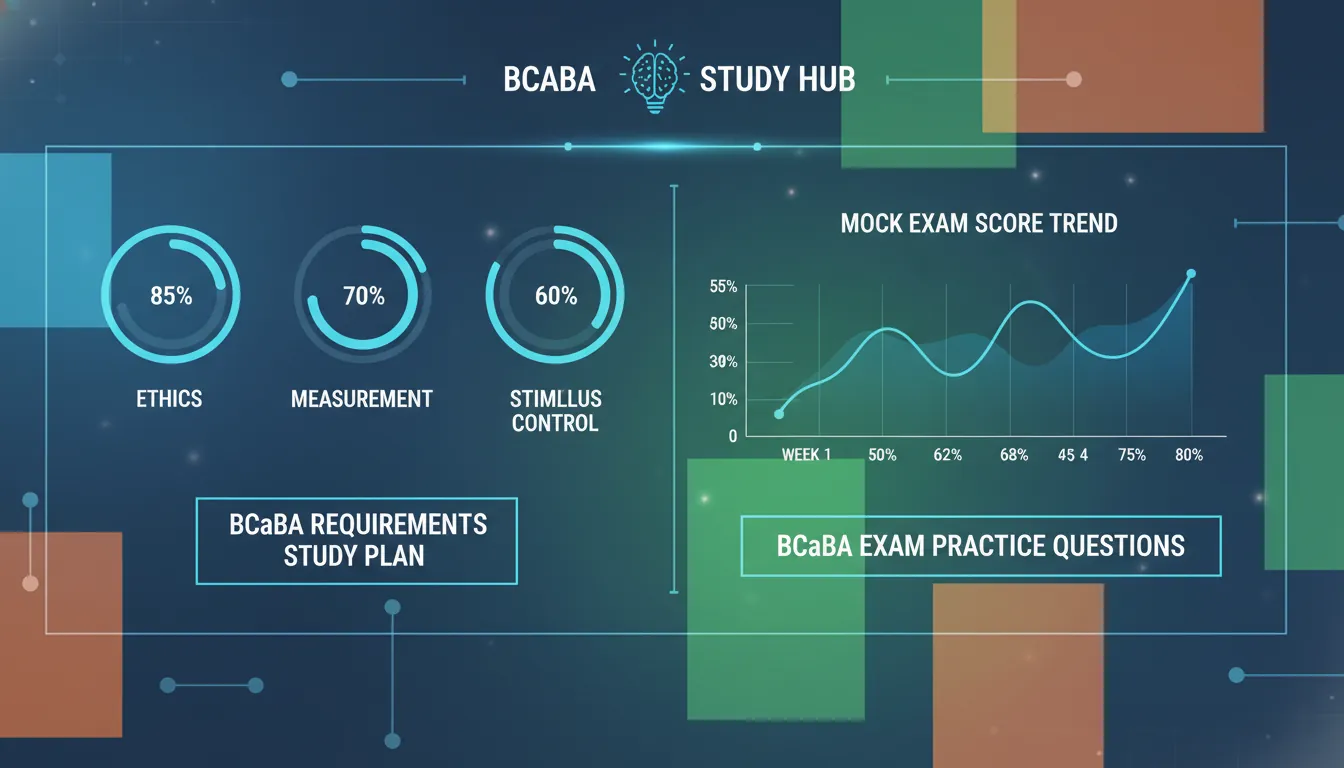
After education, coursework, and fieldwork are verified, the exam is the final major step in BCaBA requirements. The test is designed to assess applied decision-making—not just definitions. Many candidates “know the terms” but lose points on scenario nuance (stimulus control, motivating operations, and ethical judgment calls are frequent pain points).
What effective prep looks like (especially if you work full-time)
- Use exam-style questions with explanations (not just flashcards)
- Track weak areas by Task List topic
- Practice under timed conditions
- Review mistakes for patterns (not just content gaps)
If you want a structured approach to practicing like the real exam, these resources are designed around exam-style wording and pacing:
- bcba practice exam study materials
- bcba test questions strategies
- ethics in aba practice bcba exam guide
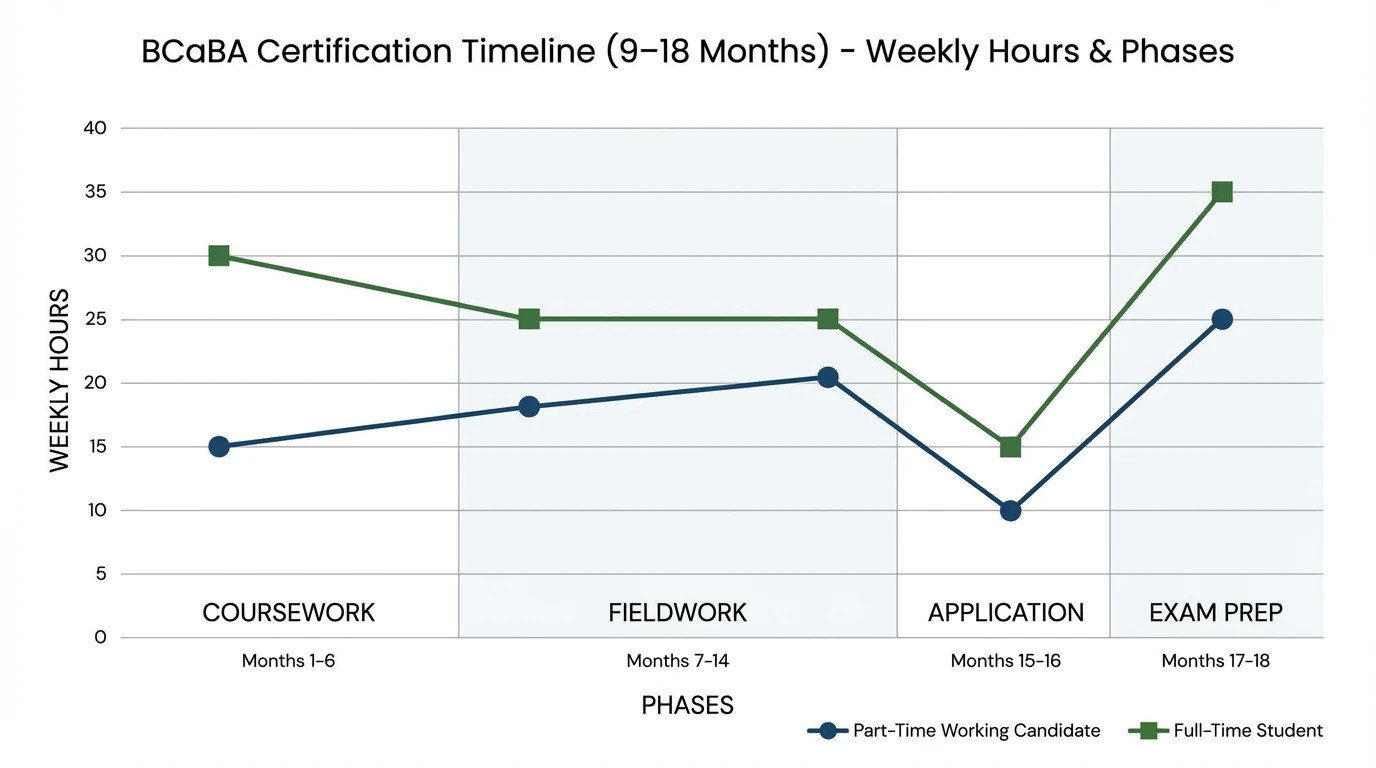
A simple timeline: how most candidates complete BCaBA requirements
Everyone’s pace differs, but most paths follow a predictable flow. Use this as a planning template:
- Confirm degree plan (graduation date + transcript timing)
- Enroll/complete verified coursework (confirm it matches current BACB guidance)
- Start supervised fieldwork early (with a documentation system from day 1)
- Submit application (double-check forms and supervisor details)
- Schedule the exam (build a 6–10 week practice plan)
- Pass + maintain (follow renewal and ethics expectations)
BCaBA vs BCBA: requirements and career reality (quick comparison)
It’s common to start by searching BCaBA requirements when you’re planning a long-term BCBA path. The big difference is independence and level of responsibility: BCaBAs work under supervision, while BCBAs practice independently (within legal/ethical limits).
For a reputable overview of how the credentials differ in scope and demand, see:
The most common reasons BCaBA applications get delayed (and how to avoid them)
If you do nothing else, avoid these “silent” problems that slow approvals:
- Edition mismatch: your coursework/fieldwork doesn’t match the current handbook pathway
- Supervisor eligibility issues: the supervisor wasn’t eligible during part of your hours
- Incomplete monthly documentation: missing signatures, missing contacts, or unclear activities
- Exam prep that’s too passive: rereading notes instead of practicing exam-style decisions
My rule of thumb: if you can’t audit your own hours in 15 minutes and clearly explain every category, your documentation system isn’t tight enough yet.
Conclusion: Turn BCaBA requirements into a clean checklist, not a guessing game
BCaBA certification is achievable—and it’s much smoother when you treat BCaBA requirements like a project plan: confirm the handbook, align your coursework, lock in supervision structure, and document everything cleanly. I’ve found that candidates who pass faster aren’t always “smarter”—they’re usually more systematic, especially with fieldwork logs and targeted question practice.
FAQ: BCaBA requirements (most searched questions)
1) What are the basic BCaBA requirements?
They generally include a bachelor’s degree, verified coursework aligned to BACB standards, supervised fieldwork with proper documentation, and passing the BCaBA exam.
2) Do BCaBAs work independently?
No. BCaBAs provide behavior-analytic services under BCBA supervision (and must follow supervision and ethics rules).
3) How long does it take to complete BCaBA requirements?
Many candidates finish in roughly 9–18 months depending on coursework pace, fieldwork opportunities, and work schedule.
4) What’s the most common mistake with BCaBA fieldwork hours?
Poor documentation and supervision structure—missing required contacts, unclear activity notes, or supervisor eligibility issues.
5) Do I need ethics coursework for BCaBA certification?
Yes—ethics is a core area in training and testing expectations, and it frequently appears as scenario-based exam questions.
6) Are BCaBA requirements the same everywhere?
The BACB sets certification standards, but your ability to practice can also depend on local laws, payer rules, and employer policies.
7) What should I study most for the BCaBA exam?
Focus on applying concepts in scenarios (measurement, assessment, behavior-change procedures, stimulus control, motivating operations, and ethics), and practice with exam-style questions and explanations.


