
If the BACB Task List 6th Edition feels like a moving target, you’re not alone. I still remember opening a new content outline for the first time and thinking, “Okay… but what do they actually ask on the exam?” The good news is the 6th Edition isn’t a mystery—it’s a map. Once you understand how the outline is organized and how questions are built from it, your studying gets simpler, faster, and more confident.
This guide breaks down what the BACB Task List 6th Edition (a.k.a. the BCBA 6th Edition Test Content Outline) covers, what changed from the 5th edition, and how to build a study plan that matches how the exam is written—especially for commonly confusing areas like stimulus control, motivating operations, and ethics.
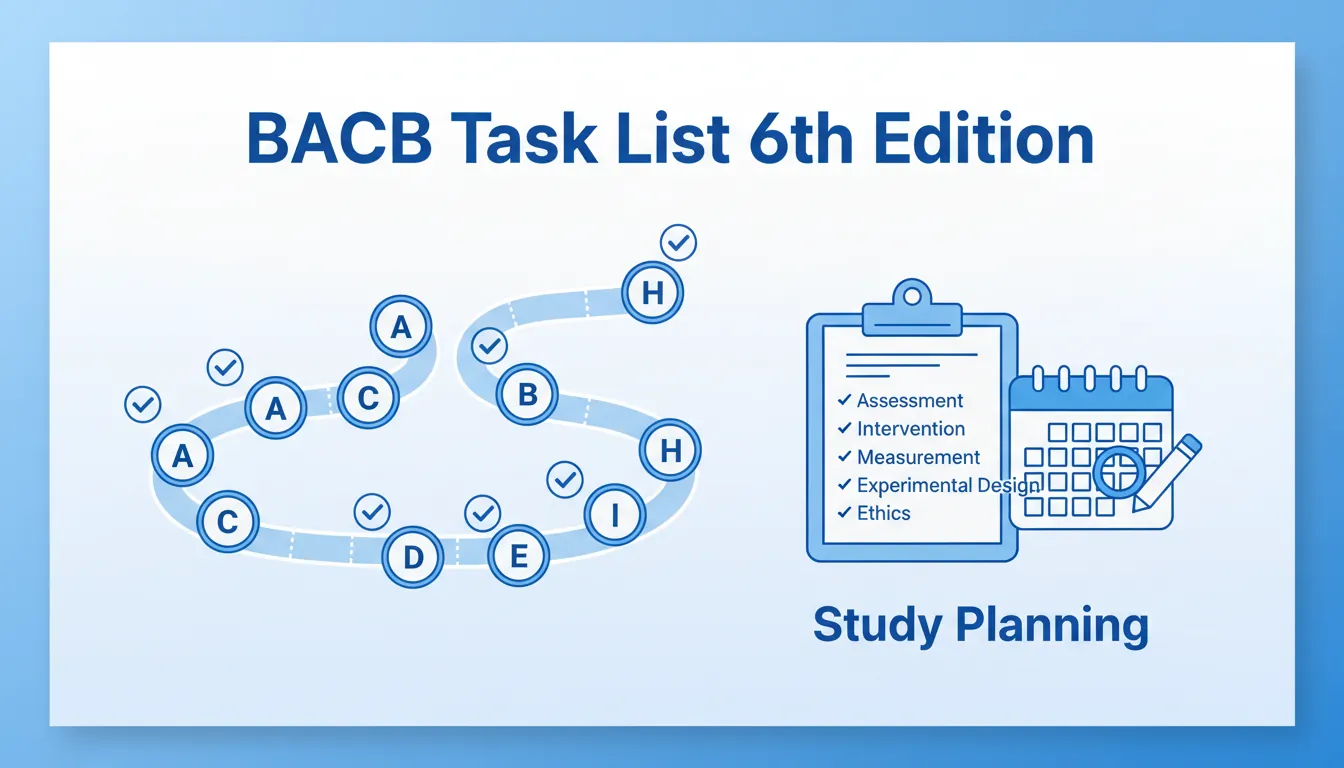
What Is the BACB Task List 6th Edition (Really)?
The BACB Task List 6th Edition is most commonly used as shorthand for the BCBA 6th Edition Test Content Outline—the official framework that defines what knowledge and skills may appear on the BCBA exam. In practice, it tells you:
- What content areas exist (domains and tasks)
- How your studying should be prioritized
- How practice questions should be written (scope, terminology, and applied decision-making)
You should treat the outline like an exam blueprint—not a textbook. Your job is to convert each task into: definitions, discrimination practice, mini-scenarios, and “what would you do next?” decisions.
Authoritative source: The BACB publishes the current BCBA outline here: BCBA Test Content Outline (6th ed.). You can also find the hub page for all outlines at Test Content Outlines for BACB Certifications.
6th Edition vs 5th Edition: What Changed (and What Didn’t)
The biggest shift I’ve seen candidates struggle with isn’t that concepts are “new”—it’s that the organization and emphasis changed enough to break old study habits. The 6th edition maintains a similar high-level structure (content domains), but it refines titles, reorganizes tasks, and reduces redundancy so testable skills flow more logically.
Key practical changes to prepare for:
- Cleaner domain naming and grouping: tasks are arranged to better match clinical workflow (assessment → interpretation → intervention → ethics/supervision).
- Less “memorize the list,” more “apply the list”: questions often test whether you can choose the right next step based on constraints (ethics, resources, data patterns).
- Greater sensitivity to confusing discriminations: stimulus vs response class, MO vs SD, reinforcement vs automatic reinforcement, and procedural fidelity vs treatment integrity.
If you want a narrative comparison, this overview is a helpful cross-check: Changes from 5th Edition to 6th Edition.
What’s Covered in the BACB Task List 6th Edition (Domains A–I)
The BCBA 6th Edition outline is organized into nine domains (A–I). Instead of treating them as separate silos, study them as a chain: concepts → measurement/design → assessment → intervention → ethics/systems.
Here’s how candidates typically experience these domains on the exam:
Domain A–C (Foundations + Concepts + Principles)
These domains often show up as short scenarios where you must discriminate between similar terms. Expect items that test whether you can identify:
- The goal of behavior analysis (description, prediction, control)
- Behavioral concepts (response class, stimulus class, motivating operations)
- Principles (reinforcement/punishment processes, stimulus control)
A common pattern: the stem “sounds like” one concept, but the details point to another. This is where timed discrimination drills pay off.
Domain D–F (Measurement, Design, and Data-Based Decision Making)
This cluster is where “book knowledge” turns into exam performance. You’ll see questions that ask you to:
- Choose the right measurement system (frequency vs rate vs duration vs latency)
- Interpret single-case design logic
- Identify threats to validity and what data patterns mean
If you tend to miss these, it’s rarely because you don’t know definitions—it’s because you haven’t practiced decision rules under time pressure.
Domain G–H (Intervention + Behavior Change Procedures)
These domains drive many scenario-based questions. The exam often tests whether you can select an intervention consistent with:
- Function and context
- Procedural constraints (setting, caregiver skills, resources)
- Ethical limits and client dignity
- Generalization and maintenance planning
This is also where confusing topics like motivating operations and stimulus control can “hide” inside an intervention question.
Domain I (Supervision & Systems)
Candidates sometimes under-study this domain, then get surprised by items about:
- Supervision best practices and performance feedback
- Training systems (BST components and mastery criteria)
- Ethical oversight and risk management in real workplaces
In real life, I’ve found this domain rewards people who’ve actually run trainings or used structured supervision tools—not just read about them.
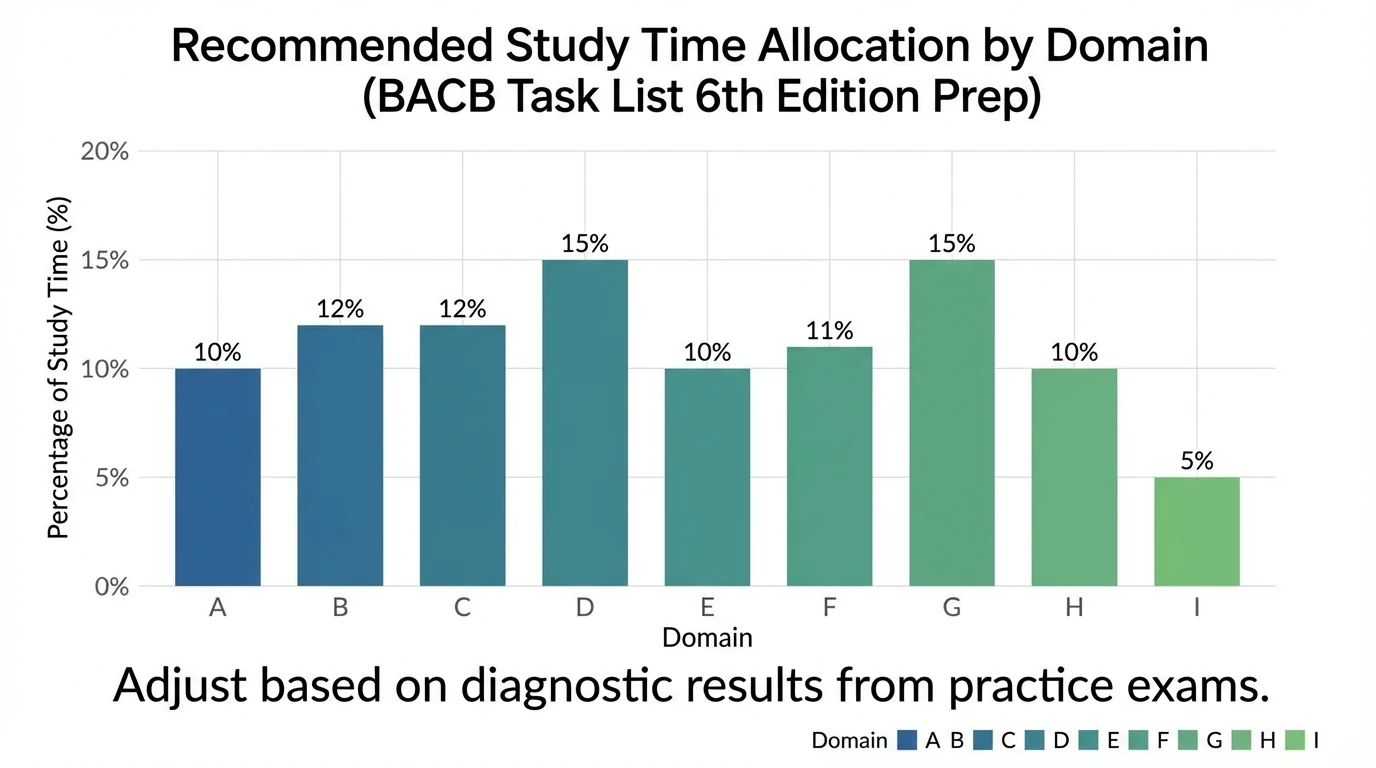
The Highest-ROI Way to Study the BACB Task List 6th Edition
The fastest improvement comes from matching your practice format to the exam’s format. When I coached candidates who were “studying a lot but not improving,” the fix was almost always the same: stop reading passively and start answering questions like the test writes them.
Use this loop:
- Diagnose with an exam-style practice set (timed).
- Analyze every miss: concept gap vs discrimination error vs reading trap.
- Remediate using targeted notes + mini-drills (10–20 items).
- Retest the same skill a week later (spaced repetition).
To build your question stamina and pinpoint weak areas, start with BCBA practice exam study materials, then layer in tactics from BCBA test questions strategies.
Common “Trap Zones” in the BACB Task List 6th Edition (and How to Beat Them)
These are the areas where strong candidates still lose points—because the wording is subtle and the discriminations are tight.
| Common Mistake | What It Looks Like on the Exam | Why It Happens | Fix (Drill/Rule) | Best Practice Resource |
|---|---|---|---|---|
| Confusing MO vs SD | Picks SD as “deprivation” cue or labels EO/AO as “signals reinforcement availability” | Both relate to behavior frequency; mixes antecedent functions | Rule: SD = availability; MO = value/effort. Drill: For each vignette, answer 2 questions: “Is reinforcement available?” (SD) and “Is the reinforcer value changed?” (MO). | Cooper, Heron, & Heward (CHH) Ch. on motivating operations; BACB Task List (6th) sections on antecedent variables |
| Mixing stimulus control with prompting | Calls a prompt an SD or says “transfer of stimulus control” without fading/transfer steps | Overgeneralizes “antecedent = SD”; prompt dependence concepts unclear | Checklist: SD evokes due to history; prompt evokes due to assistance. Drill: Identify SD vs prompt, then specify a transfer plan (e.g., most-to-least + time delay + prompt fading). | CHH Ch. on stimulus control & prompting; prompt-fading guidelines (e.g., time delay procedures) |
| Confusing reinforcement with automatic reinforcement | Labels “sensory” reinforcers as automatic even when mediated by others, or calls self-stim “social reinforcement” | Mediation (social vs non-social) and contingency wording gets missed | Rule: Reinforcement = consequence contingent on behavior; Automatic = no other person required. Drill: For each item, mark (1) mediated? (2) contingent? (3) SR+ or SR-? | CHH Ch. on reinforcement; Iwata et al. functional analysis literature (automatic vs social functions) |
| Misapplying ethics code to scenarios | Picks the “best clinical” answer that violates consent/scope/documentation; misses supervision/reporting requirements | Treats ethics as “common sense”; doesn’t map scenario to specific code elements | Drill: Use a 3-step filter: (1) Client rights/consent, (2) Competence/scope, (3) Documentation & risk management. Practice matching vignettes to the most directly relevant code requirement. | BACB Ethics Code for Behavior Analysts (current version) + official guidance/FAQs; organization policy templates (consent, documentation) |
| Misreading single-case graphs (level/trend/variability/overlap) | Claims “function” from baseline alone; confuses immediacy vs trend; misidentifies phase changes or stability | Skips visual analysis sequence; relies on intuition | Drill order: (1) Identify phases & IV points, (2) Level, (3) Trend, (4) Variability, (5) Immediacy, (6) Overlap/consistency. Use timed practice with 5–10 graphs/day and write 2-sentence interpretations. | Kratochwill et al. (visual analysis standards); CHH Ch. on single-case design & visual analysis |
A few quick fixes that consistently work:
- MO vs SD: Ask, “Did the value of the reinforcer change (MO), or did the availability/signaling of reinforcement change (SD)?”
- Reinforcement vs automatic reinforcement: Don’t assume social consequences—check if the behavior produces its own sensory consequence. If you need a deeper refresher, use automatic reinforcement bcba exam guide.
- Ethics items: Identify the primary risk (client harm, competence, consent, multiple relationships), then choose the most immediate, least intrusive compliant action.
What “6th Edition-Compliant” Practice Materials Should Include
Not all “BACB Task List 6th Edition” resources are built the same. Some are basically vocabulary lists. The exam is not.
High-quality, 6th-Edition-aligned practice materials should include:
- Exam-style stems (scenario + constraints, not trivia)
- Answer explanations that teach discriminations (why A is right and why B/C/D are wrong)
- Unlimited attempts so you can drill weak areas until fluent
- Performance breakdown by domain/task so your next study block is targeted
At BCBA Mock Exam, our products are designed around that reality: realistic question wording, domain-level diagnostics, and explanations aimed at the exact topics candidates confuse most.
Complete 6th Edition BCBA® Task List Study Guide | BCBA® Exam Task List Sixth Edition Review | A-D
A Simple 4-Week Study Plan Using the BACB Task List 6th Edition
You can stretch this to 8–12 weeks if you’re working full-time, but the structure stays the same.
Week 1: Build the map + baseline
- Take a diagnostic mock exam (timed).
- Tag misses by domain and by error type (concept vs discrimination vs data interpretation).
- Build a “Top 20 weak skills” list.
Week 2: Remediation sprints
- Do short sets (10–20 questions) on your weakest 3–4 skills.
- Write 1–2 sentence rules for each discrimination (e.g., MO vs SD).
- Retake mini-quizzes until you hit a stable accuracy target.
Week 3: Mixed practice + stamina
- Move from blocked practice to mixed sets across domains.
- Add timing: practice reading stems faster without rushing decisions.
- Review rationales like you’re training your future self.
Week 4: Full simulations + final tune-up
- Do 2–3 full-length mock exams.
- Focus on reducing “avoidable losses”: misreads, second-guessing, and overthinking ethics.
Trusted Sources to Use (and Avoid)
When in doubt, anchor your studying to official and field-standard references:
- Official outline: BCBA Test Content Outline (6th ed.)
- BACB hub page: Test Content Outlines for BACB Certifications
- Change summary perspective: 5th vs 6th Edition changes explained
Be cautious with random “study guides” that don’t show how they map to the outline. If they can’t tell you which task a question targets, they’re not helping you build test-ready fluency.
Conclusion: Turn the BACB Task List 6th Edition Into Your Advantage
The BACB Task List 6th Edition can feel overwhelming until you treat it like a practical workflow: define → measure → assess → intervene → evaluate → behave ethically → supervise effectively. I’ve watched candidates jump a full performance band simply by switching from passive reading to exam-style practice with clear feedback loops. Once you start studying the way the exam actually tests, the outline stops being a burden and starts being your strategy.
If you’re preparing now, use the 6th edition outline as your checklist, then prove each task with realistic questions and explanations.
FAQ: BACB Task List 6th Edition
1) Is the BACB Task List 6th Edition the same as the BCBA 6th Edition Test Content Outline?
Most candidates use the phrase that way, but the official exam blueprint is the BCBA Test Content Outline (6th ed.) published by the BACB.
2) When did the BCBA 6th Edition outline take effect?
The BACB’s 6th Edition outline is tied to the current exam standard; always confirm the effective dates using the BACB outline page.
3) How do I know if my study materials are 6th Edition-compliant?
They should map content directly to 6th edition domains/tasks and use scenario-style questions with explanations—not just term definitions.
4) What are the hardest topics under the BACB Task List 6th Edition?
Common “miss” areas include stimulus control, motivating operations, automatic reinforcement, ethics application, and single-case interpretation.
5) Should I memorize every task statement word-for-word?
No. You should be able to apply each task: identify it in a scenario, pick the right next step, and justify why alternatives are wrong.
6) What’s the fastest way to improve my score using the 6th edition outline?
Take a diagnostic exam, categorize misses by domain and error type, then drill weak discriminations with targeted question sets and spaced retesting.
7) How many mock exams should I take for 6th Edition prep?
Most candidates benefit from multiple full simulations, but the exact number depends on your baseline. Prioritize quality review and pattern-fixing over sheer volume.


