
The current BACB gift policy is found in Ethics Code for Behavior Analysts Standard 1.12, Giving and Receiving Gifts. In short, behavior analysts do not give gifts to or accept gifts from clients, stakeholders, supervisees, or trainees when the gift is worth more than $10 U.S. dollars, or the equivalent purchasing power in another currency.
Table of Contents
- What Is the Current BACB Gift Policy?
- Does the $10 Threshold Make a Gift Safe?
- How Do Common Gift Scenarios Differ?
- How Should a BCBA Analyze a Gift Question?
- What Should You Communicate and Document?
- What Are Common Gift-Policy Exam Traps?
- Take the Free BCBA Mock Exam
- References
That does not mean every gift worth $10 or less is automatically ethical. The Code describes a narrow context in which a gift may be acceptable: it functions as an infrequent expression of gratitude and does not create financial benefit for the recipient. Ongoing or cumulative gifts can become a problem when they turn into an expected source of income or value. An employer, funder, state law, or organization policy may also be stricter.
This guide uses the current Code, not older study materials that described a total prohibition on gifts. For a real situation, review the current Ethics Code, relevant organizational policies, and qualified supervision or consultation before deciding how to respond. Table of Contents
What Is the Current BACB Gift Policy?
Standard 1.12 applies to gifts exchanged with clients, stakeholders, supervisees, and trainees. The reason for the rule is not that every object is inherently harmful. Gift exchanges can invite conflicts of interest and multiple relationships, especially when one person has professional authority, controls access to services, evaluates performance, or is trusted with sensitive information. The current rule has three parts to remember:
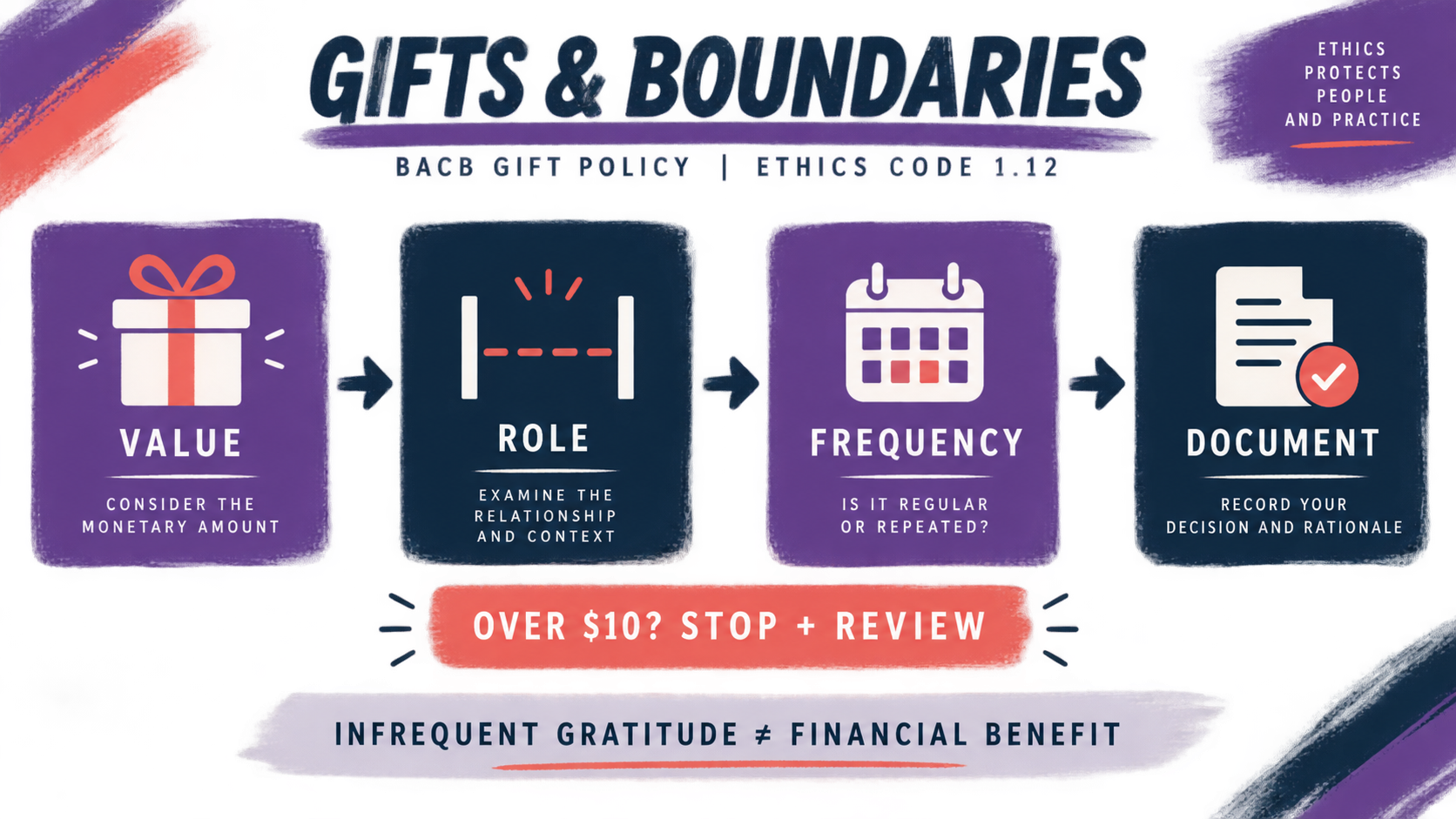
- Value: gifts over $10 are not permitted under the standard for the covered relationships.
- Purpose and effect: a lower-value gift may be acceptable when it is an infrequent expression of gratitude and does not create financial benefit.
- Pattern: repeated or cumulative gifts can become an ethical concern even when each individual item is small.
The Code also says that clients and stakeholders should be made aware of the gift requirement at the beginning of the professional relationship. This is an antecedent strategy for reducing surprise and making the boundary easier to apply later. A written organization policy, intake document, or orientation conversation can help, but it should accurately reflect the current Code and the organization’s own rules.
Does the $10 Threshold Make a Gift Safe?
No. The threshold is an important exam fact, but it is not a universal safe harbor. A $5 gift could still create a conflict if it is offered every week, tied to a request for special treatment, given by someone the analyst supervises, or likely to impair objectivity. The value is one part of the analysis, not the entire analysis.
| Scenario | Initial analysis | What to check next |
|---|---|---|
| A client offers a $25 gift card | Over the $10 threshold; do not accept it as a routine professional gift | Use the organization’s response process and document the boundary conversation |
| A stakeholder offers a one-time $5 token of gratitude | Potentially within the Code’s narrow context, but not automatically approved | Check frequency, financial benefit, power difference, and stricter policy |
| A trainee sends small gifts every month | Cumulative pattern may become a regularly expected source of value | Address the pattern, supervisory power, and documentation with consultation |
| An employer prohibits all gifts | The organization may set a stricter boundary | Follow the applicable policy and do not treat the $10 Code threshold as permission |
Also distinguish a gift from a planned behavior-analytic procedure. A reinforcer delivered according to an individualized intervention plan is not automatically the same thing as a personal gift exchanged between a professional and a stakeholder. The relationship, purpose, contingency, documentation, and plan determine the analysis.
How Do Common Gift Scenarios Differ?
The covered relationship matters because power and risk are not identical in every direction. A client or family member may feel pressure to give something to preserve services. A supervisee may worry that declining a supervisor’s gift will affect an evaluation. A trainee may feel that a gift is expected in order to receive positive feedback. The analyst should consider the possibility of coercion, favoritism, impaired judgment, or a new personal relationship.
Common items can include money, gift cards, food, tickets, discounts, personal services, or objects. Calling an item “just a thank-you” does not remove the need to evaluate its value, frequency, source, and likely effect. A group gift is not automatically outside the rule either; identify who gave it, who receives it, and whether the arrangement creates an ongoing expectation.
For a low-value, occasional expression of gratitude, the relevant question is not “Can I find a loophole?” It is “Would accepting or giving this item create financial benefit, conflict, or a multiple relationship, and can I explain the decision in a way that protects the client and the professional relationship?”
How Should a BCBA Analyze a Gift Question?
Use a short decision process before responding:
- Identify the people and roles: client, stakeholder, supervisee, trainee, colleague, or someone close to the client. Clarify who has authority or receives evaluation.
- Establish the value: determine the monetary value or equivalent purchasing power. Do not assume that a handmade or discounted item has no value.
- Look at frequency and accumulation: one small item and a repeated pattern can have different ethical meaning.
- Ask whether there is financial benefit: consider resale value, gift cards, discounts, tickets, or an expectation of future value.
- Check for pressure or special treatment: ask whether the gift could influence access, scheduling, evaluation, supervision, treatment, or professional judgment.
- Review stricter requirements: check the employer, funder, licensure board, contract, and local policy that applies to the service.
- Consult and document: when the situation is ambiguous, seek qualified consultation and record the facts, reasoning, communication, and outcome without unnecessary client details.
The best response may be to decline, return, share an item according to policy, or accept a narrowly defined token after consultation. The Ethics Code does not provide a script for every setting. Avoid promising a universal answer when the context determines whether the relationship is harmed or protected.
What Should You Communicate and Document?
Set the expectation early, before a holiday, celebration, discharge, or difficult conversation creates pressure. Explain that the professional boundary protects the client and the working relationship. Keep the explanation neutral: the issue is not that gratitude is unwelcome; the issue is that professional roles can be affected by gifts and repeated value exchanges.
- Communicate the rule: tell clients and stakeholders how the organization handles gifts at the start of the relationship.
- Offer an alternative: when appropriate, suggest a written note, feedback to the organization, or another non-financial expression permitted by policy.
- Document facts: record the item, value estimate, giver, recipient, timing, policy consulted, and response.
- Protect confidentiality: document only what is necessary and store the record according to the organization’s privacy procedures.
- Monitor the pattern: revisit the arrangement if a one-time token becomes repeated, expected, or linked to a request.
What Are Common Gift-Policy Exam Traps?
- Using the old total-ban rule: current Standard 1.12 is not the same as older materials that prohibited every gift from a client.
- Thinking $10 or less is always allowed: the item must still be infrequent gratitude without financial benefit, and context still matters.
- Applying the rule only to clients: the current standard also names stakeholders, supervisees, and trainees.
- Ignoring cumulative gifts: repeated low-value items can become an expected source of value.
- Confusing a gift with treatment reinforcement: analyze the purpose and contingency of the item, not just its physical form.
- Forgetting stricter policy: an organization may prohibit gifts even when the Code describes a narrow permissible context.
For the BCBA exam, remember the sequence: identify the relationship, value, frequency, financial benefit, conflict risk, and applicable policy. Then choose the response that protects client welfare, professional boundaries, and objective decision making. The BACB gift policy is a context question, not merely a number question. Use the current Ethics Code when you study, then practice applying it to short scenarios. Our free BCBA mock exam can help you rehearse ethics and professional-judgment questions under time pressure. Try the Free BCBA Mock Exam
Take the Free BCBA Mock Exam
If you want a low-pressure way to check your recall, use the free practice resource below. Take the Free BCBA Mock Exam
References
- BACB Ethics Code for Behavior Analysts
- BACB Ethics Codes
- BACB Ethics Resources
- Guide to Ethical Practice for Behavior Analysts
- Guidance or Compliance: What Makes an Ethical Behavior Analyst?
- Association of Professional Behavior Analysts Ethics Resources



