

If you are searching for BACB continuing education requirements, the most useful answer is a cycle-based plan, not a random list of webinars. For a BCBA, continuing education is part of certification maintenance: you must earn the required units during the correct two-year recertification cycle, record the activity, and keep documentation that supports what you entered.
Table of Contents
- What are BACB continuing education requirements?
- How many CEUs does a BCBA need?
- Which CEUs are required for ethics and supervision?
- What CE activities can count?
- What documentation should you keep?
- What changes in 2027?
- How should you plan your cycle?
- What mistakes can cost you CE credit?
- What is the quick review checklist?
- Frequently asked questions
- Take the Free BCBA Mock Exam
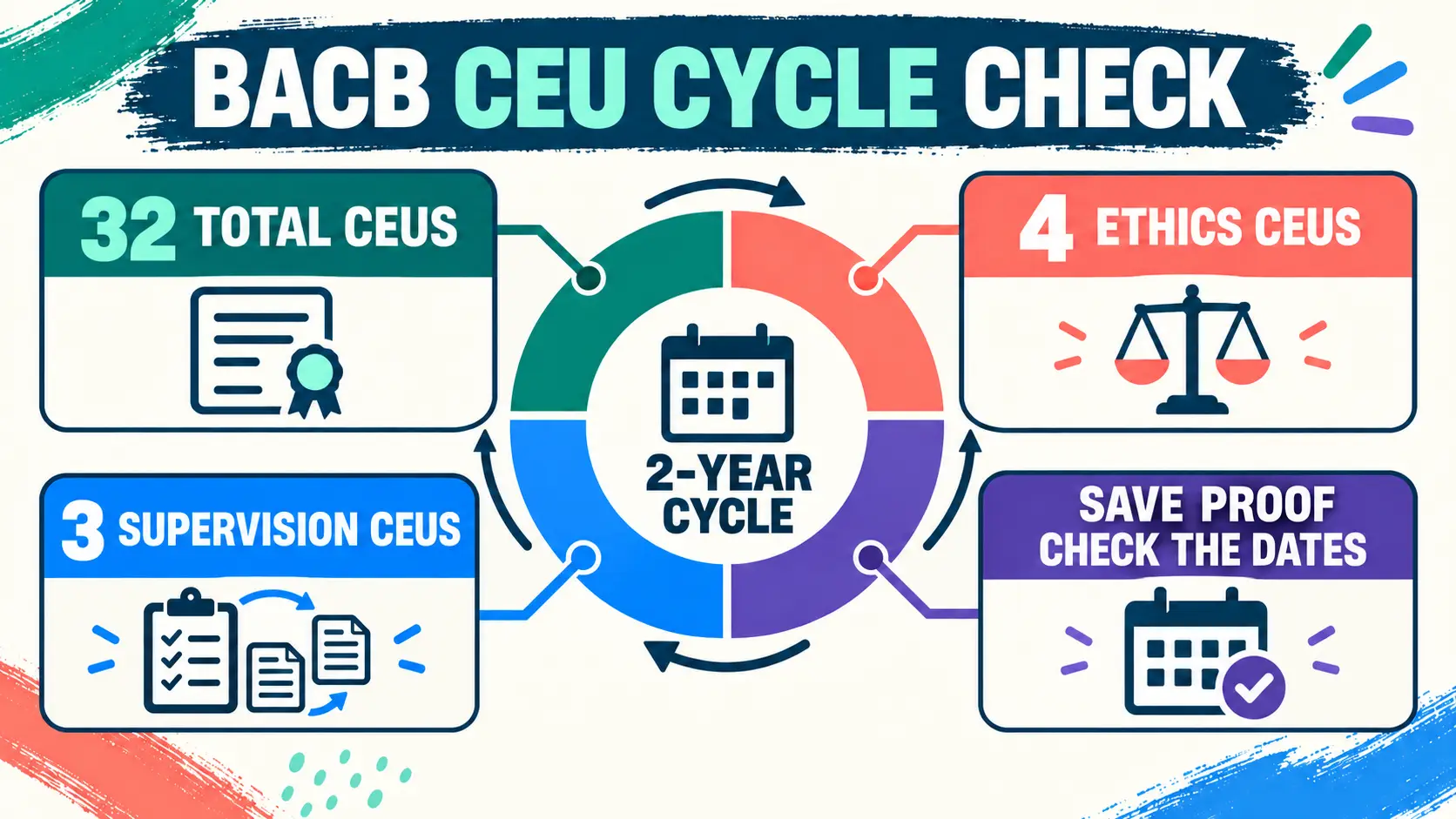
Short answer: the current BCBA maintenance rule requires 32 continuing education units (CEUs) in each two-year recertification cycle, including 4 ethics CEUs. If you supervise qualifying practice or trainees, the current handbook also requires 3 supervision CEUs. The BACB’s 2027 requirements change the supervision category to 4 CEUs for supervisors beginning January 1, 2027, while the total remains 32.
That last sentence is the important planning distinction. Your exact obligation depends on your credential, your certification cycle, whether you supervise during the cycle, and which BACB requirements apply to the activity. Use this guide to build a defensible checklist, then confirm the current BCBA Handbook and your BACB account before you submit recertification. Table of Contents
What are BACB continuing education requirements?
BACB continuing education requirements are the ongoing learning requirements a certificant meets to maintain a BCBA credential after initial certification. They are not the same as the coursework, fieldwork, or examination requirements used to become eligible for the credential. A student preparing for the BCBA exam can learn about CEUs now, but CEUs generally become a maintenance task after certification.
The BACB organizes continuing education around a two-year recertification cycle. The cycle has a beginning date and an end date tied to your certification record. Units earned outside the applicable cycle may not solve a shortfall in the current cycle, so the first step is to identify the exact dates shown in your BACB account rather than planning from a calendar year.
It also helps to separate three questions: how many total units you need, which category-specific units apply to you, and what evidence proves that an activity qualifies. A certificate alone does not automatically make every event acceptable. The activity, provider, content, timing, and documentation must line up with the current handbook.
How many CEUs does a BCBA need?
Under the current BCBA Handbook checked for this guide, a BCBA needs 32 CEUs in each two-year recertification cycle. The category requirements sit inside that total; they are not 32 general units plus another 4 ethics units. A non-supervising BCBA should still plan at least the required ethics units, while a BCBA who meets the handbook’s definition of a supervisor must also plan the supervision category.
| Planning item | Current BCBA cycle | What to verify |
|---|---|---|
| Total continuing education | 32 CEUs every two years | Your exact recertification-cycle dates |
| Ethics | 4 CEUs | Whether most of the activity genuinely focuses on ethics or cultural/contextual responsiveness |
| Supervision | 3 CEUs for qualifying supervisors under the current handbook | Whether you supervised during any part of the cycle and which rule applies |
| Remaining units | The balance needed to reach 32 | Activity type, date, provider, and supporting record |
Do not wait until the final month to discover that a course belongs to the wrong category. A simple tracker can show total units, ethics units, supervision units when applicable, activity dates, and the location of each certificate or record. The tracker is a planning tool; the BACB account and current handbook remain the controlling sources.
Which CEUs are required for ethics and supervision?
Ethics CEUs. The current BACB definition covers events related to BACB ethics requirements and/or cultural or contextual responsiveness. The content should relate to behavior-analytic practice or applied research and connect directly to behavior-analytic literature or established practice. An event that briefly mentions an ethics code while spending nearly all of its time on an unrelated topic should not be treated as an ethics event simply because the word “ethics” appears in the description.
Supervision CEUs. Under the current BCBA handbook, a BCBA who supervised ongoing RBT or BCaBA practice, or BCBA/BCaBA trainees, at any point during the cycle must meet the supervision CEU requirement. These units should concern behavior-analytic supervision and effective supervision. If you did not provide qualifying supervision, do not claim supervision units merely because you attended a general management or leadership seminar.
- Ask whether the activity’s main content matches the category, not just its title.
- Record the category at the time you complete the activity.
- Keep the activity description or agenda that explains the content.
- Recheck the handbook if your role changes from trainee to supervisor during the cycle.
- Use the 2027 requirement when the transition rule or your cycle makes it applicable.
What CE activities can count?
The BACB handbook describes continuing education through three broad activity types: Learning, Teaching, and Scholarship. The important point is that an activity must meet the applicable conditions and be documented; the label alone is not proof. Learning may include eligible events from an authorized continuing education provider, qualifying academic coursework, or certain BACB activities. Teaching and scholarship have their own documentation expectations, so record what you did rather than assuming a professional presentation automatically qualifies.
For provider-based learning, check that the provider and event are authorized for the type of CE being offered. The BACB’s ACE Provider Verification Registry is a better starting point than an advertisement that merely says “BACB approved.” Save the provider name, event title, date, number of units, category, and certificate or completion record.
For university activities, keep the syllabus, transcript, and any information needed to show the course was behavior-analytic and completed during the correct cycle. For teaching or scholarship, keep the materials and records that show the activity, date, contribution, and relevant content. If a unit is difficult to prove later, it is a weak unit to rely on for a deadline-sensitive recertification.
What documentation should you keep?
Think of each CEU entry as a small audit file. The goal is to let you reconstruct what happened without searching through email at the last minute. Store documents in one folder organized by cycle, then use a tracker that points to each file. Do not delete a certificate after entering the unit in your account.
- Write down the start and end dates of the recertification cycle.
- Save the certificate, transcript, agenda, or other supporting record.
- Record the activity title, provider, completion date, and number of CEUs.
- Mark whether the units are general, ethics, or supervision.
- Check that the activity occurred inside the cycle to which you are applying it.
- Enter the information into your BACB account while the record is easy to verify.
- Keep a backup that you can open even if a provider later changes its website.
Current BACB guidance also matters at the end of the cycle: missing units cannot simply be created after the recertification deadline, and excess units do not automatically roll into the next cycle. The safest habit is to leave a buffer for category corrections, missing certificates, and questions about whether a particular activity qualifies.
What changes in 2027?
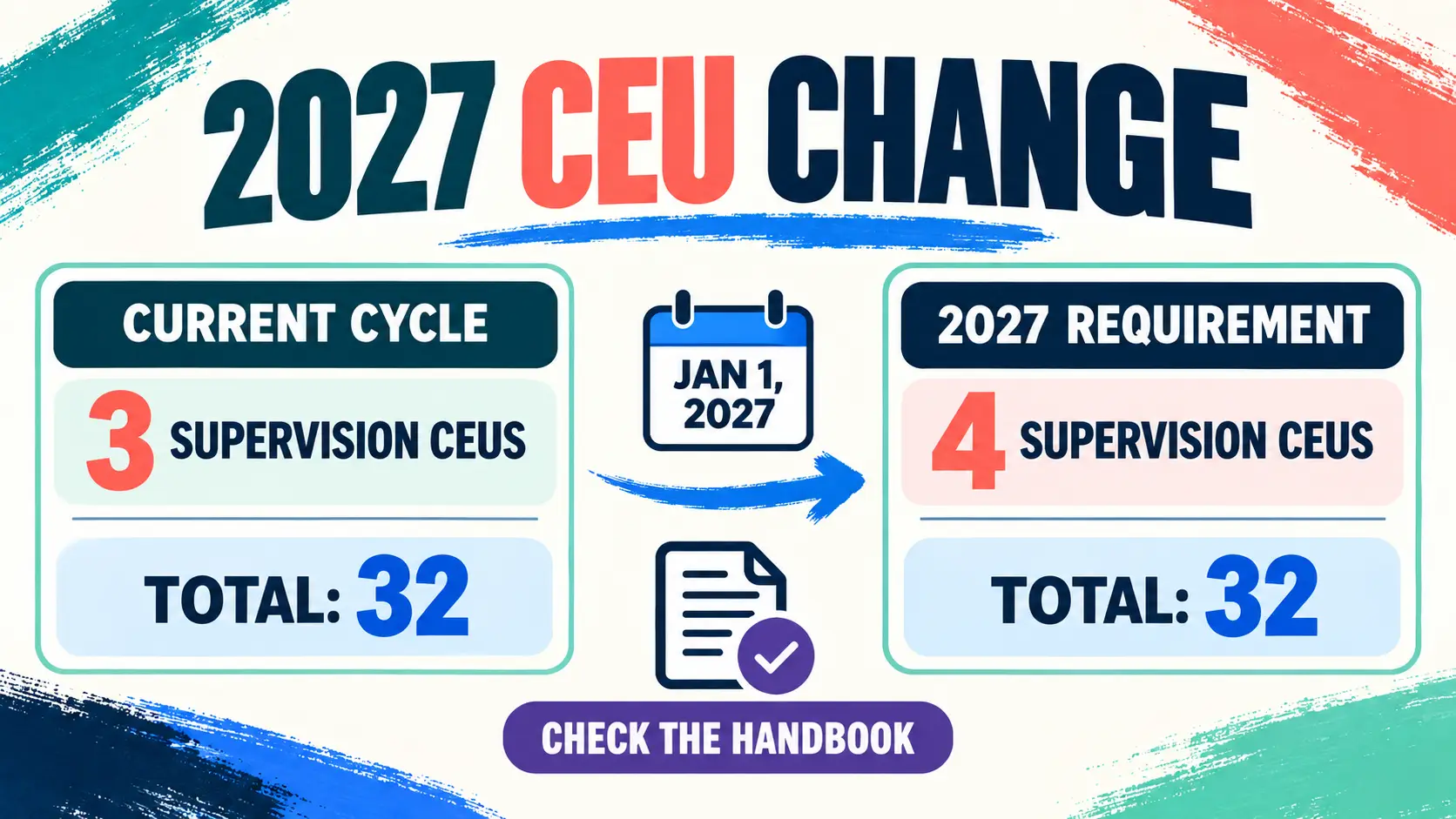
The BACB’s published 2027 BCBA requirements are effective January 1, 2027. For maintenance, the published requirement remains 32 CEUs in each two-year cycle, including 4 ethics CEUs. The significant category change for supervising BCBAs is that the supervision requirement becomes 4 CEUs, compared with the current handbook’s 3 supervision CEUs for qualifying supervisors.
| Topic | Current handbook | Published 2027 requirement |
|---|---|---|
| Total | 32 CEUs per two-year cycle | 32 CEUs per two-year cycle |
| Ethics | 4 CEUs | 4 CEUs |
| Supervision for qualifying supervisors | 3 CEUs | 4 CEUs |
| Effective date | Use the rule applicable to your current cycle | January 1, 2027, subject to the BACB transition guidance |
This does not mean every BCBA should blindly add four supervision units today. A transition depends on your certification status, cycle, role, and the instructions attached to the applicable handbook or transition resource. If your situation crosses January 1, 2027, compare the 2027 BCBA requirements with the official transition resource. When the timing is unclear, plan conservatively and confirm with the BACB rather than relying on a third-party summary.
How should you plan your cycle?
A strong plan spreads the 32 units across the cycle and reserves category-specific learning before your calendar becomes crowded. Start with your recertification date, subtract the units already entered, and create a monthly target that leaves time for verification. Treat ethics and supervision as separate checkpoints even though both count inside the total.
- At the beginning: identify the cycle dates and confirm whether you supervise.
- Each quarter: update total, ethics, and supervision balances.
- Before enrollment: verify the provider, activity type, and category.
- After completion: save the record and enter the unit while details are fresh.
- At least 60 days before recertification: audit gaps and check the current handbook.
This kind of schedule also protects study time. If you are preparing for the BCBA exam, use a mock exam for exam practice, not as a substitute for a CEU certificate. A CEU plan maintains a credential; an exam plan builds performance on the content outline. They support different tasks.
What mistakes can cost you CE credit?
Most preventable problems are timing and documentation problems rather than difficult behavior-analysis questions. Watch for these traps:
- Counting a unit earned before the current cycle began.
- Treating 32 CEUs as 32 plus another four ethics units.
- Calling a short ethics mention an ethics CEU when the event is mostly unrelated.
- Assuming every supervisor-training event satisfies the supervision category.
- Using an “approved” marketing claim without checking the provider registry.
- Waiting until recertification week to locate certificates and transcripts.
- Using the current 3-unit supervision rule after a 2027 requirement applies.
- Confusing BCBA maintenance rules with BCaBA or RBT professional-development rules.
What is the quick review checklist?
Before you rely on your plan, confirm the following:
- I know my exact two-year recertification-cycle dates.
- I am tracking toward 32 total BCBA CEUs.
- I have separated the 4 ethics CEU requirement.
- I have checked whether the supervision requirement applies to me.
- I know whether my cycle is affected by the January 1, 2027 transition.
- Every entry has a date, provider, category, unit count, and supporting record.
- I checked the current BACB Handbook before submitting recertification.
If you are studying for the BCBA exam, review the difference between certification eligibility and certification maintenance. Our BCBA ethics practice guide can help you work through ethics scenarios, and the free BCBA mock exam can help you practice under exam-style timing. Those are study resources, not official BACB questions or a guarantee of a particular exam result.
Frequently asked questions
How many CEUs does a BCBA need every two years?: A BCBA generally needs 32 CEUs in each two-year recertification cycle. The current handbook includes 4 ethics CEUs, and qualifying supervisors must also meet the current supervision category. Always use the handbook and your account for the rule attached to your cycle.
Are ethics and supervision CEUs included in the 32?: Yes. The ethics and supervision categories are part of the 32-unit total, not extra units added on top of 32. Plan the category minimums first, then use the remaining units for eligible learning, teaching, or scholarship activities.
What is the 2027 supervision CEU change?: The published 2027 BCBA requirements increase the supervision category for qualifying supervisors from 3 CEUs under the current handbook to 4 CEUs. The total remains 32, and the effective date and transition instructions still matter for your individual cycle.
Can I carry extra CEUs into the next cycle?: Do not assume that you can. Current BACB guidance says excess units cannot be applied to the next cycle, and missed units cannot simply be made up after the recertification deadline. Record units in the cycle in which they were earned and verify the current handbook.
Do BACB continuing education requirements apply to BCBA exam candidates?: CEUs are primarily a certification-maintenance requirement after certification. Candidates should focus on eligibility, fieldwork, the applicable handbook, and exam preparation unless a separate credential or employer requirement applies to them.
Take the Free BCBA Mock Exam
When you are ready to apply the idea, use the free practice resource below for additional feedback. Take the Free BCBA Mock Exam



