

If you are looking for BACB caseload guidelines, the most important answer is also the one most likely to be missed: the BACB does not publish one universal maximum number of clients that applies to every BCBA, setting, payer, and treatment model.
Table of Contents
- In This Guide
- What the BACB Actually Says About Caseloads
- BACB Rules Versus Practice Guidelines
- Factors That Determine a Responsible Caseload
- A Practical BACB Caseload-Capacity Review
- Red Flags That Capacity Has Been Exceeded
- How to Document and Escalate the Problem
- Why Setting and Payer Rules Matter
- Common BACB Caseload Mistakes
- BACB Caseload Guidelines FAQ
- Take the Free BCBA Mock Exam
The current BACB materials focus on whether a behavior analyst can provide effective, competent, ethical supervision and protect clients while carrying the work. That means caseload capacity is a professional judgment supported by client needs, supervision time, competence, staffing, documentation, and risk—not a single number copied from a chart. Use the current Ethics Code, relevant handbook, state rules, payer requirements, and employer policy together.
In This Guide
What the BACB Actually Says About Caseloads
The BACB’s supervision and training resources direct certificants to the relevant handbooks and ethics requirements. The current Ethics Code for Behavior Analysts includes responsibilities related to accepting clients, practicing within competence, providing effective services, supervising others, and managing supervisory volume. Those standards point to a capacity decision: take on work only when you can perform the required responsibilities effectively and ethically.
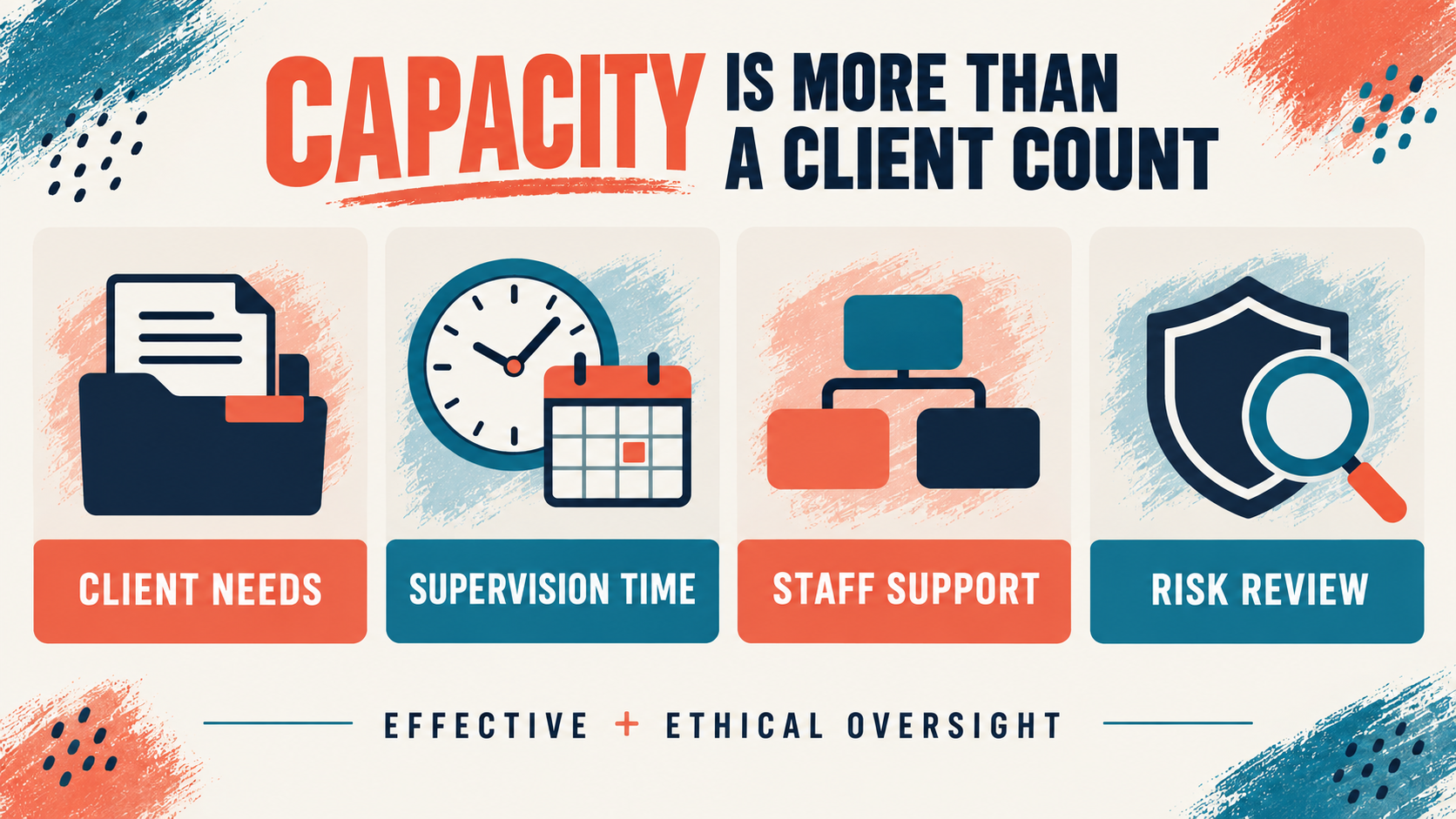
So the answer to “What is the BACB maximum caseload?” is not a nationwide client count. A caseload of eight high-acuity cases with extensive caregiver training, crisis risk, travel, and multiple staff may require more time than a larger group of lower-intensity cases with strong BCaBA support. The number of clients is only one variable.
For an exam question, remember the principle: supervisory volume must be compatible with effective supervision, competence, client protection, and the behavior analyst’s actual resources. For practice, translate that principle into a recurring review rather than a one-time promise that a caseload is manageable.
BACB Rules Versus Practice Guidelines
Online articles sometimes present a recommended caseload range as if it were a BACB rule. That is a category error. Separate the sources before you rely on a number.
| Source | What it may control | How to use it |
|---|---|---|
| BACB Ethics Code | Ethical responsibilities, competence, client protection, supervision, and professional conduct | Use it to judge whether the work can be performed responsibly; do not turn it into an invented client limit. |
| BCBA Handbook | Certification, fieldwork, supervision, documentation, and examination requirements | Use it for the specific role and requirement set that applies to you. |
| State or provincial law | Licensure, scope of practice, reporting, and local supervision rules | Check the jurisdiction where services are delivered; certification does not replace licensure. |
| Payer or employer policy | Authorization, billable units, staffing model, productivity, and internal workload expectations | Treat these as operational constraints, not proof that the model is ethically adequate. |
| Practice guideline or provider range | A recommendation for a defined service model or population | Label it as a recommendation and test whether its assumptions fit your cases. |
Factors That Determine a Responsible Caseload
A caseload review should include the demands that consume clinical and supervisory time. Consider each factor rather than counting client names alone.
- Client complexity and risk: Severe problem behavior, medical needs, communication barriers, restrictive procedures, crisis plans, and rapid changes require more assessment, observation, caregiver coordination, and review.
- Intensity and treatment hours: A client receiving many treatment hours may create more staff supervision, protocol checks, data review, and troubleshooting than a client with a smaller schedule.
- Supervision responsibilities: Count RBT supervision, trainee fieldwork, BCaBA oversight, caregiver training, team meetings, direct observation, feedback, and documentation.
- Travel and service modality: Home, school, community, center, hybrid, and telehealth models create different travel, coordination, privacy, and observation demands.
- Staff experience and stability: New technicians, turnover, vacancies, frequent cancellations, or inconsistent implementation increase the time needed for training and treatment integrity checks.
- BCBA competence and support: A case outside your current competence may require consultation, training, or a referral plan. A BCaBA or other qualified support can change capacity, but it does not transfer away the BCBA’s responsibility for oversight.
- Nonclinical workload: Authorizations, reports, scheduling, incident review, coordination with other providers, and administrative systems consume real time even when they are not direct treatment.
Capacity is therefore a relationship between available time and required work. If the work expands while protected supervision time stays flat, the caseload may no longer be manageable even if the client count has not changed.
A Practical BACB Caseload-Capacity Review
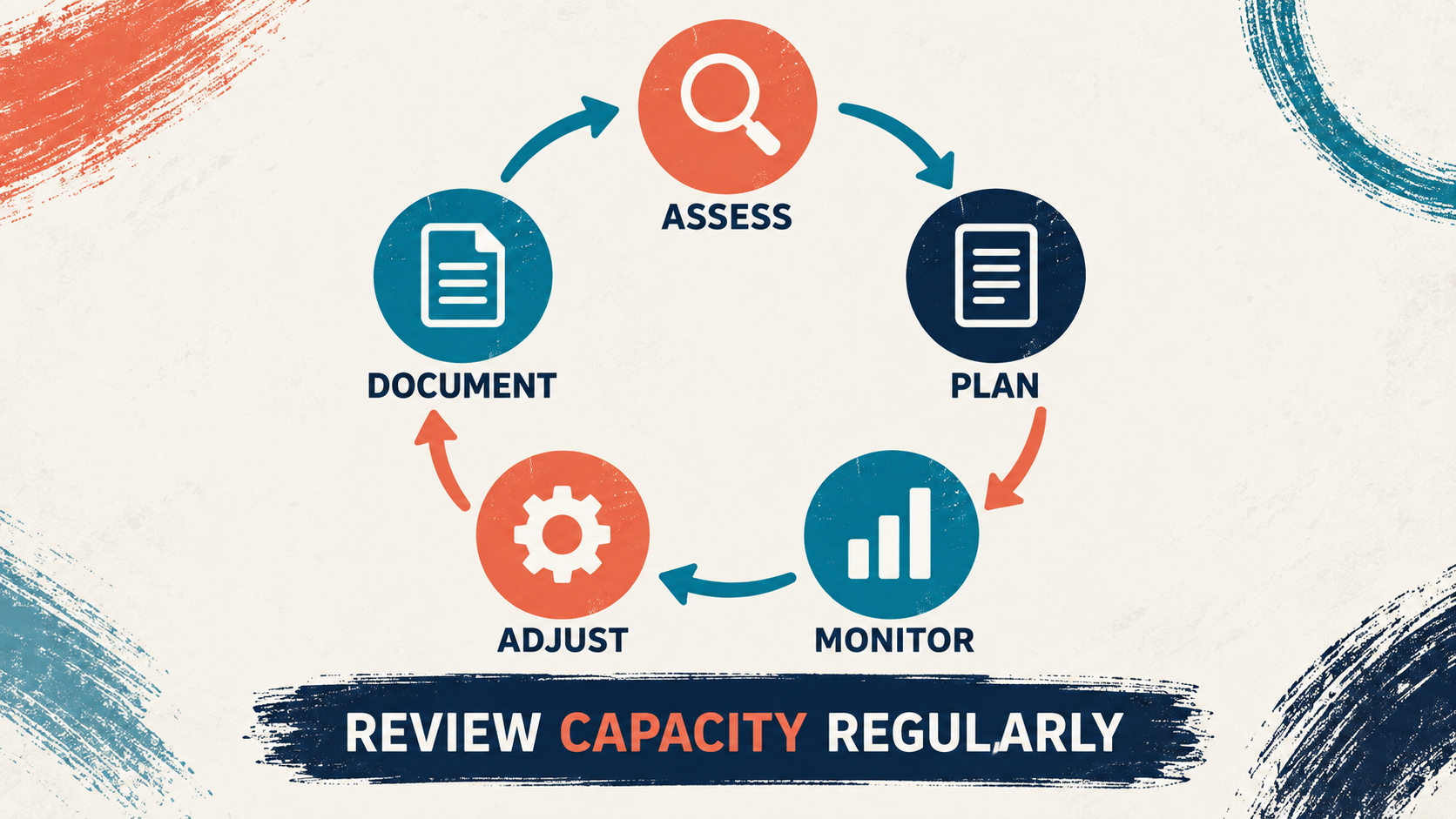
Use this five-step review monthly, at intake, after a major clinical change, and whenever staffing or authorization conditions shift.
- List required responsibilities. For every case, record assessment, program modification, direct observation, caregiver guidance, staff supervision, data review, documentation, coordination, and risk-management tasks.
- Estimate required time. Use recent calendars and actual records rather than optimistic targets. Include travel, cancellations, preparation, follow-up, and protected documentation time.
- Compare with available capacity. Subtract meetings, leave, training, supervision of trainees, and other assigned duties from the time available for case oversight.
- Check quality indicators. Review response time, treatment-integrity results, caregiver communication, overdue notes, data-review frequency, incident follow-up, and whether staff receive useful feedback.
- Make an action decision. Keep the caseload, pause new admissions, add qualified support, reduce administrative load, transfer or refer a case, or renegotiate the service model. Document the reason and review date.
A simple capacity worksheet can include the following columns:
- client or case identifier;
- complexity and current risk;
- weekly treatment hours and staff count;
- required supervision and caregiver-contact time;
- travel or coordination load;
- available BCBA time;
- support staff and their defined responsibilities;
- quality or risk indicators;
- decision, owner, and next review date.
Red Flags That Capacity Has Been Exceeded
No single red flag proves an ethics violation, but a pattern should trigger a prompt review. Examples include:
- scheduled supervision repeatedly gets canceled or replaced with undocumented “check-ins”;
- data are reviewed only after a crisis, complaint, or authorization deadline;
- program changes are delayed because there is no protected clinical time;
- caregivers or staff cannot reach the responsible BCBA when an urgent decision is needed;
- incident reports, action items, progress reports, or treatment-integrity checks remain overdue;
- new referrals are accepted even though current cases already require more time than is available;
- the BCBA is asked to supervise work outside their competence without consultation or training;
- staff turnover creates a constant cycle of emergency training instead of planned supervision;
- the caseload is technically “covered” on paper but not receiving effective clinical oversight.
These are operational signals, not a substitute for reviewing the current Ethics Code or seeking qualified advice. A responsible response is to examine the system and reduce risk—not to hide the workload by changing labels or documenting supervision that did not occur.
How to Document and Escalate the Problem
If your workload is too large to supervise effectively, document the concern in professional language. Describe the cases, responsibilities, time available, missed or at-risk tasks, client impact, and the specific support or change requested.
- Use objective records: calendars, supervision logs, response times, overdue tasks, incident follow-up, and data-review dates.
- Explain the client-safety or quality risk without exaggerating or assigning motives.
- Propose a concrete remedy, such as a paused intake, revised schedule, additional qualified support, transfer, consultation, or reduced administrative burden.
- Send the concern through the organization’s documented escalation route and keep a copy.
- Follow up on the date you set for review. If risk remains unresolved, consult the current BACB ethics resources, state licensing authority, payer rules, or an appropriately qualified professional.
Why Setting and Payer Rules Matter
A caseload guideline from one autism-service provider may assume a particular mix of focused or comprehensive treatment, a three-tier staffing model, a defined supervision percentage, and predictable travel. Those assumptions do not automatically transfer to a school district, private practice, home-based model, hospital, telehealth program, or a different payer.
Before comparing a number, ask what it counts: clients, active authorizations, treatment hours, technicians, supervisees, or service units. Also ask whether the range includes assessment, caregiver training, documentation, travel, cancellations, supervision of staff, and crisis response. If those inputs differ, the numbers are not directly comparable.
Common BACB Caseload Mistakes
- Looking for one magic number: A number without assumptions does not measure capacity.
- Calling a provider range a BACB rule: Label the source and the population it describes.
- Counting clients but not treatment hours: The workload depends on intensity and oversight demands.
- Ignoring competence: A manageable number of cases can still be outside a practitioner’s competence.
- Counting delegated tasks as transferred responsibility: Qualified team members may perform defined tasks, but the responsible BCBA must maintain effective oversight.
- Using billable hours as the capacity test: Clinical quality, documentation, communication, and risk management also require time.
- Waiting for harm before adjusting: Capacity should be reviewed when warning signs appear, not only after a crisis.
BACB Caseload Guidelines FAQ
Does the BACB set a maximum number of BCBA clients?: Do not assume there is one universal maximum. Current BACB ethics and supervision materials emphasize effective supervision, competence, client responsibility, and supervisory volume. The appropriate capacity depends on the cases, service model, staff, resources, and other professional duties.
Are common caseload ranges official BACB requirements?: Not automatically. A numeric range published by a provider, professional association, payer, or practice guideline may be useful for a specific model, but it should not be presented as a universal BACB rule without an official source that says so.
What should a BCBA do when a caseload is unsafe?: Document the workload and client-impact facts, raise the concern through the organization’s escalation route, and propose a concrete capacity change. Review current BACB ethics requirements, state or provincial rules, payer conditions, and qualified professional advice for the situation.
How can this appear on the BCBA exam?: Expect the principle rather than a memorized client count: a supervisor should accept only a volume of responsibility that permits competent, effective, ethical supervision and protection of clients and supervisees. Always match the answer to the facts in the scenario.
For ethics and supervision practice, use the free BCBA mock exam to review application scenarios and identify the principle that controls the decision. Practice questions do not replace the current BACB Ethics Code, handbook, state law, payer requirements, or individualized consultation. For targeted review, use our bacb caseload guidelines practice questions to apply the concept in exam-style scenarios.
Take the Free BCBA Mock Exam
If you want a low-pressure way to check your recall, use the free practice resource below. Take the Free BCBA Mock Exam



