
Choosing a BACB 8 hour supervision course is not only a question of finding eight hours of videos. The course has to fit the current supervision-training rules, cover the applicable curriculum, include the required completion work, and leave you with documentation that can support the next step in a supervision relationship.
Table of Contents
- What a BACB 8 Hour Supervision Course Is—and Is Not
- Live, Self-Paced, or Hybrid: Compare the Workflow
- Match the Course to the Supervision Role
- Check Pacing, Competence, and Completion Proof
- Build the Course-to-Supervision Handoff
- Avoid Enrollment Traps
- Make a Safer Enrollment Decision
- Quick Review Checklist
- Take the Free BCBA Mock Exam
The delivery format also matters. A live class, a self-paced course, and a hybrid course can all look similar on a sales page while creating very different schedules, interaction expectations, and completion records. This guide helps you compare the workflow before you enroll, without confusing a course with certification or automatic supervisor qualification. Use the current BACB supervision and training resources as the authority for role requirements. This article is a course-choice aid, not a determination that a specific provider or person satisfies every current BACB requirement.
What a BACB 8 Hour Supervision Course Is—and Is Not
The 8-hour training is preparation connected to certain supervision roles. The BACB supervision page identifies situations in which supervisors overseeing BCBA or BCaBA fieldwork, or certain ongoing supervision relationships, must complete the training before providing the relevant supervision. The current Supervisor Training Curriculum Outline (2.0) is the source to check for the detailed framework.
The course is not a BCBA credential, a BCaBA credential, a license, or a substitute for the other qualifications and responsibilities attached to supervision. Finishing the course does not authorize a person to supervise every learner, every service, or every setting. The role, credential, experience, documentation, and applicable BACB materials still matter.
That boundary helps explain why the phrase “BACB course” deserves careful reading. A provider may offer training based on the official outline without the BACB endorsing a commercial product. Before paying, identify the provider basis, the curriculum version, the cumulative duration, the competence activities, and the exact completion record.
Live, Self-Paced, or Hybrid: Compare the Workflow
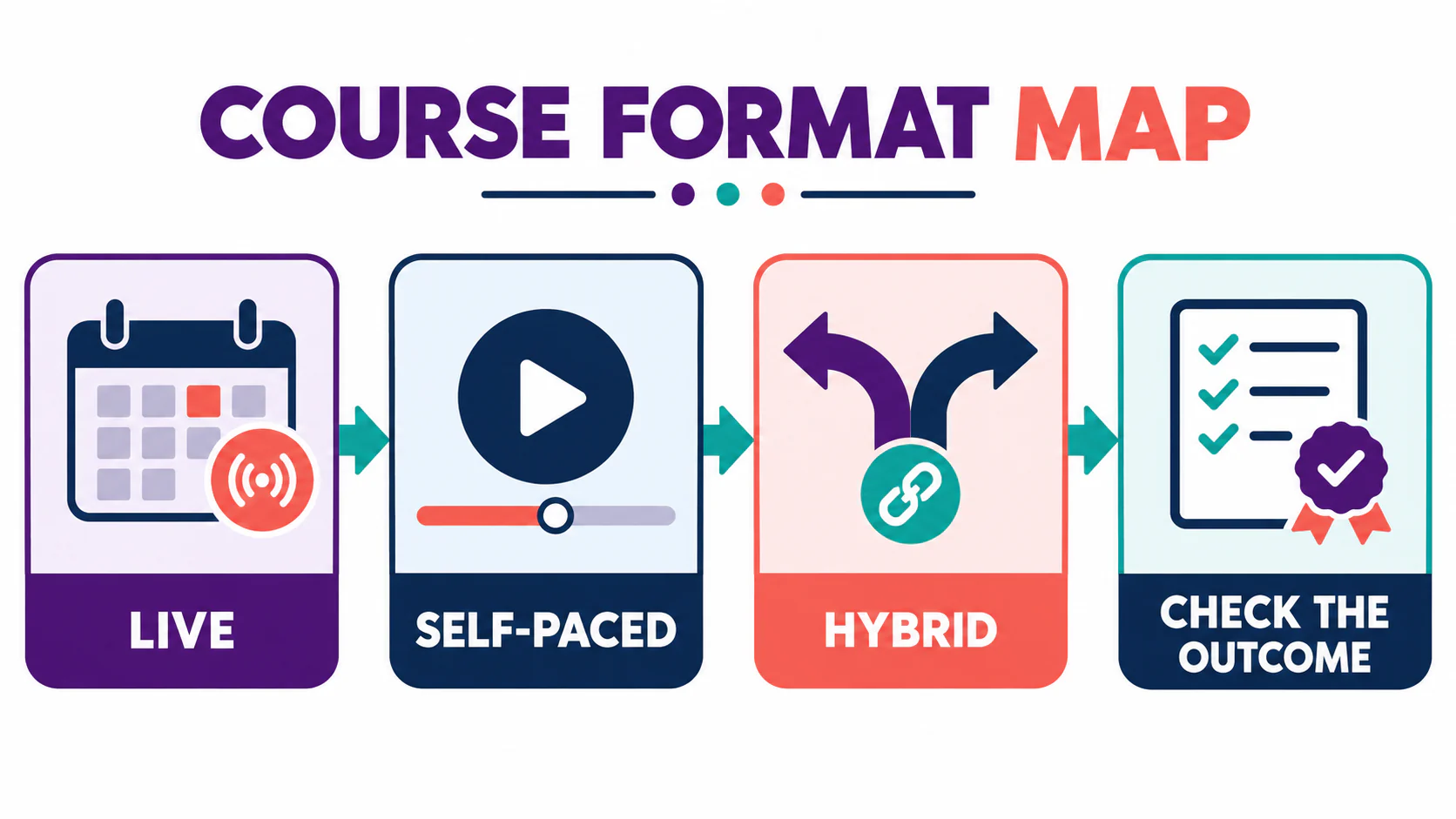
Format is a practical decision, not merely a preference. A course that fits your calendar but does not explain how completion is verified creates risk. Compare how each format handles attendance, questions, assignments, competence demonstrations, module pacing, and the document you receive at the end.
| Format | What it may make easier | What to verify before enrolling |
|---|---|---|
| Live | A fixed finish date, scheduled discussion, and a clear place to ask questions in real time. | How attendance is recorded, whether all sessions are required, and how missed time is handled. |
| Self-paced | Flexible scheduling and the ability to revisit a difficult supervision topic before finishing. | Access window, module completion rules, competence work, and how the provider confirms the full cumulative duration. |
| Hybrid | A mix of flexible content and scheduled discussion or demonstration. | Which parts are mandatory, whether live attendance is required, and whether the final record covers the complete course. |
The “best” format is the one whose completion evidence you can explain. If a self-paced course has no clear way to show that all modules and competence tasks were completed, flexibility is not a benefit. If a live course conflicts with your schedule and offers no documented make-up route, the fixed calendar may create an avoidable problem.
Match the Course to the Supervision Role
Before you compare providers, write down the role you are preparing for. A future fieldwork supervisor, an ongoing-service supervisor, and a professional who is simply taking continuing education may have different questions. Do not let a broad title answer the role question for you.
- Supervisor: confirm which supervisees and supervision context the course is intended to support, then verify the separate qualifications and documentation required for that role.
- Trainee: ask a potential supervisor when the training was completed, who provided it, and what completion record will be available before supervision begins.
- Provider or employer: check whether the course documentation can be retained in the organization’s records and whether the course version matches the current official outline.
- CE learner: do not assume that a general supervision or leadership course is the specific 8-hour training connected to BACB supervision roles.
This role-first step prevents a common error: purchasing a course because the title contains “supervision,” then discovering that it is a management workshop, an unrelated ethics CE, or a general professional-development class rather than the required curriculum-based training.
Check Pacing, Competence, and Completion Proof
The current curriculum outline explains that the training reaches a cumulative eight hours and may be delivered in units, online, or in person, subject to the current rules. It also describes learning and competence considerations. A useful course page should make those facts verifiable rather than hiding them behind a checkout button.
| Evidence to collect | Why it matters | Question to send the provider |
|---|---|---|
| Provider identity and eligibility | The current provider rules matter more than a badge or marketing phrase. | Where can I verify the provider and course basis in current BACB materials? |
| Curriculum version | An old outline or generic supervision syllabus may not answer the current requirement. | Does the course link to Supervisor Training Curriculum Outline (2.0)? |
| Cumulative schedule | You need to know what counts toward the eight hours and what is optional. | Which modules are required, and how is time or completion recorded? |
| Competence activity | Passive viewing alone may not show that the course’s required learning work was completed. | What verbal or practical competence work must a learner complete? |
| Completion proof | A receipt or enrollment email is not the same as a completion record. | Can I see what the final document contains and when it is issued? |
Save the course page, outline link, enrollment receipt, completion document, and any provider response in one folder. This is not a substitute for the official BACB process, but it gives you a clear record of what you completed and what the provider represented when you enrolled.
Build the Course-to-Supervision Handoff
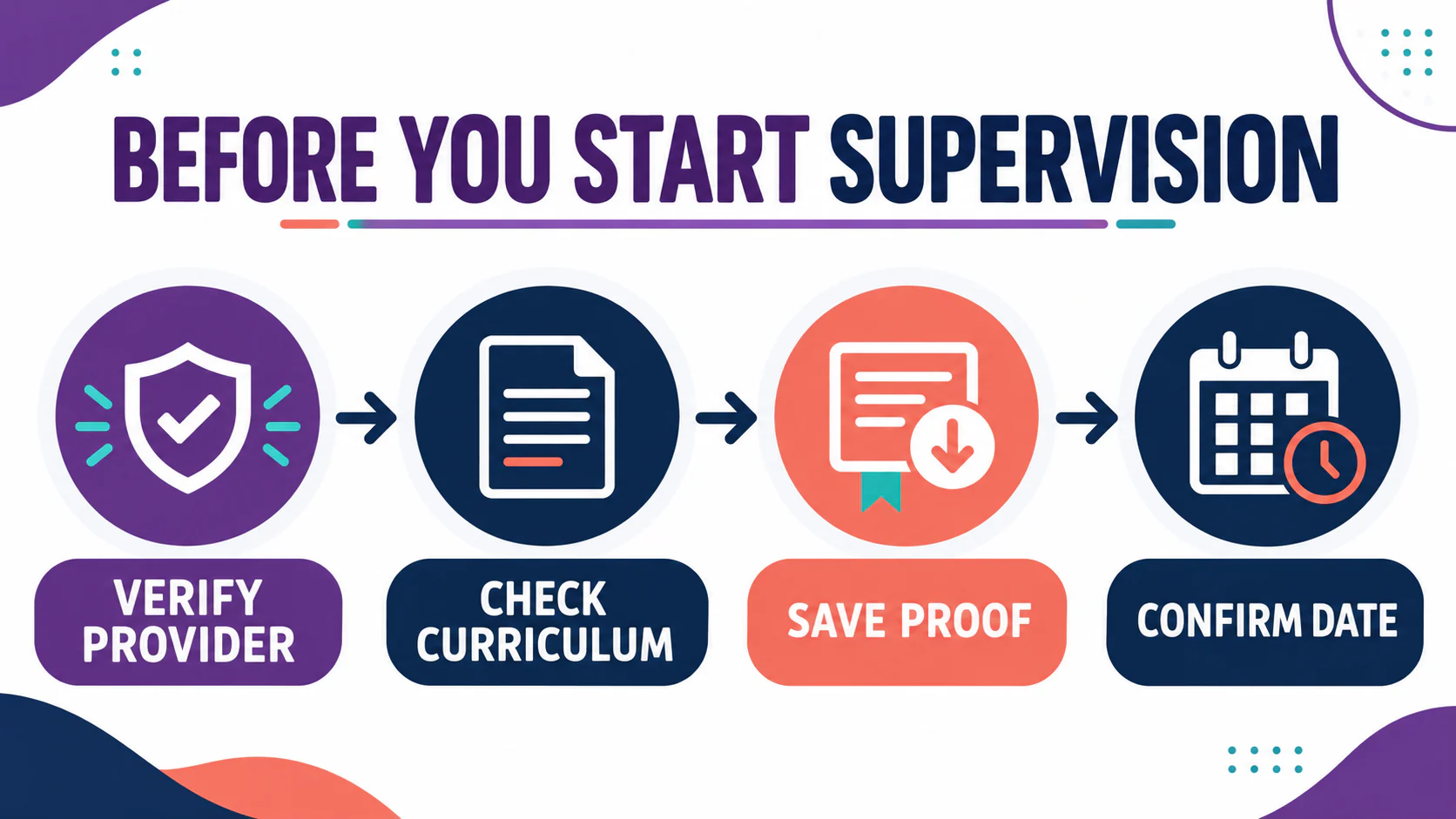
A course becomes useful to a supervision relationship only after the right people can verify it. Work backward from the intended supervision start date so that the provider’s access window, live sessions, competence work, grading or review time, and completion-document delivery do not collide with your first supervision contact.
- Verify the offer: record the provider, curriculum version, format, cumulative duration, competence activities, and proof process before payment.
- Plan the finish: choose a course window that leaves time for required modules, questions, make-up work, and the final record.
- Save the evidence: download or retain the completion document and note the course title, provider, date, and any relevant version information.
- Confirm the start: give the supervisor or organization the requested record and confirm that the supervision relationship can begin under the current rules.
If a supervisor cannot explain when the training was completed or cannot produce the relevant record, pause and verify before beginning the relationship. A short clarification delay is easier to manage than reconstructing a missing training history after supervision has started.
Avoid Enrollment Traps
“BACB approved” without a provider explanation: ask what the phrase means and where the provider status can be verified. Curriculum alignment is not automatically the same thing as BACB endorsement of a commercial course. Eight hours of browsing: a page that says “eight hours” may not explain required modules, competence work, or how the provider records completion. Ask for the cumulative schedule before paying. Certificate before completion: a registration confirmation, invoice, or attendance badge does not necessarily show that the course was completed. Ask what final documentation is issued and when.
Future-rule assumptions: the BACB’s upcoming changes can affect related eligibility and supervision topics, but an old course page cannot answer every 2027 question. Recheck the official supervision resources and current handbooks when your timing crosses a transition date.
For a broader course and curriculum overview, you can consult the existing BACB supervision course guide. This new page stays focused on choosing the course format, pacing the work, and handing off completion proof before supervision starts.
Make a Safer Enrollment Decision
Before enrolling, score the offer against five questions: Can I verify the provider? Does the course identify the current curriculum? Does the schedule show the full cumulative duration? Does it explain competence and completion? Can I finish and document it before the supervision relationship begins?
Once your course and role plan are clear, use the Free BCBA Mock Exam as a separate study-readiness diagnostic. Practice can help you identify weak content areas, but it does not verify a provider, replace supervision, or guarantee certification or a passing score.
Is a BACB 8-hour supervision course the same as BCBA certification?: No. The course is a supervisor-preparation requirement connected to certain supervision roles. It does not award the BCBA credential, a state license, or automatic authority to supervise every person or service.
Which course format is best?: Choose the format whose completion steps, competence activities, cumulative duration, and final documentation you can verify and finish on time. Live, self-paced, and hybrid options can all create different attendance and proof obligations, so do not choose based only on price or convenience.
What should a trainee ask a potential supervisor?: Ask when the supervisor completed the training, who provided it, what curriculum or provider basis applied, what completion record is available, and how the supervision contract and records will be handled. Clear answers before the relationship starts are more useful than a course badge alone.
Do 2027 BACB changes automatically change the course?: Do not assume that they do. Future changes may affect related BCBA or BCaBA requirements, while the supervision-training question still needs to be verified against the current supervision page, curriculum outline, handbook, and provider information.
Quick Review Checklist
Use this final checklist to turn bacb 8 hour supervision course into exam-ready reasoning. The goal is not to memorize a label in isolation; it is to identify the relevant evidence and explain why the best answer fits the scenario. Key ideas to review:
- State the central definition or decision point for bacb 8 hour supervision course in your own words.
- Identify the detail that makes bacb 8 hour supervision course different from its closest related ABA term.
- Separate the observable facts in a scenario from assumptions that are not supported by the facts.
- Write one example and one nonexample so you can recognize the concept in a new setting.
Exam application checks:
- Ask what the question is actually requesting before comparing the answer choices.
- Mark the antecedent, response, consequence, or other evidence that supports the selected answer.
- Look for a distractor that describes a related process but does not answer the specific question.
Final self-check:
- Explain how you would verify the interpretation with clear observations or data.
- Change one detail in the scenario and decide whether your answer should change.
- Give a one-sentence rationale that a supervisor or study partner could evaluate.
Take the Free BCBA Mock Exam
When you are ready to apply the idea, use the free practice resource below for additional feedback. Take the Free BCBA Mock Exam



