
Understanding automatic reinforcement is essential for any behavior analyst preparing for certification. This concept appears frequently on the BCBA exam and represents a fundamental principle of behavior analysis. Unlike socially-mediated reinforcement, automatic reinforcement occurs when behavior produces its own reinforcing consequences without requiring another person’s involvement.
Table of Contents
- What is Automatic Reinforcement? A Precise Definition
- Automatic Reinforcement in Action: Analyzing ABA Examples
- Automatic Reinforcement and the BCBA Exam: What to Expect
- Quick Checklist: Is It Automatic Reinforcement?
- Summary and Key Takeaways for Your Study
What is Automatic Reinforcement? A Precise Definition
Automatic reinforcement refers to reinforcement that occurs without social mediation. The behavior itself produces the reinforcing consequence, typically through sensory stimulation or internal state changes. This means the individual’s actions directly generate the reinforcing effect, making it independent of other people’s responses.
The Core Mechanism: Behavior Produces Its Own Reinforcement
The defining characteristic of automatic reinforcement is that the consequence is sensory and directly produced by the behavior. This contrasts sharply with socially-mediated reinforcement, where another person must deliver the consequence. The behavior-consequence relationship is immediate and intrinsic to the action itself.
Consider these key distinctions:
- Automatic positive reinforcement: Behavior produces or increases sensory stimulation (e.g., visual, auditory, tactile)
- Automatic negative reinforcement: Behavior reduces or removes aversive internal stimulation (e.g., pain, discomfort)
- No social mediation: No other person needs to observe or respond to the behavior
- Immediate consequence: The reinforcing effect occurs simultaneously with or immediately after the behavior
Automatic Reinforcement in Action: Analyzing ABA Examples
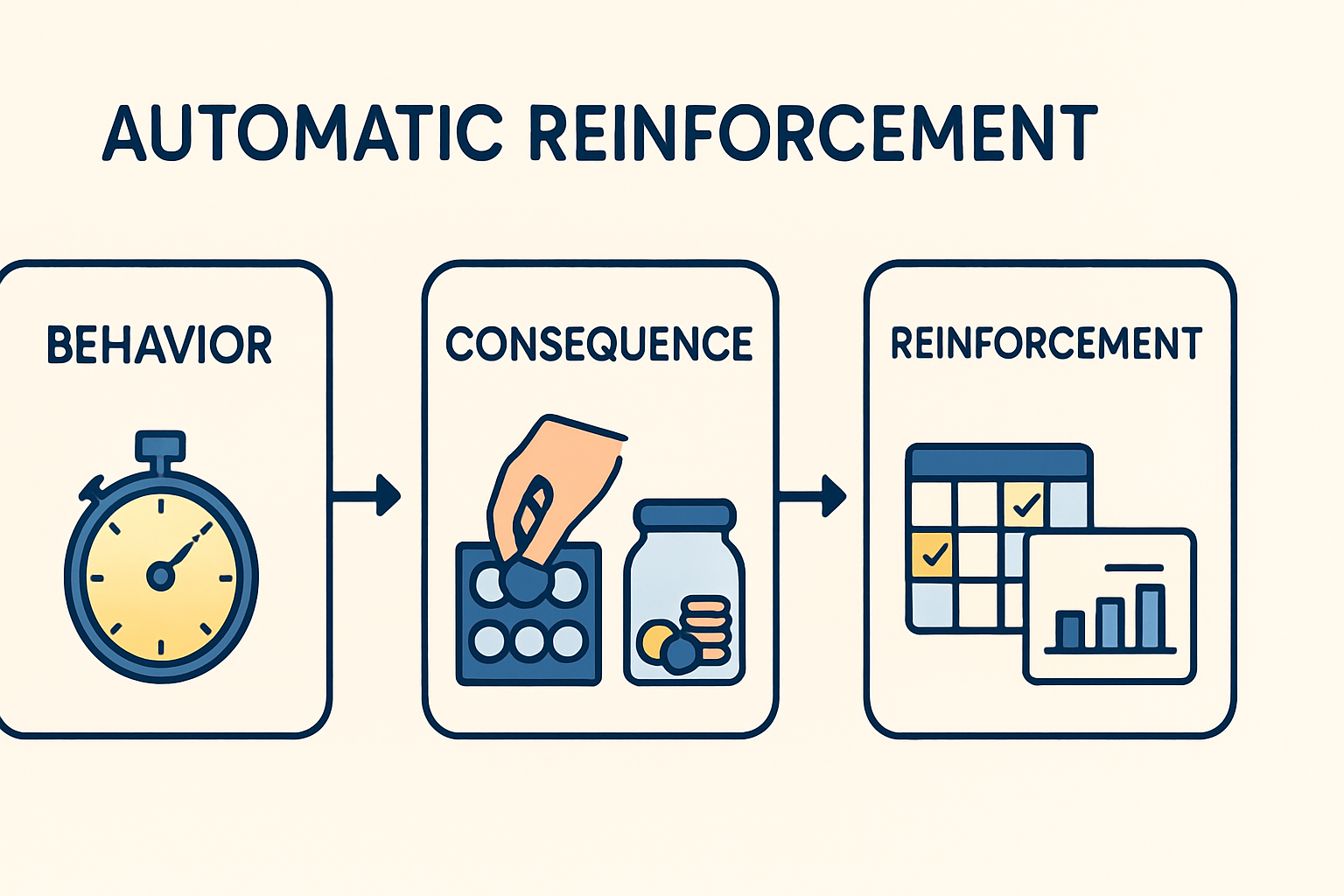
Examining concrete examples helps clarify how automatic reinforcement functions in real-world scenarios. Each example follows the ABC format (Antecedent-Behavior-Consequence) to demonstrate the behavioral relationship clearly.
Example 1: Stereotypy and Sensory Stimulation
A child engages in hand-flapping when alone in their room. The behavior produces visual stimulation and proprioceptive feedback from the arm movements. This represents automatic positive reinforcement because the behavior directly generates the reinforcing sensory input without any social component.
ABC Analysis:
- Antecedent: Child sitting alone, minimal environmental stimulation
- Behavior: Rapid hand-flapping movements
- Consequence: Visual patterns created by hand movement, kinesthetic feedback
- Function: Automatic positive reinforcement (sensory stimulation)
Example 2: Behavior Maintained by Pain Attenuation
An individual with chronic headaches engages in head-hitting against a wall. The impact produces a counter-stimulation that temporarily reduces the headache pain. This illustrates automatic negative reinforcement because the behavior removes an aversive internal state.
ABC Analysis:
- Antecedent: Intense headache pain, no medication available
- Behavior: Head-hitting against solid surface
- Consequence: Temporary reduction in headache intensity
- Function: Automatic negative reinforcement (pain attenuation)
Example 3: The Challenge of Identifying Automatic Functions
A student hums quietly during independent work time. The behavior might serve automatic reinforcement through auditory stimulation, but could also serve social functions if peers respond. Careful observation reveals the humming continues even when no one is present to hear it, supporting an automatic function hypothesis.
This example demonstrates the importance of environmental manipulation to test functional hypotheses. Removing potential social consequences helps determine if the behavior persists due to automatic reinforcement alone.
Automatic Reinforcement and the BCBA Exam: What to Expect
The BCBA exam tests your ability to identify and analyze automatic reinforcement in various contexts. Questions often present clinical scenarios requiring you to determine the behavioral function and select appropriate interventions based on that analysis.
Common Exam Traps and Misconceptions
Several common mistakes can lead to incorrect answers on exam questions about automatic reinforcement:
- Confusing automatic with unconscious: Automatic refers to the reinforcement mechanism, not awareness level
- Mislabeling socially-mediated functions: Assuming automatic when social consequences are actually maintaining the behavior
- Over-applying the label: Using automatic reinforcement without evidence of sensory consequences
- Ignoring negative reinforcement: Forgetting that automatic reinforcement includes both positive and negative forms
- Missing environmental controls: Failing to consider how motivating operations affect automatic reinforcement value
Key Terms and Related Concepts You Must Know
Several related concepts frequently appear alongside automatic reinforcement questions:
- Non-social reinforcement: Alternative term emphasizing the absence of social mediation
- Self-stimulatory behavior: Behaviors maintained by automatic positive reinforcement
- Sensory extinction: Intervention that blocks the sensory consequence maintaining behavior
- Automaticity: The property of occurring without deliberate control or social mediation
- Internal states: Physiological conditions that can serve as establishing operations for automatic reinforcement
Understanding these related concepts helps you navigate complex exam scenarios and connect automatic reinforcement to broader behavioral functions.
Quick Checklist: Is It Automatic Reinforcement?
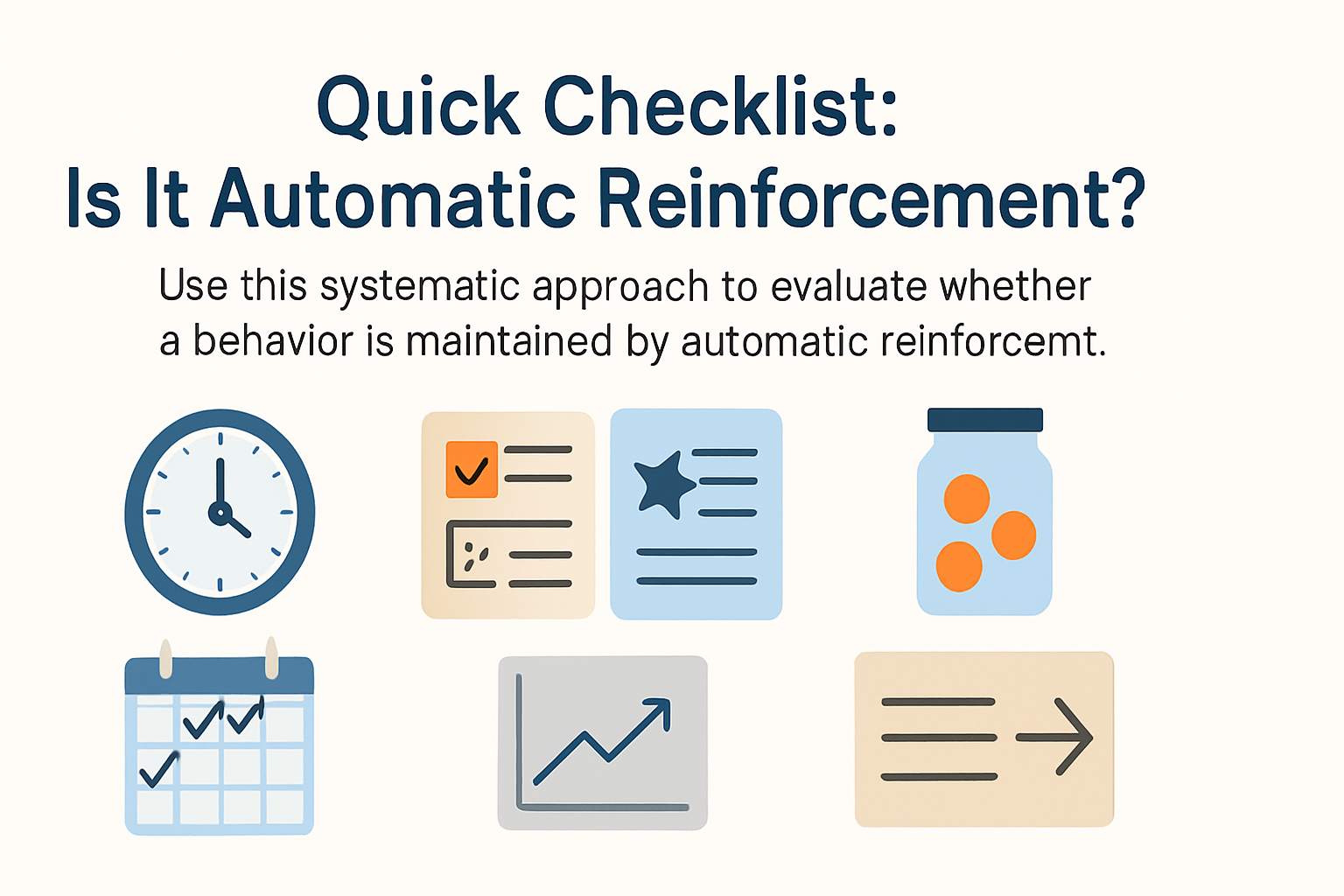
Use this systematic approach to evaluate whether a behavior is maintained by automatic reinforcement:
- Check for social mediation: Does another person need to respond for reinforcement to occur?
- Identify the consequence: What immediate sensory or internal change does the behavior produce?
- Test persistence: Does the behavior continue when no one is present to observe or respond?
- Analyze timing: Is the consequence immediate and intrinsic to the behavior itself?
- Consider alternative functions: Could social, tangible, or escape functions better explain the behavior?
- Review environmental context: Are there establishing operations that increase the value of sensory consequences?
Summary and Key Takeaways for Your Study
Mastering automatic reinforcement requires understanding both its definition and practical application. Remember these essential points for your BCBA exam preparation:
- Automatic reinforcement occurs without social mediation – the behavior produces its own consequence
- Two primary types exist: automatic positive reinforcement (adds sensory stimulation) and automatic negative reinforcement (removes aversive stimulation)
- Always look for sensory consequences or internal state changes when hypothesizing automatic functions
- Common exam traps include confusing automatic with unconscious behavior and misidentifying socially-mediated functions
- Use systematic analysis to differentiate automatic reinforcement from other behavioral functions
- Consider how interventions like sensory extinction target behaviors maintained by automatic reinforcement
For further study of behavioral principles, review the seven dimensions of ABA and practice applying functional analysis concepts to various clinical scenarios. The BACB’s 6th Edition Task List provides additional guidance on required knowledge areas related to reinforcement principles.



