
What Are Antecedent Interventions?
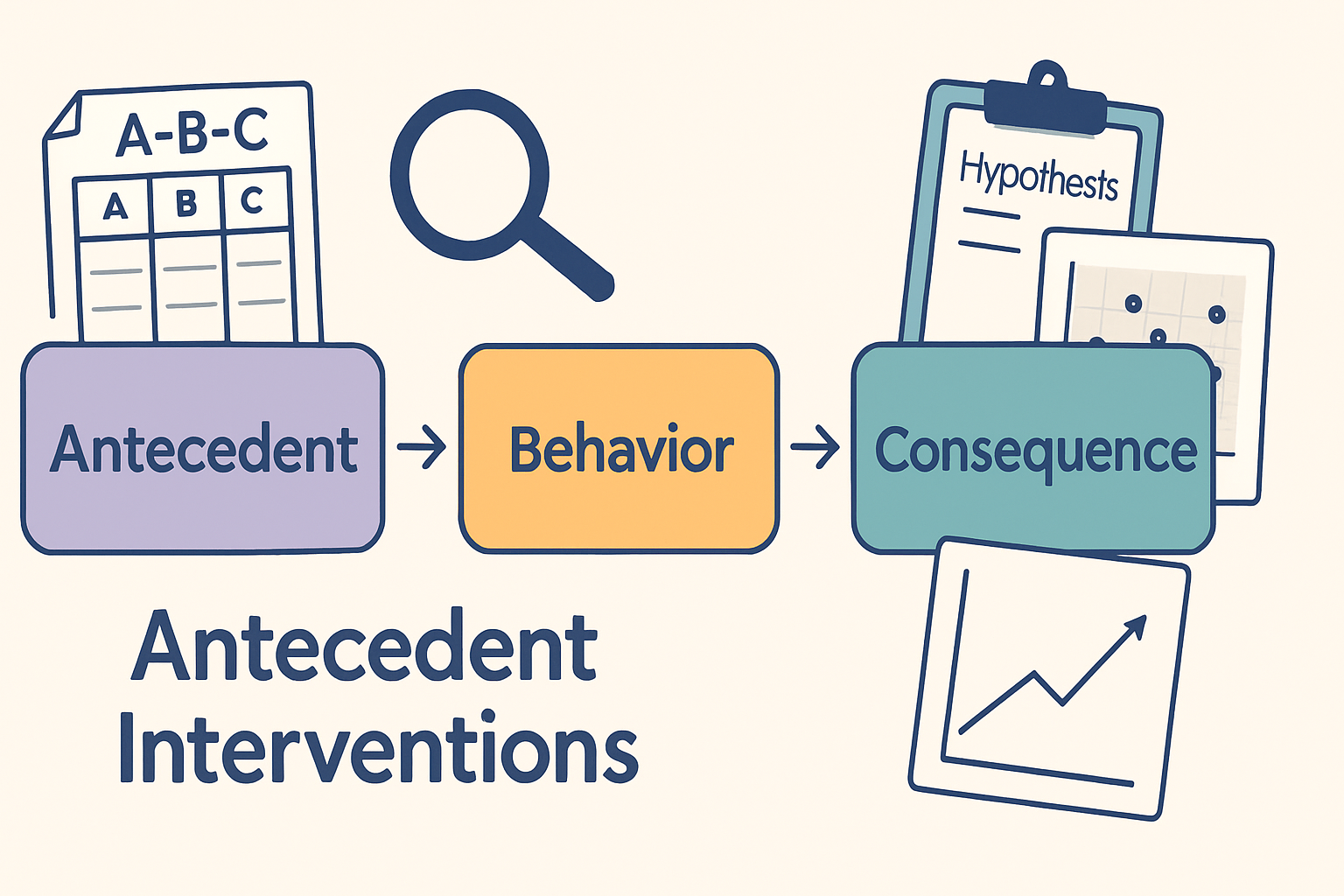
Antecedent interventions are proactive strategies that modify the environment or conditions before a target behavior occurs. These interventions focus on the ‘A’ in the ABC contingency—the antecedent—and aim to prevent challenging behaviors by addressing their triggers.
Table of Contents
- What Are Antecedent Interventions?
- Antecedent Interventions in Action: Worked Examples
- Antecedent Interventions on the BCBA Exam
- Summary and Key Takeaways
This approach aligns with ethical guidelines that prioritize least restrictive interventions and preventative measures. By changing what happens before behavior, practitioners can reduce the need for reactive consequence-based procedures.
Core Definition and Exam Significance
In applied behavior analysis, antecedent interventions involve altering environmental variables or setting events that precede behavior. These modifications make challenging behaviors less likely to occur by removing or modifying their triggers.
For exam purposes, remember that antecedent interventions are always implemented before the behavior. They represent a preventative approach that respects client dignity and autonomy while being consistent with the BACB Ethics Code requirement to use the least intrusive effective interventions.
Antecedent vs. Consequence Strategies: A Critical Distinction
Understanding this distinction is essential for both practice and exam success. Antecedent strategies occur before behavior and aim to prevent it, while consequence strategies occur after behavior and aim to change future occurrences.
- Timing: Antecedent interventions happen before behavior; consequence interventions happen after.
- Goal: Antecedent strategies prevent behavior; consequence strategies modify future behavior.
- Examples: Providing choices (antecedent) vs. differential reinforcement (consequence).
- Ethical priority: Antecedent interventions are generally considered less intrusive and more preventative.

Antecedent Interventions in Action: Worked Examples
Let’s examine three practical scenarios that demonstrate how antecedent interventions work with different behavioral functions. Each example includes ABC data analysis and a function-aligned intervention.
Example 1: Reducing Elopement Through Environmental Modification
Consider a student who elopes from the classroom during group activities. The ABC analysis reveals: Antecedent: crowded room with loud noise; Behavior: elopement; Consequence: escape to quiet hallway.
The hypothesized function is escape from aversive stimulation. An effective antecedent intervention would be to provide noise-canceling headphones or create a designated quiet corner before entering the noisy environment. This modifies the antecedent by reducing the aversive auditory stimulation that triggers elopement.
Example 2: Increasing Task Engagement with Noncontingent Reinforcement
A child consistently refuses difficult math worksheets. The ABC pattern shows: Antecedent: presentation of challenging worksheet; Behavior: task refusal and crying; Consequence: worksheet removal.
The function is escape from difficult tasks. An antecedent intervention using noncontingent reinforcement (NCR) would involve providing brief, high-quality attention before presenting the worksheet. This abolishes the worksheet’s aversive properties by pairing it with positive reinforcement, making escape less necessary.
Example 3: Preventing Tangible-Maintained Aggression with a Visual Schedule
During transitions from preferred activities, a client becomes aggressive. The ABC data indicates: Antecedent: tablet time ending; Behavior: hitting; Consequence: tablet briefly returned.
The function is access to tangibles. An antecedent intervention would implement a visual schedule showing ‘tablet’ followed by ‘snack’ well before the transition occurs. This provides predictability and signals the upcoming change, reducing the motivating operation for aggression. For more on understanding behavioral functions, see our guide on the four functions of behavior.
Antecedent Interventions on the BCBA Exam
Exam questions about antecedent interventions test your ability to distinguish them from consequence procedures and select appropriate strategies based on behavioral function. Understanding these concepts is crucial for both the exam and ethical practice.
Common Exam Traps and How to Avoid Them
Several predictable traps can trip up even well-prepared candidates. Being aware of these common mistakes will help you navigate exam questions more effectively.
- Confusing antecedent and consequence procedures: Remember that differential reinforcement of alternative behavior (DRA) is a consequence strategy, not an antecedent intervention.
- Selecting interventions without considering function: Always match the intervention to the hypothesized behavioral function from your functional behavior assessment.
- Overlooking ethical considerations: Antecedent interventions are typically less intrusive and should be considered before more restrictive options.
- Missing setting event modifications: Don’t forget that changes to broader environmental conditions (like sleep or medication) can also be antecedent interventions.
Quick-Reference Checklist for Exam Questions
Use this checklist when analyzing exam questions about behavior intervention strategies. It will help you systematically evaluate whether an intervention qualifies as antecedent-based.
- Check timing: Is the strategy applied BEFORE the target behavior occurs?
- Assess environmental focus: Does it modify the environment, setting events, or antecedent conditions?
- Verify function alignment: Is the intervention logically connected to the behavioral function?
- Consider ethical priority: Would this be considered before more intrusive consequence-based options?
- Evaluate preventative nature: Does it aim to prevent behavior rather than respond to it?
For additional exam preparation resources, explore our comprehensive BCBA exam prep guide that covers all essential content areas.
Summary and Key Takeaways
Antecedent interventions represent a proactive, ethical approach to behavior change that focuses on prevention rather than reaction. Mastering these concepts is essential for both exam success and effective practice.
- Proactive timing: Antecedent interventions always occur before the target behavior, distinguishing them from consequence strategies.
- Function-based design: Effective interventions must align with the behavioral function identified through assessment.
- Environmental modification: These strategies work by changing triggers, setting events, or establishing operations in the environment.
- Ethical priority: As less intrusive options, antecedent interventions should typically be considered before consequence-based procedures.
- Exam relevance: Understanding the distinction between antecedent and consequence strategies is frequently tested on the BCBA exam.
For authoritative information on ethical standards and professional practice, consult the BACB Ethics Code which emphasizes the use of least restrictive interventions. Additionally, research published in the Journal of Applied Behavior Analysis provides evidence-based guidance on implementing effective antecedent interventions.
Complete BCBA Exam Prep
Turn this topic into exam-day practice
Practice concepts in context with five full-length 6th Edition mock exams, two bonus practice exams, a 6th Edition study guide, and key-term flashcards—all in one $120 USD package.
Get the $120 All-in-One Prep Pack
Review everything included on the product page before ordering. No pass guarantee is implied.



