

Stimulus control is a fundamental concept in applied behavior analysis that describes how environmental cues influence behavior. When a behavior occurs reliably in the presence of specific stimuli but not in their absence, we say that behavior is under stimulus control. This principle is essential for teaching discrimination skills and understanding how individuals learn to respond appropriately to different situations.
Table of Contents
- Stimulus Control ABA: What is Stimulus Control? A Foundational Definition
- Stimulus Control in Action: Worked ABA Examples
- Stimulus Control on the BCBA Exam: Relevance and Common Traps
- Quick-Reference Checklist and Summary
- References
Stimulus Control ABA: What is Stimulus Control? A Foundational Definition
At its core, stimulus control refers to the degree of correlation between a specific stimulus and a particular behavior. When this correlation is strong, the stimulus reliably evokes the behavior. This relationship is established through reinforcement history and forms the basis for discrimination learning.
The Role of the Discriminative Stimulus (Sd)
A discriminative stimulus (Sd) signals that reinforcement is available for a specific behavior. Think of a green traffic light as an Sd for driving forward. The light doesn’t make you press the accelerator, but it signals that doing so will likely lead to successful travel. In contrast, a delta stimulus (S-delta) signals that reinforcement is NOT available for that behavior.
Key characteristics of an Sd include:
- It has a history of reinforcement for a specific behavior
- It signals the availability of reinforcement
- It does not directly cause the behavior but increases its likelihood
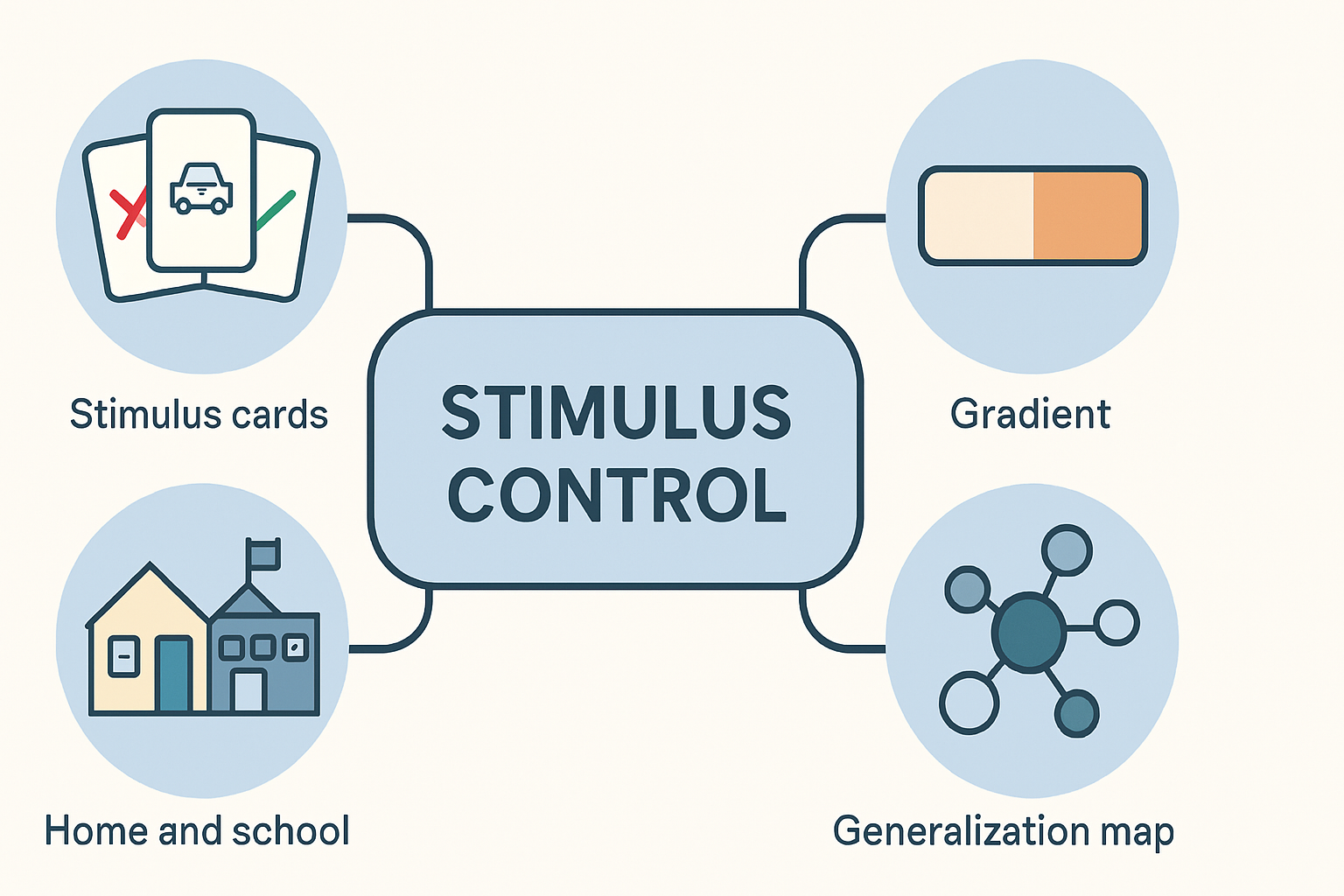
Stimulus Control vs. Generalization: A Key Distinction
While stimulus control involves responding to specific stimuli, stimulus generalization involves responding to similar stimuli. These concepts work together in skill development. Effective teaching often begins with establishing stimulus control and then programming for generalization.
For more on this distinction, see our guide on stimulus generalization vs response generalization.
Stimulus Control in Action: Worked ABA Examples
Understanding stimulus control requires seeing it in practice. These examples demonstrate how discriminative stimuli operate in real-world scenarios.
Example 1: Manding for a Preferred Item
A child learns to say ‘cookie’ only when a cookie is visible. The visible cookie serves as the Sd for the verbal mand. When no cookie is present (S-delta), the child doesn’t say ‘cookie.’
- Antecedent: Cookie visible on counter
- Behavior: Child says ‘cookie’
- Consequence: Receives cookie
- Function: Tangible access
This demonstrates precise stimulus control where the behavior occurs only in the presence of the specific discriminative stimulus.
Example 2: Following an Instruction in the Classroom
A student raises their hand when the teacher asks a question to the class. The teacher’s question serves as the Sd for hand-raising behavior.
- Antecedent: Teacher asks ‘Who knows the answer?’
- Behavior: Student raises hand
- Consequence: Teacher calls on student
- Function: Access to adult attention
When the teacher is lecturing (S-delta), hand-raising doesn’t occur, showing clear discrimination.
Example 3: Discriminating Between Safe and Unsafe
A child holds an adult’s hand when approaching a busy street but not on a quiet sidewalk. The busy street serves as the Sd for the safety behavior.
- Antecedent: Approaching busy intersection
- Behavior: Child reaches for adult’s hand
- Consequence: Adult holds hand, crosses safely
- Function: Negative reinforcement (avoiding danger)
This example shows how stimulus control develops for safety skills through differential reinforcement.
Stimulus Control on the BCBA Exam: Relevance and Common Traps
Understanding stimulus control is crucial for BCBA exam success. Questions often test your ability to identify discriminative stimuli and distinguish stimulus control from related concepts.
How to Identify Stimulus Control Questions
Look for these key indicators in exam questions:
- Scenarios describing behavior occurring in one context but not another
- References to ‘cues,’ ‘signals,’ or ‘triggers’ for behavior
- Questions about discrimination training or conditional discrimination
- Comparisons between different environmental conditions
For more on distinguishing related concepts, see our guide on Sd vs MO differences.
Frequent Exam Pitfalls and Misconceptions
Avoid these common errors when answering stimulus control questions:
- Confusing Sd with reinforcer: Remember, an Sd signals reinforcement availability but is not the reinforcer itself
- Mistaking stimulus control for motivation: Motivating operations affect value, while Sds affect availability
- Failing to distinguish from prompt dependence: Prompts are temporary supports, while Sds are naturally occurring cues
- Confusing S-delta with punishment: S-delta signals no reinforcement, not necessarily punishment
Quick-Reference Checklist and Summary
Use this checklist to test your understanding of stimulus control concepts.
Stimulus Control Self-Check
- Can I define discriminative stimulus and delta stimulus?
- Can I provide a novel example of stimulus control?
- Do I understand the difference between stimulus control and generalization?
- Can I identify common exam traps related to stimulus control?
- Do I know how to establish stimulus control in teaching?
Key Takeaways for Your Study Notes
Essential points to remember:
- Stimulus control means behavior is more likely in the presence of a specific Sd
- The Sd signals that reinforcement is available for a particular behavior
- This concept is foundational for teaching discrimination skills
- Watch for distractors confusing Sds with MOs or reinforcers on the exam
- Effective programming involves both establishing stimulus control and promoting generalization
For comprehensive exam preparation, explore our BCBA exam prep guide covering all essential concepts.
References
Complete BCBA Exam Prep
Turn this topic into exam-day practice
Practice concepts in context with five full-length 6th Edition mock exams, two bonus practice exams, a 6th Edition study guide, and key-term flashcards—all in one $120 USD package.
Get the $120 All-in-One Prep Pack
Review everything included on the product page before ordering. No pass guarantee is implied.



