
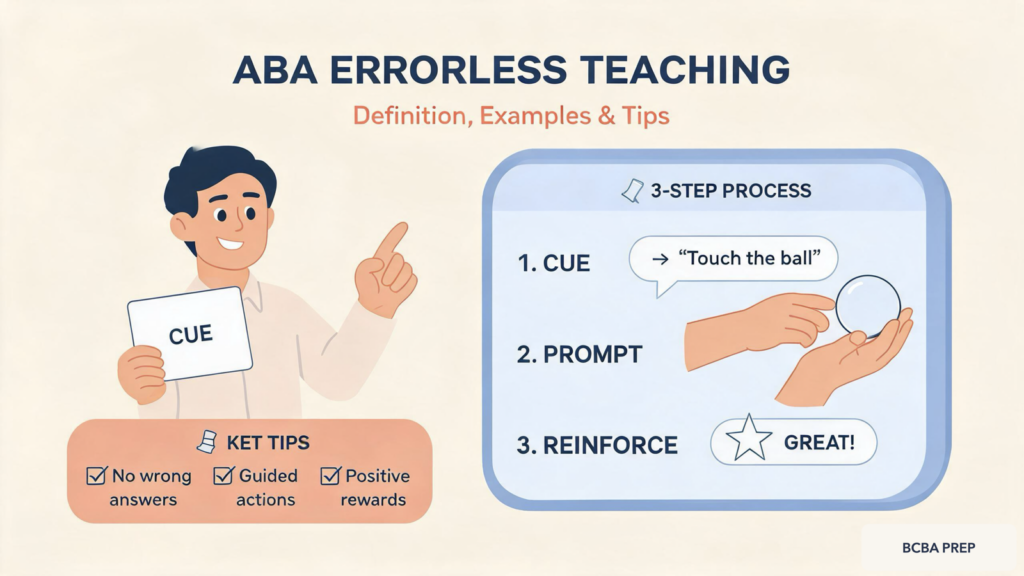
What Is Errorless Teaching in ABA?
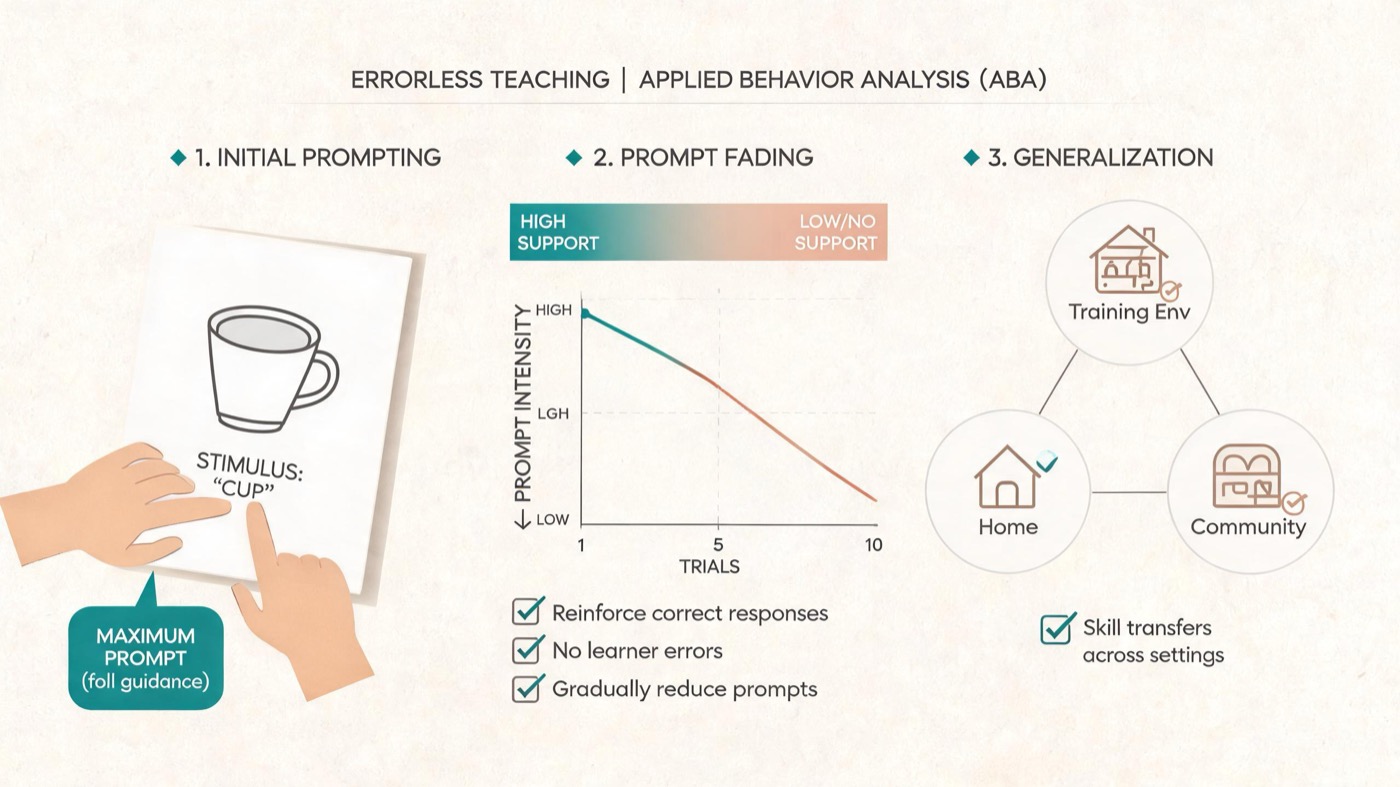
Errorless teaching is a systematic instructional strategy used in applied behavior analysis (ABA) to minimize learner errors during skill acquisition. The instructor provides a high level of prompting from the start to ensure the learner responds correctly, then gradually fades those prompts as the learner becomes more independent. This approach contrasts with error correction procedures, where the learner is allowed to make errors and then receives corrective feedback.
Table of Contents
- What Is Errorless Teaching in ABA?
- Errorless Teaching vs. Error Correction: When to Use Each
- Worked Examples: Errorless Teaching in Action
- Common Exam Traps & How to Avoid Them
- Quick Checklist for Errorless Teaching Implementation
- For BCBA Exam Relevance
- Summary
The goal of errorless teaching is to build fluent, accurate responding while reducing frustration and preventing the practice of incorrect responses. It is especially effective when teaching discrimination skills, such as identifying pictures or following one-step instructions, and when working with learners who have a history of frequent errors or challenging behavior.
The Role of Prompts in Errorless Teaching
Prompts are the backbone of errorless teaching. They are extra stimuli or supports that increase the likelihood of a correct response. Common prompt types include gestural prompts (pointing), modeling (demonstrating the action), verbal prompts (saying the answer), physical prompts (hand-over-hand guidance), and positional prompts (placing the correct item closer to the learner).
The key is to choose the least intrusive prompt that still ensures success, then systematically fade it across trials. For example, you might start with a full physical prompt and move to a partial physical prompt, then a gesture, and finally no prompt. This process is called prompt fading and is essential for transferring stimulus control to the natural discriminative stimulus (SD).
Errorless Teaching vs. Error Correction: When to Use Each
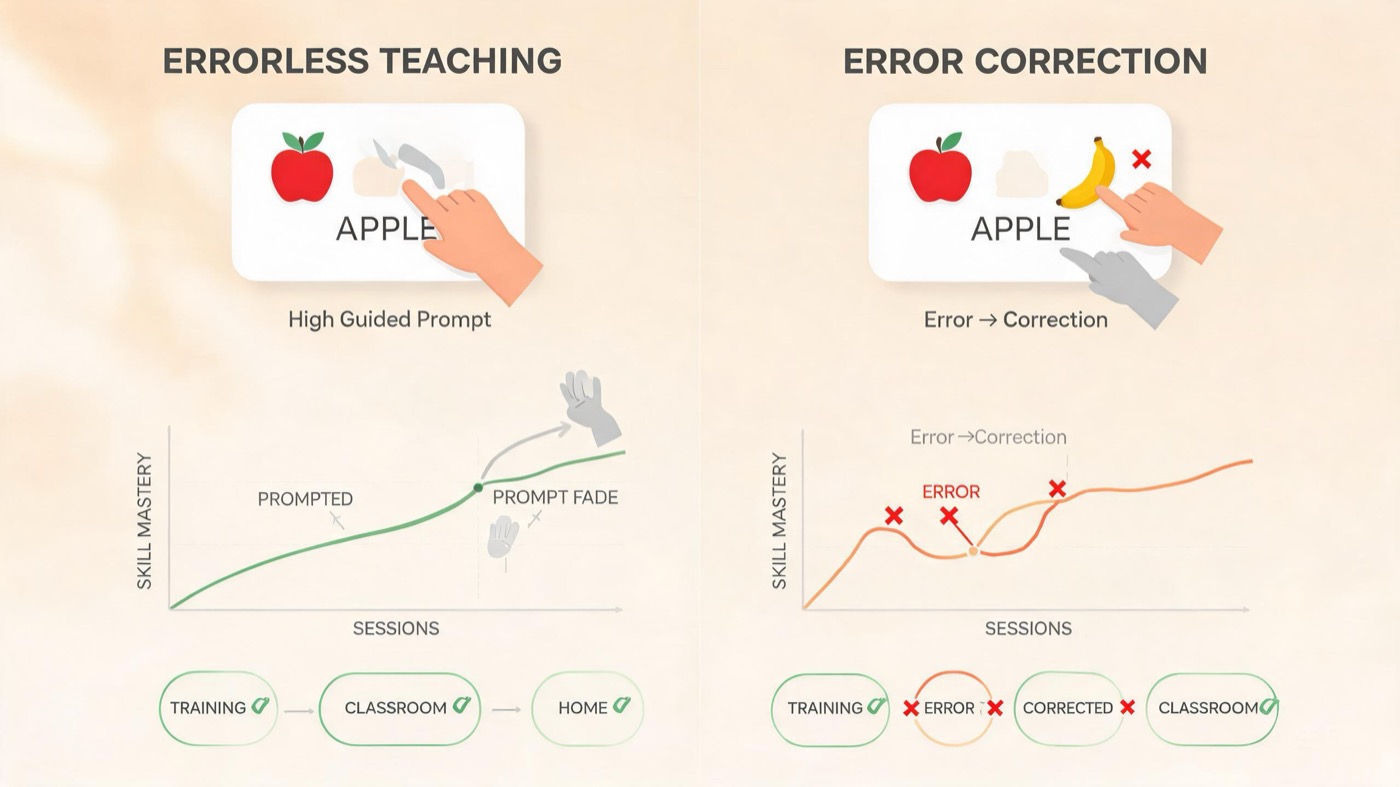
Both strategies have their place in ABA, but understanding when to use each is critical for exam success and ethical practice. Here are the key differences:
- Errorless teaching is best for initial skill acquisition when the learner has no prior correct response in their repertoire. It prevents errors from occurring, which is beneficial for building behavioral momentum and reducing escape-maintained problem behavior.
- Error correction is more appropriate when the learner has already demonstrated some correct responding but needs to improve fluency or generalization. Error correction typically involves a “model, test, repeat” sequence that allows the learner to learn from mistakes.
- On the BCBA exam, remember that errorless teaching is a prompting strategy, while error correction is a consequence-based strategy (feedback after an error).
Worked Examples: Errorless Teaching in Action
Example 1: Teaching a Child to Request “More”
Target behavior: The child will say “more” when they want additional playtime with a toy. Antecedent: The therapist holds a preferred toy just out of reach. Prompt: The therapist gestures toward the toy and says “more” (echoic prompt). Behavior: The child says “more.” Consequence: The therapist immediately hands over the toy and says “Great requesting!” Hypothesized function: Tangible (access to toy).
As the child succeeds repeatedly, the therapist reduces the verbal prompt to just a partial sound (“mo…”) and eventually uses only a nod. Prompt fading is documented across trials, showing 0 errors during acquisition.
Example 2: Discriminating Between “Car” and “Bus” Pictures
Target behavior: The learner will touch the correct picture (car or bus) when named. Antecedent: The therapist places two pictures on the table and says “Touch car.” Prompt: The therapist uses a physical prompt to guide the learner’s hand to the car picture. Behavior: The learner touches the car. Consequence: The therapist says “Yes! That’s a car!” and provides a small edible. Hypothesized function: Social positive reinforcement (praise) + tangible (edible).
The physical prompt is faded to a partial physical prompt (touching the learner’s elbow), then to a gesture (pointing), and finally to no prompt. Data show that the learner achieved 100% correct independent responding within 20 trials.
Example 3: Tacting Emotions (Happy vs. Sad)
Target behavior: The child will say “happy” when shown a happy face card and “sad” when shown a sad face card. Antecedent: The therapist shows the happy face card. Prompt: The therapist models the correct response by saying “happy” (model prompt). Behavior: The child says “happy.” Consequence: The therapist says “You’re right! Happy!” and gives a high five. Hypothesized function: Social positive reinforcement (attention).
The prompt is faded by delaying the model (e.g., 2-second delay) until the child responds independently. If an error occurs (rare), the therapist returns to the previous prompt level for the next trial, maintaining a near-errorless experience.
Common Exam Traps & How to Avoid Them
Trap 1: Assuming Errorless Means No Mistakes Ever
Errorless teaching minimizes errors; it does not guarantee zero errors. On the exam, be prepared for questions where a learner makes an occasional error during prompt fading. The correct response is to return to the previous prompt level or to provide a more intrusive prompt temporarily. Do not assume the procedure has failed entirely.
Trap 2: Confusing Prompt Fading with Errorless Teaching
Many test-takers mistakenly think that prompt fading is errorless teaching. In reality, prompt fading is a component of errorless teaching, but errorless teaching also includes the initial selection of prompts to prevent errors. Other strategies like time delay and stimulus shaping are also part of the errorless teaching umbrella. The exam might ask you to identify which procedure is being used (e.g., “The therapist uses a within-stimulus prompt to prevent errors” – that is errorless teaching, not just fading).
Trap 3: Mixing Up Errorless Teaching with Chaining or Shaping
Chaining breaks a task into steps and teaches them sequentially; shaping reinforces successive approximations toward a terminal behavior. Both may involve prompts but are not inherently errorless. An exam scenario describing a teacher who prevents all errors from the start is errorless teaching, not chaining or shaping. Look for keywords like “prompt before response” or “no errors occur during training.”
Quick Checklist for Errorless Teaching Implementation
Use this 5-step checklist to recall the procedure in an exam question or during supervision:
- Step 1: Identify the target behavior and ensure it is measurable.
- Step 2: Choose the least intrusive prompt that will evoke the correct response. Start with a prompt level that ensures immediate success.
- Step 3: Deliver the SD and immediately provide the selected prompt (do not wait for an error).
- Step 4: Reinforce the prompted response with immediate, high-quality reinforcement.
- Step 5: Systematically fade the prompt across trials (e.g., full to partial to gesture to none). If the learner makes an error, return to the previous prompt level for a few trials.
Remember to collect data on prompt level, correct responses, and errors to guide fading decisions. This data is often tested on the BCBA exam, and you may need to identify the next prompt level from a graph or table.
For BCBA Exam Relevance
Errorless teaching appears frequently on the BCBA exam under the skill acquisition section of the task list. You may be asked to:
– Identify whether a scenario uses errorless teaching or another strategy.
– Determine the appropriate prompt level after an error occurs.
– Compare errorless teaching to error correction in terms of behavioral momentum and efficiency.
– Select the best prompt fading procedure (e.g., most-to-least, least-to-most, time delay) given a learner’s history.
Practice with scenario-based questions to strengthen your ability to differentiate these procedures.
For more exam prep, check out our guide on prompt dependency and fading and explore the 7 dimensions of ABA that underpin all effective interventions.
Summary
Errorless teaching is a powerful ABA strategy for teaching new skills with minimal errors, using prompts from the outset and fading them systematically. It is especially useful when initial skill acquisition is the goal and when the learner is prone to frustration or escape behavior. Key components include prompt selection, prompt fading, and immediate reinforcement. On the BCBA exam, be careful not to confuse errorless teaching with error correction, chaining, or shaping. Use the 5-step checklist to guide implementation and data collection.
For more resources, visit the BACB’s official website or review the research on errorless learning for a deeper understanding.
Complete BCBA Exam Prep
Turn this topic into exam-day practice
Practice concepts in context with five full-length 6th Edition mock exams, two bonus practice exams, a 6th Edition study guide, and key-term flashcards—all in one $120 USD package.
Get the $120 All-in-One Prep Pack
Review everything included on the product page before ordering. No pass guarantee is implied.



