
Introduction: Why the Four Functions Are Fundamental
Understanding why behaviors occur is the cornerstone of effective applied behavior analysis. The four functions of behavior provide a systematic framework for analyzing and addressing challenging behaviors. This framework helps practitioners move beyond surface-level descriptions to identify the maintaining variables that drive behavior.
Table of Contents
- Introduction: Why the Four Functions Are Fundamental
- Defining the Four Functions of Behavior
- Applied Examples: Analyzing ABCs for Each Function
- Exam Relevance and Common Analysis Traps
- Quick Checklist for Function Identification
- Summary and Next Steps for Mastery
Mastering these concepts is essential for both clinical practice and professional certification. This guide breaks down each function with clear definitions and practical examples.
Defining the Four Functions of Behavior
Behavior analysts use the SEAT mnemonic to remember the four primary functions. Some practitioners prefer EATS, but the concepts remain identical. Each function represents a different type of reinforcement contingency that maintains behavior.
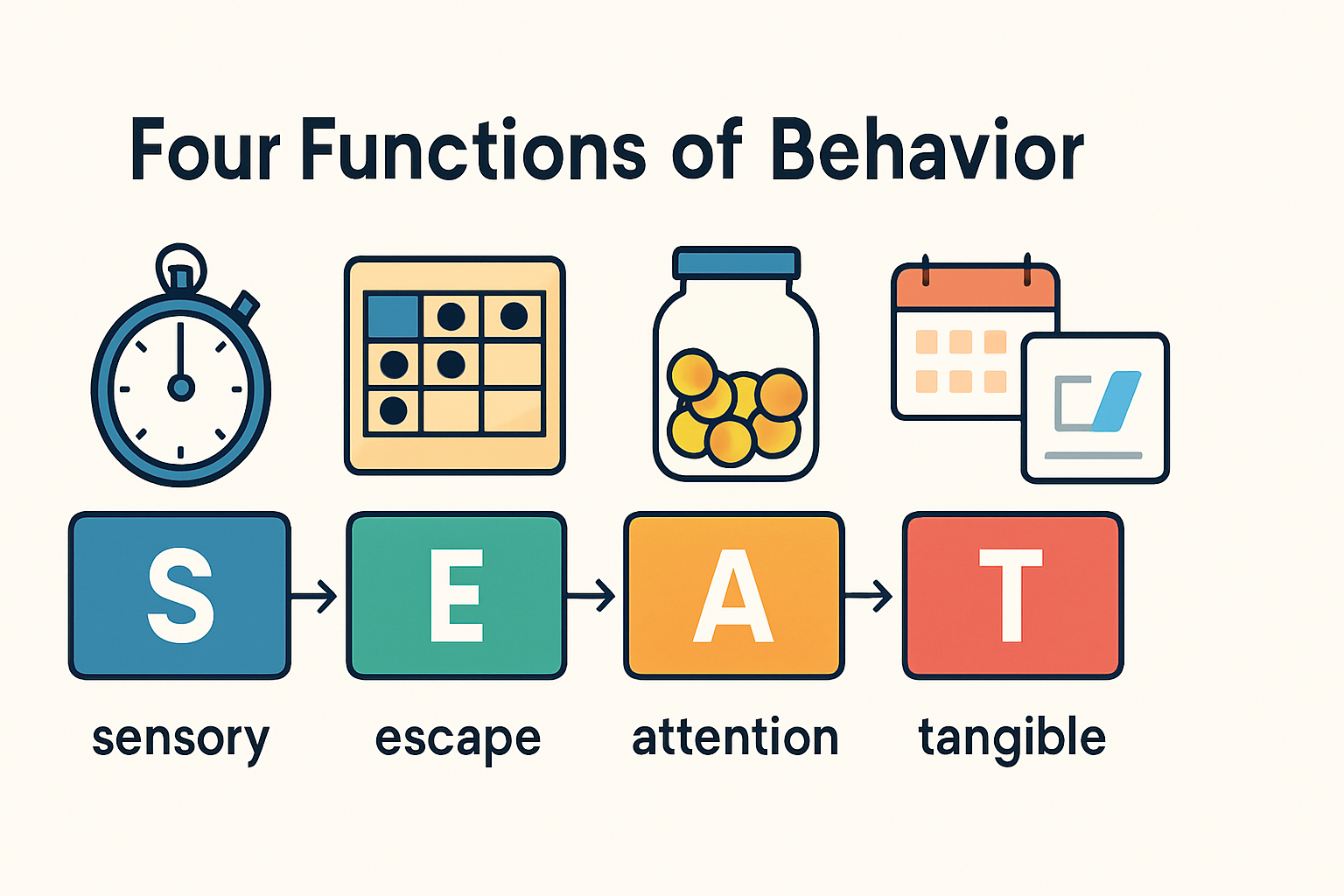
Sensory (Automatic Reinforcement)
Automatic reinforcement occurs when behavior produces its own reinforcing consequences without social mediation. The behavior feels good or reduces discomfort internally. This includes both positive automatic reinforcement (adding pleasurable stimulation) and negative automatic reinforcement (removing aversive stimulation).
Key identifier: The consequence is not delivered by another person.
Escape
Escape-maintained behaviors function to terminate, avoid, or delay an aversive stimulus. This represents negative reinforcement where behavior removes something undesirable. The aversive could be a difficult task, social demand, or uncomfortable environment.
Escape behaviors are common in educational and clinical settings where demands are placed.
Attention
Attention-seeking behaviors gain access to social interaction from others. The attention can be positive (praise, conversation) or negative (reprimands, corrections). What matters is that the behavior produces social reinforcement from another person.
Many challenging behaviors in social settings serve this function.
Access to Tangibles
Tangible-maintained behaviors function to obtain preferred items, activities, or events. This represents positive reinforcement where behavior adds something desirable. The tangible could be a toy, food item, electronic device, or preferred activity.
This function is often confused with attention but differs in the specific consequence delivered.
Applied Examples: Analyzing ABCs for Each Function
Real-world application requires careful ABC analysis of antecedents, behaviors, and consequences. Let’s examine two scenarios that demonstrate how different functions manifest in practice.
Example 1: The Classroom Scenario
During independent work time, a student engages in two different behaviors with distinct functions:
- Antecedent: Teacher presents difficult math worksheet
- Behavior: Student tears worksheet in half
- Consequence: Teacher removes worksheet and says “Okay, no more math”
- Function: Escape (negative reinforcement) – behavior terminated the aversive task
Later during group instruction:
- Antecedent: Teacher is helping another student
- Behavior: Student calls out loudly without raising hand
- Consequence: Teacher turns and says “Please raise your hand”
- Function: Attention (positive reinforcement) – behavior gained teacher’s social response
Example 2: The Home-Based Session
A child hits their sibling during a play session. Superficially, this might appear attention-seeking, but ABC analysis reveals a different function:
- Antecedent: Sibling is playing with preferred toy truck
- Behavior: Child hits sibling’s arm
- Consequence: Sibling drops toy and cries; child picks up toy
- Function: Access to tangibles – behavior obtained the preferred item
Data collection shows this pattern occurs consistently when siblings have desired items, not when parents are absent. This distinction is crucial for effective functional behavior assessment.
Exam Relevance and Common Analysis Traps
BCBA exam questions often test your ability to distinguish between functions in complex scenarios. Common errors stem from superficial analysis or misunderstanding key concepts.
Trap 1: Confusing Escape and Avoidance
Both escape and avoidance involve negative reinforcement, but they differ temporally. Escape terminates an ongoing aversive, while avoidance prevents its onset. For exam purposes, both typically fall under the escape function category.
Remember: If the behavior removes or prevents something aversive, it’s escape-maintained.
Trap 2: Overlooking Automatic Reinforcement
Many practitioners default to social functions when automatic reinforcement may be maintaining the behavior. Look for patterns where behavior persists despite inconsistent social consequences or occurs in isolation.
Rocking, hand-flapping, or skin-picking often serve sensory functions. Learn more about automatic reinforcement analysis.
Trap 3: Misidentifying the Specific Reinforcer
The most common error involves labeling attention when the actual reinforcer is tangible. Analyze the specific consequence delivered, not just the social context.
Example: A child cries until parent gives a cookie. The consequence is the cookie (tangible), not the parent’s attention during delivery.
Quick Checklist for Function Identification
Use these diagnostic questions during behavior analysis:
- Does the behavior produce internal sensory stimulation? → Sensory/automatic
- Does the behavior remove or delay demands or aversives? → Escape
- Does the behavior produce social interaction from others? → Attention
- Does the behavior obtain preferred items or activities? → Tangible access
- What happens immediately after the behavior? Identify the specific consequence
- Does the behavior occur across different social contexts? Consider automatic reinforcement
Summary and Next Steps for Mastery
The four functions of behavior—sensory/automatic, escape, attention, and tangible access—provide the foundation for effective behavioral assessment and intervention. Accurate identification requires careful ABC analysis and attention to the specific consequences maintaining behavior.
To deepen your understanding, practice analyzing case scenarios and consider how functional analysis methods experimentally test hypothesized functions. Remember that most behaviors serve one primary function, though some may have multiple maintaining variables.
For comprehensive exam preparation, explore related topics like reinforcement contingencies and motivating operations that influence behavioral function. The BACB’s Task List emphasizes functional assessment skills across multiple domains.


