
Understanding reinforcement schedules is essential for any behavior analyst working in applied behavior analysis. These rules determine when reinforcement occurs following a behavior, directly influencing the rate and pattern of responding. This guide breaks down the core concepts with practical examples and exam-focused insights.
Table of Contents
- What Are Reinforcement Schedules?
- The Four Basic Reinforcement Schedules
- Applied Examples of Reinforcement Schedules
- Reinforcement Schedules on the BCBA Exam
- Quick-Reference Study Checklist
What Are Reinforcement Schedules?
A reinforcement schedule is a rule specifying which instances of behavior will be reinforced. In ABA practice, these schedules control how frequently and predictably reinforcement follows behavior, shaping both acquisition and maintenance of skills.
The Basic Definition and Purpose
Every reinforcement schedule answers one question: when does reinforcement occur? The schedule’s structure determines the response pattern and resistance to extinction. Schedules range from continuous reinforcement (every response reinforced) to various intermittent patterns that maintain behavior more efficiently.
Key Dimensions: Ratio vs. Interval and Fixed vs. Variable
Reinforcement schedules differ along two primary dimensions. First, they can be ratio-based (dependent on number of responses) or interval-based (dependent on time elapsed). Second, they can be fixed (predictable) or variable (unpredictable).
- Ratio schedules reinforce after a certain number of responses
- Interval schedules reinforce the first response after a time period
- Fixed schedules have consistent requirements
- Variable schedules have requirements that average to a specific value
The Four Basic Reinforcement Schedules
These four fundamental schedules form the building blocks of more complex reinforcement arrangements. Each produces distinct behavioral patterns that every BCBA candidate must recognize.
Fixed Ratio (FR) and Variable Ratio (VR)
Fixed Ratio schedules deliver reinforcement after a set number of responses. For example, FR-5 means reinforcement follows every fifth response. This typically produces a post-reinforcement pause followed by rapid responding.
Variable Ratio schedules deliver reinforcement after an average number of responses. VR-10 might reinforce after 7, 12, 9, and 12 responses (averaging 10). This produces high, steady response rates and creates resistance to extinction.
Fixed Interval (FI) and Variable Interval (VI)
Fixed Interval schedules reinforce the first response after a fixed time period. FI-2min means the first response after 2 minutes gets reinforced. This creates a scallop pattern with slow responding early in the interval and acceleration near the end.
Variable Interval schedules reinforce the first response after varying time periods that average to a specific value. VI-3min might reinforce after 1, 4, 2, and 5 minutes. This maintains steady, moderate response rates with little pausing.
Applied Examples of Reinforcement Schedules
Real-world applications demonstrate how reinforcement schedules function in ABA interventions. These examples show practical implementation with clear behavioral outcomes.
Example 1: Token Economy with a Fixed Ratio Schedule
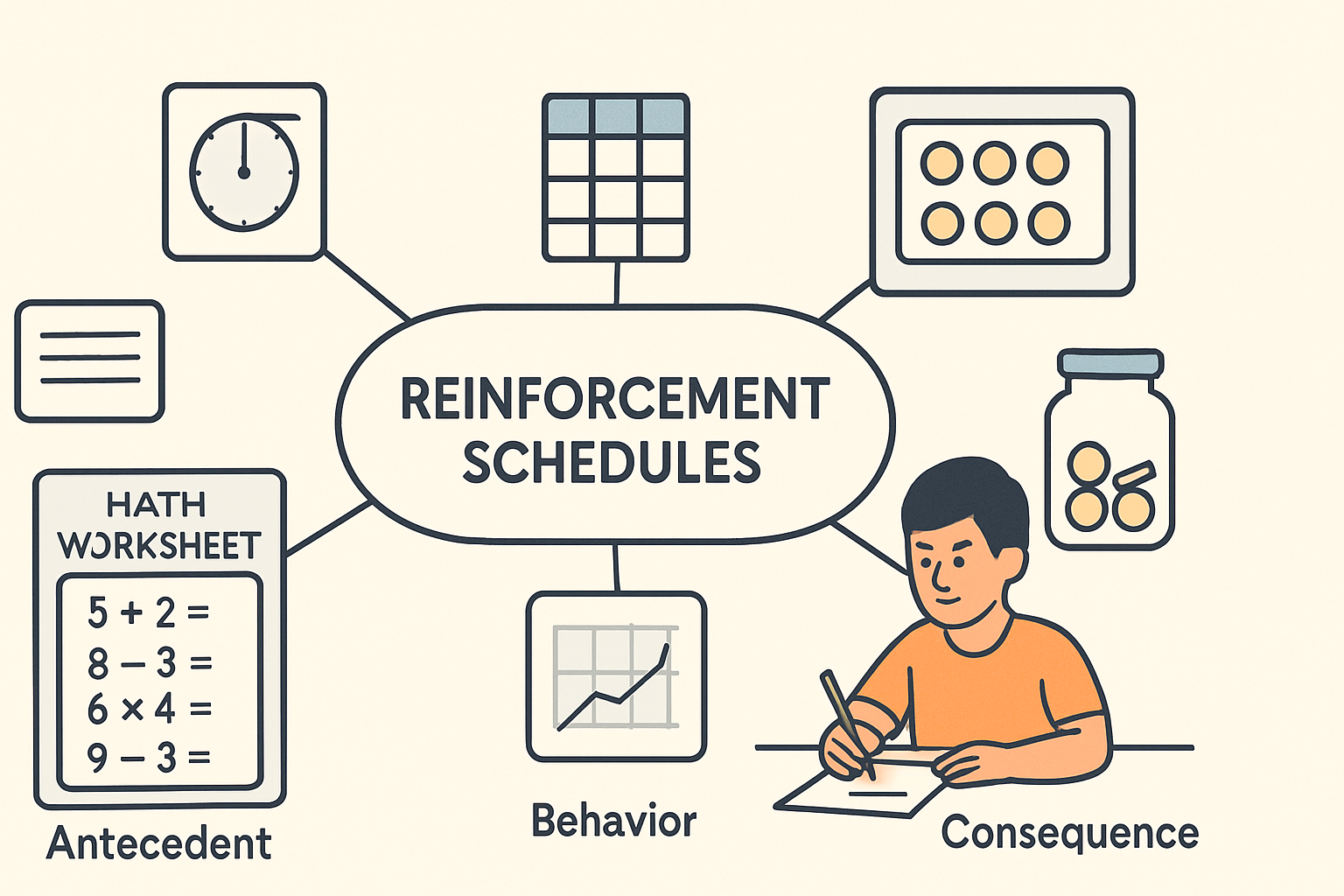
Antecedent: Math worksheet presented. Behavior: Completing math problems. Consequence: Token delivered after every 5 completed problems (FR-5).
This token economy uses an FR-5 schedule where tokens function as conditioned reinforcers. The likely pattern includes brief pauses after token delivery followed by bursts of problem-solving. Tokens are later exchanged for backup reinforcers, maintaining the acquisition of academic skills.
Example 2: Praise on a Variable Interval Schedule for On-Task Behavior
Antecedent: Independent work period. Behavior: Staying on-task during seatwork. Consequence: Teacher delivers praise on average every 3 minutes (VI-3min).
This social reinforcement schedule maintains consistent on-task behavior. Because praise occurs unpredictably, the student remains engaged throughout the work period. This schedule is particularly effective for behavior maintenance in classroom settings.
Reinforcement Schedules on the BCBA Exam
Exam questions often test your ability to identify schedules from descriptions and predict behavioral patterns. Understanding common traps is crucial for success.
Common Exam Traps and How to Avoid Them
Several patterns consistently trip up candidates. Recognizing these can improve your exam performance significantly.
- Confusing ratio schedules (response-based) with interval schedules (time-based)
- Mistaking ‘fixed’ for predictable versus ‘variable’ for unpredictable requirements
- Misinterpreting cumulative records: scallops indicate FI, steady slopes indicate VR or VI
- Forgetting that VR produces the highest response rates and greatest resistance to extinction
- Overlooking that VI maintains steady responding without post-reinforcement pauses
Sample Exam Practice Prompts
Test your understanding with these exam-style questions:
- A client earns a break after completing an average of 8 worksheets. What schedule is this? (Answer: VR-8)
- Which schedule typically produces a scallop pattern on a cumulative record? (Answer: FI)
- A student receives attention from the teacher for the first hand raise after approximately 5 minutes. What schedule? (Answer: VI-5min)
For more practice with BCBA exam questions, explore our free mock exam questions.
Quick-Reference Study Checklist
Use this checklist for last-minute review before your exam or when designing interventions.
- Fixed Ratio (FR): Reinforcement after set number of responses; produces post-reinforcement pause then rapid responding
- Variable Ratio (VR): Reinforcement after average number of responses; produces high, steady rates with resistance to extinction
- Fixed Interval (FI): First response after set time reinforced; produces scallop pattern with acceleration near interval end
- Variable Interval (VI): First response after average time reinforced; produces steady, moderate response rates
- Remember: Ratio = responses; Interval = time; Fixed = predictable; Variable = unpredictable
- For complex schedules, review our guide on compound vs. simple schedules
Mastering reinforcement schedules requires understanding both the theoretical foundations and practical applications. These schedules form the backbone of effective behavior change procedures in ABA. For comprehensive exam preparation, consider our BCBA exam prep guide covering all essential domains.
Complete BCBA Exam Prep
Turn this topic into exam-day practice
Practice concepts in context with five full-length 6th Edition mock exams, two bonus practice exams, a 6th Edition study guide, and key-term flashcards—all in one $120 USD package.
Get the $120 All-in-One Prep Pack
Review everything included on the product page before ordering. No pass guarantee is implied.



