

What is Discontinuous Measurement in ABA?
Discontinuous measurement refers to observing and recording behavior during only part of an observation period, rather than continuously tracking every occurrence. This approach provides a practical alternative when continuous measurement isn’t feasible due to resource constraints or the nature of the target behavior.
Table of Contents
- What is Discontinuous Measurement in ABA?
- Discontinuous Measurement ABA Examples in Practice
- Exam Relevance and Common Measurement Traps
- Quick Checklist for Discontinuous Measurement
- Summary and Key Takeaways
Key Definitions: From Continuous to Discontinuous
Continuous measurement involves tracking every instance of behavior throughout an observation period. Common methods include frequency counting, duration recording, and latency measurement. In contrast, discontinuous measurement samples behavior at specific intervals, offering efficiency at the cost of potential measurement error.
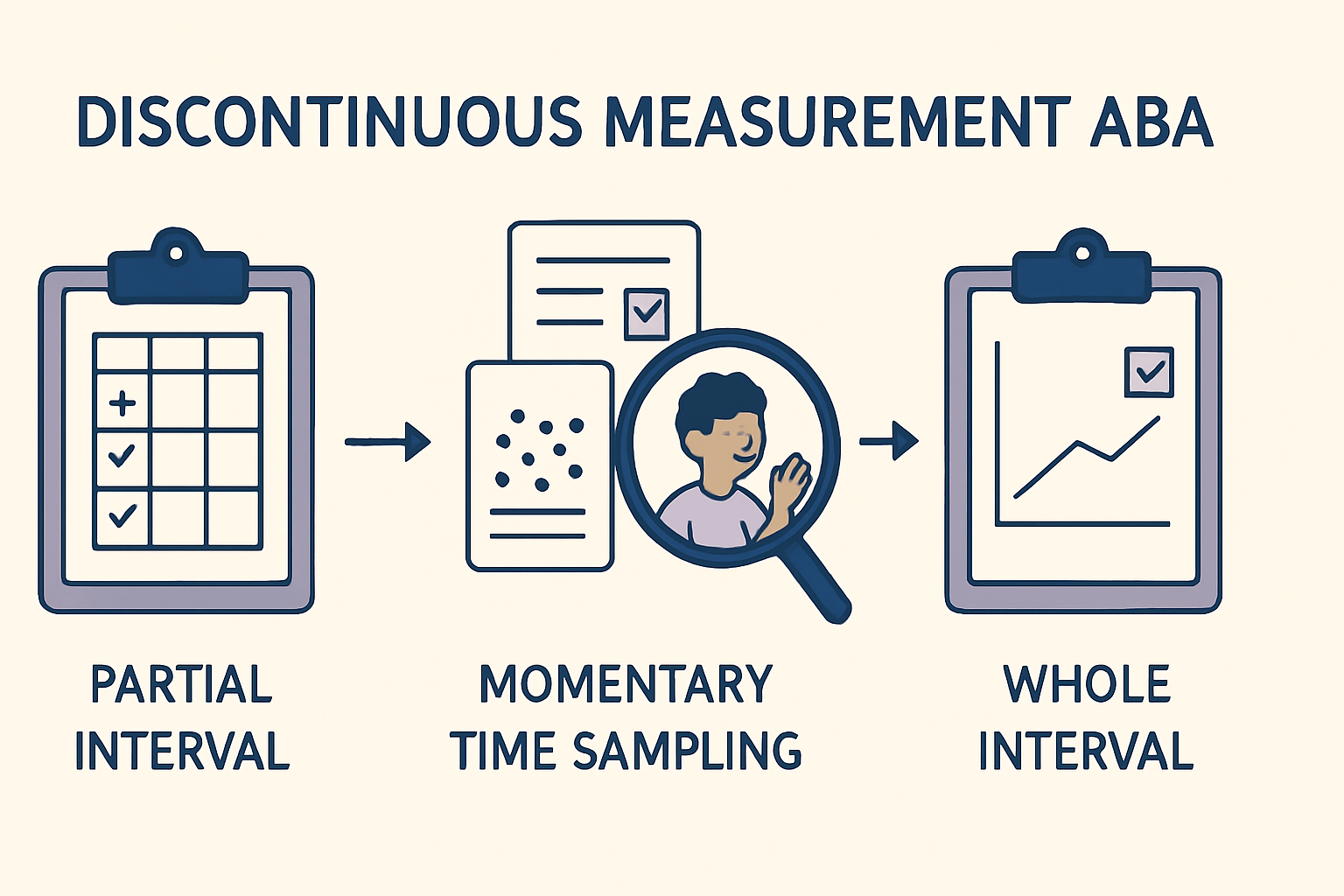
The three primary discontinuous methods are:
- Partial Interval Recording: Behavior is scored if it occurs at any point during the observation interval
- Whole Interval Recording: Behavior must occur throughout the entire interval to be scored
- Momentary Time Sampling: Behavior is recorded only if it occurs at the exact moment of observation
When to Use Discontinuous Measurement Procedures
Discontinuous measurement becomes appropriate when you need to monitor high-rate behaviors or when observer resources are limited. It’s particularly useful for behaviors with unclear onset and offset points, or when multiple behaviors need simultaneous tracking.
The trade-off between efficiency and accuracy is crucial. While discontinuous methods save time and resources, they can overestimate or underestimate actual behavior occurrence. Understanding this balance helps practitioners select the most appropriate measurement system for each clinical situation.
Discontinuous Measurement ABA Examples in Practice
Real-world applications demonstrate how discontinuous measurement works in various clinical settings. These examples show the practical implementation of different methods with specific target behaviors.
Example 1: Partial Interval Recording for Hand Flapping
Target Behavior: Hand flapping defined as rapid movement of either hand more than 6 inches from the body, with fingers extended and palm facing downward.
Observation Context: 10-minute circle time session in a preschool classroom. The hypothesized function is automatic reinforcement (sensory stimulation).
Data Collection: Using 10-second intervals (5 seconds observe, 5 seconds record):
- Interval 1: Hand flapping occurs at second 3 – Score as occurrence
- Interval 2: No hand flapping observed – Score as non-occurrence
- Interval 3: Brief flapping at second 8 – Score as occurrence
This method tends to overestimate duration since any occurrence during the interval counts, even if brief.
Example 2: Whole Interval Recording for On-Task Behavior
Target Behavior: On-task defined as eyes oriented toward work materials or teacher, hands manipulating relevant items, and no vocalizations unrelated to the task.
Observation Context: 15-minute independent work period in an elementary classroom. The hypothesized function is access to adult attention and preferred breaks.
Data Collection: Using 30-second intervals:
- Student works continuously for 28 seconds, looks away at second 29 – Score as non-occurrence
- Student remains focused entire interval – Score as occurrence
- Student looks away briefly at second 15, returns immediately – Score as non-occurrence
Whole interval recording typically underestimates actual duration since behavior must persist throughout the entire observation window.
Example 3: Momentary Time Sampling for Out-of-Seat
Target Behavior: Out-of-seat defined as buttocks not in contact with chair seat, with both feet on the floor.
Observation Context: 20-minute group instruction in a clinic setting. The hypothesized function is escape from task demands and difficult academic work.
Data Collection: Using variable intervals (every 2 minutes):
- Minute 2: Student seated – Score as non-occurrence
- Minute 4: Student standing by bookshelf – Score as occurrence
- Minute 6: Student returning to seat – Score as occurrence if still standing at exact moment
This method provides efficient duration estimates for long observation periods and works well for behaviors that change slowly.
Exam Relevance and Common Measurement Traps
BCBA exam questions frequently test your ability to select appropriate measurement systems and recognize potential errors. Understanding common traps helps avoid costly mistakes on test day.

Matching the Procedure to the Clinical or Research Scenario
Exam questions often present detailed scenarios requiring you to identify the most appropriate measurement system. Consider these decision factors:
- Choose continuous measurement when precision is critical and resources allow
- Select partial interval when you want to detect any occurrence of low-frequency behaviors
- Use whole interval when you need to ensure behavior persists for minimum durations
- Apply momentary time sampling for efficient monitoring over extended periods
For more on measurement fundamentals, see our guide to data collection in ABA.
Identifying Overestimation vs. Underestimation
This critical distinction frequently appears on the BCBA exam. Remember these key patterns:
- Partial Interval Recording consistently OVERestimates duration and rate
- Whole Interval Recording consistently UNDERestimates duration and rate
- Momentary Time Sampling provides estimates that can over or under, but generally approximate true duration with random intervals
The BACB’s task list emphasizes measurement system selection as a core competency area.
Quick Checklist for Discontinuous Measurement
Use this practical checklist when selecting and implementing discontinuous measurement procedures:
- Define the target behavior with clear operational criteria
- Determine the primary purpose: detection, duration estimation, or efficiency
- Select interval length based on behavior characteristics and resources
- Train observers to maintain procedural integrity
- Calculate interobserver agreement regularly
- Consider the trade-off between measurement accuracy and practical constraints
- Document your measurement rationale in the behavior intervention plan
For related content on experimental design, explore our guide to single-subject designs.
Summary and Key Takeaways
Discontinuous measurement provides practical alternatives when continuous tracking isn’t feasible. The three main methods—partial interval, whole interval, and momentary time sampling—each have specific applications and measurement characteristics.
Partial interval recording tends to overestimate behavior occurrence, making it suitable for detecting low-frequency behaviors. Whole interval recording typically underestimates occurrence, useful for ensuring behavior persistence. Momentary time sampling offers efficiency for extended observations.
On the BCBA exam, focus on matching measurement systems to scenario requirements and recognizing potential measurement error patterns. Practical implementation requires clear operational definitions, appropriate interval selection, and ongoing procedural integrity checks.
Mastering these concepts prepares you for both exam success and effective clinical practice in applied behavior analysis.


