

A partial verbal prompt is a fundamental teaching tool in Applied Behavior Analysis that provides part of the verbal response required from a learner. This type of response prompt helps bridge the gap between what a person can do independently and what they need to learn, making it particularly valuable for building communication skills. Understanding how to use partial verbal prompts effectively is essential for both clinical practice and BCBA exam success.
Table of Contents
- What is a Partial Verbal Prompt in ABA?
- Applying Partial Verbal Prompts: Worked Examples
- Partial Verbal Prompts on the BCBA Exam
- Quick-Reference Implementation Checklist
- Summary and Key Takeaways
- References
What is a Partial Verbal Prompt in ABA?
In ABA, a partial verbal prompt involves providing part of the verbal response needed for a specific skill. Unlike a full verbal prompt that gives the complete answer, a partial prompt offers just enough support to help the learner complete the response independently.
Definition and Key Characteristics
A partial verbal prompt is defined as providing part of the target response verbally. This could be the first sound, syllable, or word of a multi-word response. It falls under response prompts in the BACB Task List (Section G-14: Use prompt and prompt fading). The key characteristic is that it provides partial assistance rather than complete modeling.
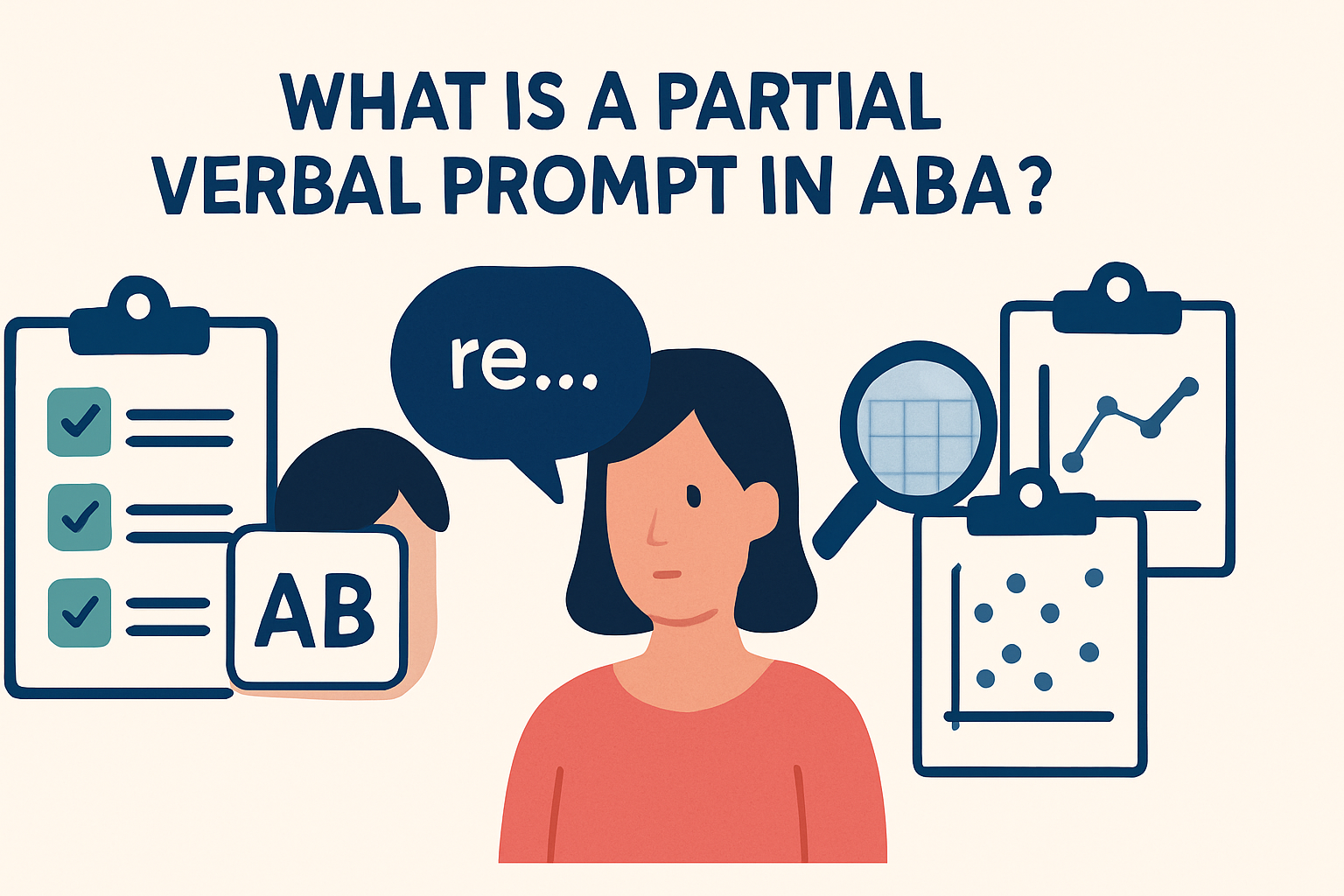
For example, if teaching a child to say “cookie,” a partial verbal prompt might be “coo…” rather than saying the full word. This approach supports learning while maintaining opportunities for independent responding.
Placement in the Prompting Hierarchy
Partial verbal prompts occupy a specific position in the prompting hierarchy. They typically fall between full verbal prompts and gestural prompts in terms of intrusiveness. Understanding this hierarchy is crucial for implementing least-to-most prompting strategies effectively.
- Most intrusive: Full verbal prompts (complete model)
- Moderately intrusive: Partial verbal prompts (partial model)
- Less intrusive: Gestural prompts (pointing, nodding)
- Least intrusive: Positional or visual prompts
Applying Partial Verbal Prompts: Worked Examples
Practical application demonstrates how partial verbal prompts function within the three-term contingency. Each example shows the antecedent, behavior, and consequence sequence.
Example 1: Teaching a Child to Request
This scenario illustrates teaching a manding skill using partial verbal support.
- Antecedent (SD): Juice is present and visible
- Prompt: Therapist says “ju…” (partial for “juice”)
- Target Behavior: Child says “juice”
- Consequence: Child receives juice
- Hypothesized function: Access to tangibles
As the child becomes more proficient, the prompt can be faded to a gestural prompt (pointing to the juice) or eliminated entirely. This progression follows prompt fading principles to promote independence.
Example 2: Supporting an Adult in a Vocational Setting
This example shows partial verbal prompts in adult skill acquisition contexts.
- Antecedent (SD): Supervisor asks “What’s the next step?”
- Prompt: Coworker says “Check the…” (partial for “Check the schedule”)
- Target Behavior: Adult says “Check the schedule”
- Consequence: Praise and correct task initiation
- Hypothesized function: Access to social approval/escape task uncertainty
This application demonstrates how partial verbal prompts support vocational independence while reducing reliance on full verbal models.
Ethical Considerations and When to Use This Prompt
Ethical use of partial verbal prompts requires careful consideration of client autonomy and skill level. These prompts should be used strategically to promote independence rather than create prompt dependency.
- Use when the learner has some echoic repertoire but needs support with specific responses
- Apply within a least-to-most prompting sequence to minimize intrusiveness
- Always plan for prompt fading from the beginning of intervention
- Consider the learner’s current verbal imitation skills when selecting prompt type
- Monitor for signs of prompt dependence and adjust strategies accordingly
For more on ethical prompting practices, see our guide on ethics in ABA practice.
Partial Verbal Prompts on the BCBA Exam
Understanding partial verbal prompts is essential for BCBA exam success. These prompts frequently appear in questions about prompting procedures, skill acquisition, and ethical implementation.
Common Exam Traps and Distractors
Several common pitfalls can lead to incorrect answers on exam questions about partial verbal prompts.
- Confusing with phonemic prompts: The BACB doesn’t use “phonemic prompt” as an official term
- Mistaking for gestural prompts: Remember partial verbal involves verbal components
- Selecting full verbal when partial is correct (and vice versa)
- Forgetting it’s a response prompt type within the prompting hierarchy
- Not considering least-to-most prompting sequences in scenario questions
Practice Application Prompts
Test your understanding with these scenario-based practice items:
A therapist is teaching a child to label animals. When shown a picture of a cat, the therapist says “ca…” and the child responds “cat.” What type of prompt was used?
During vocational training, a job coach says “Next you need to cl…” and the client completes “clean the tables.” How would you describe this prompting strategy in a behavior plan?
For additional practice with ABA concepts, explore our free BCBA mock exam questions.
Quick-Reference Implementation Checklist
Use this actionable checklist to ensure proper implementation of partial verbal prompts in practice.
- Assess prerequisite skills: Ensure the learner has basic echoic/imitation abilities
- Define target response clearly: Specify exactly what verbal behavior you’re teaching
- Determine prompt level: Decide which part of the response to provide (first sound, syllable, etc.)
- Establish fading plan: Outline how you’ll reduce prompt intensity over time
- Collect baseline data: Measure performance without prompts initially
- Implement systematically: Use consistent prompt delivery across sessions
- Monitor independence: Track percentage of unprompted correct responses
- Adjust as needed: Modify prompt type or intensity based on progress data
Summary and Key Takeaways
Partial verbal prompts are valuable tools for teaching verbal behavior while promoting independence. These prompts provide part of the target response, helping learners complete verbal chains they cannot yet produce independently.
Key points to remember include their position in the prompting hierarchy (between full verbal and gestural prompts), their role in least-to-most prompting sequences, and the importance of planning for prompt fading from the outset. Ethical implementation requires considering client autonomy and avoiding prompt dependency.
For BCBA exam preparation, focus on distinguishing partial verbal prompts from other prompt types and understanding their application within skill acquisition programs. Mastering this concept contributes to effective teaching strategies and exam success. Continue building your prompting knowledge with our guide on prompt dependency prevention.


