
Understanding the difference between continuous vs discontinuous measurement is essential for effective data collection in applied behavior analysis. These measurement systems form the foundation of how we quantify behavior, and choosing the right one impacts both clinical decisions and exam performance.
Table of Contents
- Continuous vs Discontinuous Measurement: Defining Continuous and Discontinuous Measurement
- Applied Examples: Choosing the Right System
- Exam Relevance and Common Traps
- Quick Decision Checklist for Practitioners
- Summary and Key Takeaways
Continuous vs Discontinuous Measurement: Defining Continuous and Discontinuous Measurement
Measurement systems in ABA fall into two broad categories based on how completely they capture behavioral occurrences. The choice between them balances accuracy against practicality.
What is Continuous Measurement?
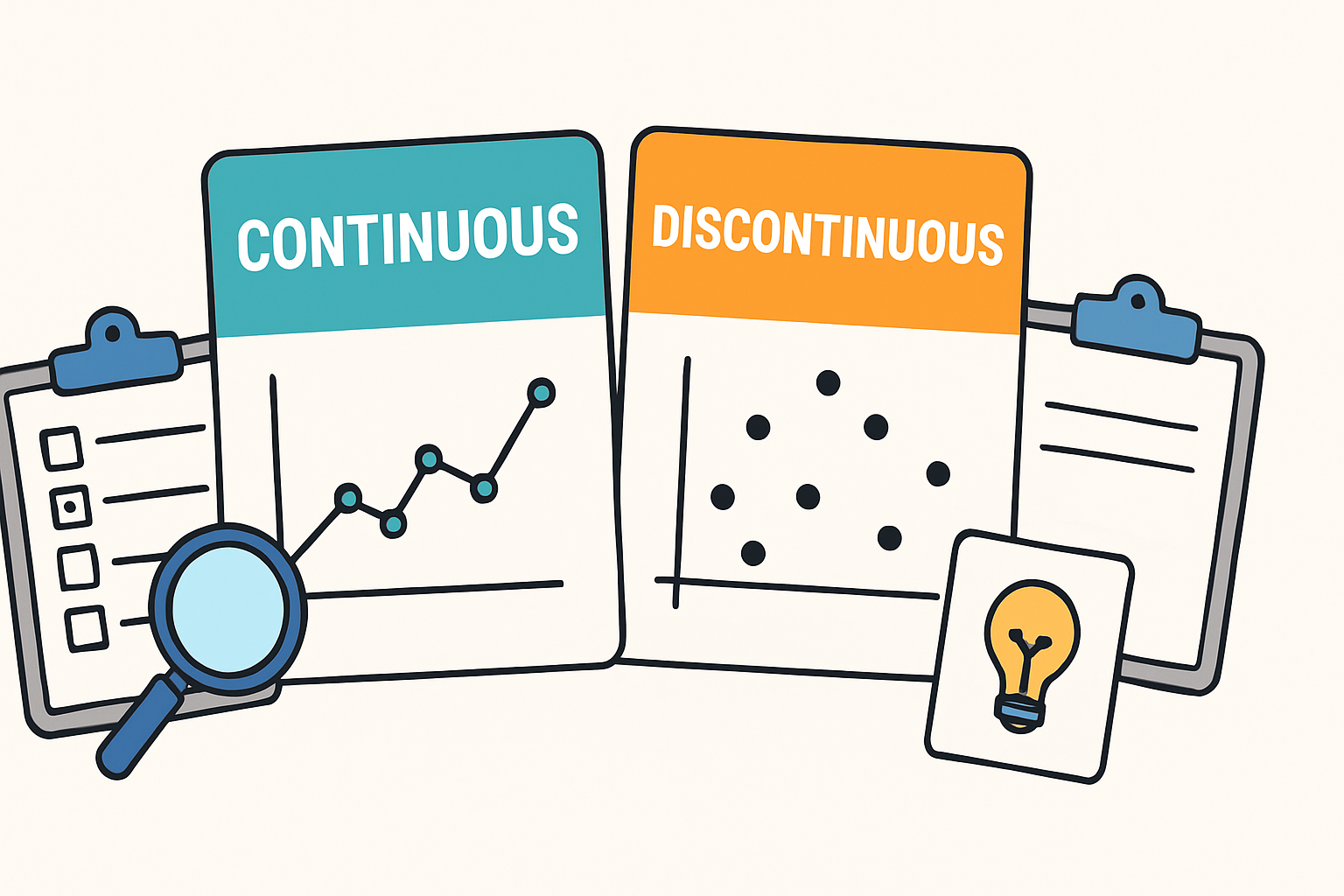
Continuous measurement records every instance of a target behavior throughout an observation period. This approach provides the most complete and accurate data possible.
- Frequency: Counts each occurrence of behavior
- Rate: Frequency divided by observation time
- Duration: Measures total time behavior occurs
- Latency: Time from antecedent to behavior onset
- Interresponse Time (IRT): Time between behavior instances
Continuous methods are ideal when you need precise data about behavior dimensions like exact count or timing.
What is Discontinuous Measurement?
Discontinuous measurement estimates behavior by sampling occurrences at specific intervals. While less accurate, it’s more practical for high-rate or long-duration behaviors.
- Partial Interval Recording: Behavior occurs at any point during interval
- Whole Interval Recording: Behavior occurs throughout entire interval
- Momentary Time Sampling: Behavior occurs at exact moment interval ends
These methods provide estimates rather than exact counts, making them suitable when continuous observation isn’t feasible.
Applied Examples: Choosing the Right System
Clinical decisions about measurement depend on behavior characteristics, available resources, and data needs. Let’s examine practical scenarios.
Example 1: Hand Flapping (Automatic Reinforcement)
A client engages in hand flapping throughout the day. The ABC analysis shows automatic sensory stimulation maintains this behavior.
- Continuous option: Duration recording would measure exact time spent flapping
- Discontinuous option: Momentary time sampling could estimate occurrence
- Considerations: Duration provides precise data but requires constant observation
For this automatic reinforcement behavior, momentary sampling might be more practical for all-day monitoring.
Example 2: Task Refusal (Escape-Maintained)
During academic sessions, a client says ‘no’ and pushes work away when presented with difficult tasks. The behavior functions as escape from demands.
- Continuous option: Frequency recording counts each refusal instance
- Discontinuous option: Partial interval recording estimates occurrence
- Considerations: Frequency provides exact count needed for intervention planning
Since refusals are discrete and relatively low-rate, frequency measurement offers the most useful clinical data.
Example 3: Peer Initiations (Socially-Maintained)
The target is increasing social initiations during recess. The behavior involves tapping peers and asking to play, maintained by social reinforcement.
- Continuous option: Latency measurement tracks time to initiate
- Discontinuous option: Whole interval recording captures sustained interaction
- Considerations: Different dimensions require different measurement approaches
For teaching social skills, latency might be most relevant, while whole interval could measure interaction quality.
Exam Relevance and Common Traps
The BCBA exam frequently tests your ability to distinguish between measurement systems and select appropriate methods for given scenarios.
Key Distinctions the BCBA Exam Tests
- Accuracy comparison: Continuous methods are always more accurate
- Practicality factors: Discontinuous methods are often more feasible
- Behavior dimensions: Match measurement to the dimension of interest
- Data interpretation: Understand what each method actually measures
These distinctions appear frequently in exam questions about data collection procedures.
Frequent Exam Mistakes to Avoid
Candidates often stumble on subtle differences between measurement methods.
- Confusing interval types: Partial vs whole interval definitions
- Overestimating accuracy: Selecting discontinuous when precise count needed
- Timing errors: Forgetting momentary sampling records at interval end only
- Dimension mismatch: Using frequency for duration-based behaviors
Review our guide on data collection methods for more detailed examples.
Quick Decision Checklist for Practitioners
Use this practical guide when selecting measurement systems in clinical practice.
- Assess behavior characteristics: Rate, duration, and topography
- Determine data needs: Precision required for decision-making
- Evaluate resources: Observer availability and time constraints
- Consider behavior function: How measurement relates to intervention goals
- Review ethical considerations: Choose least intrusive effective method
- Plan for reliability: Ensure measurement can be implemented consistently
This checklist aligns with applied dimensions of behavior analysis.
Summary and Key Takeaways
Mastering measurement systems is crucial for both clinical practice and exam success.
- Continuous measurement provides complete data but requires more resources
- Discontinuous measurement offers practical estimates for challenging scenarios
- Selection depends on behavior characteristics and clinical needs
- Exam questions test your ability to distinguish and apply these concepts
- Clinical decisions should balance accuracy with feasibility
For additional study resources, explore our BCBA exam preparation guide.


