

Selecting the right applied behavior analysis books is not just about building a library—it’s about strategic exam preparation. The BCBA exam draws directly from foundational texts, and understanding which books cover which domains can make the difference between passing and failing.
Table of Contents
- Why Your Choice of Applied Behavior Analysis Books Matters for the Exam
- Core Texts and Their Strategic Exam Relevance
- From Reading to Answering: A Study Method for ABA Texts
- Common Exam Traps Related to Foundational Literature
- Your Pre-Exam Book Review Checklist
This guide moves beyond generic book lists to show you how to use these resources effectively for exam success.
Why Your Choice of Applied Behavior Analysis Books Matters for the Exam
Your textbook selection directly impacts your ability to answer complex scenario-based questions. The exam tests not just recall but deep understanding of principles as presented in authoritative sources.
The BACB Task List as Your Reading Blueprint
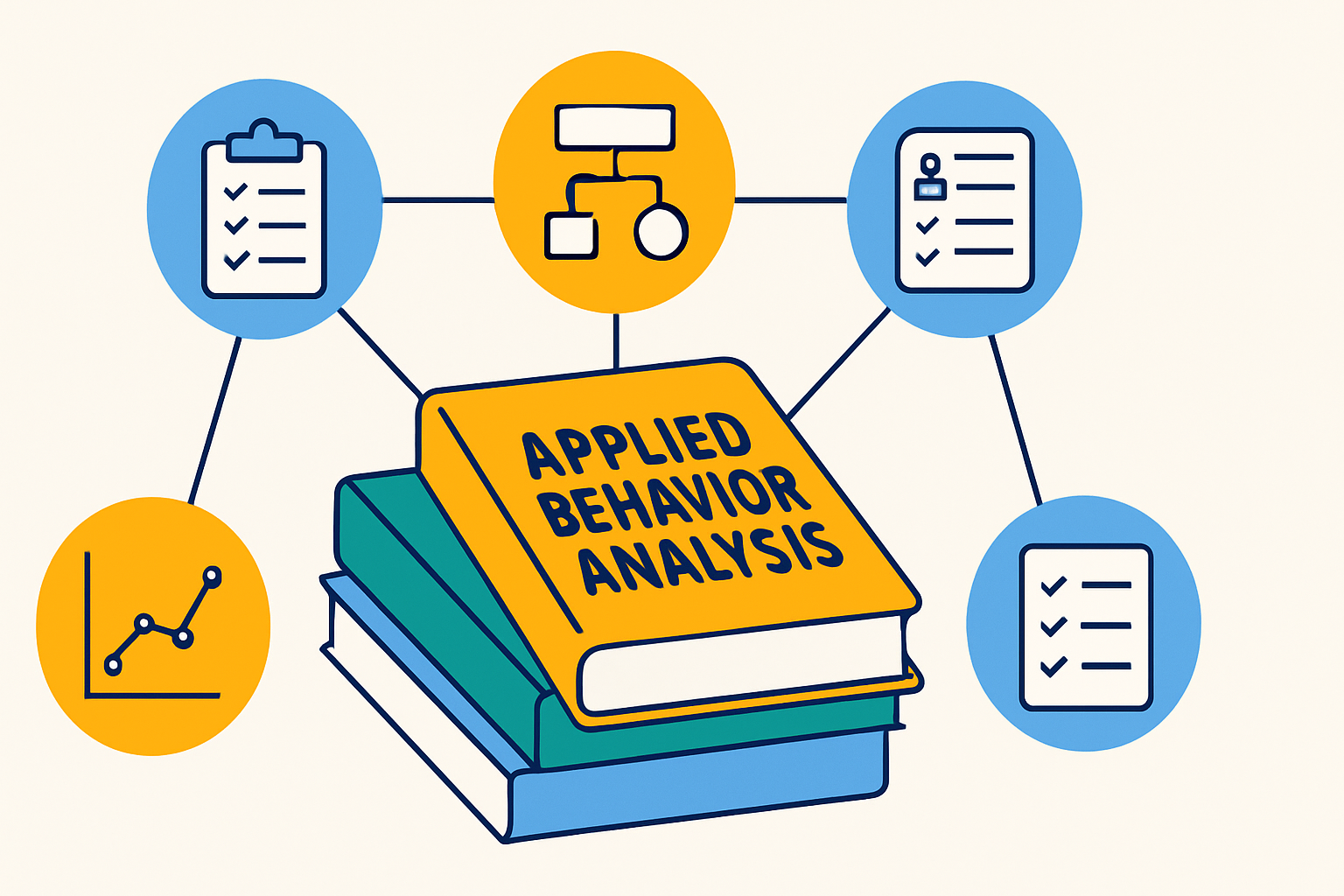
The BACB Task List serves as your primary study guide, and specific books are the official sources for these domains. Primary source texts like Cooper, Heron, & Heward’s ‘Applied Behavior Analysis’ directly map to exam content areas.
Understanding this connection helps you prioritize reading and focus on high-yield chapters. Each section of the Task List has corresponding textbook explanations that form the basis of exam questions.
Beyond Definitions: How Exam Questions Test Textual Knowledge
Exam questions require application of principles explained in key texts. For example, a question about stimulus equivalence might test your understanding of reflexivity, symmetry, and transitivity as defined in foundational literature.
Consider this scenario: A student learns that ‘apple’ matches with a picture of an apple, then spontaneously matches the picture with the word ‘apple.’ This tests symmetry as explained in core ABA texts.
Core Texts and Their Strategic Exam Relevance
Certain books are non-negotiable for BCBA preparation. Each covers specific high-weight exam sections with varying approaches to content delivery.
The Foundational Canon: Cooper, Heron, & Heward and Miltenberger
Cooper, Heron, & Heward’s ‘Applied Behavior Analysis’ provides conceptual depth essential for understanding complex principles. Key chapters include measurement, reinforcement, punishment, and stimulus control.
Miltenberger’s ‘Behavior Modification’ offers applied clarity with practical examples. It excels in explaining assessment procedures and intervention strategies that appear frequently on the exam.
- Cooper et al.: Chapters 1-4 (concepts), 5-7 (measurement), 10-13 (reinforcement), 14-15 (punishment)
- Miltenberger: Chapters on functional assessment, differential reinforcement, and antecedent interventions
- Critical overlap: Both cover ethics, generalization, and maintenance procedures
Specialized Volumes for Critical Domains
Specific areas require dedicated texts. Bailey & Burch’s ‘Ethics for Behavior Analysts’ is essential for the ethics section, covering all professional conduct codes.
Kazdin’s ‘Single Case Research Designs’ provides the foundation for experimental design questions. For assessment, texts on functional analysis and measurement complete your study library.
- Ethics: Bailey & Burch covers all BACB ethics codes with scenarios
- Experimental Design: Kazdin explains reversal, multiple baseline, and changing criterion designs
- Assessment: Functional analysis protocols and preference assessment methods
From Reading to Answering: A Study Method for ABA Texts
Reading dense theoretical material requires a systematic approach. This method transforms passive reading into active exam preparation.
The ABCs of Active Textbook Review
Use this three-step method for each chapter. First, identify antecedent conditions by reviewing Task List objectives. Next, engage in active reading behavior with focus on examples. Finally, create self-test consequences to reinforce learning.
For stimulus control, pre-read to identify key concepts. During reading, note examples of discriminative stimuli. After reading, create questions about stimulus delta and generalization.
Practice Application: Translating Book Examples to Exam Scenarios
Textbook examples become exam questions. Consider this common case: A child screams when asked to complete math work, and the teacher removes the demand.
The textbook presents this as negative reinforcement (escape). An exam question might ask you to identify the maintaining variable or select an appropriate intervention based on this function.
Another example: A student receives attention from peers after making inappropriate comments. The textbook explains this as social positive reinforcement. Exam questions test whether you can identify the reinforcement contingency and design an appropriate replacement behavior.
Common Exam Traps Related to Foundational Literature
Superficial reading leads to predictable errors on the exam. Understanding these traps helps you avoid them.
Terminology Confusions and Nuanced Definitions
The exam tests precise, book-based definitions. Commonly confused terms include negative reinforcement versus punishment, where the key distinction is whether behavior increases or decreases.
Response generalization versus stimulus generalization represents another frequent confusion point. Response generalization involves novel responses, while stimulus generalization involves responding to novel stimuli.
- Negative reinforcement: Behavior increases to remove/avoid stimulus
- Positive punishment: Behavior decreases due to added stimulus
- Stimulus equivalence: Requires reflexivity, symmetry, transitivity
- Motivating operations: Value-altering versus behavior-altering effects
Misapplying Procedures from Memorized Steps
Recalling procedures by rote without understanding functional rationale leads to errors. For example, knowing DRA steps without understanding the reinforcement contingency prevents correct application in novel scenarios.
Exam questions often present variations of standard procedures. Understanding the functional rationale behind each step allows you to adapt procedures appropriately.
Your Pre-Exam Book Review Checklist
Use this checklist to ensure comprehensive preparation. Each item corresponds to critical exam content areas.
- Review Cooper et al. chapters on measurement and fundamental principles
- Master Miltenberger’s functional assessment protocols
- Study Bailey & Burch ethics scenarios and code applications
- Practice Kazdin’s experimental design decision-making
- Create self-test questions for each Task List item
- Review commonly confused terminology with textbook definitions
- Apply principles to novel scenarios beyond memorized examples
Successful BCBA candidates don’t just read applied behavior analysis books—they study them strategically. By connecting each text to specific exam domains and practicing application, you build the deep understanding needed for exam success. Remember that the exam tests your ability to apply principles, not just recall definitions.
For additional study support, explore our BCBA exam prep guide and Task List study map. For authoritative information on exam content, refer to the official BACB Handbook and Task List documents.


