

Parsimony is a core philosophical assumption in behavior analysis that guides practitioners toward the simplest sufficient explanation. This principle, rooted in Occam’s Razor, shapes how BCBAs approach assessment, intervention design, and ethical decision-making. Understanding parsimony in ABA is essential for both clinical practice and exam success.
Table of Contents
- Parsimony in ABA: What is Parsimony? Defining a Core Assumption
- Parsimony in Action: Applied Examples for BCBAs
- Parsimony on the BCBA Exam: What to Expect
- The Ethical Dimension of Parsimony
- Quick Checklist: Applying Parsimony in Practice
- Summary and Key Takeaways
Parsimony in ABA: What is Parsimony? Defining a Core Assumption
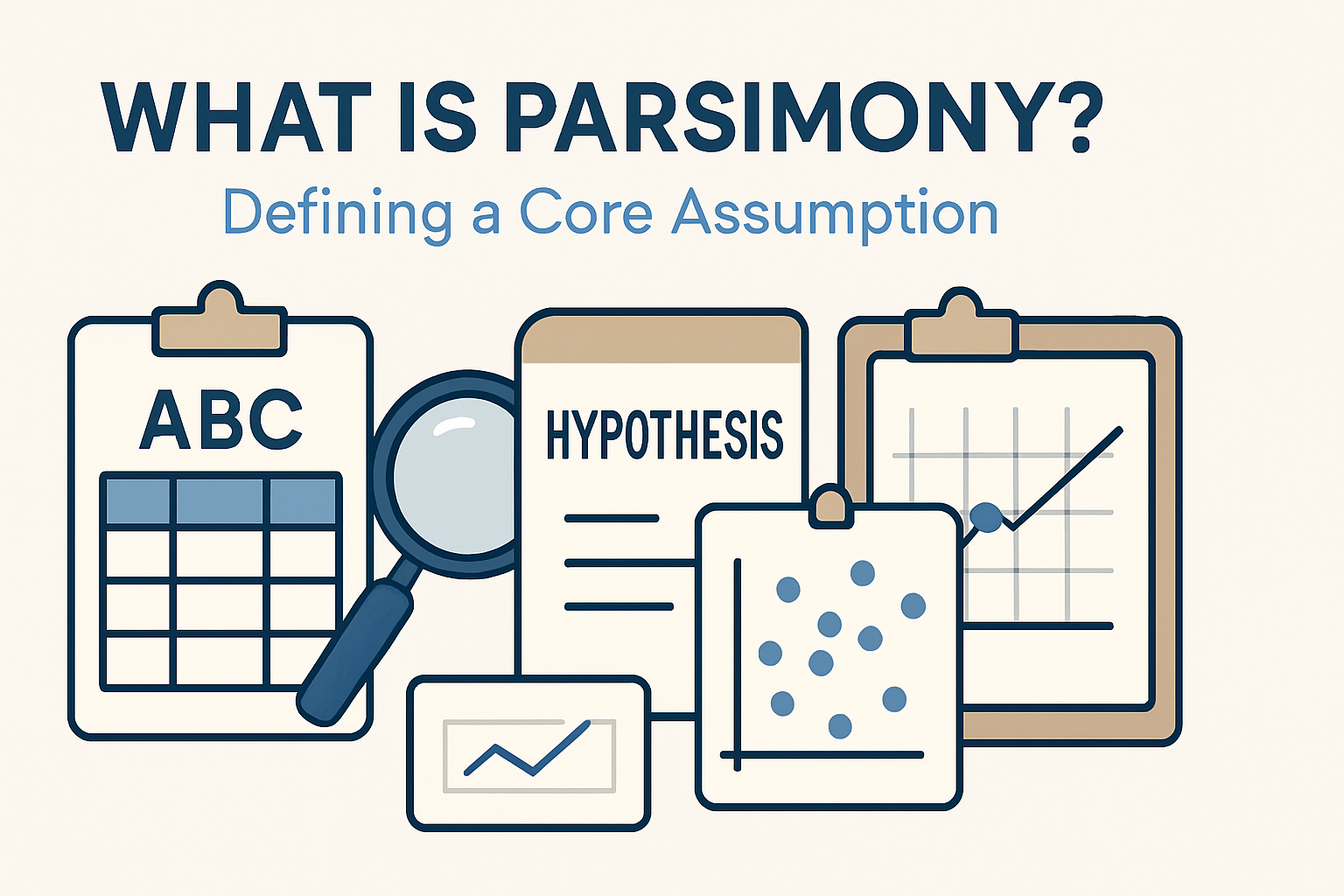
Parsimony represents the philosophical commitment to selecting the simplest sufficient explanation that accounts for all available data. It’s not about oversimplification but about avoiding unnecessary complexity when a straightforward explanation fits the facts.
From Occam’s Razor to Behavior Analysis
The concept originates from William of Ockham, a 14th-century philosopher who argued that entities should not be multiplied beyond necessity. In behavior analysis, this translates to preferring explanations that require the fewest assumptions while still accounting for all observed behavior. This approach aligns with the scientific method and helps maintain focus on observable, measurable variables.
Parsimony vs. Simplicity: A Critical Distinction
Parsony is often misunderstood as mere simplicity. The key distinction lies in the word ‘sufficient’. A parsimonious explanation must fully account for all data points, not just some of them. It’s about finding the most elegant solution that explains everything without adding unnecessary layers of complexity.
Parsimony in Action: Applied Examples for BCBAs
Understanding parsimony becomes clearer through practical examples. These scenarios demonstrate how the principle guides decision-making in real-world behavior analysis.
Example 1: Elopement in the Classroom
Consider a student who leaves their seat during math instruction. ABC data shows elopement occurs consistently during difficult math problems, followed by teacher attention when redirected. A complex explanation might suggest sensory seeking, escape from demands, and attention seeking all operating simultaneously. The parsimonious explanation? Escape from academic demands accounts for all data points without requiring multiple hypothetical constructs.
Example 2: Hand Mouthing During Play
A child engages in hand mouthing during independent play. Data shows the behavior occurs regardless of social attention and decreases when preferred toys are available. While one might hypothesize social functions or multiple contingencies, the parsimonious explanation points to automatic reinforcement. This single explanation fits all observations without inferring unseen social variables.
Applying Parsimony to Intervention Design
Parsony extends beyond assessment to intervention selection. Consider a behavior maintained by escape. A complex intervention might include token economy, extinction, antecedent modifications, and functional communication training. The parsimonious approach starts with differential reinforcement of alternative behavior (DRA) paired with extinction. This simpler intervention often proves effective without unnecessary complexity.
Parsimony on the BCBA Exam: What to Expect
The BCBA exam frequently tests understanding of parsimony through scenario-based questions. Recognizing how this principle applies to exam questions is crucial for success.
Common Exam Question Formats
Exam questions about parsimony typically follow specific patterns:
- ‘Which is the most parsimonious explanation given the following data?’
- ‘A BCBA is reviewing an FBA report and must select the simplest sufficient hypothesis.’
- ‘According to the philosophical assumption of parsimony, which intervention should be tried first?’
- Questions presenting multiple hypotheses with varying levels of complexity.
Traps and Misconceptions to Avoid
Candidates often stumble on parsimony questions due to common misunderstandings:
- Confusing ‘simplest’ with ‘easiest to implement’ – parsimony relates to explanatory power, not implementation difficulty
- Selecting explanations that ignore key data just because they’re simple
- Forgetting that parsimony applies to explanations, not just interventions
- Overlooking that the simplest explanation must still account for all observed facts
The Ethical Dimension of Parsimony
Parsony connects directly to ethical practice in behavior analysis. The BACB Ethics Code emphasizes reliance on scientific knowledge and effective, efficient interventions.
Parsimony, Efficiency, and Client Dignity
Overly complex assessments or interventions can burden clients and families, potentially violating ethical principles. Parsimonious approaches respect client dignity by avoiding unnecessary procedures. They align with the ethical requirement to use least restrictive and most effective interventions. Complex explanations that require multiple hypothetical constructs may lead to interventions that are difficult to implement with treatment integrity.
Quick Checklist: Applying Parsimony in Practice
Use this checklist to ensure you’re applying parsimony correctly in both practice and exam preparation:
- Review all available assessment data before forming hypotheses
- Ask: ‘Does this explanation require unnecessary assumptions?’
- Verify that your chosen hypothesis accounts for all data points
- Consider whether a simpler intervention would achieve the same clinical outcomes
- Evaluate if added complexity provides measurable benefit to the client
- Document your decision-making process to demonstrate parsimonious thinking
Summary and Key Takeaways
Parsimony remains a fundamental principle guiding behavior analytic practice. It represents the commitment to scientific rigor and ethical efficiency in both assessment and intervention. For BCBA candidates, mastering this concept involves understanding its philosophical roots, recognizing its application in real-world scenarios, and avoiding common misconceptions. Remember that parsimony isn’t about cutting corners—it’s about finding the most elegant, sufficient explanation that serves clients best while maintaining scientific integrity.
To deepen your understanding of behavior analysis principles, explore our guide on philosophical assumptions or learn about functional assessment approaches. For authoritative information on behavior analysis principles, consult the Behavior Analyst Certification Board and peer-reviewed journals like the Journal of Applied Behavior Analysis.


