
Understanding discriminative stimuli is fundamental to mastering stimulus control in applied behavior analysis. These antecedent events signal when reinforcement is available for specific behaviors, forming the basis of how we learn to respond appropriately to our environment. This guide provides clear discriminative stimulus examples to help you grasp this essential concept for both clinical practice and exam preparation.
Table of Contents
- Discriminative stimulus examples: What is a Discriminative Stimulus (SD)? A Core ABA Conce
- Practical Examples of SD in ABA Scenarios
- SDs on the BCBA Exam: Application and Common Traps
- Summary: Mastering Stimulus Control for Practice and the Exam
Discriminative stimulus examples: What is a Discriminative Stimulus (SD)? A Core ABA Conce
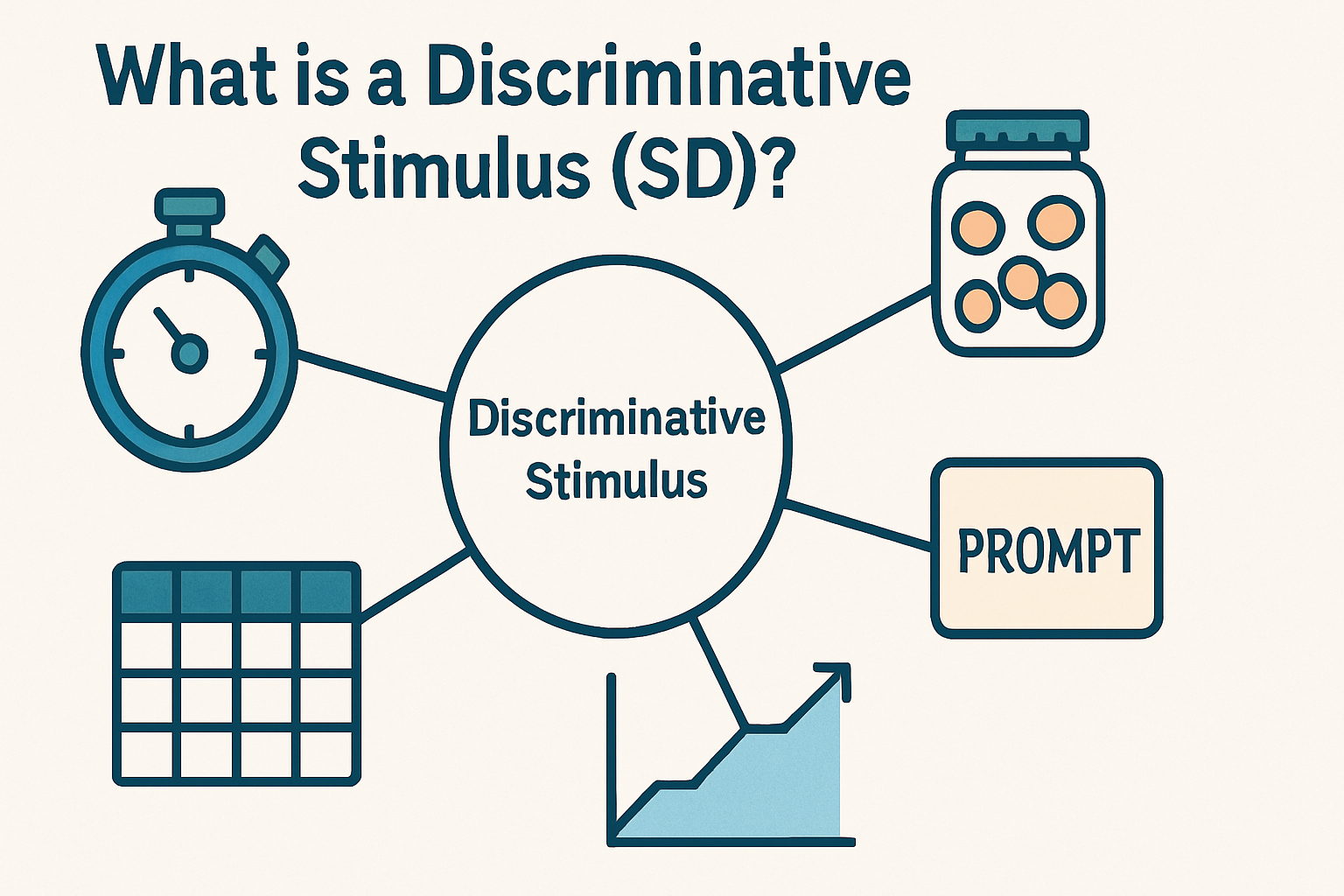
A discriminative stimulus (SD) is an antecedent in the presence of which a particular response has been reinforced in the past. This stimulus control relationship means the SD signals that reinforcement is currently available for that specific behavior.
The Formal Definition and Key Characteristics
The technical definition states that an SD is a stimulus in the presence of which a response has been reinforced and in the absence of which that same response has not been reinforced. This creates differential reinforcement based on environmental cues. The critical distinction lies between SD and S-delta (SΔ), which signals that reinforcement is NOT available for that behavior.
For example, when a teacher says “sit down” (SD), sitting is reinforced with praise. When the teacher says “stand up” (SΔ), sitting would not be reinforced. This discrimination training establishes stimulus control over the sitting behavior.
SD vs. Motivating Operation (MO): A Critical Distinction
Many candidates confuse SDs with motivating operations. While both are antecedents, they serve different functions. An SD signals if reinforcement is available, while an MO alters the value of that reinforcement.
Consider this analogy: A green traffic light (SD) signals you can proceed safely. Being late for work (MO) increases the value of getting through the intersection quickly. The light tells you when you can go; your urgency affects how much you want to go.
Practical Examples of SD in ABA Scenarios
Let’s examine concrete examples across different teaching contexts to solidify your understanding of how SDs operate in practice.
Example 1: SD in Discrete Trial Teaching (DTT)
In a classic discrete trial, the instructor presents a clear antecedent that serves as the SD. The three-term contingency looks like this:
- Antecedent (SD): Instructor holds up a red card and says “Touch red”
- Behavior: Client touches the red card
- Consequence: Instructor delivers praise and a token
The verbal instruction “Touch red” combined with the visual stimulus of the red card creates the compound SD that sets the occasion for the correct response. Through repeated trials, this SD gains control over the touching behavior.
Example 2: SD in Natural Environment Teaching (NET)
During play-based instruction, SDs often emerge from the natural context rather than explicit instructions:
- Antecedent (SD): Ball rolls within reach during a game
- Behavior: Child says “ball” or reaches for it
- Consequence: Natural reinforcement of getting the ball to continue play
The ball’s position and the social play context together form the SD that signals reinforcement is available for communicative or play behaviors. This demonstrates how naturalistic teaching embeds SDs within meaningful activities.
Example 3: SDs in Community and Daily Routines
Everyday life is filled with SDs that control our behavior through learned reinforcement histories:
- Antecedent (SD): Phone rings with a specific tone
- Behavior: You answer the phone
- Consequence: Social interaction (reinforcement)
The ringing sound has become an SD through repeated pairing with social reinforcement. Similarly, a “Push” sign on a door, a green walk signal, or a teacher’s raised hand all serve as SDs that control specific responses based on their reinforcement history.
SDs on the BCBA Exam: Application and Common Traps
Exam questions often test your ability to identify SDs within brief scenarios and distinguish them from other antecedent variables.
Identifying SDs in Vignette-Based Questions
When presented with a scenario, ask yourself: “What specific antecedent signaled that reinforcement was available for the behavior described?” Look for the stimulus that has a history of being associated with reinforcement for that particular response.
For example, if a question describes a child who only raises their hand when the teacher is looking at them, the teacher’s gaze is the SD that signals hand-raising will be reinforced with attention.
The S-Delta and Extinction Trap
A common exam trap involves questions testing the difference between SD and S-delta. Remember that in the presence of an S-delta, the target behavior is on extinction (not reinforced), which is why it decreases over time.
Consider this: When a parent says “no” (SΔ) to a request for candy, asking for candy is not reinforced. When the parent says “yes” (SD) to the same request, asking is reinforced with candy. This discrimination training teaches the child when asking is likely to be successful.
Quick Checklist: Is it an SD?
- Is it an antecedent event that occurs before the behavior?
- Does it have a history of signaling reinforcement for this specific behavior?
- Is the current behavior under its stimulus control (more likely to occur when it’s present)?
- Would the behavior occur less often if this stimulus were absent?
If you answer yes to these questions, you’re likely dealing with a discriminative stimulus. For more on antecedent analysis, see our guide on antecedent exam traps.
Summary: Mastering Stimulus Control for Practice and the Exam
Discriminative stimuli form the foundation of stimulus control in ABA. These antecedents signal when reinforcement is available, allowing individuals to respond appropriately to their environment. Understanding SDs is crucial for both effective intervention design and exam success.
Remember these key points: SDs differ from motivating operations in function, work in conjunction with S-deltas to establish discrimination, and are present in both structured teaching and natural environments. When analyzing scenarios, focus on the reinforcement history associated with specific antecedents.
For further study of related concepts, explore our resources on stimulus control and SD vs MO differences. The BACB’s task list also provides official guidance on stimulus control concepts.
Mastering discriminative stimulus examples will enhance your clinical practice and prepare you for exam questions that test this fundamental ABA concept. Apply these principles systematically to improve your analysis of behavior-environment relationships.



