
Understanding ontogeny is essential for BCBA candidates and practicing behavior analysts. This concept explains how an individual’s unique learning history shapes their current behavior patterns. Unlike species-wide evolutionary history, ontogeny focuses on the personal experiences that create behavioral repertoires through environmental interactions.
Table of Contents
- Ontogeny in ABA: What is Ontogeny? A Foundational Definition for BCBAs
- Ontogeny in Action: Worked ABA Examples
- Ontogeny on the BCBA Exam: Common Traps and How to Avoid Them
- Quick Checklist: Applying Ontogenic Thinking
- Summary and Key Takeaways
- References
Ontogeny in ABA: What is Ontogeny? A Foundational Definition for BCBAs
Ontogeny refers to the development of an individual organism throughout its lifetime. In behavior analysis, this specifically means the learning history that shapes behavior through interactions with the environment. Every reinforcement, punishment, and stimulus pairing contributes to this personal history.
Ontogeny vs. Phylogeny: A Critical Distinction
These two concepts often appear together on the BCBA exam. Phylogeny describes species-wide evolutionary history—behaviors that developed through natural selection over generations. In contrast, ontogeny focuses on individual learning experiences. A simple analogy: phylogeny is like the pre-installed software your species comes with, while ontogeny is the personal data and preferences you accumulate through use.
For exam questions, remember this key difference: phylogenetic explanations involve species history and evolutionary adaptations, while ontogenic explanations involve individual learning and environmental interactions.
Why Ontogeny Matters in Applied Behavior Analysis
Ontogenic understanding drives ethical assessment and intervention design. When we consider a client’s unique learning history, we avoid one-size-fits-all approaches and develop truly individualized programs. This perspective helps explain why two individuals with similar diagnoses might display completely different behavioral patterns.
Consider how radical behaviorism emphasizes the importance of individual learning histories in understanding behavior. This philosophical foundation directly connects to ontogenic analysis in practice.
Ontogeny in Action: Worked ABA Examples
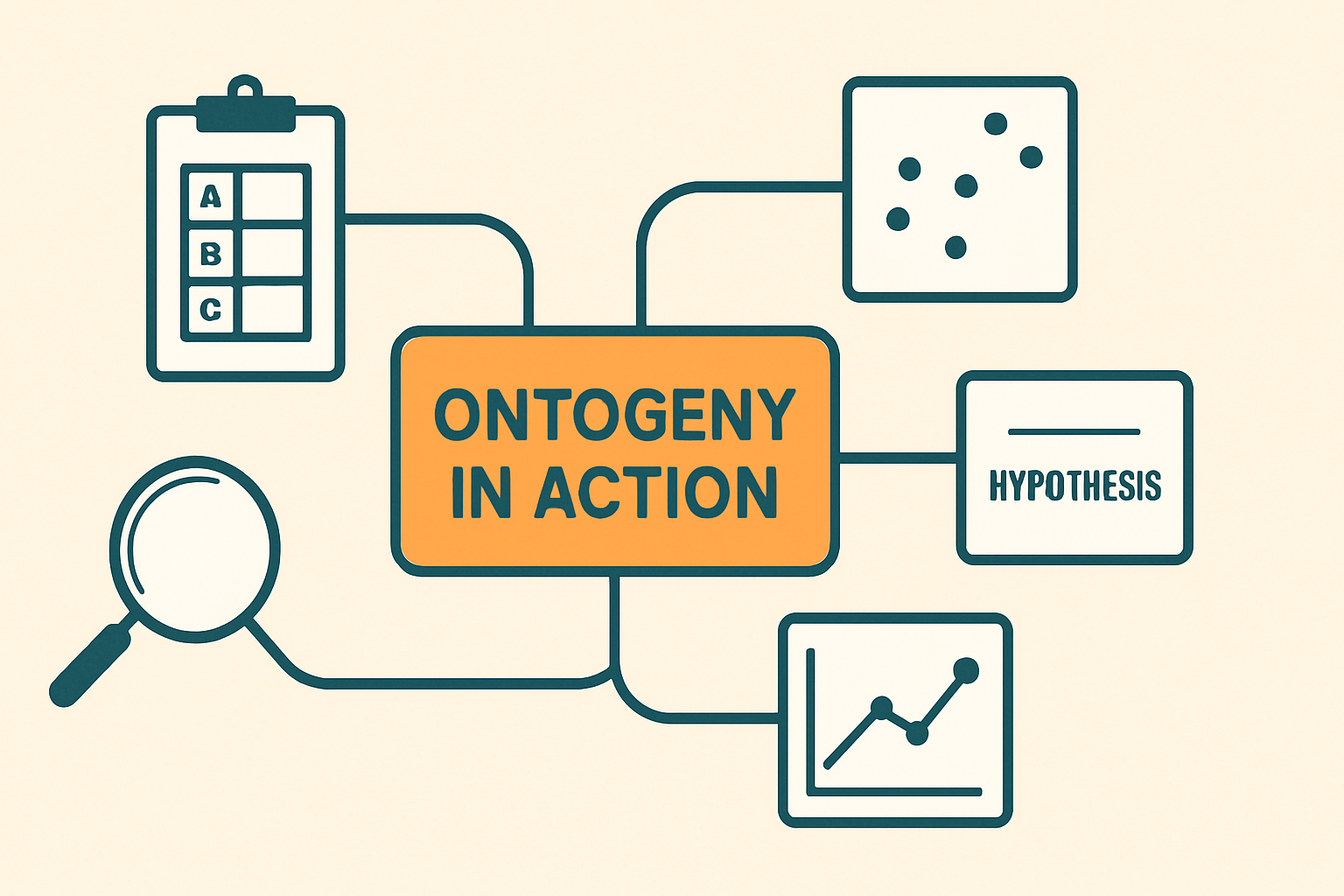
Let’s examine three realistic scenarios where ontogenic history explains current behavior patterns. Each example includes ABC analysis and hypothesized function based on individual learning history.
Example 1: Escape-Maintained Behavior and a History of Negative Reinforcement
Scenario: A 7-year-old child with autism elopes from the table during discrete trial training sessions. The behavior occurs most frequently during difficult academic demands.
- Antecedent: Difficult academic task presented
- Behavior: Child leaves seat and moves away from work area
- Consequence: Task demands are temporarily removed
- Function: Escape from aversive academic demands
The ontogenic history likely includes repeated instances where elopement successfully terminated difficult tasks. This pattern of negative reinforcement strengthened the escape behavior over time. The child’s individual learning history, not any species-typical trait, explains this behavioral pattern.
Example 2: Social Attention and a Deprived Ontogenic History
Scenario: A teenager engages in repetitive, off-topic questioning during social interactions. The behavior occurs most frequently when peers are engaged in other conversations.
- Antecedent: Limited social attention from peers
- Behavior: Repetitive questioning on unrelated topics
- Consequence: Peers provide brief attention or responses
- Function: Access to social attention
The ontogenic analysis suggests a history where appropriate social approaches received inconsistent reinforcement, while repetitive questioning reliably gained attention. This individual learning pattern shaped the current behavior, demonstrating how social reinforcement histories vary between individuals.
Example 3: Automatic Reinforcement and Sensory Ontogeny
Scenario: An adult rocks rhythmically while seated. The behavior occurs across various settings and appears independent of social consequences.
- Antecedent: Internal sensory state or environmental stimulation
- Behavior: Rhythmic rocking motion
- Consequence: Proprioceptive or vestibular sensory feedback
- Function: Automatic reinforcement through sensory stimulation
This behavior’s ontogenic history involves the individual discovering that rocking produces pleasurable sensory consequences. The specific pattern likely developed through shaping processes where certain rocking motions produced more reinforcing sensory feedback than others. This illustrates how even automatically reinforced behaviors have individual learning histories.
Ontogeny on the BCBA Exam: Common Traps and How to Avoid Them
Exam questions about ontogeny often include subtle distinctions and common misconceptions. Understanding these traps will help you select the correct answers.
Trap 1: Confusing Ontogenic with Phylogenetic Explanations
This is the most frequent exam trap. Questions may describe a behavior and ask for the “most likely explanation.” Distractors often incorrectly attribute behaviors to evolutionary history when the question stem clearly implies individual learning.
Example trap question: “A child avoids touching hot surfaces after being burned once. This is best explained by:”
- Wrong answer: Phylogenetic selection for pain avoidance (this describes species history)
- Correct answer: Ontogenic learning through direct experience (this describes individual history)
Key phrase to watch for: “individual’s history” or “personal learning experience” points toward ontogenic explanations.
Trap 2: Overlooking the Ontogenic Component in Assessment
Functional behavior assessment questions implicitly test your understanding of ontogeny. When analyzing behavior functions, you must consider how the individual’s unique learning history shaped current patterns.
Common exam scenarios include:
- Questions about functional behavior assessment that require considering learning history
- Intervention planning questions where you must individualize based on history
- Data interpretation questions where learning history explains response patterns
Remember that effective functional behavior assessment always considers the client’s unique ontogenic history when hypothesizing functions.
Quick Checklist: Applying Ontogenic Thinking
Use this practical checklist to apply ontogenic analysis in both clinical practice and exam preparation:
- Identify learning opportunities that shaped the current behavior pattern
- Analyze reinforcement histories for similar behaviors in the past
- Consider stimulus pairing experiences that created current stimulus control
- Evaluate shaping processes that gradually developed the behavior
- Assess generalization patterns from original learning contexts
- Review punishment histories that may have suppressed alternative behaviors
This checklist helps ensure you consider the full individual learning history rather than making assumptions based on diagnosis or group characteristics.
Summary and Key Takeaways
Ontogeny represents a fundamental concept in behavior analysis with direct implications for assessment, intervention, and exam success. Remember these essential points:
- Ontogeny describes individual learning history, while phylogeny describes species evolutionary history
- Every behavior has an ontogenic component shaped by reinforcement, punishment, and stimulus pairing
- Effective assessment in ABA requires understanding the client’s unique learning history
- Exam questions often test your ability to distinguish ontogenic from phylogenetic explanations
- Individualized intervention plans must consider ontogenic factors to be effective
- The seven dimensions of ABA all relate to understanding and influencing ontogenic processes
By mastering ontogenic analysis, you’ll not only perform better on the BCBA exam but also develop more effective, ethical, and individualized behavior intervention plans. This understanding helps explain why behaviors develop and persist, providing the foundation for meaningful behavior change.



