

A mand represents one of the most fundamental concepts in applied behavior analysis, yet it frequently trips up exam candidates. Understanding this verbal operant goes beyond simply recognizing requests—it requires analyzing the specific conditions that define its function. This guide breaks down the mand in ABA with clear definitions, practical examples, and exam-focused strategies.
Table of Contents
- Mand in ABA: Defining the Mand: A Core Verbal Operant
- Analyzing Mands: Worked Examples from Simple to Complex
- Mands on the BCBA Exam: What to Expect and How to Prepare
- Quick-Reference Checklist: Identifying a Mand
- Summary and Next Steps for Mastery
Mand in ABA: Defining the Mand: A Core Verbal Operant
In B.F. Skinner’s analysis of verbal behavior, a mand is defined as a verbal operant that is under the control of motivating operations and reinforced by a specific consequence. Unlike everyday language where we might call any request a “mand,” the behavioral definition is precise and functional.
Skinner’s Original Framework and Key Characteristics
Skinner introduced the mand in his 1957 work Verbal Behavior as the first verbal operant to develop in human language. The critical feature is that a mand is MO-controlled—its occurrence depends on the presence of a relevant motivating operation. The reinforcement must be specific to that MO, meaning if someone mands for water, only receiving water (or something functionally equivalent) will serve as reinforcement.
This functional definition means that form does not determine function. A question like “What time is it?” could be a mand for information, but only if the antecedent includes an MO for that specific information and the consequence provides it.
Mand vs. Tact: A Critical Distinction for the Exam
Many exam questions test your ability to distinguish mands from tacts, another verbal operant. While both involve verbal behavior, their controlling variables differ fundamentally. A mand is controlled by motivating operations, while a tact is controlled by nonverbal stimuli in the environment.
The reinforcement also differs: mands receive specific reinforcement related to the MO, while tacts receive generalized reinforcement like praise or acknowledgment. For example, saying “cookie” when you want one (mand) versus saying “cookie” when you see one (tact) represents this critical distinction.
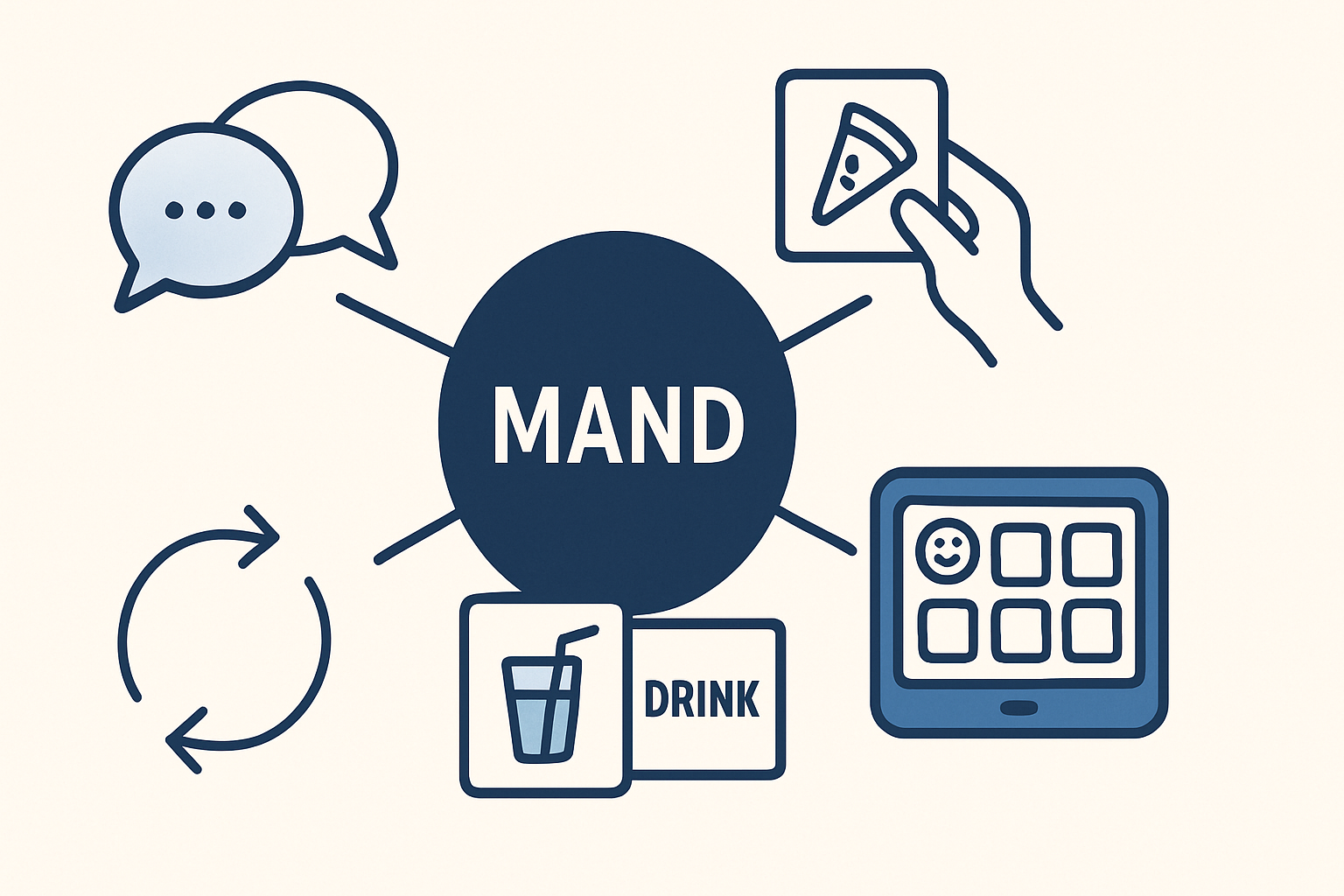
Analyzing Mands: Worked Examples from Simple to Complex
Applying the definition through concrete ABC analysis helps solidify understanding. Let’s examine three scenarios that demonstrate how mands function across different contexts.
Example 1: The Basic Request (Tangible)
Consider a child who hasn’t eaten in three hours. The antecedent includes deprivation of food (an MO for eating). The child points to a cookie on the counter and says “cookie.” The behavior is the verbal response “cookie.” The consequence is receiving the cookie.
This is a clear mand because: (1) it’s under control of an MO (food deprivation), (2) the reinforcement is specific to that MO (receiving food), and (3) the form matches the function (requesting what is needed).
Example 2: The Mand for Information
A client’s therapist is 15 minutes late for their session. The antecedent includes the therapist’s absence creating an MO for information about their location. The client asks a staff member, “Where is my therapist?” The behavior is the question. The consequence is the staff member responding, “She’s in a meeting that ran over.”
This qualifies as a mand because the MO is the need for specific information, and the reinforcement is precisely that information. The question form serves the function of obtaining missing information.
Example 3: The Mand as a Question (Attention/Escape)
A student struggles with a difficult math problem. The antecedent includes challenging work creating an MO for escape from the task difficulty. The student asks the teacher, “Can you help me?” The behavior is the question. The consequence is the teacher providing assistance.
This could function as either a mand for attention or a mand for escape, depending on the specific MO. Careful analysis of the antecedent conditions is crucial for accurate identification.
Mands on the BCBA Exam: What to Expect and How to Prepare
Exam questions about mands typically test both definitional knowledge and applied analysis skills. Understanding common traps will help you avoid costly mistakes.
Common Exam Traps and Misconceptions
Several patterns consistently challenge candidates:
- Confusing form with function: Assuming all questions are mands or all requests are mands without analyzing antecedents
- Overlooking specific reinforcement requirement: Forgetting that the consequence must directly relate to the MO
- Misidentifying tacts as mands: Failing to distinguish stimulus-controlled versus MO-controlled behavior
- Ignoring the MO component: Focusing only on the consequence without considering antecedent conditions
To deepen your understanding of related concepts, explore our guide on motivating operations in ABA, which are crucial for mand analysis.

Sample Practice Questions and Rationales
Let’s examine two exam-style questions:
Question 1: A child sees a dog across the street and says “dog!” excitedly. His mother says, “Yes, that’s a dog!” What verbal operant is this?
Rationale: This is a tact, not a mand. The antecedent is the nonverbal stimulus (the dog), not an MO. The reinforcement is generalized (acknowledgment), not specific to an MO.
Question 2: A client who hasn’t had water all morning says “water, please” to a staff member. The staff member gives them a glass of water. What verbal operant is this?
Rationale: This is a mand. The antecedent includes deprivation (MO for water), the behavior is the request, and the consequence is specific reinforcement (receiving water).
Quick-Reference Checklist: Identifying a Mand
Use this checklist when analyzing verbal behavior:
- Check for motivating operations: Is there an MO present in the antecedent?
- Analyze the consequence: Is the reinforcement specific to that MO?
- Consider alternative operants: Could this be a tact, intraverbal, or other verbal operant?
- Look beyond form: Don’t assume questions are always mands or statements are never mands
- Verify function: Does the behavior serve to obtain something specific that relates to the MO?
For more on verbal operants, see our comprehensive verbal operants guide covering all six categories.
Summary and Next Steps for Mastery
The mand represents a foundational verbal operant in ABA that requires careful functional analysis. Remember that it’s defined by MO control and specific reinforcement, not by its form or topography. Successful identification depends on analyzing the complete three-term contingency.
To further develop your skills, practice analyzing diverse scenarios and study related concepts like functional communication training, which often focuses on teaching mands. The official BACB resources on verbal behavior provide additional authoritative guidance on this topic.
Consistent practice with varied examples will build the analytical skills needed to accurately identify mands in both clinical practice and exam scenarios.



