
Preference Assessments ABA: What Are Preference Assessments and Why Do They Matter?
Preference assessments are systematic procedures used to identify stimuli that are likely to function as effective reinforcers for an individual. These assessments are fundamental to applied behavior analysis because they help practitioners select meaningful consequences that will increase target behaviors.
Table of Contents
- Preference Assessments ABA: What Are Preference Assessments and Why Do They Matter?
- Core Types of Stimulus Preference Assessments
- Applying Assessments: From Preference to Function (With Worked Examples)
- Exam Focus: Common Traps and How to Avoid Them
- Quick-Reference Clinical Checklist
- Summary and Key Takeaways for Your Study
From an ethical standpoint, conducting proper preference assessments ensures we respect client autonomy and dignity by using stimuli they genuinely value. For the BCBA exam, this topic appears frequently across multiple domains, particularly in assessment and intervention planning sections.
Core Types of Stimulus Preference Assessments
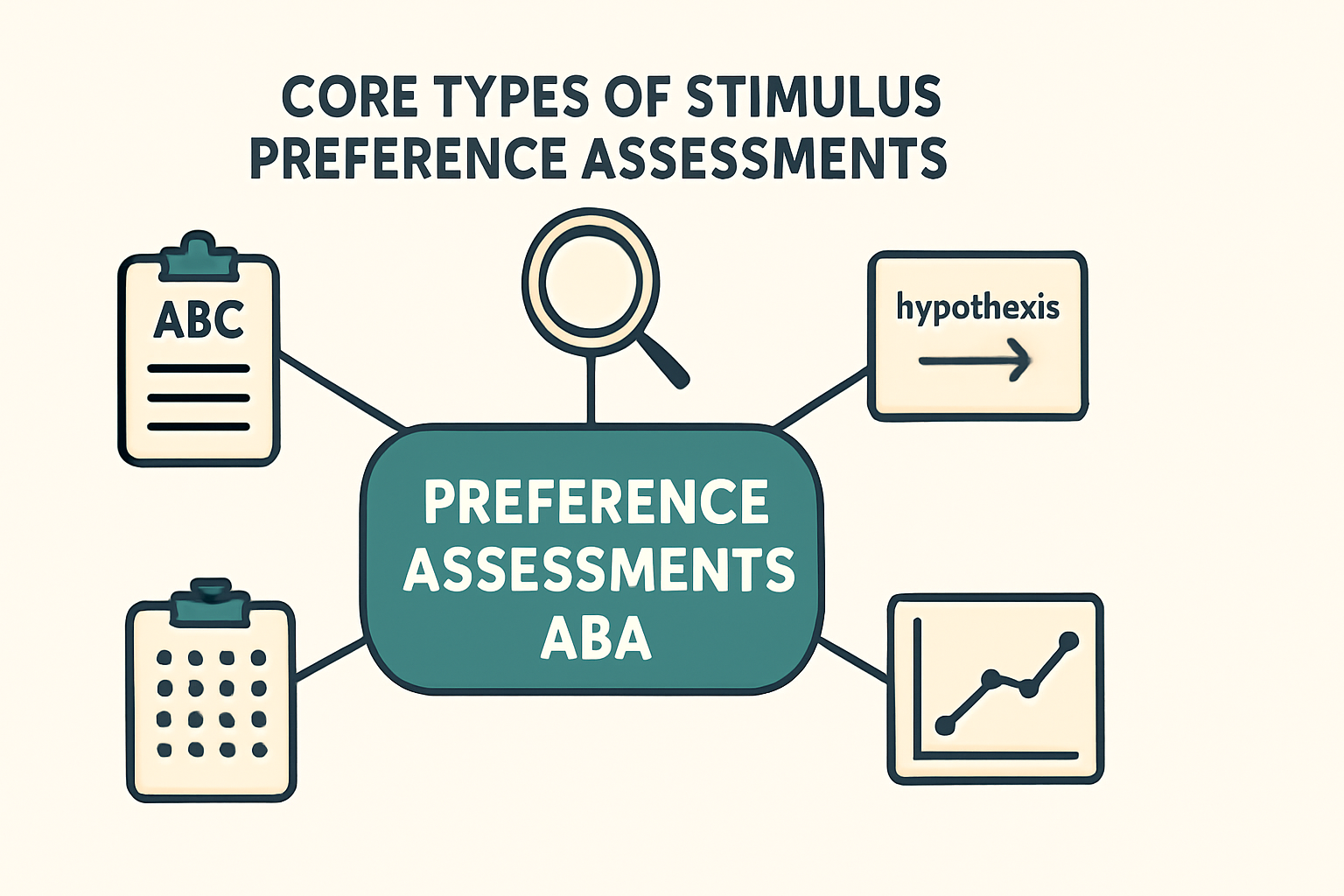
Preference assessments fall into three main categories, each with specific procedures and applications. Understanding these distinctions is crucial for both clinical practice and exam success.
Indirect Methods: The Starting Point
Indirect assessments include interviews, surveys, and checklists completed by caregivers or clients themselves. These methods identify potential reinforcers but must always be followed by direct assessment. Common tools include the Reinforcer Assessment for Individuals with Severe Disabilities (RAISD) and preference inventories.
Limitations include response bias and the fact that reported preferences don’t always translate to actual reinforcement effects. On the exam, remember that indirect methods alone are insufficient for determining functional reinforcers.
Direct Observational Methods: Free-Operant Assessments
Free-operant assessments involve observing which items or activities a client engages with when multiple options are available simultaneously. The key measure is engagement duration or frequency of approach.
- Naturalistic observation occurs in the client’s typical environment
- Contrived observation presents items in a controlled setting
- Data collected includes approach responses and time spent with each stimulus
- This method is particularly useful for clients who cannot make discrete choices
Direct Systematic Methods: Trial-Based Assessments
These structured assessments present stimuli in specific trial formats to establish a preference hierarchy. The four main types differ in their procedures and outcomes.
- Single Stimulus (successive choice): Presents one item at a time, records approach or rejection
- Paired-Choice (forced choice): Presents two items simultaneously, client chooses one
- Multiple Stimulus Without Replacement (MSWO): Presents multiple items, chosen item is removed from array
- Multiple Stimulus With Replacement (MSW): Chosen item remains in array for subsequent trials
MSWO generates a clear preference hierarchy, while MSW identifies a single most preferred item. Paired-choice assessments are particularly useful for clients with limited scanning abilities.
Applying Assessments: From Preference to Function (With Worked Examples)
Identifying preferences is only the first step. The real clinical value comes from integrating these findings with functional assessment data to create effective interventions.

Example 1: MSWO Informs an Escape-Maintained Behavior Intervention
Consider a client who engages in task refusal during academic work. A functional analysis confirms the behavior is maintained by escape from demands. An MSWO assessment identifies highly preferred sensory items.
The intervention uses non-contingent reinforcement (NCR) by providing access to preferred sensory items during work periods. This reduces the motivating operation for escape by making the work environment more reinforcing. The BCBA might also implement a differential reinforcement procedure using these items as reinforcers for task completion.
Example 2: Paired-Choice Assessment for Attention-Seeking Behavior
A child engages in disruptive behavior during group activities. Functional assessment indicates the behavior is maintained by access to adult attention. A paired-choice assessment identifies that the child strongly prefers specific types of social interaction over tangible items.
The intervention implements functional communication training (FCT), teaching the child to request attention using an appropriate communication response. The identified preferred social interactions serve as potent reinforcers for the new communication behavior, effectively reducing the disruptive behavior through differential reinforcement of alternative behavior (DRA).
Exam Focus: Common Traps and How to Avoid Them
The BCBA exam frequently tests subtle distinctions in preference assessment procedures and applications. Understanding these common pitfalls can significantly improve your exam performance.
Trap 1: Confusing Preference with Reinforcement
A preference assessment identifies stimuli an individual selects or engages with, but this doesn’t guarantee they will function as reinforcers. Only a reinforcer assessment can demonstrate that a stimulus increases behavior when made contingent upon it.
On the exam, look for questions that test this distinction. Preference assessments identify potential reinforcers, while reinforcer assessments (like concurrent operants or reversal designs) prove their effectiveness.
Trap 2: Misapplying Assessment Procedures
- Using single stimulus assessments with clients who have strong side biases
- Failing to rotate positions in paired-choice assessments, creating position preferences
- Misunderstanding the ‘without replacement’ rule in MSWO assessments
- Using inappropriate stimulus arrays (too many or too few items)
- Not conducting assessments regularly to account for satiation effects
Trap 3: Overlooking the Ethical Imperative
The BACB Ethics Code emphasizes client rights and effective treatment. Using ineffective reinforcers wastes client time and resources, potentially violating ethical standards. Regular preference assessments ensure interventions remain effective and respectful of client preferences.
Quick-Reference Clinical Checklist
Use this actionable checklist when implementing preference assessments in clinical practice:
- Start with indirect assessment to identify potential reinforcers
- Select appropriate direct assessment method based on client abilities
- Prepare stimulus array with 5-8 items of varying types (edible, tangible, sensory, social)
- Conduct assessment in controlled environment with minimal distractions
- Record data systematically (approach, engagement, choice responses)
- Analyze results to establish preference hierarchy
- Validate findings through reinforcer assessment in actual intervention context
- Schedule regular reassessments (weekly or when satiation occurs)
- Document procedures and results in client records
Summary and Key Takeaways for Your Study
Preference assessments are essential tools in applied behavior analysis that bridge assessment to effective intervention. For the BCBA exam, focus on these critical points:
- Differentiate between indirect, free-operant, and trial-based assessments
- Understand procedural details of MSWO, MSW, and paired-choice assessments
- Recognize that preference doesn’t equal reinforcement – always validate with reinforcer assessment
- Integrate preference data with functional assessment findings for comprehensive intervention planning
- Apply ethical considerations from the BACB Ethics Code to assessment procedures
- Use assessment findings to inform differential reinforcement procedures and other evidence-based interventions
For additional study resources on related topics, explore our guides on functions of behavior and differential reinforcement procedures.



