

What is a Conditioned Reinforcer? Definition and Key Characteristics
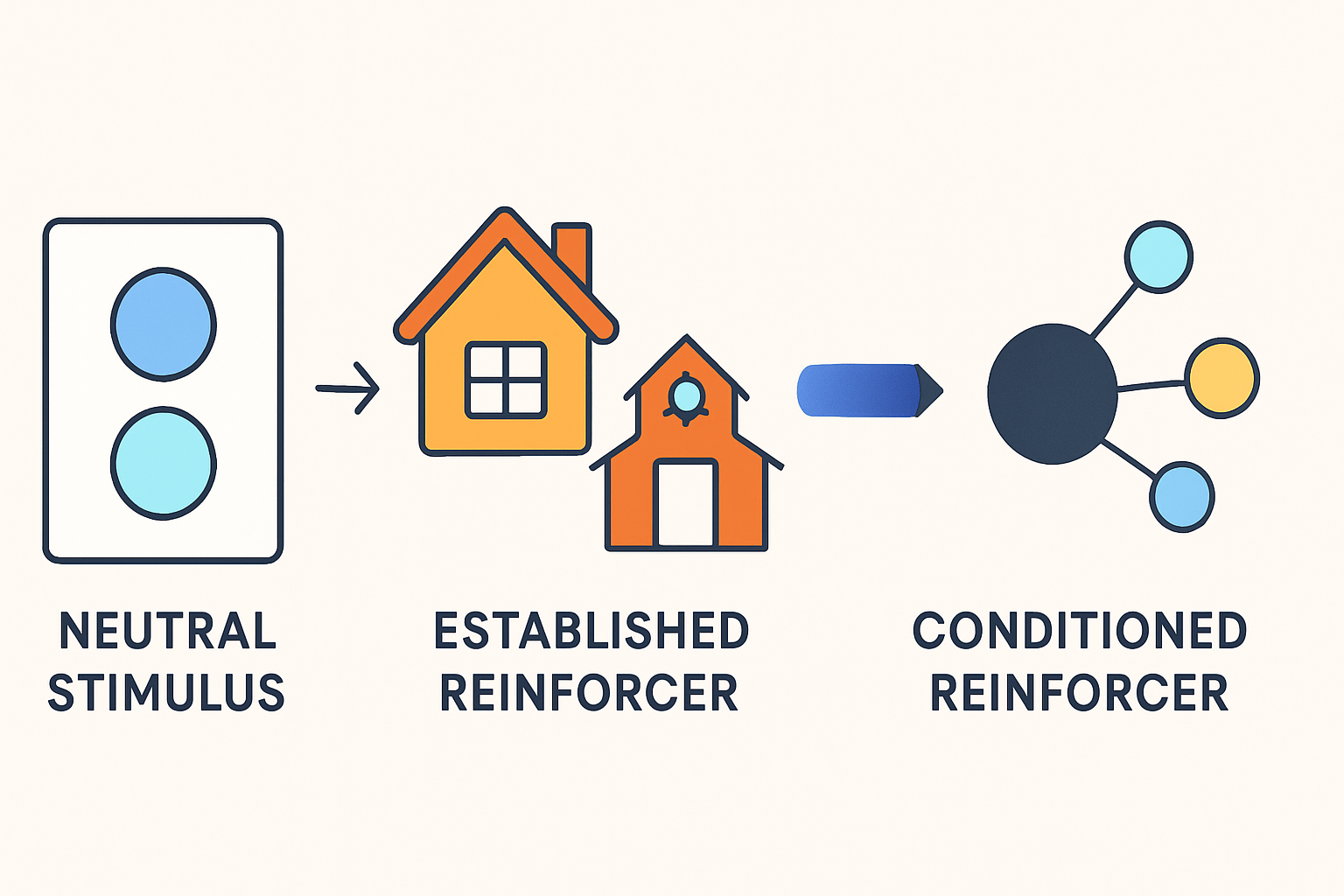
A conditioned reinforcer is a previously neutral stimulus that gains reinforcing properties through association with an established reinforcer. This fundamental concept in applied behavior analysis explains how many everyday rewards develop their power to influence behavior.
Table of Contents
- What is a Conditioned Reinforcer? Definition and Key Characteristics
- Conditioned Reinforcers in Practice: ABA Examples and Analysis
- Conditioned Reinforcers on the BCBA Exam: Relevance and Common Traps
- Quick-Reference Checklist for Study and Application
- Summary and Key Takeaways
Core Definition and the Pairing Process
The creation of a conditioned reinforcer occurs through a pairing process where a neutral stimulus is repeatedly presented alongside an already effective reinforcer. Over time, the neutral stimulus itself becomes reinforcing. This process is also called stimulus-stimulus pairing and is central to many ABA interventions.
For example, when a teacher consistently gives praise immediately before delivering a preferred edible, the praise becomes a secondary reinforcer that can maintain behavior independently.
Conditioned vs. Unconditioned vs. Generalized Reinforcer
Understanding these distinctions is crucial for accurate analysis:
- Unconditioned reinforcers are biologically significant stimuli that don’t require learning history. Examples include food, water, and warmth.
- Conditioned reinforcers require pairing history with established reinforcers. Examples include praise, tokens, and grades.
- Generalized conditioned reinforcers are conditioned reinforcers paired with multiple backup reinforcers, making them effective across various motivating operations. Money is the classic example.
Conditioned Reinforcers in Practice: ABA Examples and Analysis
Real-world applications demonstrate how conditioned reinforcers function within three-term contingencies. Each example below includes the antecedent, behavior, and consequence to model exam-style thinking.
Example 1: The Token Economy System
Token economies represent one of the most powerful applications of conditioned reinforcement in clinical settings.
- Antecedent: Teacher presents academic worksheet
- Behavior: Student completes five math problems correctly
- Consequence: Teacher delivers a plastic token
The token serves as a conditioned reinforcer because it has been paired with backup reinforcers like iPad time or small toys. This system allows for delayed reinforcement while maintaining behavior.
Example 2: Praise and Social Attention
Social praise becomes a conditioned reinforcer through consistent pairing with primary reinforcers during early development.
- Antecedent: Parent says ‘Time to clean up your toys’
- Behavior: Child puts toys in the bin
- Consequence: Parent says ‘Great job!’ with enthusiastic tone and smile
The praise functions as social positive reinforcement. Its effectiveness depends on the child’s pairing history where praise was consistently followed by preferred outcomes.
Example 3: Clicker Training in Skill Acquisition
Clicker training utilizes an auditory stimulus as a conditioned reinforcer in discrete trial training.
- Antecedent: Therapist presents SD ‘Touch blue’
- Behavior: Client touches blue card
- Consequence: Therapist clicks clicker, then delivers small edible
The clicker becomes a conditioned reinforcer that marks the precise moment of correct behavior. This allows for immediate reinforcement even when the primary reinforcer must be delivered slightly delayed.
Conditioned Reinforcers on the BCBA Exam: Relevance and Common Traps
Exam questions often test your ability to identify and apply conditioned reinforcement concepts in clinical vignettes. Understanding common pitfalls can improve your accuracy.
How the Exam Tests This Concept
The BCBA exam presents several question types related to conditioned reinforcement:
- Identifying conditioned reinforcers within behavior descriptions
- Selecting appropriate conditioned reinforcers for intervention plans
- Differentiating conditioned from unconditioned reinforcers
- Analyzing the effectiveness of conditioned reinforcers based on pairing history
These questions often appear in contexts involving token economies, social reinforcement, and skill acquisition programs.
Frequent Misconceptions and Exam Pitfalls
Avoid these common errors when answering exam questions:
- Confusing conditioned with unconditioned reinforcers: Remember that conditioned reinforcers require learning history
- Overlooking pairing history necessity: A stimulus is only a conditioned reinforcer if it has been paired with established reinforcers
- Misidentifying generalized conditioned reinforcers: These are conditioned reinforcers paired with multiple backup reinforcers
- Forgetting about motivating operations: The effectiveness of conditioned reinforcers can depend on current MOs
Quick-Reference Checklist for Study and Application
Use this checklist to review key concepts and prepare for exam questions:
- Verify the stimulus has a pairing history with established reinforcers
- Confirm it functions as a reinforcer (increases future probability of behavior)
- Differentiate from unconditioned reinforcers (biological vs. learned)
- Identify if it’s a generalized conditioned reinforcer (paired with multiple backups)
- Consider current motivating operations that might affect its effectiveness
- Check if it allows for delayed reinforcement in intervention plans
- Ensure proper pairing procedures are maintained during implementation
For more on related concepts, review our guide to positive reinforcement and token economy systems.
Summary and Key Takeaways
Conditioned reinforcers are essential tools in applied behavior analysis that expand our reinforcement options beyond biological necessities. Their effectiveness depends entirely on consistent pairing with established reinforcers through stimulus-stimulus pairing.
For BCBA exam preparation, focus on identifying conditioned reinforcers in vignettes, understanding their development through pairing history, and recognizing their role in common interventions like token economies and clicker training. Remember that generalized conditioned reinforcers offer particular advantages due to their effectiveness across various motivating operations.
Mastering this concept requires both theoretical understanding and practical application skills. For additional study resources, explore the BACB Task List and our comprehensive BCBA exam preparation guide.



