

Understanding stimulus control is fundamental to mastering applied behavior analysis and preparing for the BCBA exam. This concept explains how environmental cues influence our behavior patterns in predictable ways. When you grasp stimulus control, you can design more effective interventions and analyze behavior with greater precision.
Table of Contents
- Stimulus Control ABA: What Is Stimulus Control in Applied Behavior Analysis?
- Practical ABA Examples of Stimulus Control
- Why Stimulus Control Matters for BCBA Exam Success
- Common Stimulus Control Traps on the BCBA Exam
- Establishing Effective Stimulus Control
- Quick Checklist for Stimulus Control Analysis
- Connections to Other ABA Concepts
- Final Summary and Key Takeaways
- References
Stimulus Control ABA: What Is Stimulus Control in Applied Behavior Analysis?
Stimulus control occurs when a specific behavior is more likely to occur in the presence of certain environmental cues than in their absence. These cues, called discriminative stimuli, signal that reinforcement is available for a particular response. The concept demonstrates how our environment shapes our actions through learned associations.
Three key elements define stimulus control: the discriminative stimulus (SD), the target behavior, and the reinforcing consequence. When these elements consistently occur together, the SD gains control over the behavior. This means the behavior becomes more probable when the SD is present and less probable when it’s absent.
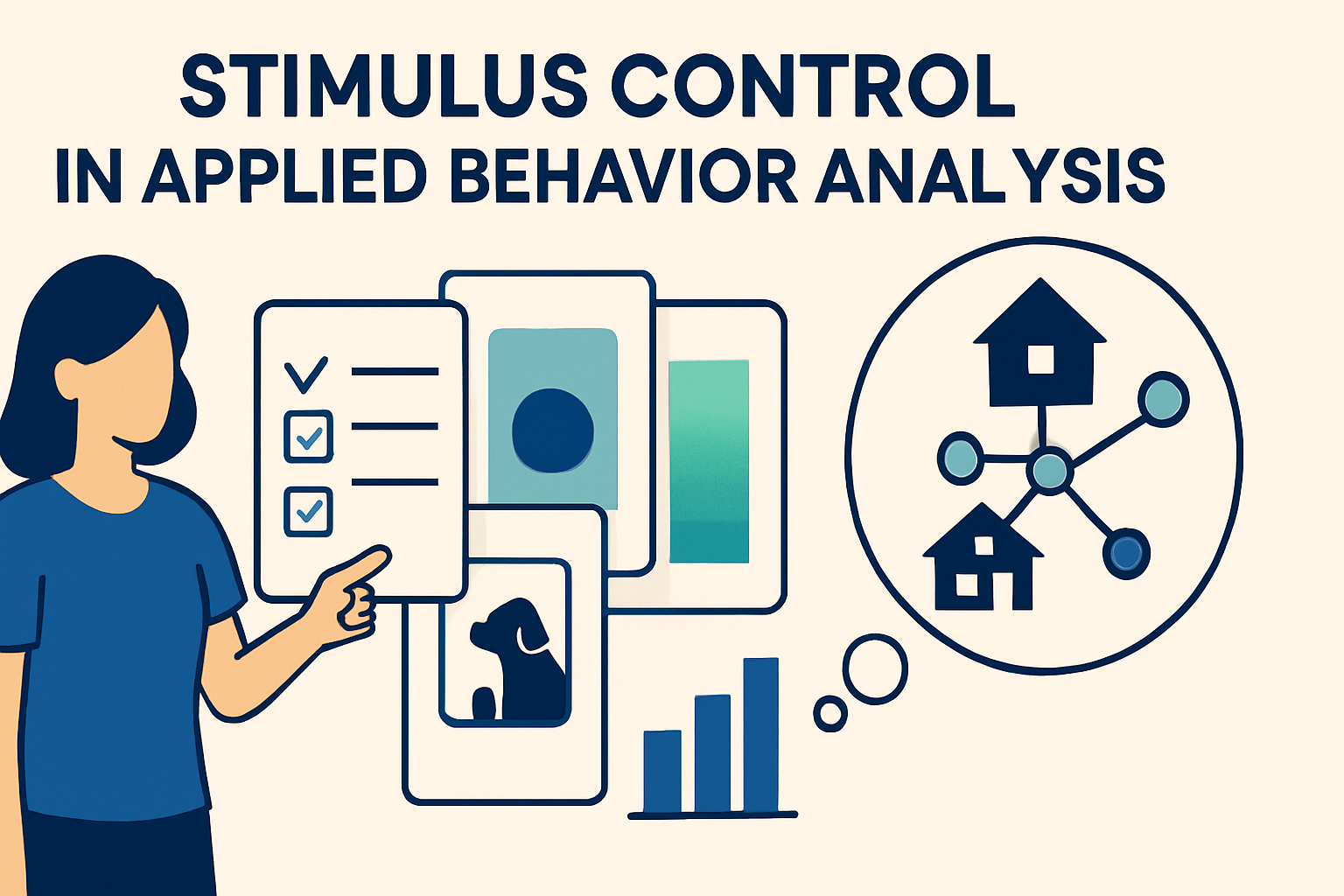
Key Components of Stimulus Control
- Discriminative Stimulus (SD): The environmental cue that signals reinforcement availability
- Target Behavior: The specific response that occurs in the SD’s presence
- Reinforcing Consequence: The outcome that maintains the behavior-SD relationship
- Stimulus Delta (SΔ): Cues that signal reinforcement is NOT available
- Response Differentiation: Behavior occurring selectively in SD presence
Practical ABA Examples of Stimulus Control
Real-world applications help clarify how stimulus control operates in everyday situations and therapeutic settings. These examples demonstrate the practical utility of this fundamental principle.
Example 1: Classroom Learning Environment
When a teacher raises their hand, students learn to stop talking and raise their own hands. The raised hand serves as an SD for quiet attention. In this scenario, reinforcement comes through teacher acknowledgment and participation opportunities. Without this cue, talking might continue at previous levels.
Example 2: Traffic Signal Compliance
A green traffic light functions as an SD for driving through an intersection. Drivers have learned through consistent reinforcement (safe passage) and punishment avoidance (accidents, tickets) to respond to this cue. The red light serves as an SΔ for stopping, signaling that proceeding would lead to negative consequences.
Example 3: Workplace Procedures
In an office setting, a ringing phone serves as an SD for answering it. Employees have been reinforced for this response through successful communication and problem resolution. The absence of ringing represents an SΔ where answering behavior doesn’t occur.
Why Stimulus Control Matters for BCBA Exam Success
Stimulus control appears throughout the BACB Task List and represents a core analytical concept. Exam questions often test your ability to identify SDs, SΔs, and analyze stimulus control relationships in various scenarios.
You’ll encounter stimulus control questions in multiple exam domains, including assessment, intervention, and experimental design. Understanding this concept helps you answer questions about discrimination training, generalization programming, and prompt fading strategies.
-
- Identify SDs and SΔs in case scenarios
>
- Analyze faulty stimulus control in intervention plans
- Design discrimination training procedures
- Evaluate generalization and maintenance strategies
- Apply stimulus control to reduce problem behavior
Common Stimulus Control Traps on the BCBA Exam
Many candidates struggle with specific aspects of stimulus control during the exam. Recognizing these common pitfalls can help you avoid costly mistakes.
- Confusing SD with MO: Remember that discriminative stimuli signal reinforcement availability, while motivating operations alter reinforcement value
- Overlooking SΔ importance: Both SD and SΔ are essential for establishing discrimination
- Missing faulty stimulus control: When behavior occurs under inappropriate stimulus conditions
- Confusing generalization with maintenance: Generalization involves responding to novel stimuli, while maintenance involves continued responding over time
- Misidentifying conditional discrimination: When reinforcement depends on multiple stimulus conditions
Establishing Effective Stimulus Control
Creating reliable stimulus control requires systematic procedures and careful implementation. Follow these steps to establish strong discrimination in therapeutic settings.
Step 1: Select Clear Discriminative Stimuli
Choose stimuli that are easily distinguishable from other environmental cues. Ensure they’re consistently present when reinforcement is available and absent when it’s not. This clarity helps establish reliable discrimination from the beginning.
Step 2: Implement Discrimination Training
Use simultaneous or successive presentation methods to teach the discrimination. Provide reinforcement only for responses in the SD’s presence. Withhold reinforcement for responses in the SΔ’s presence to establish response differentiation.
Step 3: Fade Prompts Systematically
Begin with strong prompts to ensure correct responding, then gradually reduce prompt intensity. Use prompt fading strategies like most-to-least or least-to-most prompting to transfer control from prompts to natural SDs.
Step 4: Program for Generalization
Teach responses to multiple exemplars of the SD class. Vary teaching conditions and incorporate natural maintaining contingencies. This ensures the behavior occurs across relevant situations, not just in training contexts.
Quick Checklist for Stimulus Control Analysis
Use this practical checklist when analyzing stimulus control in assessment or intervention scenarios. These questions help ensure comprehensive analysis and appropriate application.
- Identify the target behavior and its maintaining reinforcement
- Determine which stimuli currently control the behavior
- Assess whether current stimulus control is appropriate or faulty
- Check if discrimination training is needed or has occurred
- Evaluate generalization and maintenance of stimulus control
- Consider motivating operations that might influence responding
- Review prompt dependency and fading needs
Connections to Other ABA Concepts
Stimulus control intersects with numerous other important ABA principles. Understanding these relationships enhances your overall conceptual grasp and exam performance.
This concept directly relates to discriminative stimuli versus motivating operations, where the key distinction lies in signaling versus altering reinforcement value. It also connects to stimulus generalization and response generalization, which represent extensions of stimulus control principles.
In clinical practice, stimulus control principles inform functional communication training and other replacement behavior interventions. By establishing appropriate stimulus control, you can help clients develop more adaptive response patterns to environmental cues.
Final Summary and Key Takeaways
Stimulus control represents a fundamental mechanism through which environment-behavior relationships develop. Mastering this concept requires understanding how discriminative stimuli gain control over behavior through consistent reinforcement contingencies.
For BCBA exam preparation, focus on identifying SDs and SΔs in various scenarios, analyzing discrimination training procedures, and recognizing faulty stimulus control patterns. Remember that effective stimulus control establishment requires clear discrimination training, systematic prompt fading, and deliberate generalization programming.
In practice, apply stimulus control principles to create more effective interventions and analyze behavior-environment relationships with greater precision. By understanding how cues influence behavior, you can design environments that support desired behaviors and reduce problematic ones through strategic arrangement of discriminative stimuli.


